
Pulp Fiction, 1882 · page 15 of 32
Beadle's Dime Library No. 211 — page 15: what you’re looking at
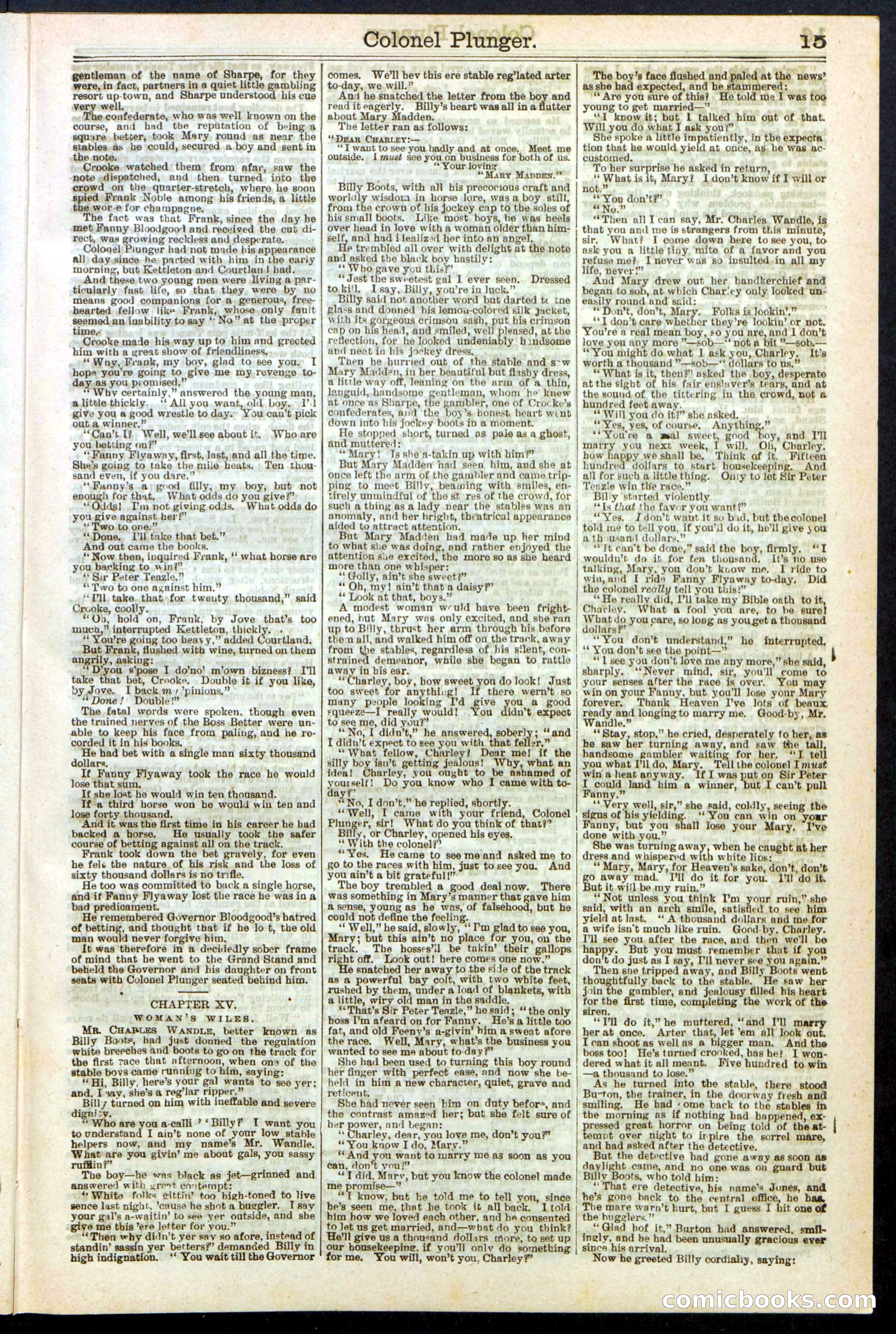
A restored page from Pulp Fiction, 1882. Page through the whole issue in the reader above.
📄 Transcribed text from this page (OCR, searchable)
Machine-transcribed from the original scan — historical spelling and the odd misread are preserved.
Colonel Plunger. 15 gentleman of the name of Sharpe, for they were, in fact, partners in a quiet little gambling resort up-town, and Sharpe understood his cue very well, confederate, who was well known on the course, and had tbe reputation of being a square better, took Mary round as near the stables.as he could, secured a boy and sent in the note. Crooke. watched them from afar, saw the note »dispatched, and then turned into the crowd on the quarter-stretch, where he soon spied Frank Noble among his friends, a little the wor-e for champagne. The fact was that Frank, since the day he met Fanny Bloodgood and received the cus di- rect, was growing reckless and desperate. Colonel Piunger had not made his appearance all day since he parted with him in the eariy morning, but Kettleton and Courtlan.! had. And these two young men were living a par- ticularly fust life, so that they, were by no means good companions for a. generous, free- hearted fellow like Frank, whose only fault seemed an inability tosay ‘* No” at the proper time. Crooke made his way up to him and greeted him with a great show of friendliness, “ Why, Frank, my boy, glad to see you. I hope you’re going to give me my revenge to- day as you promised,” ‘Why certainly,” answered the young man, alittle thickly. ‘‘ All you want, old boy. 1’1 give you a good wrestle to day. You can’t pick out.a winner,” ‘“‘Can’t.[? Well, we'llsee about it. Who are you betting on?” “ ora iiesss first, last, and all the time. She’s going to take the mile heats. Ten thou- sand even, if you dare.” ‘Fanny’s a: good filly, my boy; but not enough for that. What odds do you give?” “Odds! I’m not giving odds. What odds do you give against her?” ‘Two to one.” “Done, I'll take that bet.” And out came the books. ** Now then, inquired Frank, ‘‘ what horse are you backing to win?” ‘*Sir Peter Teazle.” “Two to one against him.” “Pll. take. that. for twenty thousand,” said Crcoke, coolly. “Oh, hold on, Frank, by Jove that’s too much,” interrupted Kettleton, thickly. . “You're oing too heavy,” added Courtland. But Frank, flushed with wine, turned on them angrily, asking: *D’you s'pose I do’no’ m’own bizness? I'll take that bet, Creoke. Double it if you like, by Jove. I back m, ’pinions,” “Done! Double!” The fatal words were spoken. though even the trained nerves of the Boss Better were un- able to keep his face from paling, and he re- corded it in his books, He had bet with a single man sixty thousand dollars. If Fanny Flyaway took the race he would lose that sum. . If she lost he would win ten thousand. Ifa third horse won he would win ten and lose forty thousand. . And it was the first time in his career he bad backed a horse. He usually took the safer course of betting against all on the track. Frank took down the bet gravely, for even he felé the nature of his risk and the loss of sixty thousand dollars is no trifle. He too was committed to back a single horse, and if Fanny Flyaway lost the race he was ina bad predicament. He remembered Governor Bloodgood’s hatred of betting, and thought that if he lot, the old man would never forgive bim. It was therefore in a decidedly sober frame of mind that he went to the Grand Stand and beheld the Governor and his daughter on front seats with Colonel Plunger seated behind him. CHAPTER XV. ' WOMAN’S WILES. Mr. CHABLES WANDLE, better known as Billy Boots, had just donned the regulation white breeches and boots to go on the track for the first race that afternoon, when ona of the stable bovs came runniug to him, saying: ‘Hi, Billy, here’s your gal wants to see yer; and, I say, she’s a reg’lar ripper.” Bill; turned on him with ineffable and severe digni sy. e oO are you a-calli ’‘ Billy? I want you to understand I ain’t none of your low stable helpers now, and my name’s Mr. Wandle. What are you givin’ me about gals, you sassy ruffiin?” The boy—he was black as jet—grinned and answered with yreet contempt: “White folks gittin? too high-toned to live gence last night, ’eause he shot a buggler. I say your gal’s a-waitin’ to see yer outside, and she give me this ’ere letter for you.” ; “Then why didn’t yer say so afore, instead of standin’ sassin yer betters?’ demanded Billy in high indignation. ‘‘ You wait till the Governor ---_- — rr joo for me. You will, won’t you, Charley?” comes, We'll hev this ere stable reg’lated arter to-day, we will.” And he snatched the letter from the boy and read iteagerly. Billy’s beart was all in a flutter about Mary Madden. The letter ran as follows: ‘Dear CHARLEY:— “I want to see you badly and at once, Meet me outside. 1 must see you_on business for both of us. * Your loving “Mary Mappen.” Billy Boots, with all his precocious craft and worldly wisdom in horse lore, was a boy still, from the crown of his jockey cap to the soles of his small boots. Like most. boys, be was heels over head in love with a woman older than him- self, and had ilealized her into an angel, He trembled all over with delight at the note and asked the black boy hastily: ‘* Who gave you this?” “Jest the sweetest gal 1 ever seen. to kill. Isay, Billy, you’re in Juck.” Billy said not another word but darted tc tne gla-s and donned his lemou-colored silk jacket, With its gorgeous crimson sash, put his crimson cap on his head, and smiled, well pleased, at the reflection, for he looked undeniably hindsome and neet in his jockey dress, Then he burried out of the stable and s-w Mary Madden, in her beautiful but flashy dress, a little way off, leaning on the arm of a thin, languid, handsome gentleman, whom he knew at once as Sharpe, the gambler, one of Crocke’s | confederates, and ‘the boy’s, honest. heart went down into bis jockey boots in a moment. He stopped short, turned as pale as a ghost, and muttered: “Mary! Is she a-takin up with him?’ But Mary Madden’ had seen him, and she at once left the arm of the gambler and came trip- ping to meet Billy, beaming with smiles, en- tirely unmindful of the st res of the crowd, for such a thing as a lady near the stables was an | anomaly, and her bright, theatrical appearance aided to attract attention. But Mary Madden had made up her mind The boy's face flushed and paled at the news’ as she had expected, and he stammered; ‘“ Are you sure of this? He told me I was too young to get married—” | “I know it; but L talked him out of that. Will you do what I ask you?” She spoke a little impatiently, in the expecta tion that he would yield at once, as, he was ac- customed, To her surprise he asked in return, fs What is it, Mary? I don’t know if I will or not, “ You don’t?” “Then all Tcan say, Mr. Charles Wandle, is that you and me is strangers from this minute, sir. What? I come down here to see you, to ask you a little tiny, mite of a favor and you refuse me?, I never was so insulted-in all my life, never!” And Mary drew out her handkerchief and began to sob, at which Char‘ey only looked un- easily round and said: ** Don’t, don’t, Mary. Folks is Jookin’,” **1 don’t care whether they’re lookin’ or not. ‘You’re a real mean boy, £0 you are, and I don’t love you any more ”—sob—"‘ not a bit.”"—sob,— “You might do. what I ask you, Charley. It’s worth a thousand ”—sob—*‘ dollars to us,” “What is it, then?’ asked the boy, desperate at the sight of his fair enslaver’s tears, and at the sound of the tittering in the crowd, not a hundred feet away. ** Will you do it?” she asked, “Yes, yes, of course, Anything.” ‘*You're a mal sweet, good boy, and Ill marry you next week, I will, Oh, Charley, | how BABY Ho shall be. Think of it. Fifteen _hundred dollars to start bousekeeping, And all for such a little thing. Only to let Sir Peter Teazle win the race,” Bil'y started violently ‘“*[s that the favor you want?” “Yes. I don’t want it so bad, but the colonel told me to tell you, if you'll do it, he'll give you a thousand dollars,” Dressed ee to what she was doing, and rather enjoyed the | ‘It can't be done,” said the boy, firmly. ‘TI attention she excited, the more so as she heard wouldn’t do it for ten thousand, It’s no use more than one whisper: talking, Mary, you don’t know me. I ride to ‘“* Golly, ain’t she sweet?” wia,and [ ride Fanny Flyaway to-day. Did “Oh, my! ain’t that a daisy?” the colonel really tell you this?” ** Look at that, boys.” : ‘He really did, ll take my Bible oath to it A modest woman wuld have been fright- | Chacley. What a fool you are, ta be sure! ened, but Mary was only excited, and sbe ran | Whatdo you care, so long as youget a thousand up to Billy, thrust her arm through bis before | dollars?” : them all, and walked him off on the track, away | “You don’t understand,” he interrupted, from the stables, regardless of his silent, con- | ‘‘ You don’t see the point—” strained demeanor, while she began to rattle | ‘1 see you don’t love me any more,” she said, away in bis ear. sharply. ‘“‘Never mind, sir, you'll come to ‘Charley, boy, how sweet you do look! Just | your senses after the race is over. You may too sweet for anythiug! If there wern’t so, win on your Fanny, but you'll lose your Mary many people looking I'd give you a good | forever. Thank Heaven I’ye lots of beaux squeeze—I really would! You didn’t expect | ready and longingto marry me. Good-by, Mr. to see me, did you?” Wandle.” “Stay, stop,” he cried, desperately to her, as “No, I didn’t,” he answered, soberly; “and I didn’t expect to see you with that feller,” he saw her turning away, and saw the handsome gambler waiting for her, “T tell “What fellow, Charley? Dear me! if the silly boy isn’t getting jealous! Why, what an | you what l’lldo, Mary. Tell the colonel I must idea! Charley, you ought to be ashamed of | win a heat anyway. eI was put on Sir Peter yourself! Do you know who I came with to- s could | Jand him a winner, but I can’t pull : anny. “*No, I don’t,” he replied, shortly. ‘‘ Very well, sir,” she said, coldly, seeing th “Well, [ came with your friend, Colonel | signs of his yieldin . “You can 4 y on ~ Plunger, sir! What do you think of that?” Fanny, but you shall Billy, or Charley, opened his eyes. “ lose your Mary, I'v Aigge with you.” ¥ at od e was turning away, when he caught at her dress and whispered with white Tibas ahh ‘““Mary, Mary, for Heaven’s sake, don’t, fous 0 away mad. I'll do it for you. Wl! do i ut it will be my ruin,” ‘** Not unless you think [’'m your ruin,”.she said, with an arch smile, satisfied to see oi yield at last. ‘‘ A thousand dolars and me for a wife isn't much Jike ruin. Good-by, Charley. I'll see you after the race, and then we'll be happy. But you must remember that if you don’t do just as I say, I'll never see you again.” Then she tripped away, and Billy Boots went thoughtfully back to the stable. He saw her join the gambler, and jealousy filled his hear for the first time, completing the work of th siren. “ll do it,” he muttered, ‘‘and I'll mary her at once. Arter that, Jet ’em all look ou I can shoot as well as a bigger man. And the boss too! He’s turned crooked, has he? I won- dered what it all meant. Five hundred to win —a thousand to lose.” ‘With the colonel? “Yes. Hecame to see meand asked me to go to the races with him, just tosee you. And you ain’t a bit grateful!” The boy trembled a good dealnow. There was something in Mary’s manner that gave him a sense, young as he was, of falsehood, but he could not define the feeling. ‘* Well,” he said, slowly, ‘‘ I’m glad to see you, Mary; but this ain’t no place for you, on the track. _The hosses’il be takin’ their gallops right off. Look out! here comes one now.” e snatched her away to the side of the track as a powerful bay colt, with two white feet, rushed by them, under a load of blankets, with a little, wiry old man in the saddle, “*That’s Sir Peter Teazle,” he said; “the only boss I’m afeard on for Fanny. He’s a little too fat, and old Feeny’s a-giyin’ him a sweat afore the race, Well, Mary, what’s the business you wanted to see me about to-day?” She had been used to turning this boy round her finger with perfect ease, and now she be- held in him a new character, quiet, grave and | As he turned into the stable, there s reticent. _ Bu~ton, the trainer, in the doorway fresh an She had never seen him on duty before, and smiling, He bad ‘ome back to the stables in the contrast amazed her; but she felt sure of | the morning as if nothing had bappened, ex- her power, and began: pressed great horror on being told of the at- ‘* Charley, dear, you love me, don’t you?” tempt over night to irpire the sorrel mare, *“You know I do, Mary.” and had asked after the detective. ** And you want to marry Me a3 soon as you But the detective had gone away as soon as can, don’t you?” daylight came, and no one was on guard but “T did, Marv, but you know the colonel made | Billy Boots, who told him: me promise—” |. ‘That ere detective, his name’s Jones, and ‘Tt know, but he told me to tell yon, since | he’s gone back to the central office, he bag he’s seen me, that he took it all back. Itold | The mare warn’t hurt, but I guess I hit one of him how we loved each other, and he consented | the bugglers.” to Jet us get married, and—what do you think?| ‘Glad bof it,” Burton had answered, smil- We'll give us a thousand dollars more, to set up | ingly, and be had been unusually gracious ever our housekeeping, if you'll only do something | since his arrival. Now he greeted Billy cordialiy, saying: —_—— aMiceleyeye) (E(0), LG “S Cc (0)