
Pulp Fiction, 1882 · page 17 of 32
Beadle's Dime Library No. 211 — page 17: what you’re looking at
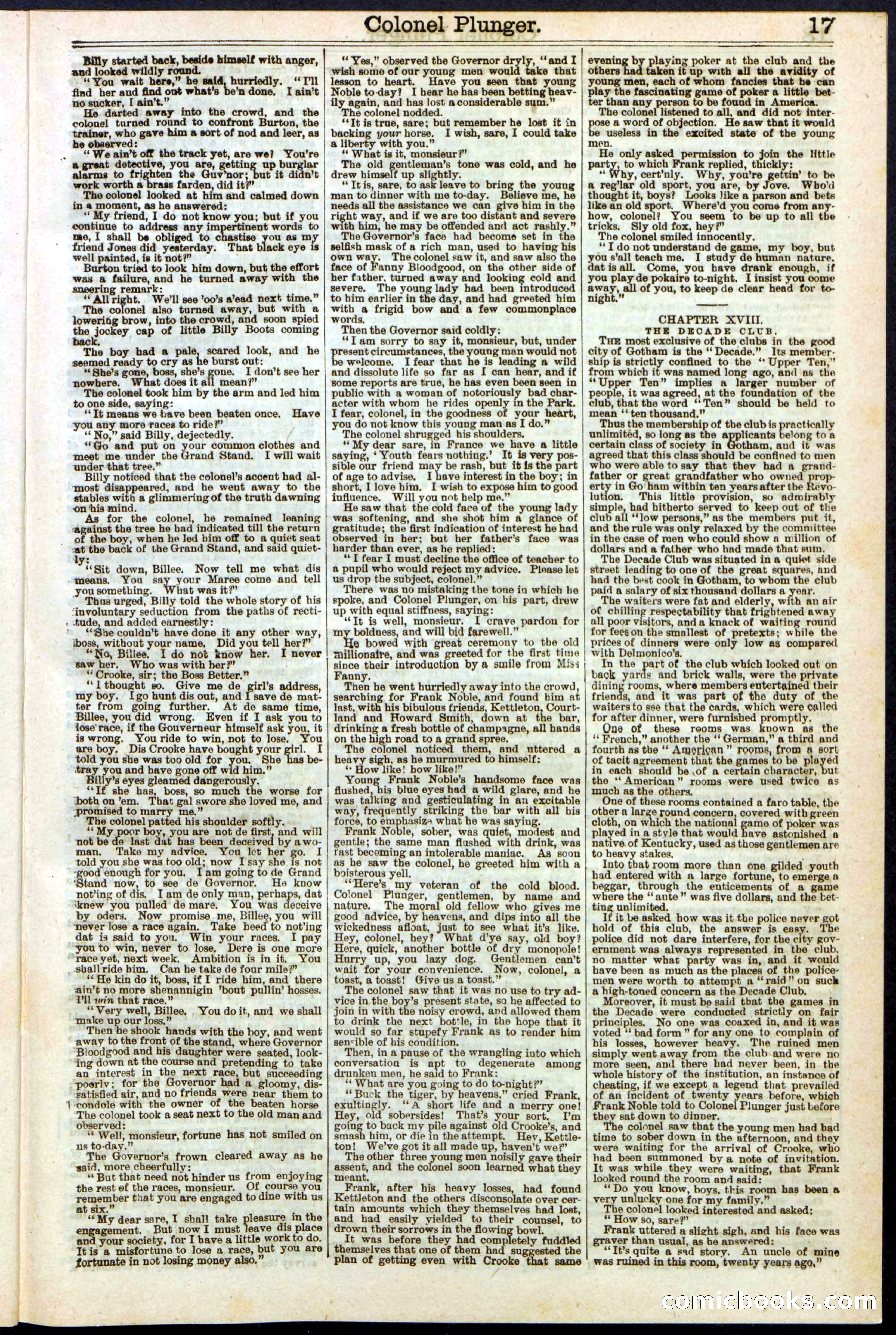
A restored page from Pulp Fiction, 1882. Page through the whole issue in the reader above.
📄 Transcribed text from this page (OCR, searchable)
Machine-transcribed from the original scan — historical spelling and the odd misread are preserved.
17 Billy started back, beside himself with anger, * Yes,” observed the Governor Pt , “andI and looked wildly roand. wish some of our young men wo ke that “You wait here,” he hurriedly. ‘I'll | lesson to heart. Have you seen that young find her aud find out what's be’n done, I ain’t | Noble today? I hear he has been betting heav- no sucker, [ ain’t.” in, and has lost aconsiderable sum.” He darted away into the crowd, and the colonel turned round to confront Burton, the | y aga The colonel nodded. ‘*Tt is true, sare; but remember he lost it in trainer, who gave him a sort of nod and leer,as backing your horse. I wish, sare, I could take he observed: ‘We ain’t off the track yet, are we? You're ” a great detective, you are, getting up burglar alarms to frighten the Gutecre but 16 didn’t work worth a brass farden, did it?” —_ ‘race yet, next week. Ambition is iu if, ‘poerlv; for the Governor ha ‘satisfied air, and no friends were near them to -condole with the owner of the beaten horse The colonel looked at him and calmed down in a moment, as he answered: “My friend, I do not know you; but if you continue to address any im nent words to me, I shall be obliged to chastise you as m friend Jones did yesterday. That black eye well painted, is it not?” Burton tried to look him down, but the effort was a failure, and he turned away with the sneering remark: “Allright. We'll see ’00’s a’ead next time.” The colonel also turned away, but with a lowerifg brow, into the crowd, and soon spied the jockey cap of little Billy Boots coming back. The boy had a pale, scared look, and he seemed ready to cry as he burst out: “She’s gone, boss, she’s gone. I don’t see her nowhere. What does it all mean?” The colonel took him by the arm and led him to one side, saying: ‘* Tt means we have been beaten once. ou any more racez to ride?’ ‘* No,” said Billy, dejectedly. Have “Go and put on your common clothes and meet me under the Grand Stand. I will wait under that tree.” Billy noticed that the colonel’s accent had al- most disappeared, and he went away to the stables with a glimmering of the truth dawning on his mind. As for the colonel, he remained leaning against the tree he had indicated till the return of the boy, when he led bim off to a quiet seat vat the back of the Grand Stand, and said quiet- ly: Tie sit down, Billee. Now tell me what dis means. You say your Maree come and tell you something. hat was it?” ~ Thus urged, Billy told the whole story of his ‘involuntary seduction from the paths of recti- tude, and added earnestly: “She couldn’t have done it any other way, iboss, without your name, Did you tell her?” “No, Bilies. Ido not know her. I never saw her. Who was with her?” ** Crooke, sir; the Boss Better.” “I thought so. Give me de girl’s address, my boy. Igo hunt dis out, and I save de mat- ter from going further. At de same time, Billee, you did wrong. Even if I ask you to lose’race, if the Gouverneur himself ask you, it is wrong. You ride to win, not to lose, You are boy. Dis Crooke have bought your girl. I told you she was too old for ie She be- ~~ ag and have gone off w ae illy’s eyes gleamed dangerously. “If she has, boss, so much the worse for both on’em. That gal swore she loved me, and ‘promised to ma me.” The colonel patted his shoulder softly. “My Fin boy, you are not de first, and will not be de last dat has been deceived by awo- man. Take my advice. You lect her go. I told you she was too old; now I say she is not ‘good enough for you. Iam going to de Grand ‘Btond now, to see de Governor. He know noting of dis. I am de only man, ie dat iknew you pulled demare. You was deceive by oders. Now promise me, Billee, you will never lose a race again. Take heed to not’ing dat is said to you. Win your races. I pay ‘you to win, never to lose. Dere is one more You Sballride him. Can he take de four mile?” ** He kin do it, boss, if I ride him, and there ain’t no more shenannigin ’bout pullin’ hosses. Tl win that race.” ** Very well, Billee, You doit, and we shall make up our loss,” Then he shook hands with the boy, and went away to the front of the stand, where Governor ‘Bloodgood and his daughter were seated, look- ing down at the course and pretending to take an interest in the next race, but succeeding d a gloomy, dis- ake. colonel took a seat next to the old man aad observed: ‘“* Well, monsieur, fortune has not smiled on us to-day.” The Governor’s frown cleared away as he said, more cheerfully: ‘‘ But that need not hinder us from enjoying the rest ef the races, monsieur. Of course you remember that you are engaged to dine with us at six.” “My dear sare, I shall take plearan in the ment. But now I must leave dis place a your society, for I have a little work to do. It is a misfortune to lose a race, but you are fortunate in not losing money also.” ee eee a as a liberty with you.” ‘* What is it, monsieur?” The old gentleman’s tone was cold, and he drew himself up slightly. “Tt is, sare, to ask leave to bring the young man to dinner with me to-day. Believe me, he needs all the assistance we can give him in the right way, and if we are too distant and severe th him, he may be offended and act rashly.” The Governor’s face had become set in the selfish mask of a rich man, used to having his own yh The colonel saw it, and saw also the face of Fanny Bloodgood, on the other side of her father, turned away and ae cold and severe. The young lady had been introduced to him earlier in the day, and had greeted him with a frigid bow and a few commonplace words, Then the Governor said coldly: “Tam sorry to say it, monsieur, but, under resent circumstances, the iy man would not welcome. I fear that he is leading a wild and dissolute life so far as I can hear, and if some reports are true, he has even been seen in public with a woman of notoriously bad char- acter with whom he rides openly in the Park. I fear, colonel, in the goodness of your heart, you do not know this young man as I do.” The colonel shrugged his shoulders, ‘‘ My dear sare, in France we have a little saying, ‘ Youth fears nothing.’ It is very pos- sible our friend may be rash, but it is the part of age to advise, I have interest in the boy; in short, I love him. I wish to expose him to good influence. Will you not help me.” He saw that the cold face of the young lady was softening, and she shot him a glance of gratitude; the first indication of interest he had observed in her; but her father’s face was harder than ever, as he replied: “*T fear I must decline the office of teacher to a pupil who would reject my advice. Please let us drop the subject, colonel.” There was no mistaking the tone in which he spoke, and Colonel Plunger, on his part, drew up with equal stiffness, saying: ‘Tt is well, monsieur. I crave pardon for my boldness, and will bid farewell.” He bowed with great ceremony to tbe old millionaire, and was greeted for the first time since their introduction by a smile from Miss Fanny. Then he went hurriedly away into the crowd, searching for Frank Noble, and found him at last, with his bibulous friends, Kettleton, Court- land and Howard Smith, down at the bar, drinking a fresh bottle of champagne, all hands on the high road to a grand spree. The colonel noti them, and uttered a heavy sigh, as he murmured to himself: a How like! how like!” a Frank Noble’s handsome face was flushed, his blue eyes had a wild glare, and he was talking and gesticulating in an excitable way, frequently striking the bar with all his force, to emphasize what he was saying. Frank Noble, sober, was quiet, modest and gentle; the same man flushed with drink, was tast becoming an intolerable maniac, As soon as he saw the colonel, he greeted him with a boisterous yell. ‘“Here’s my veteran of the cold blood. Colonel Plunger, gentlemen, by name and nature. The moral old fellow who gives me good advice, by heavens, and dips into all the wickedness afloat, just to see what it’s like. Hey, colonel, hey? What d’ye say, old boy? Here, quick, another bottle of dry monopole! Hurry up, you lazy dog. Gentlemen can't wait for your convenience. Now, colonel, a toast, a toast! Give us a toast.” Tbe colonel saw that if was no use to try ad- vice in the boy’s present state, so he affected to join in with the noisy crowd, and allowed them to drink the next bottle, in the hope that it would so far stupefy Frank as to render him sensible of his condition. Then, in a pause of the wrangling into which conversation is apt to degenerate among drunken men, he said to Frank: ‘* What are you going to do to-night?” “Buck the tiger, by heavens,” cried Frank, exultingly. “A short life and a merry one! Hey, old sobersides! That’s your sort. I’m one te back my pile against old Crooke’s, and smash him, or die in the attempt. Hey, Kettle- ton! We’ve got it all made up, haven’t we?” The other three young men noisily gave their assent, and the colonel soon learned what they meant. Frank, after his heavy losses, had found Kettleton and the others disconsolate over cer- tain amounts which they themselves had lost, and had easily yielded to their counsel, to drown their sorrows in the flowing bowl. It was before they had com fetely fuddled themselves that one of them had suggested the plan of getting even with Crooke “that same ppc Ae Playing poker at the club and the others taken it up with all the avidity of yo men, each of whom fancies that he can play the fascinating game of poker a little bet- ter than any person to be found in America. The colonel listened to all, and did not inter- pose a word of objection. He saw that it would useless in the excited state of the young men. He only asked permission to join the little party, to which Frank replied, thickly: “Why, cert’nly. Why, you're gettin’ to be a reg’lar old sport, you are, by Jove. Who'd thought it, boys? Looks Jike a parson and bets like an old sport. Where’d you come from any- how, colonel? You seem to be up to all the tricks. Sly old fox, hey?” The colonel smiled innocently. ‘“*IT do not understand de game, my boy, but you s’all teach me. I study de human nature, dat is all. Come, you have drank enough, if you Ligps Ape pokaire to-night. I insist you come mete” of you, to keep de clear head for to- CHAPTER XVIII. THE DECADE CLUB. THE most exclusive of the clubs in the good city of Gotham is the “Decade.” Its member- ship is strictly confined to the ‘* Upper Ten,” from which it was named long ago, and as the “Upper Ten” implies a larger number of people, it was a , at the foundation of the club, that the word “Ten” should be held to mean ‘‘ ten thousand.” Thus the membership of tbe club is peony unlimited, so long as the er long toa certain class of society in tham, and it was es that this class should be confined to men who were able to say that they had a grand- father or great grandfather who owned erty in Go’ ham within ten years after the Revo- lution. This little provision, so admirably simple, had hitherto served to keep out of the club all “low persons,” as the members put it, and the rule was only relaxed by the committee in the case of men who could show a million of dollars and a father who had made that sum. The Decade Club was situated in a quiet side street leading to one of the great squares, and had the best cook in Gotham, to whom the club paid a salary of six thousand dollars a year. The waiters were fat and elderly, with an air of chilling respectability that frightened away all poor visitors, anda knack of waiting round for fees on the smallest of pretexts; while the prices of dinners were only low as compared with Delmonico’s, In the part of the club which looked out on back yards and brick walls, were the private dining rooms, where members entertained their friends, and it was part of the duty of the waiters to see that the cards, which were called for after dinner, were furnished promptly. One of these reoms was known as the ‘‘ French,” another the ‘‘German,” a third and fourth as the ‘‘ American” rooms, from a sort of tacit agreement that the games to be played in each should be .of a certain character, but the *‘ American” rooms were used twice as much as the others. One of these rooms contained a faro table, the otber a large round concern, covered with green cloth, on which the national game of poker was played in a style that would have astonished a native of Kentucky, used as those gentlemen are to heavy stakes, Into that room more than one gilded youth had entered with a large fortune, to emerge a beggar, through the enticements of a game where the “ante” was five dollars, and the bet- ting unlimited. If it be asked how was it the police never got hold of this club, the answer is mys e police did not dare interfere, for the city gov- ernment was always represented in the club, no matter what party was in, and it would have been as much as the places of the police- men were worth to attempt a “raid” on suck a high-toned concern as the Decade Club, Moreover, it must be said tbat the games in the Decade were conducted strictly on fair principles. No one was coaxed in, and it was voted ‘‘ bad form” for any one to complain of his losses, however heavy. The ruined men simply went away from the club and were no more seven, and there had never been, in the whole history of the institution, an instance of cheating, if we except a legend that prevailed of an incident of twenty years before, which Frank Noble told to Colonel Plunger just before they sat down to dinner. The colonel saw that the young men had had time to sober down in the afternoon, and they were waiting for the arrival of Crooke, who had been summoned by a note of invitation. It was while they were waiting, that Frank looked round the room and said: “Do — know, boys, this room has been a very unlucky one for my family.” The colonel looked interested and asked: ** How so, sare?” Frank uttered a slight sigh, and his face was graver than usual, as he answered: , ‘*Tt’s quite a sad story. An uncle of mine was ruined in this room, twenty years ago,” rop- JOO (E(@) AMUSE “S (E()