
Pulp Fiction, 1882 · page 6 of 24
Beadle's New York Dime Library No. 209 — page 6: what you’re looking at
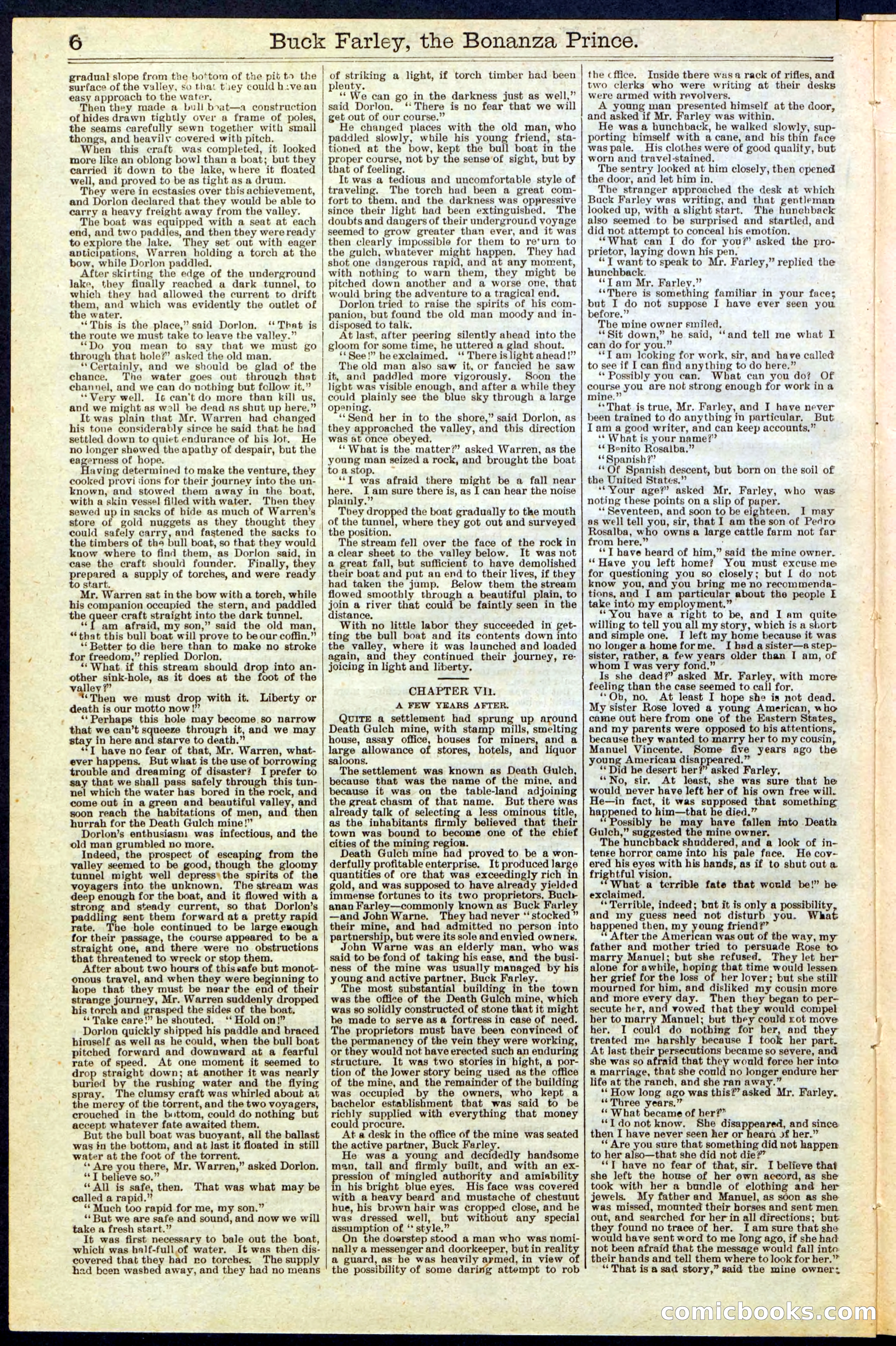
A restored page from Pulp Fiction, 1882. Page through the whole issue in the reader above.
📄 Transcribed text from this page (OCR, searchable)
Machine-transcribed from the original scan — historical spelling and the odd misread are preserved.
6 gradual slope from the bottom of the pit to the surface of the valley, so that tuey could h:vean easy approach to the water. Then they made a bull boat—a construction of hides drawn tightly over a frame of poles, the seams carefully sewn together with small thongs, and heavily covered witb pitch. When this craft was completed, it looked more like an oblong bow] than a boat; but they carried it down to the lake, where it floated well, and proved to be as tight as a drum. They were in ecstasies over this achievement, and Dorlon declared that they would be able to carry a heavy freight away from the valley. The boat was equipped with a seat at each end, and two paddles, and then they were ready to explore the lake. They set out with eager apticipations, Warren holding a torch at the bow, while Dorlon paddled, After skirting the edge of the underground lake, they finally reached a dark tunnel, to which they bad allowed the current to drift them, and which was evidently the outlet of the water. “This is the place,” said Dorlon, ‘‘ That is the route we must take to leave the valley.” “Do you mean to say that we must go through that hole?’ asked the old man. **Certainly, and we should be glad of the chance. The water goes out through that channel, and we can do nothing but follow it.” ‘Very well. Is can't do more than kill us, and we might as well be dead as shut up here,” It was plain that Mr. Warren had changed his tone considerably sirce he said that he had settled down to quiet endurance of bis lot. He no longer showed the apathy of despair, but the eagerness of hope. aving determined to make the venture, they cooked provi sions for their journey into the un- known, and stowed them away in the boat, with a skin vessel filled with water. Then they sewed up in sacks of hide as much of Warren’s store of gold nuggets as they thought they could safely carry, and fastened the sacks to the timbers of the bull boat, so that they would know where to find them, as Dorlon said, in case the craft should founder. Finally, they prepared a supply of torches, and were ready to start. Mr. Warren sat in the bow with a torch, while his companion occupied the stern, and paddled the queer craft straight into the dark tunnel, “t am afraid, my son,” said the old man, *“*that this bull boat will prove to be our coffin.” ** Better to die here than to make no stroke for freedom,” replied Dorlon. ‘“* What. if this stream should drop into an- other sink-hole, as it does at the foot of the valley au ‘Then we must drop with it. Liberty or death is our motto now!” ‘‘ Perhaps this hole may become.so narrow that we can’t squeeze through it, and we may stay in here and starve to death.” *‘T have no fear of that, Mr. Warren, what- ever happens. But what is the use of borrowing trouble and dreaming of disaster? I prefer to say that we shall pass safely through this tun- nel which the water has bored in the rock, and come out in a green and beautiful valley, and soon reach the habitations of men, and then hurrah for the Death Gulch mine!” Dorlon’s enthusiasm was infectious, and the old man grumbled no more. Indeed, the prospect of eoceyeng from the valley seemed to be good, though the gloomy tunnel might well depress»the spirits of the voyagers into the unknown, The stream was deep enough for the boat, and it flowed with a strong and steady current, so that Dorlon’s paddling sent them forward ata pretty rapid rate. The hole continued to be large eaough for their passage, the course appeared to be a straight one, and there were no obstructions that threatened to wreck or stop them. After about two hours of this safe but monot- onous travel, and when they were Peres to hope that they must be near the end of their strange journey, Mr. Warren suddenly dropped his torch and grasped the sides of the boat, ‘Take care!” he shouted. ‘‘ Hold on!” Dorlon quickly shipped his paddle and braced bimself as well as he could, when the bull boat pitched forward and downward at a fearful rate of speed. At one moment it seemed to drop straight down; at another it was nearly buried by the rushing water and the flying spray. The clumsy craft was whirled about at the mercy of the torrent, and the two voyagers, crouched in the bottom, could do nothing but accept whatever fate awaited them. But the bull boat was buoyant, all the ballast was in the bottom, and at last it floated in still water at the foot of the torrent. ‘* Are you there, Mr. Warren,” asked Dorlon. ‘“*T believe so.” ‘‘ All is safe, then. That was what may be called a rapid.” | ** Much too rapid for me, my son.” ‘* But we are safe and sound, and now we will take a fresh start.” It was first necessary to bale out the boat, which was half-full.of water. It was then dis- covered that they had no torches, The supply had been washed away, and they had no means ' Buck Farley, the Bonanza Prince. ooo a a ss eee ee. ee ar a ae ae ee Se ae ee of striking a light, if torch timber had been plenty. ‘‘ We can go in the darkness just as well,” said Dorlon. ‘ There is no fear that we will get out of our course.” He changed places with the old man, who paddled slowly, while his young friend, sta- tioned at the bow, kept the bull boat in the proper course, not by the sense of sight, but by that of feeling. It was a tedious and uncomfortable style of traveling. The torch had been a great com- fort to them, and the darkness was oppressive since their light had been extinguished. The doubts and dangers of their underground voyage seemed to grow greater than ever, and it was then clearly impossible for them to return to the guich, whatever might happen. They had shot one dangerous rapid, and at any moment, with nothing to warn them, they might be pitched down another and a worse one, that would bring the adventure to a tragical end. Dorlon tried to raise the spirits of his com- panion, but found the old man moody and in- disposed to talk, At last, after peering silently ahead into the gloom for some time, he uttered a glad shout. ** See!” heexclaimed, ‘‘ There is light ahead!” The old man also saw it, or fancied he saw it, and paddled more vigorously. Soon the ligbt was visible enough, and after a while they could plainly see the blue sky through a large opening. : ‘*Send her in to the shore,” said Dorlon, as they approached the valley, and this direction was at once obeyed. ‘* What is the matter?’ asked Warren, as the young man seized a rock, and brought the boat toastop. — ‘*] was afraid there might be a fall near here. Iam sure there is, as I can hear the noise plainly.” They dropped the boat gradually to the mouth of the tunnel, where they got out and surveyed the position. The stream fell over the face of the rock in a clear sheet to the valley below. It was not a great fall, but sufficient to have demolished their boat and put an end to their lives, if they had taken the jump. Below them the stream flowed smoothly through a beautiful plain, to join a river that could be faintly seen in the distance. With no little labor they succeeded in get- ting the bull boat and its contents down into the valley, where it was launched and loaded again, and they continued their journey, re- joicing in light and liberty. CHAPTER VIL. A FEW YEARS AFTER. QUITE a settlement had sprung up around Death Gulch mine, with stamp mills, smelting house, assay office, houses for miners, and a large allowance of stores, hotels, and liquor saloons. The settlement was known as Death Gulch, because that was the name of the mine, and because it was on the table-land adjoining the great chasm of that name. But there was already talk of selecting a less ominous title, as the inhabitants firmly believed that their town was bound to become one of the chief cities of the mining region. Death Gulch mine had proved to be a won- derfully profitable enterprise. It produced large quantities of ore that was exceedingly rich in gold, and was supposed to have already yielded immense fortunes to its two proprietors, Bucl+ anan Harlem commony known as Buck Farley —and John Warne. They had never “stocked ” their mine, and had admitted no person into PasmnershiD, but were its sole and envied owners. John Warne was an elderly man, who was said to be fond of taking his ease, and the busi- ness of the mine was usually managed by his young and active partner, Buck Farley. The most substantial building in the town was the office of the Death Gulch mine, which was so solidly constructed of stone that it might be made to serve as a fortress in case of need. The proprietors must have been convinced of the permanency of the vein they were working, or they would not have erected such an enduring structure. It was two stories in hight, a por- tion of the Jower story being used as the office of the mine, and the remainder of the building was occupied by the owners, who kept a bachelor establishment that was said to be richly supplied with everything that money could procure. At a desk in the office of the mine was seated the active partner, Buck Farley. He was a young and decidedly handsome man, tall and firmly built, and with an ex- ression of mingled authority and amiability in his bright blue eyes. His face was covered with a heavy beard and mustache of chestuut hue, his brown hair was cropped close, and he was dressed well, but without any special assumption of ‘* style.” On the doerstep stood a man who was nomi- nally a messenger and doorkeeper, but in reality a guard, as he was heavily aypmed, in view of the possibility of some daring attempt to rob the cffice. Inside there wasa rack of rifles, and two clerks who were writing at their desks were armed with revolvers. A young man shine ih himself at the door, and asked if Mr. Farley was within. He was a hunchback, he walked slowly, sup- porting himself with a cane, and his thin face was pale. His clothes were of good quality, but worn and travel-stained. The sentry looked at him closely, then opened the door, and let him in. The stranger approached the desk at which Buck Farley was writing, and that gentleman looked up, with a slight start. The hunehback also seemed to be surprised and startled, and did not attempt to conceal his emotion. ‘““What can I do for you?’ asked the pro- prietor, laying down his pen. “T want to speak to Mr. Farley,” replied the hunchback. “Tam Mr. Farley.” ‘There is something familiar in your face; but I do not suppose I have ever seen you before.” The mine owner smiled, “Sit down,” he said, ‘‘and tell me what I can do for you.” ‘‘T am looking for work, sir, and have called to see if I can find anything to do here.” ** Possibly you can. What can you do? Of course you are not strong enough for work ina mine.” ‘That is true, Mr. Farley, and I have never been trained to do anything in particular. But I am a good writer, and can keep accounts,” . ‘* What is your name?” ‘* Benito Rosalba,” ** Spanish?” ‘Of Spanish descent, but born on the soil of the United States,” ‘Your age?’ asked Mr, Farley, who was noting these points on a slip of paper. ‘* Seventeen, and soon to be eighteen. I may as well tell you, sir, that I am the son of Pedro Rosalba, who owns a large cattle farm not far from here,” ‘*T have heard of him,” said the mine owner. ‘‘Have you left home? You must excuse me for questioning you so closely; but [I do not know you, and you bring me no recommenda- tions, and I am particular about the people E take into my employment,” ‘You have a right to be, and I am quite willing to tell you all my story, which is a short and simple one. I left my home because it was no lounger a home forme. I had asister—a step- sister, rather, a few years older than I am, of whom I was very fond.” Is she dead?’ asked Mr. Farley, with more feeling than the case seemed to call for. **Ob, no. At least I hope she is not dead. My sister Rose loved a young American, who came out here from one of the Eastern States, and my parents were opposed to his attentions, because they wanted to marry her to my cousin, Manuel Vincente. Some five years ago the young American disa red,” ‘*Did he desert her?” asked Farley, ‘No, sir. At least, she was sure that he would never have left her of his own free will. He—in fact, it was supposed that something happened to him—that he died.” ‘Possibly he may have fallen into Death Gulch,” suggested the mine owner. The hunchback shuddered, and a look of in- tenee horror came into his pale face. He cov- ered his eyes with his hands, as if to shut out a frigh tful vision. ‘What a terrible fate that would be!” he exclaimed, ‘Terrible, indeed; but it is only. a possibility and my guess need not distur you. What happened then, my young friend?” ‘ After the American was out of the way, my father and mother tried to persuade Rose to marry Manuel; but she refused. They let ber alone for awhile, hoping that time would lessen her grief for the loss of her lover; but she still mourned for him, and disliked my cousin more and more every day. Then they began to per- secute her, and vowed that they would compel her to marry Manuel; but they could rot move her, I could do nothing for her, and they treated me harshly because I took her part. At last their persecutions became so severe, and she was so afraid that they would force her into a marriage, that she could no longer endure her life at the ranch, and she ran ie ‘* How long ago was this?’ asked Mr. Farley. “Three years.” ‘* What became of her?” ‘“*1 do not know. She cieppeares and since then I have never seen her or heara Jf her.” ** Are you sure that something did not happen to her also—that she did not die?” **T have no fear of that, sir. I believe that she left the house of her own accord, as she took with her a bundle of elothing and her jewels. My father and Manuel, as soon as she was missed, mounted their horses and sent men out, and searched for her in all directions; but they found no trace of her. I am sure that she would have sent word to me long ago, if she had not been afraid that the message would fall into their hands and tell them where to look for her.” “That is a sad story,” said the mine owner; com (E “S 0X0) * 2 «>