
Pulp Fiction, 1882 · page 7 of 24
Beadle's New York Dime Library No. 209 — page 7: what you’re looking at
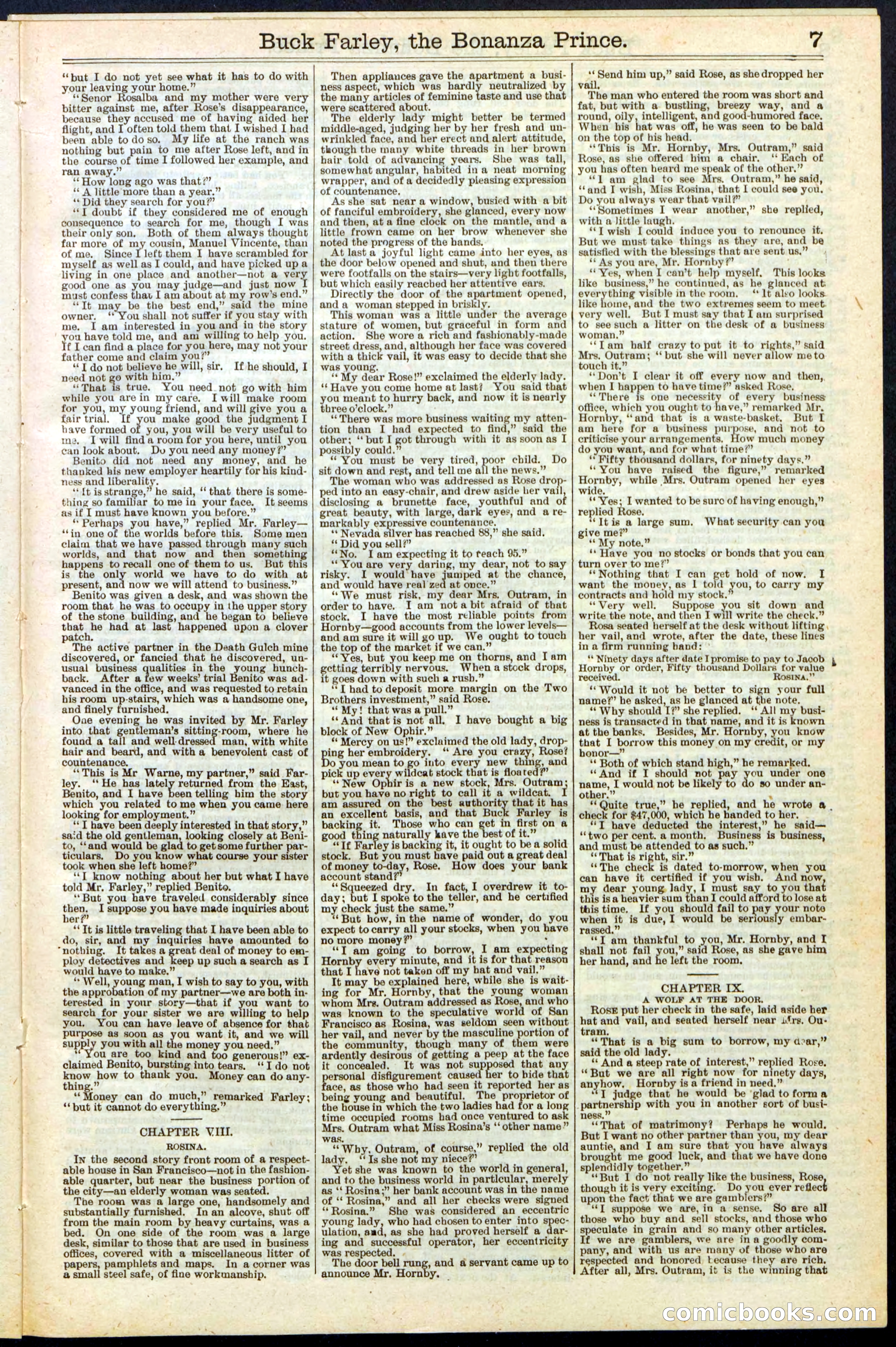
A restored page from Pulp Fiction, 1882. Page through the whole issue in the reader above.
📄 Transcribed text from this page (OCR, searchable)
Machine-transcribed from the original scan — historical spelling and the odd misread are preserved.
A — % i ov . . ee — —— A Buck Farley, the Bonanza Prince. — ~ — - a — — @ “but I do not yet see what it has to do with your leaving your home.” ** Senor Iba and my mother were very bitter against me, after Rose’s disappearance, because they accused me of having aided her flight, and I often told them that I wished I had been able todoso. My life at the ranch was nothing but pain to me after Rose left, and in the course of time I followed her example, and ran away.” ‘“How long ago was that?’ ‘* A little more than a year.” ‘* Did they search for you?” ‘*{ doubt if they considered me of enough consequence to search for me, though I was their only son, Both of them always thought far more of my cousin, Manuel Vincente, than of me. Since I left them I have scrambled for myself as well as I could, and have picked up a living in one place and anotber—not a ver good one as you may judge—and just now must confess thav I am about at my row’s end.” “Tt may be the best end,” said the mine owner. ‘* You shall not suffer if you stay with me. I am interested in you and in the story you have told me, and am willing to help you. f I can find a place for you here, may not your father come and claim you?” ‘ T do not believe he will, sir. If he should, I need not go with him.” “That is true. You need not go with him while you arein my care. I will make room for you, my young friend, and will give you a fair trial. If you make good the judgment I have formed of you, you will be very useful to me, I will find a room for you here, until you can look about. Do you need any money?” Benito did not need any money, and he thanked his new employer heartily for his kind- ness and liberality. ‘‘{t is strange,” he said, “‘ that there is some- thing so familiar to mein your face. It seems as if I must have known you before.” ‘* Perhaps you have,” replied Mr. Farley— ‘tin one of the worlds before this. Some men claim that we have passed through many such worlds, and that now and then something happens to recall one of them to us. But this is the only world we have to do with at present, and now we will attend to business.” Benito was given a desk, and was shown the room that he was to occupy in the upper story of the stone building, and he began to believe thay he had at last happened upon a clover ch. The active partner in the Death Gulch mine discovered, or fancied that he discovered, un- usual business qoaiines in the young hunch- back. After a few weeks’ trial Benito was ad- vanced in the office, and was requested to retain his room up-stairs, which was a handsome one, and finely furnished, Oae evening he was invited by Mr. Farley into that gentleman’s sitting-room, where he found a tall and well-dressed man, with white hair and beard, and with a benevolent cast of countenance. “This is Mr Warne, my partner,” said Far- ley. ‘* He has lately returned from the East, Benito, and I have been telling him the story which you related tome when you came here looking for employment,” ‘*T have been deeply interested in that story,” sa:d the old gentleman, looking closely at Beni- to, ‘“‘and would be glad to get some further par- ticulars, Do you know what course your sister took when she left home?” ‘‘T know nothing about her but what I have told Mr, Farley,” replied Benito. ‘*But you have traveled considerably since then. I suppose you have made inquiries about er ‘‘ Tt is little traveling that I have been able to do, sir, and my inquiries have amounted to “nothing. It takesa gress deal of money to em- ploy detectives and would have to make,” * Well, young man, I wish to say to you, with the approbation of my partner—we are both in- terested in your story—that if you want to search for your sister we are willing to help you. You can have leave of absence for that purpose as soon as be want it, and we will supply you with all the money you need.” “You are too kind and too generous!” ex- claimed Benito, bursting into tears. ‘Ido not ae show to thank you. Money can do any- thing. ‘Money can do much,” remarked Farley; ‘*but it cannot do everything,” eep up such a search as I CHAPTER VIII. ROSINA. In the second story front room of a peapent able house in San Francisco—not in the fashion- able quarter, but near the business portion of the city—an elderly woman was seated. The room was a large one, handsomely and substantially furnished. In an alcove, shut off from the main room by heavy curtains, was a bed. On one side of the room was a large desk, similar to those that are used in business offices, covered with a miscellaneous litter of papers, pamphlets and maps. In a corner was a small steel safe, of fine workmanship. Then appliances gave the apartment a busi- ness aspect, which was tae neutralized by the many articles of feminine taste and use that were scattered about. The elderly lady might better be termed middle-aged, judging her by her fresh and un- wrinkled face, and her erect and alert attitude, though the many white threads in her brown hair told of advancing years. She was tall, somewhat angular, habited ina neat morning wrapper, and of a decidedly pleasing expression of countenance, As she sat near a window, busied with a bit of fanciful embroidery, she glanced, every now and then, at a fine clock on the mantle, and a little frown came on her brow whenever she noted the progress of the bands. At last a joyful light came into her eyes, as the door below opened and shut, and then there were footfalls on the stairs—very light footfalls, but which easily reacbed her attentive ears. Directly the door of the apartment opened, and a woman stepped in briskly. This woman was a little under the average stature of women, but graceful in form and action. She wore a rich and fashionably-made street dress, and, although her face was covered with a thick vail, it was easy to decide that she was young. ‘My dear Rose!” exclaimed the elderly lady. ‘‘ Have you come home at last? You said that you meant to hurry back, and now it is nearly three o’clock,” “There was more business waiting my atten- tion than I had expected to find,” said the other; ‘but I got through with it as soon as I possibly could.” “You must be very tired, poor child. Do sit down and rest, and tell me all the news.” The woman who was addressed as Rose drop- ped into an easy-chair, and drew aside ber vail, disclosing a brunette face, youthful and of great beauty, with large, dark eyes, and a re- markably expressive countenance. ‘* Nevada silver has reached 88,” she said. ** Did you sell?” “No. Iam expecting it to teach 95.” ‘You are very daring, my dear, not to say risky. I would have st at the chance, and would have real zed at once.” ‘We must risk, my dear Mrs, Outram, in order to have. I am nota bit afraid of that stock. I have the most reliable points from Hornby—good accounts from the lower levels— and am sure it will goup. We ought to touch the top of the market if we can.” ‘““Yes, but you keep me on thorns, and I am etting terribly nervous. When a stock drops, t goes down with such a rush.” “*T had to deposit more margin on the Two Brothers investment,” said Rose, “My! that was a pull.” ‘‘And thatis not all. I have bought a big block of New Ophir.” * Mercy on us!” exclaimed the old lady, drop- ping her embroidery. ‘“‘ Are you gt Rose? you mean to go into every new t , and pick up every wildcat stock that is floated?’ ‘‘New Ophir is a new stock, Mrs. Outram; but you have no right to call it a wildcat. I am assured on the best authority that it has an excellent basis, and that Buck Farley is backing it. Those who can get in first on a good thing naturally kave the best of it.” “If Farley is backing it, it ought to bea solid stock. But you must have paid out a great deal of money to-day, Rose. How does your bank account stand? Rapecmee dry. In fact, I overdrew it to- day; but I spoke to the teller, and he certified my check just the same,” ‘‘But how, in the name of wonder, do you expect tocarry all your stocks, when you have no more money?” . “T am going to borrow, I am expecting Hornby every minute, and it is for that reason that I have not taken off my bat and vail.” It may be explained here, while she is wait- ing for Mr. Hornby, that the young woman whom Mrs. Outram addressed as Rose, and who was known to the speculative world of San Francisco as Rosina, was seldom seen without her vail, and never by the masculine portion of the community, though many of them were ardently desirous of getting a peep at the face it concealed. It was not su pone that any rsonal disfigurement banison er to hide that ace, as those who had seen it reported her as being young and beautiful. The proprietor of the house in which the two ladies had for a long time occupied rooms had once ventured to ask Mrs. Outram what Miss Rosina’s ‘‘ other name” was. ‘‘ Why. Outram, of course,” replied the old lady. ‘Is she not my niece?” Yet she was known to the world in general, and to the business world in particular, merely as ‘‘ Rosina;” her bank account was in the name of ‘ Rosina,” and all her checks were signed “Rosina.” She was considered an eccentric young lady, who had chosen to enter into spec- ulation, aud, as she had proved herself a dar- ing and successful operator, her eccentricity was respected. . The door bell rung, and a servant came up to announce Mr, Hornby, _ | Aiton him up,” said Rose, as she dropped her vail, The man who entered the room was short and fat, but with a bustling, breezy way, and a round, oily, intelligent, and good-humored face. When his hat was off, he was seen to be bald on the top of his head. ‘This is Mr. Hornby, Mrs. Outram,” said Rose, as she offered him a chair. ‘ Each of you has often heard me speak of the other,” ‘““] am glad to see Mrs. Outram,” he said, ‘‘and I wish, Miss Rosina, that I could see you, Do you always wear that vail?” ‘‘Sometimes I wear another,” she replied, with a little laugh. ‘“‘T wish I could induce you to renounce it. But we must take things as they are, and be satisfied with the blessings that are sent us,” ‘* As you are, Mr. Hornby?” | ‘Yes, when I can’t help myself, This looks like business,” he continued, as he glanced at everything visible in the room. ‘'1t also looks like home, and the two extremes seem to meet. very well. But I must say that I am surprised to see such a litter on the desk of a business woman,” ‘‘Tam half crazy to put it to rights,” said Mrs, Outram; ‘*‘ but she will never allow meto touch it.” **Don’t I clear it off every now and then, when I happen to have time?” asked Rose, ** There iS one necessity of every business office, which you ought to have,” remarked Mr, Hornby, ‘‘and that is a waste-basket, But IT am here for a business purpose, and not to criticise your arrangements, How much money do you want, and for what time?” ‘Fifty thousand dollars, for ninety days.” ‘You have raised the figure,” remarked omg while Mrs. Outram opened her eyes wide. ‘Yes: I wanted to be sure of having enough,” replied Rose. ‘Itis a large sum. What security can you give me?” ‘* My note,” ‘* Have you no stocks or bonds that you can turn over to me?” ‘‘Nothing that I can get hold of now. I want the money, as | told you, to carry my contracts and hold my stock, “Very well. Suppose you sit down and write the note, and then I will write the check.” Rosa seated herself at the desk without lifting her vail, and wrote, after the date, these lines in a firm running band: © ‘* Ninety days after date I promise to pay to Jacob Hornby or order, Fifty thousand Dollars for value received. Rostna,.” ‘Would it not be better to sign your full name?” he asked, as he glanced aft the note, “Why should [?”’ she replied. ‘* All my busi- ness is transacted in that name, and it is known at the banks. Besides, Mr. Hornby, you know that I borrow this money on my credit, or my honor—” ‘* Both of which stand high,” he remarked, “And if I should not pay you under one ores would not be likely to do so under an- other. . “Quite true,” he replied, and he wrote a. check for $47,000, which he handed to her. “T have deducted the interest,” he said— ‘two per cent. a month, Business is business, and must be attended to as such.” “That is right, sir.” “The check is dated to-morrow, when you can have it certified if you wish. And now my dear young. neh I must say to en that this isa heavier sum than I could afford to lose at this time. If you should fail to pay your note when it is due, I would be seriously embar- rassed,” ‘T am thankful to you, Mr. Hornby, and [ shall not fail you,” said Rose, as she gave him her hand, and he left the room, CHAPTER IX. A WOLF AT THE DOOR. Ross put her check in the safe, laid aside her hat and vail, and seated herself near irs, Ou- tram. “That is a big sum to borrow, my dear,” said the old lady. ‘« And a steep rate of interest,” replied Rose. “But we are all right now for ninety days, anyhow, Hornby is a friend in need.” ““T judge that he would be ‘glad to forma partners p with you in another sort of busi- ness, “That of matrimony? Perhaps he would. ‘ But I want no other partner than you, my dear | auntie, and I am sure that te have always brought me good luck, and that we have done splendidly together.” “But I do not really like the business, Rose though it is very exciting. Do you ever reflect upon the fact that we are gamblers?” “T suppose we are, in a sense, So are all those who buy and sell stocks, and those who speculate in grain and so many other articles, If we are gamblers, we are ina goodly com- pany, and with us are many of those who are respected and honored because they are rich, After all, Mrs. Outram, it is the winning that Micboo (E(o) S.C (@)