
Pulp Fiction, 1882 · page 5 of 24
Beadle's New York Dime Library No. 209 — page 5: what you’re looking at
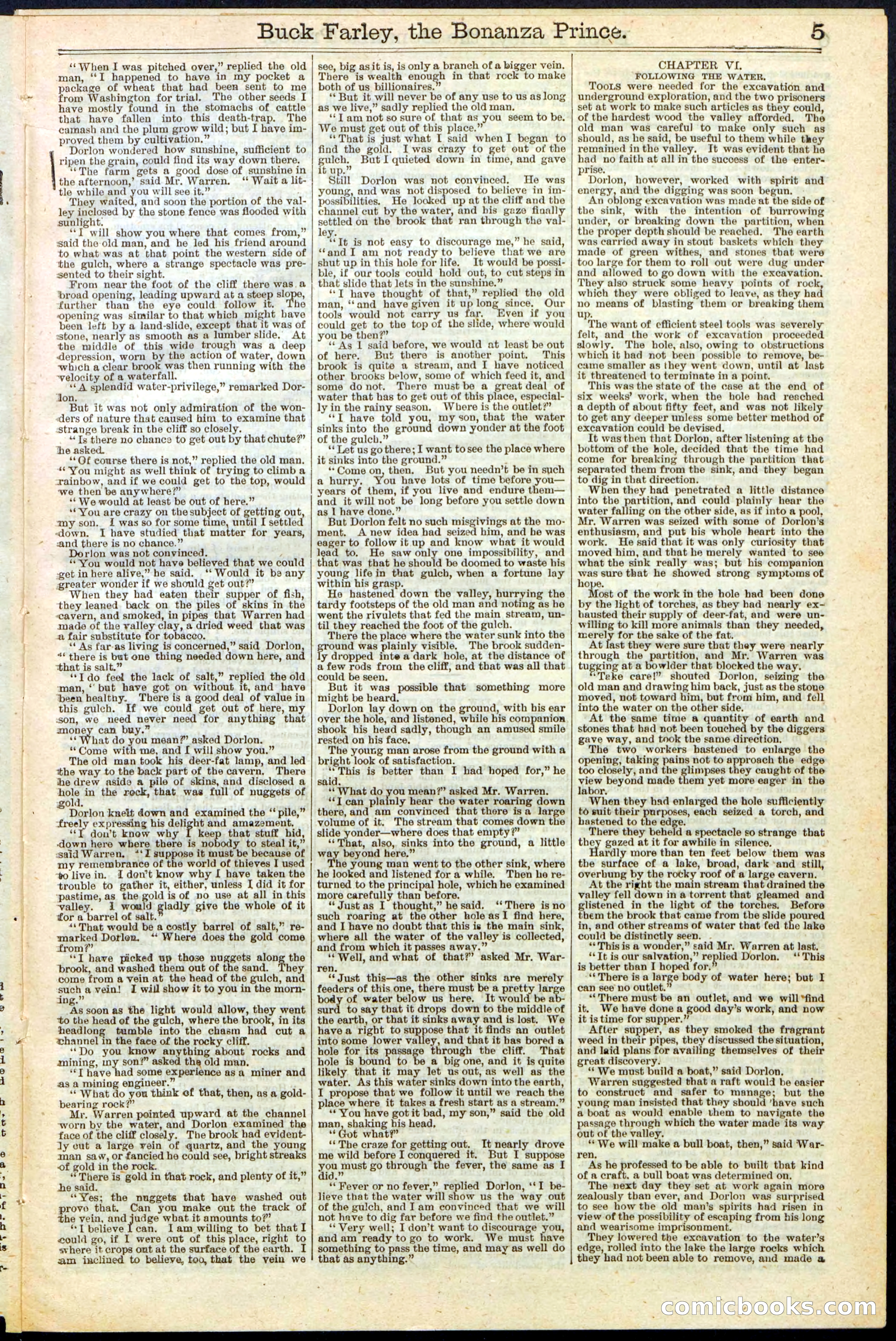
A restored page from Pulp Fiction, 1882. Page through the whole issue in the reader above.
📄 Transcribed text from this page (OCR, searchable)
Machine-transcribed from the original scan — historical spelling and the odd misread are preserved.
Y St wey BHO eNom FY ct cty a A =o. + a ~ Buck Farley, the Bonanza Prince. ‘‘When I was pitched over,” replied the old man, ‘‘I happened to have in my pocket a package of wheat that had been sent to me from Washington for trial. The other seeds I have mostly found in the stomachs of cattle that have fallen into this death-trap. The camash and the plum grow wild; but I have im- proved them by cultivation,” Dorlon wondered how sunshine, sufficient to ripen the grain, could find its way down there. ‘‘The farm gets a good dose of sunshine in the afternoon,’ said Mr. Warren. ‘ Wait a lit- tle while and you will see it.” They waited, and soon the portion of the val- ley inclosed by the stone fence was flooded with sunlight. ‘‘T will show you where that comes from,” said the old man, and he led his friend around to what was at that point the western side of tthe gulch, where a strange spectacle was pre- sented to their sight. From near the foot of the cliff there was. a broad opening, leading upward at a steep slope, further than the eye could follow it. he opening was similar to that which might have been left by a land-slide, except that it was of stone, nearly as smooth as a lumber slide. At the middle of this wide trough was a deep depression, worn by the action of water, down which a clear brook was then running with the velocity of a waterfall. ‘‘ A splendid water-privilege,” remarked Dor- don, But it was not only admiration of the won- ders of nature that caused him to examine that strange break in the cliff so closely. “Ts there no chance to get out by that chute?” he asked. ‘Of course there is not,” replied the old man. “You might as well think of trying to climba rainbow, and if we could get to the top, would we then be anywhere?” ‘‘ We would at least be out of here.” ‘You are crazy on the subject of getting out, my son. iI was so for some time, until I settled «<lown. I have studied that matter for years, and there is no chance.” Dorlon was not convinced. , ““You would not have believed that we could get in here alive,” he said. ‘‘ Would it be any greater wonder if we should get out?” When they had eaten their supper of fish, they leaned back on the piles of skins in the cavern, and smoked, in pipes that Warren had made of the valley clay, a dried weed that was a fair substitute for tobacco. ‘“« As far-as living is concerned,” said Dorlon “‘ there is but one thing needed down here, and that is salt.” ‘*I do feel the lack of salt,” replied the old man, ‘‘ but have got on without it, and have ‘been healthy. There is a good deal of value in this guich. If we could get out of here, my son, we need never need for anything that money can buy.” ‘‘ What do you mean?’ asked Dorlon. ‘Come with me, and [ will show you.” The old man took his deer-fat lamp, and led the way to the back part of the cavern, There ihe drew asido a pile of skins, and disclosed a hole in the rock, that was full of nuggets of old, . Dorlon knelt down and examined the “‘ pile,” freely expressing his delight and amazement, op don’t know why I keep that stuff hid, down here where there is nobody to steal it,” ssaid Warren, “*‘I suppose it must be because of my remembrance of the world of thieves I used ‘eo live in. I den’t know why I have taken the trouble to gather it, either, unless [ did it for ‘pastime, as the gold is of no use at all in this valley. i would gladly give the whole of it for a barrel of salt. “‘That would be a costly barrel of salt,” re- marked Dotlen. “‘ Where does the gold come from?” ‘*T have picked up those nuggets along the brook, and washed them out of the sand. ey come from a vein at the head of the gulch, and such a vein! I will show it to you in the morn- ing.” Xs soon as the light would allow, they went ‘to the head of the gulch, where the brook, in its headlong tumble into the chasm had cut a whannel in the face of the rocky cliff. ‘*Do you know anything about rocks and mining, my son?” asked the old man. ‘‘T have had some experience asa miner and as a mining engineer.” ‘‘ What do you think of that, then, as a gold- bearing rock?” Mr. Warren pointed upward at the channel ‘worn by the water, and Dorlon examined the face of the cliff closely. The brook had evident- ly eut a large vein of quartz, and the young man saw, or fancied he could see, bright streaks of gold in the rock. “There is gold in that rock, and plenty of it,” he said. ‘““Yes; the nuggets that have washed out prove that. Can you make out the track of the vein, and judge what it amounts to?’ “I believe Lean. Iam willing to bet that I could go, if I were out of this place, right to svhere it crops ont at the surface of the earth. I aam inclined to believe, too, that the vein we seers ee EE see, big asit is, is only a branch of a bigger vein. There is wealth enough in that rock to make both of us billionaires.” ‘* But it will never be of any use to us as long as we live,” sad)y replied the old man. ‘‘T am not so sure of that as you seem to be. We must get out of this place.” ‘That is just what I said when I began to find the gold. Iwas crazy to get out of the guich. But I quieted down in time, and gave it up.” Still Dorlon was not convinced. He was young, and was not disposed to believe in im- possibilities. He looked up at the cliff and the channel cut by the water, and bis gaze agen settled on the brook that ran through the val- ley. of It is nob easy to discourage me,” he said, ‘“andI am not ready to believe that we are shut up in this hole for life. It would be possi- ble, if our tools could hold out, to cut steps in that slide that lets in the sunshine.” ‘*T have thought of that,” replied the old man, ‘‘and have given it up long since. Our tools would not carry us far, Even if you could get to the top of the slide, where would you be then?” ‘* As 1 said before, we would at least be out of here. But there is another point. This brook is quite a stream, and I have noticed other brooks below, some of which feed it, and some donot. There must be a great deal of water that bas to get out of this place, especial- ly in the rainy season. Where is the outlet?” ‘*T have told you, my son, that the water sinks into the ground down yonder at the foot of the gulch.” ‘* Let us go there; I want tosee the place where it sinks into the ground.” **Come on, then. But you needn’t be in such a hurry. ou have lots of time before you— years of them, if you live and endure them— and it will not be long before you settle down as I have done.” But Dorlon felt no such misgivings at the mo- ment, A new idea had seized him, and be was eager to follow it up and know what it would lead to. He saw only one impossibility, and that was that he should be doomed to waste his young lifein that gulch, when a fortune lay within his grasp. He hastened down the valley, hurrying the tardy footsteps of the old man and noting as he went the rivulets that fed the main stream, un- til they reached the foot of the gulch. _ There the place where the water sunk into the grou was plainly visible. The brook sudden- y dropped inte a dark hole, at the distance of a few rods from the cliff, and that was all that could be seen. But it was possible that something more might be heard. Dorlon lay down on the ground, with bis ear over the hole, and listened, while his companion shook his head sadly, though an amused smile rested on his face. The young man arose from the ground with a bright look of satisfaction. This is better than I had hoped for,” he said, ‘* What do you mean?” asked Mr. Warren. ‘*T can plainly hear the water roaring down there, and am convinced that there isa lar volume of it. The stream that comes down the slide yonder—where does that empty?” ‘‘That, also, sinks into the ground, a little es 8 beyond here.” he young man went to the other sink, where he looked and listened for a while. Then he re- turned to the principal hole, which he examined more carefully than before. * Just as I thought,” hesaid. ‘There is no such roaring at the other hole asI find here, and I have no doubt that this is the main sink, where all the water of the valley is collected, and from which it passes away.” ‘* Well, and what of that?’ asked Mr. War- ren. ‘‘ Just this—as the other sinks are merely feeders of this one, there must be a pretty large body of water below us here. It would bea curd to say that it drops down to the middle of the earth, or that it sinks away and is lost. We have a right to suppose that it finds an outlet into some lower va ey, and that it bas bored a hole for its passa hrough the cliff. That hole is bound to a big one, and it is quite likely that it may let us out, as well as the water. As this water sinks down into the earth, I propose that we follow it until we reach the place where it takes a fresh start as a stream.” ‘*'You have got it bad, my son,” said the old man, shaking his head, ‘Got what?” ‘* The craze for getting out. It nearly drove me wild before I conquered it. But I suppose you must go through the fever, the same as I id ‘* Fever or no fever,” replied Dorlon, ‘‘I be- lieve that the water will show us the way out of the gulch, and Iam convinced that we will not have to dig far before we find the outlet.” ** Very well; I don’t want to discourage you, and am ready to go to work. We must have something to pass the time, and may as well do that as anything.” CHAPTER VI. FOLLOWING THE WATER, TOoLS were needed for the excavation and underground exploration, and the two prisoners set at work to make such articles as they could, of the hardest wood the valley afforded. The old man was careful to make only such as should, as he said, be useful to them while they remained inthe valley. It was evident that he had no faith at all in the success of the enter- prise. Dorlon, however, worked with spirit and energy, and the digging was soon begun. An oblong excavation was made at the side of - the sink, with the intention of burrowing under, or breaking down the partition, when the proper depth should be reached. The earth was carried away in stout baskets which they made of green withes, and stones that were too large for them to roll out were dug under and allowed to go down with the excavation. They also struck some heavy points of rock, which they were obliged to leave, as they had no means of blasting them or breaking them up. The want of efficient steel tools was severely felt, and the work of excavation proceeded slowly. The hole, also, owing to obstructions which it had not been possible to remove, be- came smaller as they went down, until at last it threatened to terminate in a point. This was the state of the case at the end of six weeks’ work, when the hole had reached a depth of about fifty feet, and was not likely to get any deeper unless some better method of excavation could be devised. It was then that Dorlon, after listening at the bottom of the hole, decided that the time had come for breaking through the partition that separated them from the sink, and they began to dig in that direction. When they had penetrated a little distance” into the partition, and could plainly hear the water falling on the other side, as if into a pool, Mr. Warren was seized with some of Dorlon’s enthusiasm, and put his whole heart into the work. He said that it was only curiosity that moved him, and that he merely wanted to see what the sink really was; but his companion was sure that he showed strong symptoms of hope. Most of the work in the hole had been done by the light of torches, as they had nearly ex- hausted their supply of deer-fat, and were un- willing to kill more animals than they needed, merely for the sake of the fat. At last they were sure that they were nearly through the partition, and Mr. Warren was tugging at a bowlder that blocked the way. ‘Teke care!” shouted Dorlon, seizing the old man and drawing him back, just as the stone moved, not toward him, but from him, and fell into the water on the other side. . At the same time a quantity of earth and . stones that had not been touched by the diggers gave way, and took the same direction. The two workers hastened to enlarge the opening, taking pains not to i ay the edge too closely, and the glimpses they caught of the view beyond made them yet more eager in the abor. When they had enlarged the hole sufficiently to suit their purposes, each seized a torch, and hastened to the op There they beheld a spectacle so strange that they gazed at it for awhile in silence. ardly more than ten feet below them was the surface of a lake, broad, dark ‘and still, overbung by the rocky roof of a large cavern. At the right the main stream that drained the valley fell down in a torrent that gleamed and glistened in the light of the torches. Before them the brook that came from the slide poured in, and other streams of water that fed the lake could be distinctly seen. . | **This is a wonder,” said Mr. Warren at last. ‘‘Tt is our salvation,” replied Dorlon. “This is better than I hoped for. ‘“*There is a large body of water here; but I can see no outlet.” “There must be an outlet, and we will "find it. We have donea good day’s work, and now it is time for supper.’ After supper, as they smoked the fragrant weed in their pipes, ca discussed the situation, and laid plans for availing themselves of their great discovery. ‘* We must build a boat,” said Dorlon. Warren suggested that a raft would be easier to construct and safer to manage; but the young man insisted that they should ‘have such a boat as would enable them to navigate the passage through which the water made its way out of the valley. ** We will make a bull boat, then,” said ‘War- ren, As he professed to be able to built that kind of a craft, a bull boat was determined on, The next day they set at work again more zealously tban ever, and Dorlon was surprised to see how the old man’s spirits had risen in view of the possibility of escaping from his long and wearisome imprisonment. They lowered the excavation to the water’s edge, rolled into the lake the large rocks which they had not been able to remove, and made a 5. ~ v MIC LCOS (0) (Elo)