
Pulp Fiction, 1882 · page 4 of 24
Beadle's New York Dime Library No. 209 — page 4: what you’re looking at
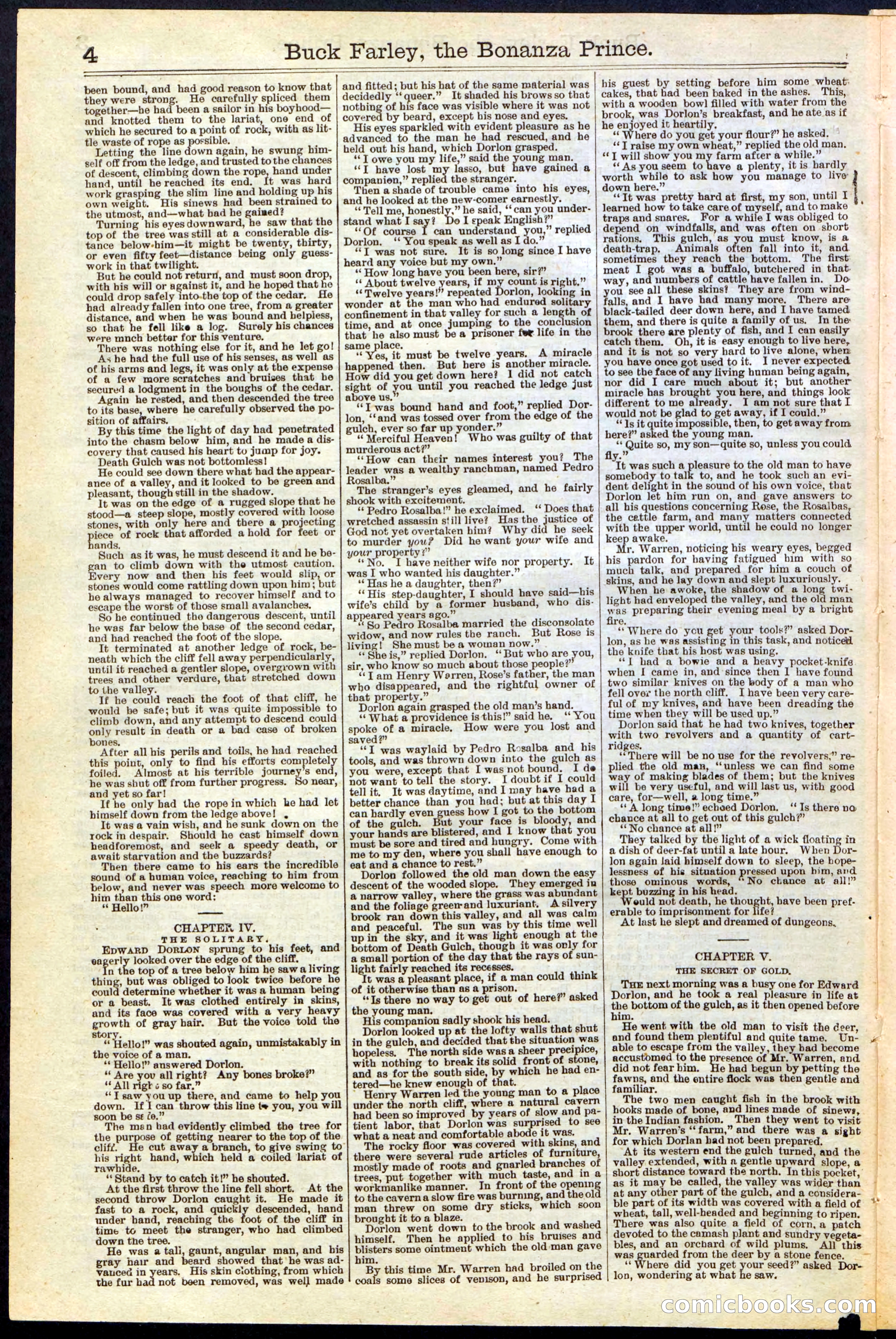
A restored page from Pulp Fiction, 1882. Page through the whole issue in the reader above.
📄 Transcribed text from this page (OCR, searchable)
Machine-transcribed from the original scan — historical spelling and the odd misread are preserved.
& been bound, and had good reason to know that they were strong. He carefully spliced them together—he had been a sailor in his boyhood— and knotted them to the lariat, one end of which he secured to a point of rock, with as lit- tle waste of rope as possible. Letting the line down again, he swung him- self off from the ledge, and trusted to the chances of descent, climbing down the rope, hand under hand, until he reached its end. ft was hard work grasping the slim line and holding up his own weight. His sinews had been strained to the utmost, and—what bad he gaimed? Turning his eyes downward, he saw that the top of the tree was still at a considerable dis- tance below-him—it might be twenty, thirty, or even fifty feet—distance being only guess- work in that twilight. But he could not return, and must soon drop, with his will or against it, and he hoped that he could drop safely into-the top of the cedar, He had already fallen into one tree, from a greater distance, and when he was bound and helpless, so that he fell like a log. Surely his chances were mnch better for this venture. There was nothing else for it, and he let go! As he had the full use of his senses, as well as of his arms and legs, it was only at the expense of a few more scratches and bruises that he secured a lodgment in the boughs of the cedar. Again he rested, and then descended the tree to its base, where he carefully observed the po- sition of affairs. By this time the light of day had penetrated into the chasm below him, and he made a dis- covery that caused his heart to jump for joy. Death Gulch was not bottomless! He could see down there what had the appear- ance of a valley, and it looked to be green and pleasant, though still in the shadow. It was on the edge of a rugged slope that he stood—a steep slope, mostly covered with loose stones, with only here and there a projecting ose of rock that afforded ahold for feet or ands, Such as it was, he must descend it and he be- an to climb down with the utmost caution. very now and then his feet would slip, or stones would come rattling down upon bim; but he get managed to recover himself and to escape the worst of those small avalanches, So he continued the dangerous descent, until he was far below the base of the second cedar, and had reached the foot of the slope. It terminated at another ledge of rock, be- neath which the cliff fell away perpendicularly, until it reached a gentler slope, overgrown with trees and other verdure, that stretched down to the valley. If he could reach the foot of that cliff, he would be safe; but it was quite impossible to climb down, and any attempt to descend could only result in death or a bad case of broken bones. After all his perils and toils, he had reached this point, only to find his efforts compte’ foiled. Almost at his terrible somraeys end, he was shut off from further progress. 5bo near, and yet so far! If he only bad the rope in which he had let himself down from the ledge above! , It was a vain wish, and he sunk down on the rock in despair. Should he cast himself down headforemost, and seek a speedy death, or await starvation and the buzzards? Then there came to his ears the incredible sound of a human voice, reaching to him from below, and never was speech more welcome to him than this one word: ** Hello!” CHAPTER IV. THE SOLITARY. Epwarp Dorion sprung to his feet, and eagerly looked over the edge of the cliff. n the top of a tree below him he saw a living pial! but was obliged to look twice before he could determine whether it was a human being or a beast. It was clothed entirely in skins, and its face was covered with a very heavy growth of gray hair. But the voice told the story. Hello!” was shouted again, unmistakably in the voice of a man. ‘* Hello!” answered Dorlon. “ Are you all right? Any bones broke?” ‘* All righ s so far.” “T saw — up there, and came to help you down. If I can throw this line te you, you will soon be se fe,” The men bad evidently climbed the tree for ge se of getting nearer to the top of the clifé. his right hand, which held a coiled lariat of rawhide. ‘*Stand by to catch it!” he shouted. At the first throw the line fell short. At the second throw Dorlon caught it. He made it fast to a rock, and quickly descended, hand under hand, reaching the foot of the cliff in time to meet the stranger, who had climbed down the tree. He was a tali, gaunt, angular man, and bis gray hair and beard showed that he was ad- Vauced in years. His skin ciothing, from which the fur had not been removed, was well made Buck Farley, the Bonanza P appeared years a living! e cut away a branch, to give swing to and fitted; but his hat of the same material was decidedly ‘‘queer.” It shaded his brows so that pea of his face was visible where it was not covered by beard, except bis nose and eyes. His eyes sparkled with evident pleasure as he advanced to the man he had rescued, and he held out his hand, which Dorlon grasped. ‘‘T owe you my life,” said the young man. ‘T have lost my lasso, but have gained a companien,” replied the stranger. Then a shade of trouble came into his eyes, and he looked at the new-comer earnestly. ** Tell me, <S aartge SA he said, ‘‘can you under- stand what I say? I speak English?” “Of course I can understand you,” replied Dorlon. ‘* You speak as well as I do.” ‘““T was not sure. It is so long since I have heard any voice but my own.” ‘How long have you been here, sir?” ‘¢ About twelve years, if my count is right,” “Twelve years!” repeated Dorlon, looking in wonder at the man who had endured solitary confinement in that valley for such a length of time, and at once jumping to the conclusion that he also must be a prisoner fer life in the same place. ‘Yes, it must be twelve years. A miracle happened then. But here is another miracle. How did you get down here? 1 did not catch sight of you until you reached the ledge just above us.” ‘‘T was bound hand and foot,” replied Dor- lon, ‘‘and was tossed over from the edge of the gulch, ever so far up yonder.” “Merciful Heaven! Who was guilty of that murderous act?” ‘““How can their names interest you? The leader was a wealthy ranchman, named Pedro Rosalba.” The stranger’s eyes gleamed, and he fairly shook with excitement. ‘‘ Pedro Rosalba!” he exclaimed. ‘ Does that wretched assassin still live? Has the justice of God not yet overtaken him? Why did he seek to murder you? Did he want your wife and your property ¢” ‘‘No. I have neither wife nor property. It was I who wanted his daughter.” ‘Has he a daughter, then?’ “His step-daughter, I should have said—his wife’s child by a former husband, who dis- 0. ‘‘ So Pedro Rosalba married the disconsolate widow, and now rules the ranch. But Rose is She must be a woman now.” ‘‘ She is,” replied Dorlon. “ But who are you, sir, who know so much about those people? ‘‘T am Henry Werren, Rose’s father, the man who disappeared, and the rightful owner of that property.” Dorlon again grasped the old man’s hand. ‘“‘ What a providence is this!” said he, ‘* You spoke of a miracle. How were you lost and saved?” ““T was waylaid by Pedro Rosalba and his tools, and was thrown down into the gulch as you were, gs) ie that I was not bound. I de not want to tell the story. I doubt if I could tell it. It was daytime, and 1 may have had a better chance than you had; but at this day I can hardly even guess how I got to the bottom of the gulch. But your face is bloody, and your hands are blistered, and I know that you must be sore and tired and hungry. Come with me to my den, where you shall have enough to eat and a chance to rest.” Dorlon followed the old man down the easy descent of the wooded slope. They emerged in a narrow valley, where the grass was abundant and the foliage green-and luxuriant. A silvery brook ran down this valley, and all was calm and peaceful. The sun was by this time well up in the sky, and it was light enough at the bottom of Death Gulch, though it was orly for a small portion of the day that the rays of sun- light fairly reached its recesses. : It was a pleasant place, if a man could think of it otherwise than as a prison. “Ts there no way to get out of here?” asked the young man. His companion sadly shook his head. Dorlon looked up at the lofty walls that shut in the gulch, and decided that the situation was hopeless. The north side was a sheer precipice, with nothing to break its solid front of stone, and as for the south side, by which he had en- tered—he knew enough of that. ~ Henry Warren led the young man to a place under the north cliff, where a natural cavern had been so improved by years of slow and pa- tient labor, that Dorlon was su rised to see what a neat and comfortable abode it was. The rocky floor was covered with skins, and there were several rude articles of furniture, mostly made of roots and gnarled branches of trees, put together with much taste, and ina workmanlike manner. In front of the openin to the caverna slow fire was burning, and the ol man threw on some dry sticks, which soon brought it to a blaze. Dorlon went down to the brook and washed himself. Then he applied to his bruises and a some ointment which the old man gave im. By this time Mr. Warren had broiled on the coals some slices of venison, and he surprised rince. ‘ —— his guest by setting before him some wheat: cakes, that had been baked in the ashes. This, with a wooden bow] filled with water from the brook, was Dorlon’s breakfast, and he ate as if he enjoyed it heartily, ‘Where do you get your flour?” he asked. ‘‘T raise my own wheat,” replied the old man, ‘7 will show you at farm afcer a while.” . ‘‘ As you seem to have a plenty, it is hardly worth while to ask how down here.” “Tt was pretty hard at first, my son, until I learned how to take care of myself, and to make °° traps and snares. For a shite I was obliged to depend on windfalls, and was often on sbort rations. This gulch, as you must know, is a death-trap. Animals often fall into it, and. sometimes they reach the bottom. The first: meat I got was a buffalo, butchered in that. way, and numbers of cattle have fallenin. Do ou see all these skins? They are from wind- alls, and I have had many more. There are black-tailed deer down here, and I have tamed them, and there is quite a family of us. In the: brook there are plenty of fish, and I can easily catch them. Oh, it is easy enough to live here, and it is not so very bard to live alone, wher you have once got used to it. I never expected to see the face of any living human being again, nor did I care much about it; but another miracle has brought > here, and things look different to me already. I am not sure that I would not be glad to get away, if I could.” ‘1s it quite impossible, then, to get away from here?” asked the young man. 4 “ Quite so, my son—quite so, unless youcould y. It was such a pleasure to the old man to have somebody to talk to, and he took such an evi- dent delight in the sound of his own voice, that Dorlon let him run on, and gave answers to all his questions concerning Rose, the Rosalbas the cettle farm, and many matters connected with the upper world, until he could no longer a awake, r. Warren, noticing his weary eyes, begged his pardon for having fatigued bim with so much talk, and prepared for him a couch of skins, and he lay down and slept luxuriously. When he awoke, the shadow of a long twi- light had enveloped the valley, and the old man was preparing their evening meal by a bright you manage to live e. ‘Where do you get your tools?” asked Dor- lon, as he was assisting in this task, and noticetl the knife that his host was using. ‘““T had a bowie and a heavy pocket-knife when I came in, and since then 1 have found | two similar knives on the body of a man who fell over the north cliff. I have been very care- ful of my knives, and have been dreading the time when they will be used up.” Dorlon said that he had two knives, together | with two revolvers and a quantity of cart- | ridges. ‘There will be no use for the revolvers,” re- plied the old man, “unless we can find some __ way of making blades of them; but the knives will be very useful, and will last us, with good care, for—well, a long time.” ‘* A long time!” echeed Dorlon, ‘Is there no chance at all to get out of this gulch?” **No chance at all!” They talked by the light of a wick floating in a dish of deer-fat until a late hour, When Dor- lon again laid himseJf down to sleep, the bope- lessness of his situation pressed upon bim, and those ominous words, “No chance at all!” we 5 buzzing in his head. euld not death, he thought, have been pref- erable to imprisonment for life? ; At last he slept and dreamed of dungeons, oan | | : CHAPTER V. THE SECRET OF GOLD. THE next morning wasa busy onefor Edward ~ Dorlon, and he took a real pleasure in life at se bottom of the gulch, as it then opened before im. He went with the old man to visit t and found them plentiful and quite se “Om able to escape from the valley, they bad become accustomed to the presence of Mr. Warren, and | did not fearbim. He had begun by petting the fawns, and the entire flock was then gentle and is mgr e two men caught fish in the brook wi hooks made of bone, and lines made of eee in the Indian fashion. Then they went to visit Mr. Warren’s “farm,” and there was a sight for which Dorlan had not been prepared. At its western end the guich turned, and the valley extended, with a gentle upward slope, a short distance toward the north. In this pocket, as it may be called, the valley was wider than | at any other part of the gulch, and a considera- _ ble part of its width was covered with a field of * wheat, tall, well-headed and beginning to ripen. _ There was also quite a field of corn,a patch © devoted to the camash plant and sundry vegeta- bles, and an orchard of wild plums. All this was guarded from the deer by a stone fence. ‘‘Where did you get your seed?” asked Dor- lon, wondering at what he saw. EGoOmic at - JOO Ss) ~ »- ( f heel _— (Eo) —