
Pulp Fiction, 1882 · page 12 of 28
Beadle's New York Dime Library, No. 196 — page 12: what you’re looking at
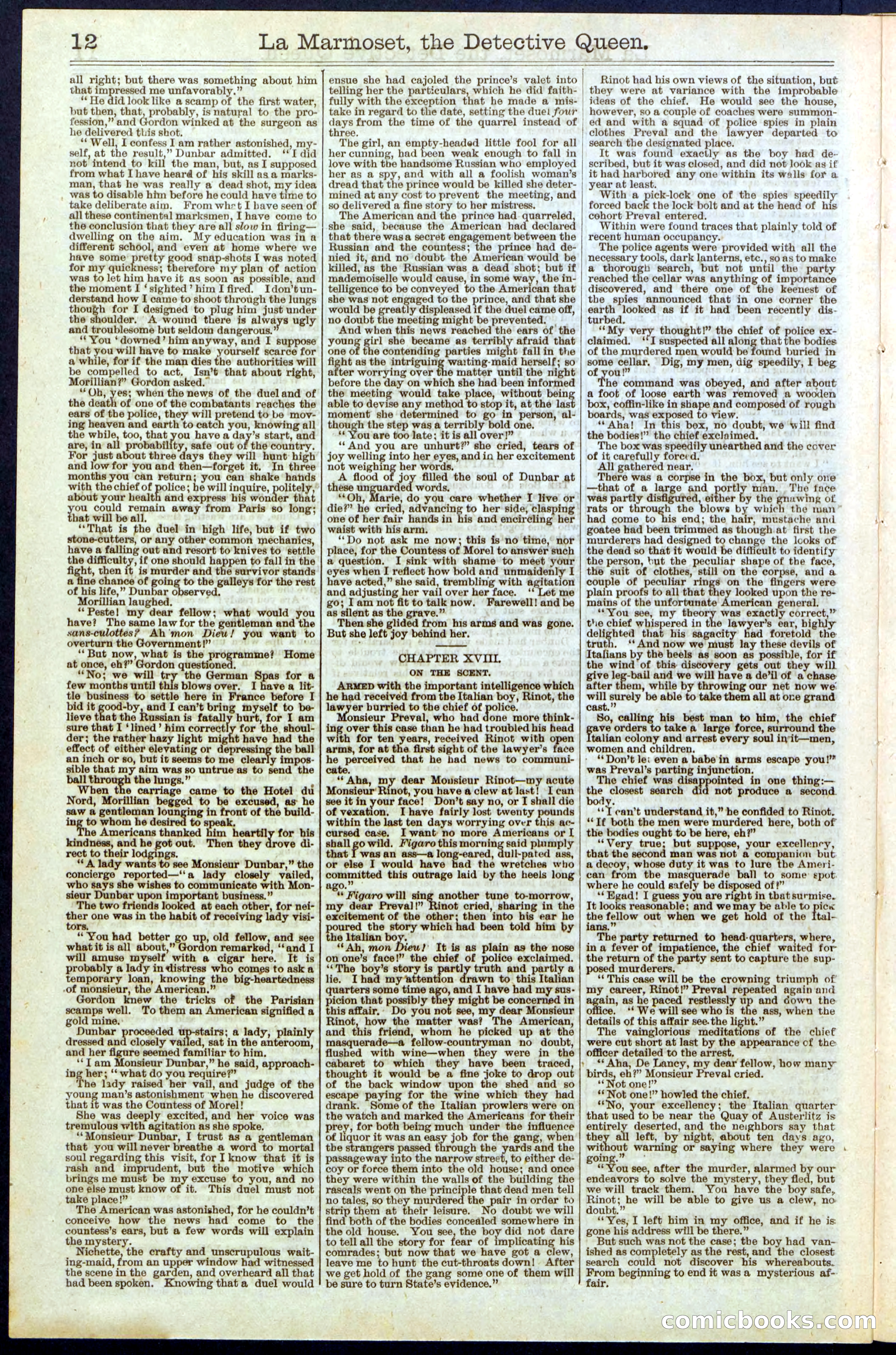
A restored page from Pulp Fiction, 1882. Page through the whole issue in the reader above.
📄 Transcribed text from this page (OCR, searchable)
Machine-transcribed from the original scan — historical spelling and the odd misread are preserved.
12 ——e all right; but there was something about him that impressed me unfavorably.” ‘He did look like a scamp of the first water, but then, that, probably, is natural to the pro- fession,” and Gordon winked at the surgeon as he delivered this shot. “* Well, I confess I am rather astonished, my- self, at the result,” Dunbar admitted. ‘I did not intend to kill the man, but, as I supposed from what I have heard of his skill as a marks- man, that he was really a dead shot, my idea . was to disable him before he could have time to take deliberate aim. From whrt I bave seen of all these continental marksmen, I have come to the conclusion that they are all slow in firing— dwelling on the aim. My education was in a different school, and even at home where we have some pretty good snap-shots I was noted for my quickness; therefore my plan of action was to let him have it as soon as possible, and the moment I ‘ sighted’ him I fired” I don’t un- derstand how I came to shoot through the lungs though for I designed to plug him just under the shoulder. A wound there is always ugly and troublesome but seldom dangerous.’ ‘You ‘downed’ him anyway, and I suppose that Me will have to make yourself scarce for a while, for if the man dies the authorities will be compelled to act, Isn’t that about right, Morillian?” Gordon asked. “Ob, yes; when the news of the duel and of the death of one of the combatants reaches the ears of the police, they will pretend to be mov- ing heaven and earth to catch you, knowing all the while, too, that pa have a day’s start, and are, in all probability, safe out of the country. For just about three days they will hunt high and low for you and then—forget it. In three months you can return; you can shake hands with the chief of polices he will inquire, politely, about your health and express his wonder that A could remain away from Paris so long; hat will be all. “That is the duel in high life, but if two stone-cutters, or any other common mechanics, have a falling out and resort to knives to settle the difficulty, if one should happen to fall in the fight, then it is murder and the survivor stands a fine chance of going to the galleys for the rest of his life,” Dunbar observed. Morillian laughed, ** Peste! my dear fellow; what would you have? The same law for the gentleman and the sans-culottes? Ah'mon Dieu! you want to overturn the Government!” , ‘But now, what is the me? Home at once, eh?’ Gordon questioned. “No; we will the German § for a few months until blows over. I have a lit- bid it good-by, and T'ean’s bring myself to be- -by, and I can ng myse lieve that the Russian is fatall Pert, for I am sure that I ‘lined’ him correctly for the. shoul- der; the rather hazy light might have had the effect of either elevating or depressing the ball an inch or so, but it seems to me clearly impos- sible that my aim was so untrue as to send the ball through the lungs.” ° When the carriage came to the Hotel du Nord, Morillian begged to excused, as he saw a gentleman lo in front of the build- to whom he d to e Americans thanked heartily for his kindness, and he got out. Then they drove di- rect to their lodgings. **A lady wants to see Monsieur Dunbar,” the concierge reported—‘‘a lad y closely vailed, who says she wishes to communicate with Mon- sieur Dunbar upon important business.” The two friends looked at each other, for nei- ther one was in the habit of receiving lady visi- tors, “You had better go up, old fellow, and see what it is all about,” Gordon remarked, ‘tand I amuse myself with a cigar here. It is probably a lady in distress who comes to ask a tem y loan, knowing the big-heartedness of monsieur, the American.” Gordon knew the tricks of the Parisian scamps well. To them an American signified a gold mine. : Dunbar peace ; a lady, plainly dressed and closely vailed, sat in the anteroom, and her re seemed familiar to him. ‘*T am Monsieur Dunbar,” he said, approach- ing her; “‘ what do you require?” he lady raised her vail, and judge of the young man’s astonishment when he discovered that it was the Countess of Morel! She was deeply excited, and her voice was tremulous with agitation as she spoke. ‘“*Monsieur Dunbar, I trust as a gentleman that you will never breathe a word to mortal soul regarding this visit, for I know that it is rash and imprudent, but the motive which brings me must be my excuse to you, and no one else must know of it. This duel must not take place!” The American was astonished, for he couldn’t conceive how the news had come to the countess’s ears, but a few words will explain the mystery. Nichette, the crafty and unscrupulous wait- ing-maid, from an upper window had witnessed the scene in the garden, and overheard all that had been spoken. Knowing that a duel would La Marmoset, the Detective Que en, ensue she had cajoled the prince’s valet into | Rinot had his own views of the situation, but telling her the particulars, which he did faith- | fully with the exception that he made a mis- take in regard to the date, setting the duel four | days from the time of the quarrel instead of | three, The girl, an empty-headed little fool for all her cunning, had been weak enough to fall in love with the handsome Russian who employed her as a spy, and with all a foolish woman’s dread that the prince would be killed she deter- mined at any cost to prevent the meeting, and so delivered a fine story to her mistress. The American and the prince had quarreled, she said, because the American had declared that there wasa secret engagement between the Russian and the countess; the prinee had de- nied it, and no doubt the American would be killed, as the Russian was a dead shot; but if mademoiselle would cause, in some way, the in- telligence to be conveyed to the American that she was not or Se to the prince, and that she would be greatly displeased if the duel came off, no doubt the meeting might be prevented. | And when this news reached the ears of the young girl she became as terribly afraid that one of the contending parties might fallin the fight as the intriguing wa:ting-maid herself; so alter worrying over the matter until the night before the day on which she had been informed the meeting would take place, without bein able to devise any method to stop it, at the las moment she determined to go in person, al- though the step was a terribly bold one. ‘You are too late; it is all over!” ‘“‘And you are unhurt?’ she cried, tears of joy cone into her eyes, andin her excitement not weighing her words. _A flood of joy filled the soul of Dunbar at guarde words. **Oh, Marie, do you care whether I live or die?” he cried, advancing to her side, clasping one of her fair hands in his and encircling her waist with his arm. “Do not ask me now; this is no time, nor place, for the Countess of Morel to answer such a question. I sink with shame to meet your eyes when I reflect how bold and unmaidenly I have acted,” she said, trembling with agitation and adjusting her vail over her face. ‘‘ Let me go; Iam not fit to talk now. Farewell! and be as silent as the grave.” Then she glided from his arms and was gone. But she left joy behind her. CHAPTER XVIII. ON THE SCENT. ARMED with the important intelligence which he had received from the Italian boy, Rinot, the lawyer burried to the chief of police. onsieur Preval, who had done more think- ing over this case than he had troubled his head with for ten years, received Rinot with _ arms, for at the first sight of the lawyer’s face cod etd y= that he had news to communi- cate. ‘* Aha, my dear Mousieur Rinot—my acute Monsieur’ Rinot, you have a clew at last! I can see it in your face! Don’t say no, or I shall die of vexation. I have fairly lost: twenty pounds within the last ten days worrying over this ac- cursed case. I want no more Americans or I shall f° wild. Figaro this morning said plumply that I was an ass—a long-eared, dull-pated ass, or else I would have had the wretches who committed this outrage laid by the heels long * Figaro will another tune to-morrow, my dear Preval!” Rinot cried, sharing in the excitement of the other; then into his ear he poured the story which had been told him by 6 ltalian ay ' ‘*Ah, mon Diew! It is as plain as the nose ve ho ve chief of Bee ee C) 88 — and partly a lie. I had set A on drawe to this Ttalan quarters some time ago, and I have my sus- on that possibly they might be concerned in his affair. Do you not see, my dear Monsieur Rinot, how the matter was? The American, and this friend, whom he picked up at the masquerade—a fellow-countryman no doubt, flushed with wine—when they were in the cabaret to which they have been traced, thought it would be a fine joke to drop out of the back window upon the shed and so escape paying for the wine which they had drank. Some of the Italian prowlers were on the watch and marked the Americans for their prey, for both being much under the influence of liquor it was an easy job for the gang, when the strangers passed through the yards and the passageway into the narrow street, to either de- coy or force them into the old house; and once they were within the walls of the building the rascals went on the principle that dead men tell no tales, so they murdered the pair in order to strip them at their leisure. No doubt we will find both of the bodies concealed somewhere in the old house. You see, the boy did not dare to tell all the story for fear of implicating his comrades; but now that we have got a clew, leave me to hunt the cut-throats down! After we get hold of the gang some one of them will be sure to turn State’s evidence.” they were at variance with the improbable ideas of the chief. He would see the house, however, so a couple of coaches were summon- ed and with a squad of police spies in plain clothes Preval and the lawyer departed to search the designated place. It was found exactly as the boy had de- scribed, but it was closed, and did not look as if it had harbored any one within its walls for a year at least. With a pick-lock one of the spies speedily forced back the lock bolt and at the head of his cohort Preval entered. Within were found traces that plainly told of recent human occupancy. The police agents were provided with all the necessary tools, dark lanterns, etc., so as to make a thorough search, but not until the party reached the cellar was anything of importance discovered, and there one of the keenest of the spies announced that in one corner the earth looked as if it had been recently dis- turbed. “My very thought!” the chief of police ex- claimed. ‘I suspected all along that the bodies of the murdered men would be found buried in some cellar. Dig, my men, dig speedily, I beg of you!” he command was obeyed, and after about: a foot of loose earth was removed a wooden box, coffin-like in shape and composed of rough boards, was exposed to view. **Aha! In this box, no doubt, we will find the bodies!” the chief exclaimed. The box was speedily unearthed and the cover of it carefully foreed. All gathered near. There was a corpse in the box, but only ore —that of a large and pony. man. The face was partly disfigured, either by the gnawing of rats or through the blows by which the man had come to his end; the hair, mustache and goatee had been trimmed as though at first the murderers had designed to change the looks of the dead so that it would be difficult to identify the person, but the peculiar shape of the face, the suit of clothes, still on the corpse, and a couple of peculiar rings on the fingers were plain proofs to all that they looked upon the re- mains of the unfortunate American general. “You see, my eg?! was exactly correct,” the chief whispered in the lawyer’s ear, highly delighted that his sagacity had foretold the truth. ‘‘And now we m lay these devils of Italians by the heels as soon as possible, for if the wind of this discovery gets out they will give leg-bail and we will have a de’il of a chase after them, while by throwing our net now we ba surely be able to take them all at one grand cast. : So, calling his best man to him, the chief gate orders to take a large force, surround the talian colony and arrest every soul init—men, women and children. **Don’t lei even a babe in arms escape you!” was Preval’s parting injunction. The chief was disa 1 ees in one thing:— the closest search not produce a second. body. Oy can’t understand it,” he confided to Rinot. ‘*Tf both the men were murdered here, both of the bodies ought to be here, eh?” ‘“‘Very true; but suppose, your excellency, that the second man was not a companion but a decoy, whose duty it was to lure the Ameri- can from the pat gy ball to some: spot. where he could safely be di of?” ‘* gad! I guess you are right in that surmise. It looks reasonable; and we may be able to pic« the fellow out when we get hold of the Ital- The party returned to head-quarters, where, in a fever of impatience, the chief waited for the return of the party sent to capture the sup- posed murderers. ‘** This case will be the crowning triumph of my career, Rinot!” Preval repeated again and in, as he paced restlessly up and down the office. ** We willsee whois the ass, when the details of this affair see. the light.” The vainglorious meditations of the chief were cut short at last by the appearance cf the officer detailed to the arrest, ** Aha, De cy, my dear fellow, how many birds, eh?” Monsieur Preval cried. “Not one!” ** Not one!” howled the chief. ‘"No, your excellency; the Italian quarter that used to be near the Quay of Austerlitz is otter he deserted, and the neighbors say that the left, by night, about ten days ago, wit out warning or saying where they were going. “You see, after the murder, alarmed by our endeavors to solve the mystery, they fled, but we will track them. You have the boy safe, Rinot; he will be able to give us a clew, no doubt.” “Yes, I left him in my office, and if he is gone his address will be there.” But such was not the case; the boy had van- ished as completely as the rest, and the closest search could not discover his whereabouts. met beginning to end it was a mysterious af- Tr, Gomicbooks.e (E <s) (0) 4 :