
Pulp Fiction, 1882 · page 13 of 28
Beadle's New York Dime Library, No. 196 — page 13: what you’re looking at
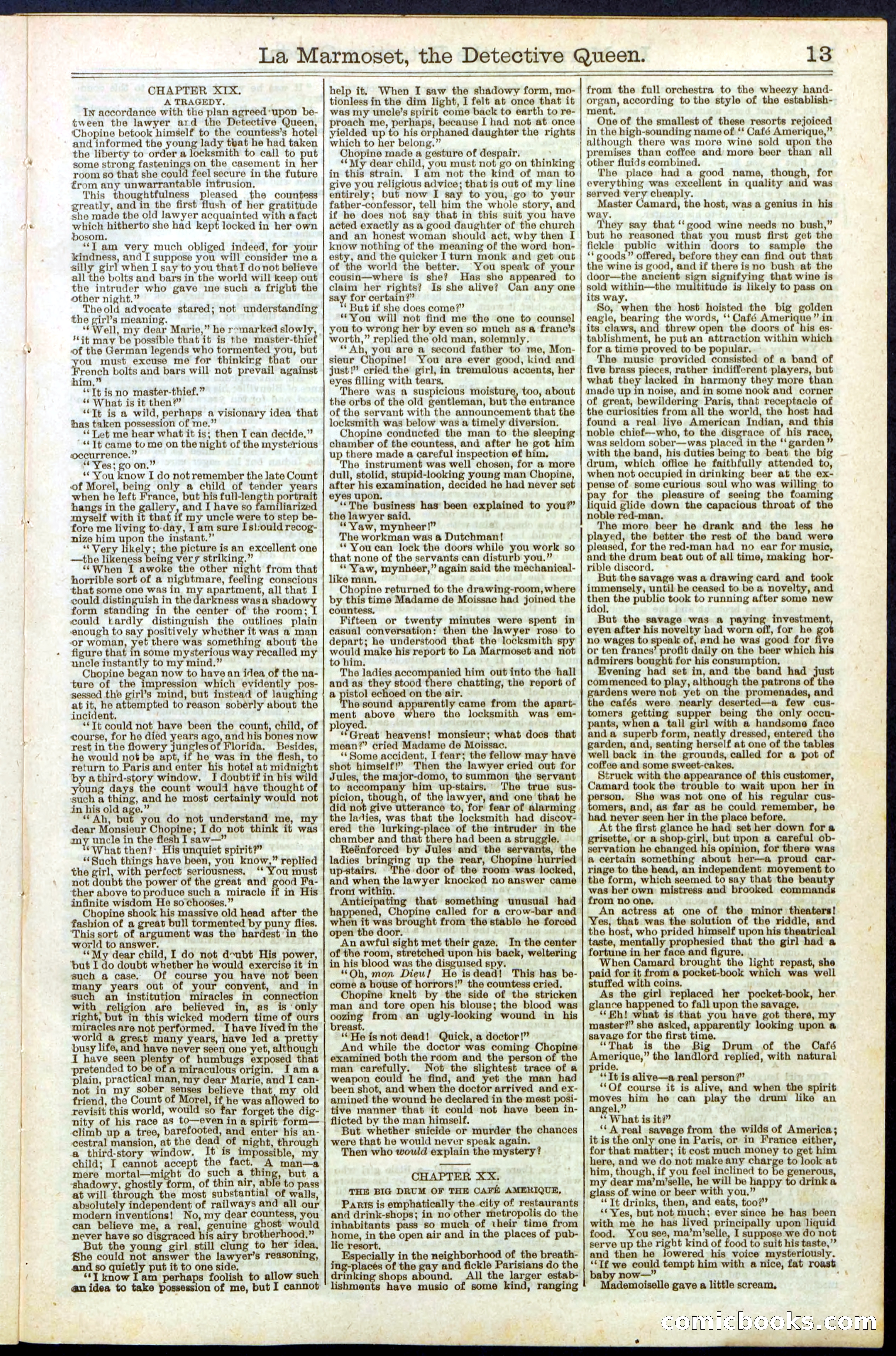
A restored page from Pulp Fiction, 1882. Page through the whole issue in the reader above.
📄 Transcribed text from this page (OCR, searchable)
Machine-transcribed from the original scan — historical spelling and the odd misread are preserved.
La Marmoset, the Detective Queen. CHAPTER XIX, A TRAGEDY. In accordance with the plan agreed:upon be- tween the lawyer ard the Detective Queen, Chopine betook himself to the countess’s hotel and informed the young lady that he had taken the liberty to order a locksmith to call to put some strong fastenings on the casement in her room so that she could feel secure in the future from any unwarrantable intrusion. This thoughtfulness pleased the countess greatly, and in the first flush of her gratitude she made the old lawyer acquainted with a fact which hitherto she had kept locked in her own bosom. ““T am very much obliged indeed, for your kindness, and [ suppose you will consider me a silly girl when I say to you thatI do not believe all the bolts and bars in the world will keep out the intruder who gave ime such a fright the other night.” Theold advocate stared; not understanding the girl’s meaning. ‘* Well, my dear Marie,” he remarked slowly ‘it may be possible that it is the master-thiet of the German legends who tormented you, but you must excuse me for thinkirg that our French bolts and bars will not prevail against him,” ‘It is no master-thief.” ‘What is it then?” ‘‘Tt is a wild, perhaps a visionary idea that has taken possession of me.” ‘¢ Tet me hear what it is; then T can decide.” ** Tt came to me on the night of the mysterious occurrence.” ‘¢-Yes; go on.” ** You know I do not remember the late Count of Morel, being only a child of tender years when he left France, but his full-length portrait hangs in the gallery, and I have so familiarized myself with it that if my uncle were to step be- fore me living to-day, I am sure Isl:ould recog- nize him upon the instant.’’ “Very me the picture is an excellent one —the likeness being very striking.” ‘‘When I awoke the other night from that horrible sort of a nightmare, feeling conscious that some one was in my apartment, all that I could distinguish in the darkness was a shado form standing in the center of the room; could tardly distinguish the outlines plain enough to say positively whether it was a man or woman, yet there was something about the figure that in some mysterious way recalled my uncle instantly to my mind.” Chopine began now to have an idea of the na- ture of the impression which evidently pos- sessed the girl’s mind, but instead of laughing at it, he attempted to reason soberly about the incident. ‘*Tt could not have been the count, child, of course, for he died years ago, and his bones now rest in the flowery jungles of Florida. Besides, he would not be apt, if he was in the flesh, to return to Paris and enter his hotel at midnight by a third-story window, I doubtif in his wild young days the count would have thought of such a thing, and he most certainly would not in his old age.” ‘Ah, bué you do not understand me, my dear Monsieur Chopine; I do not think it was my uncle in the flesh I saw—” ‘What then?’ His unquiet spirit?” “Such things have been, you know,” replied the girl, with perfect seriousness, ‘* You must not doubt the power of the great and good Fa- ther above to produce such a miracle if in His infinite wisdom He so chooses,” Chopine shook his massive old head after the fashion of a great bull tormented by puny flies. ‘This sort of argument was the hardest in the world to answer. ‘*My dear child, I do not doubt His power, ‘but I do doubt whether he would exercise it in such a case. Of course you have not been many years out of your convent, and in such an institution miracles in connection with religion are believed in, as is ‘only right, but in this wicked modern time of ours miracles are not performed. Ihave lived in the world a great many years, have led a prett busy life, and have never seen one yet, althoug I have seen plenty of humbugs exposed that pretended to be ofa miraculous origin. Iama plain, practical man, my dear Marie, and I can- not in my sober senses believe that my old friend, the Count of Morel, if he was allowed to revisit this world, would so far porket the dig- nity of his race as to—even in a spirit form— climb up a tree, barefooted, and enter his an- cestral mansion, at the dead of night, through a third-story window. It is impossible, my child; I cannot accept the fact. A man—a mere mortal—might do such a thing, but a shadowy, ghostly form, of thin air, able to pass at will through the most substantial of walls, absolutely independent of railways and all our modern inventions! No, my dear countess, you can believe me, a real, ig ghost would never have so disgraced his airy brotherhood.” But the young girl still clung to her idea, She could not answer the lawyer’s reasoning, and so quietly put it to one side. ‘*? know Iam perhaps foolish to allow such an idea to take possession of me, but I cannot ET eee help it. When I saw the shadowy form, mo- tionless in the dim light, I felt at once that it was my uncle’s spirit come back to earth to re- proach me, perhaps, because I had not at once yielded up to his orphaned daughter the rights which to her belong.” Chopine made a gesture of despair. “My dear child, you must not go on thinking in this strain. I am not the kind of man to give you religious advice; that is out of my line entirely; but now I say to you, go to yeur father-confessor, tell him the whole story, and if he does not say that in this suit you have acted exactly as a good daughter of the church and an honest woman should act, why then I know nothing of the meaning of the word hon- esty, and the quicker I turn monk and get out of the world the better. You speak of your cousin—where is she? Has she appeared to claim her rights? Is she alive? Can any one say for certain?” ‘But if she does come?” “You will not find me the one to counsel you to wrong her by even so much as a franc’s worth,” replied the old man, solemnly. ‘‘Ah, you are a second father to me, Mon- sieur Chopine! You are ever good, kind and just!” cried the girl, in tremulous accents, her eyes filling with tears, There was a suspicious moisture, too, about the orbs of the old gentleman, but the entrance of the servant with the announcement that the locksmith was below was a timely diversion. Chopine conducted the man to the were 4 chamber of the countess, and after he got him up there made a careful inspection of him, The instrument was well chosen, for a more dull, stolid, stupid-looking young man Chopine, after his examination, decided he had never set eyes upon. ‘The business has been explained to you?” the lawyer said. “Yaw, mynheer!” | The workman was & Dutchman! ** You can lock the doors while you work so that none of the servants can disturb you.” “Yaw, mynheer,” again said the mechanical- like man, Chopine returned to the drawing-room, where by this time Madame de Moissac had joined the countess. Fifteen or twenty minutes were spent in casual conversation: then the lawyer rose to depart; he understood that the locksmith spy Wed make his report to La Marmoset and not to him. The ladies accompanied him out into the hall and as they stood there chatting, the report of a pistol echoed on the air. he sound apparently came from the apart- ment above ere the locksmith was em- ployed. ‘Great heavens! monsieur; what does that mean?” cried Madame de Moissac. ‘Some accident, I fear; the fellow may have shot himself!” Then the lawyer cried out for Jules, the major-domo, to summon the servant to accompany him up-stairs.’ The true sus- icion, though, of the lawyer, and one that he id not give utteranco to, for fear of alarming | the laties, was that the locksmith had discov- ered the lurking-place of the intruder in the chamber and that there had been a struggle. Reénforced by Jules and the servants, the ladies bringing up the rear, Chopine hurried upstairs. he door of the room was locked, and when the lawyer knocked no answer came from within. Anticipating that something unusual had happened, Chopine called for a crow-bar and when it was brought from the stable he forced open the door. An awful sight met their gaze, In the center of the room, stretched upon his back, weltering in his blood was the disguised spy. “Oh, mon Dieu! He isdead! This has be- come a house of horrors!” the countess cried. Chopine knelt by the side of the stricken man and tore open his blouse; the blood was oozing from an ugly-looking wound in his breast. ‘He is not dead! Quick, a doctor!” And while the doctor was coming Chopine examined both the room and the person of the man pg Not the slightest trace of a weapon could he find, and yet the man had been shot, and when the doctor arrived and ex- amined the wound he declared in the most posi- tive manner that it could not have been in- flicted by the man himself. But whether suicide or murder the chances were that he would never speak again. Then who would explain the mystery? CHAPTER XX, THE BIG DRUM OF THE CAFS AMERIQUE, Paris is emphatically the city of restaurants and drink-shops; in no other metropolis do the inhabitants pass so much of their time from ore, in the open air and in the places of pub- c resort. sepecialty in the neighborhood of the breath- ing- of the gay and fickle Parisians do the drinking shops abound. All the Ba? estab- lishments have music of some . ranging * 13 from the full orchestra to the wheezy hand- organ, according to the style of the establish- ment. One of the smallest of these resorts rejoiced in the high-sounding name of ‘* Café Amerique,” although there was more wine sold upon the premises than coffee and more beer than all other fluids combined. The place had a good name, though, for everything was excellent in quality and was served very cheaply. Master Camard, the host, was a genius in his way. They say that ‘‘ good wine needs no bush,” but he reasoned that you must first get the fickle public within doors to sample the ‘* poods” offered, before they can find out that the wine is good, and if there is no bush at the door—the ancient sign signifying that wine is sold within—the multitude is likely to pass on its way. So, when the host hoisted the big golden eagle, peaking the words, ‘‘ Café Amerique ” in its claws, and threw open the doors of his es- tablishment, he put an attraction within which for a time proved to be popular. The music provided consisted of a band of five brass pieces, rather indifferent players, but what they lacked in harmony they more than made up in noise, and in some nook and corner of great, bewildering Paris, that receptacle of the curiosities from all the world, the host had found a real live American Indian, and this noble chief—who, to the disgrace of his race, was seldom sober—was placed in the *‘ garden’ with the band, his duties being to beat the big drum, which office he faithfully attended to, when not occupied in drinking beer at the ex- peuse of some curious soul who was willing to pay for the pleasure of seeing the foaming iquid glide down the capacious throat of the noble red-man. The more beer he drank and the less he played, the better the rest of the band were pleased, for the red-man had no ear for music, and the drum beat out of all time, making hor- rible discord. But the savage was a drawing card ae took immensely, until he ceased to be a novelty, and pee the public took to running after some new idol. But the savage was a paying investment even after his novelty bad worn off, for he go no wages to speak of, end he was good for five or ten francs’ profit daily on the beer which his admirers bought for his consumption, Evening had set in, and the band had just commenced to play, although the patrons of the gardens were not yet on the promenades, and the cafés were nearly deserted—a few cus- tomers getting supper being the only occu- pants, when a tall girl with a handsome face anda superb form, neatly dressed, entered the gz and, seating herself at one of the tables well back in the grounds, called for a pot of coffee and some sweet-cakes. Struck with the appearance of this customer, Camard took the trouble to wait upon her in erson. She was not one of his regular cus- mers, and, as far as he could remember, he had never seen her in the place before, At the first glance he had set her down fora grisette, or a shop-girl, but upon a careful ob- servation he changed his opinion, for there was a certain something about her—a proud car- riage to the head, an independent moyement to the form, which seemed to say that the beaut was her own mistress and brooked copertands from no one. An actress at one of the minor theaters! Yes, that was the solution of the riddle, and the host, who prided himself upon his theatrical taste, mentally prophesied that the girl had a fortune in her face and figure, When Camard brought the light repast, she paid for it from a pocket-book which was well nae rae Felice her pocket-book, h s the re er e er glance ea to fall upon the savage, “Eh! what is that you have got there, my master?” she asked, apparently looking upon a savage for the first time. “That the Big Drum of the Café Fie the landlord replied, with natural pride. “It is alive—a real person?” *‘Of course it is alive, and when the spirit moves him he can play the drum like an angel,” ** What is it?” ‘‘A real savage from the wilds of America; it is the only one in Paris, or in France either, for that matter; it cost much money to get him here, and we do not make any charge to look at him, though, if you feel inclined to be generous, my dear ma’m’selle, he will be happy to drink a of wine or beer with you,” “Tt drinks, then, and eats, too?’ ‘¢- Yes, but not much; ever since he has been with me he has lived principally upon liquid food. You see, ma’m’selle, I su we do not serve up the right kind of food to suit his taste,” and then he lowered his voice mysteriously. ‘Tf we could tempt him with a nice, fat roast baby now—” emoiselle gave a little scream, Gomichboo <S)5(E (0) - - ma