
Pulp Fiction, 1882 · page 11 of 28
Beadle's New York Dime Library, No. 196 — page 11: what you’re looking at
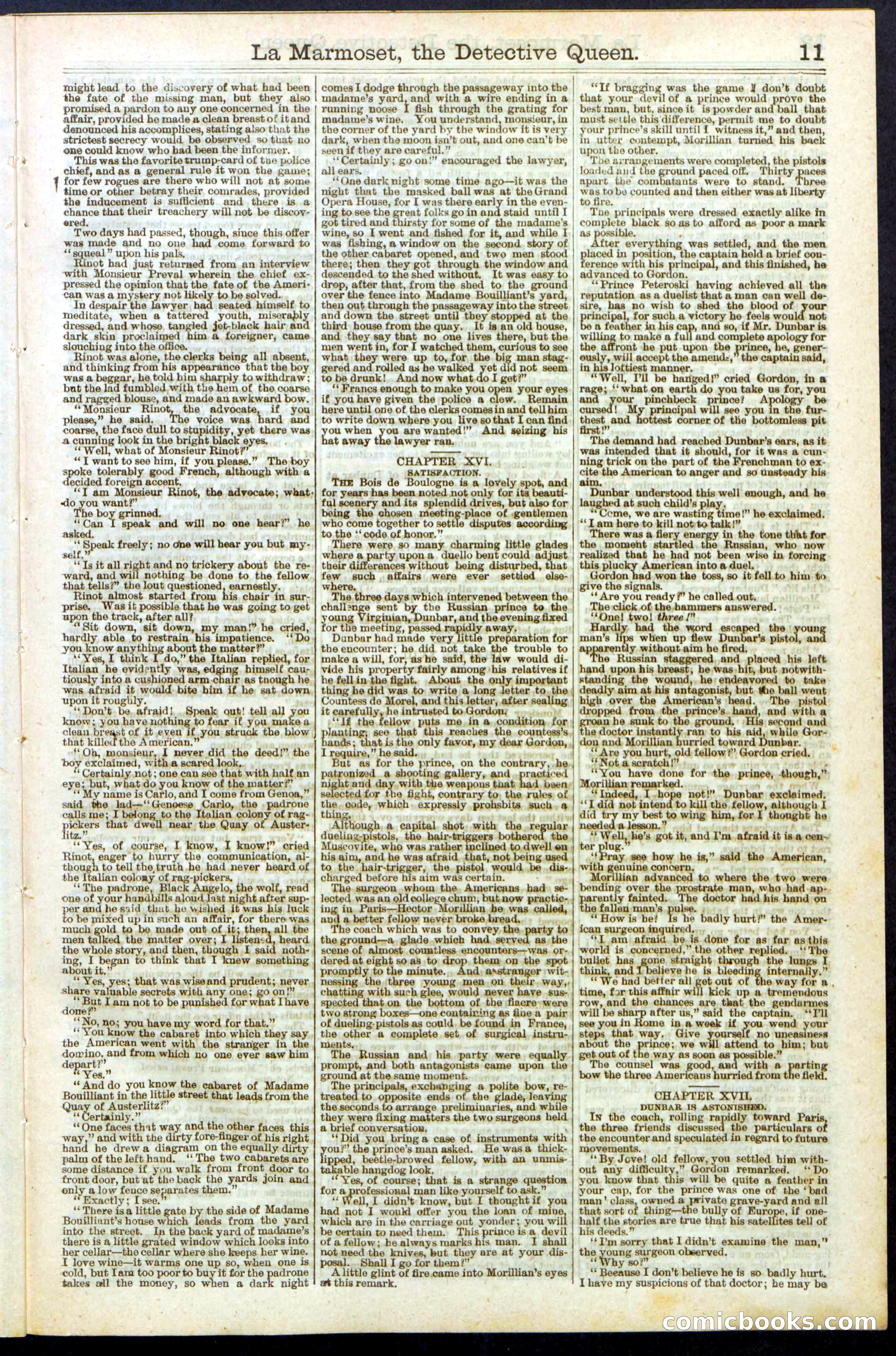
A restored page from Pulp Fiction, 1882. Page through the whole issue in the reader above.
📄 Transcribed text from this page (OCR, searchable)
Machine-transcribed from the original scan — historical spelling and the odd misread are preserved.
a might lead to the discovery of what had been the fate of the missing man, but they also promised a pardon to any one concerned in the affair, provided he made a clean breast of it and denounced his accomplices, stating also that the strictest secrecy would be observed so that no one could know who had been the informer. This was the favorite trump-card of tue police chief, and as a general rule it won the game; for few rogues are there who will not at some time or other betray their comrades, provided the inducement is sufficient and there is a chance that their treachery will not. be discoy- ered, Two days had passed, though, since this offer was made and no one had come forward to “squeal” upon his pals, Rinot had just returned from an interview with Monsieur Preval wherein the chief ex- pressed the opinion that the fate of the Ameri- can was a mystery not likely to be solved. In despair the lawyer had seated himself to Meditate, when a tattered youth, miserably dressed, and whose, tangled jet-black hair and dark skin proclaimed him a foreigner, came slouching into the office. Rinot was alone, the clerks being all absent, and thinking from his appearance that the boy was a beggar, he told him sharply to withdraw: but the lad fumbled with the hem of the coarse and ragged blouse, and made an awkward bow, **Monsieur Rinot, the advocate, if you please,” he said, The voice was bard and coarse, the face dull to Srapiciby yet there was a cunning look in the bright black eyes, ‘Well, what of Monsieur Rinot?’ “T want to see him, if you please.” The boy spore tolerably good French, although with a decided foreign accent, ‘‘T am Monsieur Rinot, the advocate; what: «lo you want?” he poy grinned. gia speak and will no one hear?” he as ° * speak freely; no One will hear you but my- self,’ ‘Ts it all right and no trickery about the re- ward, and will nothing be done to the fellow that tells?’ the lout questioned, earnestly. Rinot_ almost started from his chair in sur- prise, Wasit possible that he was going to get upon the track, after all? “Sit down, sit down, my man!” he cried, hardly able to restrain his impatience. ‘‘Do you know anything about the matter?” “Yes, I think I do,” the Italian replied, for Italian he evidently was, edging tiously into a cushioned arm.chair as tho was afraid it would. bite him if he sat upon it roughly. ell all out! t ou make a himself cau- h he. own, ‘Don’t be, afraid! § know, you have nothing to fear if you clean breast of it even if you struck the blow that killed the American.” ‘Oh, monsieur, I never did the deed!” the boy exclaimed, witha scared look,. , Certainly not; one can seo that with half an eye; but, what do you know of the matter?’ * neue is ano; and poomne — an sai ) —'‘Genoese Carlo, ne calls me; I pargne te the Italian colony of rag- ickers that dwell near, the Quay of Auster- itz. ; ‘Yes, of course, I know, I know!” cried Rinot, eager to hurry the communication, al- though to tell the, truth he had never heard of the Italian colony of rag-pickers, é, ‘‘The padrone, Black elo, the wolf, read one of your handbills aloud Jast night after sup- par and he said that he wished it was his luck o be mixed up in such an affair, for there was much gold to be made out of it; then, all the men talked the matter over; I listens rink the whole story, and then, though I said no ing, I began think that I knew something about it,’ ‘Yes, yes; that was wiseand prudent; never share valuable secrets with any one; go on!” ‘‘ But Iam not to be punished for what Ihave done?” ; ‘No, no; you have my word for that.” ‘You know the cabaret into which they say the American went with the stranger in the dowino, and from which no one ever saw him depart?” : ‘ Yes.” ““And do you know the cabaret of Madame Bouilliant in the little street that leads from the Quay of Austerlitz” | te rtainly. ” ‘One faces that way and the other faces this way,” and with the dirty fore-finger of his right hand he drew a diagram on the equally dirty palm of the left hand. ‘‘ The two cabarets are some distance if you walk from front door to front door, but‘at the back the yards join and only alow fence separates them.” “Exactly; [ see.” ‘‘ There isa little gate by the side of Madame Bouilliant’s house hick toads from the yard into the street. Ip the back yard of ne’s there is a little grated window which looks into her cellar—the cellar where she keeps her wine. I love wine—it warms one up so, when one 1s cold, but [am too poor to buy it for the padrone takes all the money, so when a dark night comes I dodge through the passageway into the madame’s yard, and with a wire ending in a running noose I fish through the grating for madame’s wine. You understand, monsieur, in the corner of the yard by the window it is very dark, when the moon isn’t out, and one can’t be | seen if they are careful.” ‘Certainly; go on!” encouraged the lawyer, all ears. night that the masked ball was at the Grand Opera House, for I was there early in the even- ing to. see the great folks goin and staid until I got tired and thir was fishing, a window on the second SHORE. © the other cabaret opened, and two men stood there; then they got through the window and descended to the shed without, It was easy to drop, after that, from the shed to the ground over the fence into Madame Bouilliant’s yard, then out throngh the passageway into the street and down the street until they stopped at the third house from the quay. It is an old house, and they say that no one lives there, but the men went in, for I watched them, curious to see what they were up to, for the big man stag- gered and rolled as he walked yet did not seem to be drunk!. And now what.do I get?” ‘* Frances enough to make you 0 your eyes if you have given the police a clew. Remain here until one of the clerks comesin and tell him to write down where you live sothat I can find ou when you are wanted!” And seizing his t away the lawyer ran, CHAPTER XVI, SATISFACTION. THE Bois de Boulogne is a lovely spot, and for years has been noted not only for its beauti- ful scenery and its splendid drives, but also for being the chosen acting piace of gentlemen who come together to settle disputes according to the *‘ code of honor.” There were sO many. pharming little glades OPT Bh DAES. upon a duello bent could adjust their differences without being disturbed, that few such . affairs where, ’ ) The three days which intervened between the challenge sent by the Russian prince te. the young Virginian, Dunbar, and the evening fixed for the meeting, % away. Dunbar had made very little preparation for the encounter; he did not take the trouble to make a will, for, ashe said, the law would di- vide his property fairly among ‘his relatives if be fella fight. About the portant thing he did was to write a long letter to Countess de Morel, and this letter, after it carefully, he intrusted toGordony ~.....)) “If the fellow pyle me in a condition for plamiangy. see that this reaches the e A my ands; that is the only favor, my dear Gordon, I require,” hesaid..._, is § - But as for the prince, on the contrary, .he. atronized a shooting gallery, and practiced itaaeie acute tie ice ‘he fight, con rules o the. code, which axateneticaa bits such 4 th : if i it at : ik_ Alttiough, a eapital. shot. with the. ar dueling-pistols, the hair-tri bo the Nee de meet eotend aim, an was afraid. n ng to the hair-trigger, the would, .be dis-. aoe before z rent <a ue - e surgeon whom the. Americans se- lected was an old college chum, but. now ing in Paste bocton, Masi be was ¢ and a better fellow never broke bread, ., e otro was x pen bie groun ew served as the scene of almost countless encounters—was or- dered at eight so as to one & them on the ig Ww were ever settled promptly to the minute... And, nessing the three young men on way, chatting with such clon would ve pont v' spected that. on the bottom of or two strong ne con of dueling: pistols as could, be found in Franee, the other a complete set of surgical i - ments, The Russian and his party were equally. prompt, and both antagonists came upon the eo at eens menens va e princ exchanging a po w, re- Laanint to opposite ends of the glade, leaving the seconds to arrange iminaries, and while they were fixing matters the two surgeons held a brief conversation, Hy ‘Did you bring a case of instruments with ou?” the prince’s man asked. He wasa thick- ipped, e-browed fellow, with an unmis- takable hangdog look. “Yes, of course; that is a strange question for a peotessional man like yourself to. ask.” “ Well, I didn’t know, but I thought if + on had not I wouki offer you the loan of mive which are in the carriage out yonder; you will be certain to need them, This prince is a devil of a fellow; he always marks his man. I shall not need the knives, but they are at your dis- - Shall I go for them?” ? A little glint of fire.came into Morillian’s eyes at this remark. were | well \ tic-. taining as fine a pair . La Marmoset, the Detective Queen. | | | | } | loaded and the ground paced off. ‘*One dark night some time ago—it was the | ' i ; ; ' sty for some of the madame’s | wine, so I went and fished for it, and while ; 11 “Tf bragging was the game Y don’t doubt that your devil of a prince would prove the best man, but, since it is powder and ball that must settle this difference, permit me to doubt your prince’s skill until 1 witness it,” and then, in utter contempt, Morillian turned his back upon the other. The arrangements were completed, the pistols Thirty aces apart the combatants were to stand. Three bel to be counted and then either was at liberty to fire. The principals were dressed exactly alike in complete black so as to afford as poor a mark ———ooe as possible. , Xtter everything was settled, and the men »laced in position, the captain held a brief con- erence with his ripsiael, and this finished, he advanced to Gordon. “Prince Peteroski having achieved all the reputation as a duelist that a man can well de- sire, has no wish to shed the blood of your incipal, for such a victory he. feels sth} joo’ a feather in his cap, and so, if Mr. Dunbar is willing to make a full and complete apology for the affront he put upon the prince, e, gener- NEN s will accept the amendz:,” the captain said, in his lottiest manner. “Well, I'll be hariged!” cried Gordon, in a rage; ‘‘what on earth do you take us for, you peal (ig? pinchbeck prince? a be c { ig Hee sargy exe will see you in the fur- ee Aes corner of the bottomless pit The demand had reached Dunbar’s ears, as it was intended that it should, for it was a cun- ning trick on the part of the Frenchman to ex- cite the American to anger and so unsteady his aim. ’ Dunbar understood this well enough, and he laughed at such Child's PIAY, **Come, we are was ime!” he exclaimed. “‘Lam here to kill notito ” There was a fiery e in the tone thht for. the moment startled the Russian, who now realized that he had not been wise in forcing this plucky American into a duel. Gordon had won the toss, so it fell to him to give the signals. ‘* Are you ready?” he called out, The click of the bammers answered. Bani ad Os Gort cng ardly word es oun man’s ip when up flew Dun pistol, and y without aim he fired, , he Russian red, and ty his left upon his br , be was hit, but notwith- standing the wound, he endeavored to pers a ae A antagonist but #p ball ing Rade on «a went P @ prince’s.. and with a grep he sunk to Sree ‘His send and nad eater. inane ran to his aid Lad be Gor- don and Morilli urried toward zr. : an you hurt, old fellow?’ Gordon cried, ‘* Not a scratch!” “You have done for the pvinee, though,” cs ced, -hope not!” Dunbar exclaimed. not inten Cor et yoeet Te | did my ca wing for I thonght he need a lesson, in eri? ey? ae \ , fh Well, he’s got it, and I'm afraid it is a cen~ ph ; At tog" ai ray. ne how he is,” said the American, th gen concern, |. | advanced to where the two were bending over the. man, who had.-ap-. ntly fainted. ‘The doctor had his hand on fallen man’s . . eHow is bet te he badly hurt?” the Amer- ican surgeon inguired,.., ~nttet bed pot “T am afraid he is done for as far as this Proliel. bag mene winlabt, toceeee any age t ull e stra u | and bel eve +. is bleedin leimal in y.” “We had better all get out of the way for a time, for this affair kick up a tremendous row, and the chances are that the gendarmes will be eg tage = = Capen, “Pi see you in einaw ou wend your steps that way, Give ourself no uneasiness about the prince; we attend to ; but get out of the way as soon as ible.” The counsel was good, and with a tin bow the three Americans hurried from the fle CHAPTER XVIL, Iw tho coach, rolling rapidly toward Paris N the coach, rolling rapidly tow i the three friends dened tee particulars o the encounter and speculated in regard to future movements. ‘* By Jove! old fellow, you settled him with- out any giant ce Gordon remarked. ‘Do you know that this will be quite a feather in your cap, for the prince was one of the ‘bad man’ class, owned a private grave-yard and all that sort of thing—the bully of Europe, if one- half the stories are true that his satellites tell of his deeds.” ‘I’m sorry that I didn’t examine the man,” the ey surgeon observed. ‘“c bh so?” ‘* Beeause I don’t believe he is so. badly hurt. I have my suspicions of that doctor; he may be ra (<(0) | m e i