
Pulp Fiction, 1882 · page 25 of 28
Beadle's New York Dime Library, No. 195 — page 25: what you’re looking at
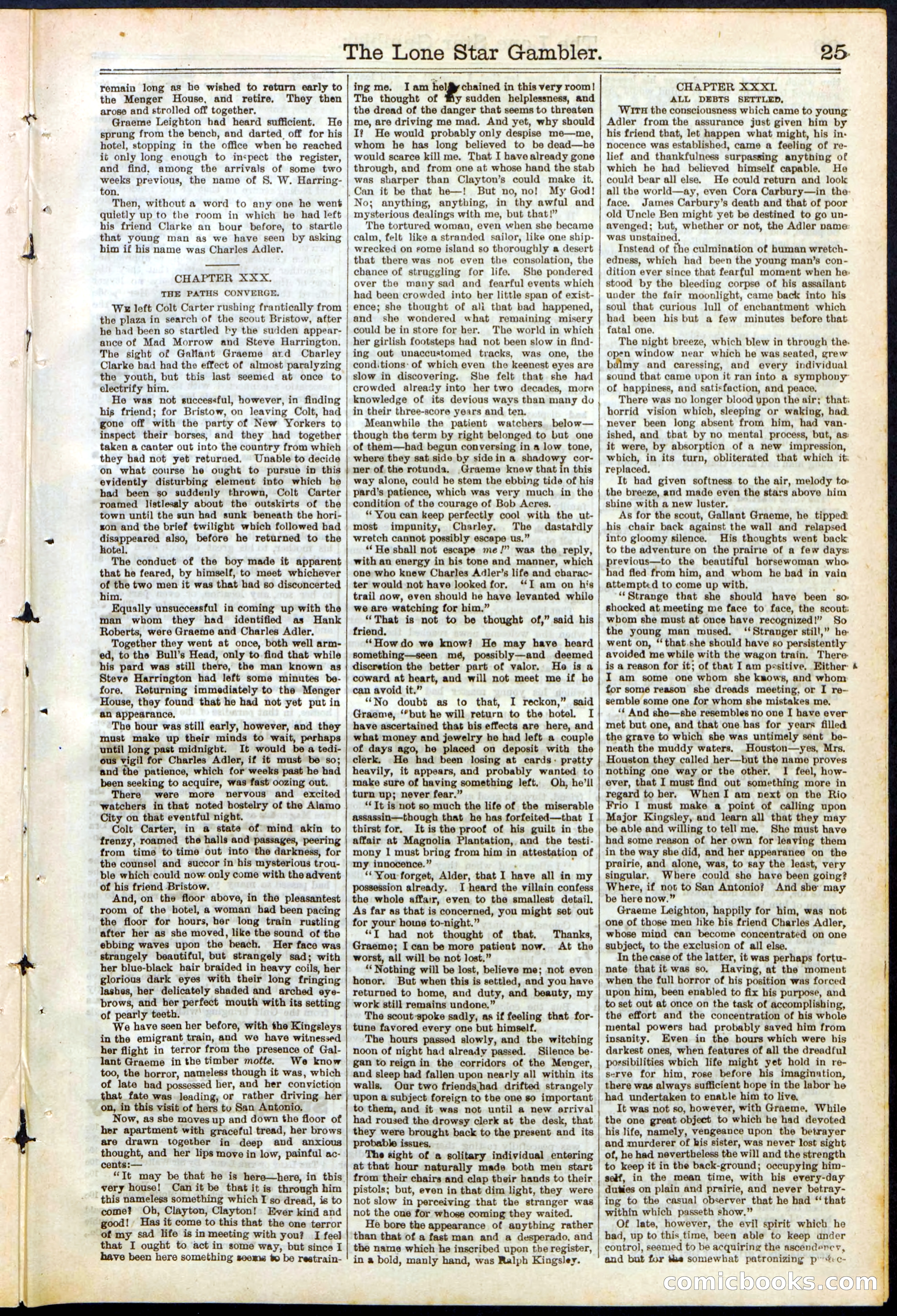
A restored page from Pulp Fiction, 1882. Page through the whole issue in the reader above.
📄 Transcribed text from this page (OCR, searchable)
Machine-transcribed from the original scan — historical spelling and the odd misread are preserved.
eee ee —_ eer se The Lone Star Gambler. remain long as be wished to return early to the Menger House, and retire, They then arose and strolled off together. Graeme Leighton had heard sufficient. He sprung from the bench, and darted off for his hotel, stopping in the office when he reached it only long enough to inspect the register, and find. among the arrivals of some two weeks previous, the name of S. W. Harring- ton. Then, without a word to any one he went quietly up to the room in which he had left his friend Clarke an hour before, to startle that young man as we have seen by asking him if his name was Charles Adler. CHAPTER XXX. THE PATHS CONVERGE, We left Colt Carter rushing frantically from the plaza in search of the scout Bristow, after he had been so startled by the sudden appear- ance of Mad Morrow and Steve Harrington. The sight of Galant Graeme ard Charley Clarke bad had the effect of almost paralyzing the youth, but this last seemed at once to electrify him. He was not successful, however, in finding his friend; for Bristow, on leaving Colt, had gone off with the party of New Yorkers to inspect their horses, and they had together taken a canter out into the country from which they bad not yet returned. Unable to decide on what course he ought to pursue in this evidently disturbing element into which he had been so suddenly thrown, Colt Carter roamed listlessly about the outskirts of the town until the sun had sunk beneath the hori- son and the brief twilight which followed bad disappeared also, before he returned to the hotel. The conduct of the boy made it apparent that he feared, by himself, to meet whichever of the two men it was that had so disconcerted him. Equally unsuccessful in coming up with the man whom they had identified as Hank Roberts, were Graeme and Charles Adler. Together they went at once, both well arm- ed, to the Bull’s Head, only to find that while his pard was still there, the man known as Steve Harrington had left some minutes be- fore. Returning immediately to the Menger House, they found that he had not yet put in an appearance. The bour was still early, however, and they must make up their minds to wait, perhaps until long past midnight. It would be a tedi- 6us Vigil for Charles Adler, if it must be so; and the patience, which for weeks past he had been seeking to acquire, was fast oozing out. There were more nervous and excited watchers in that noted bostelry of the Alamo City on that eventful nigbt. Colt Carter, in a state of mind akin to frenzy, roamed the halls and passages, peering from time to time out into the darkness, for the counsel and succor in his mysterious trou- ble which could now only come with the advent of his friend Bristow. And, on the floor above, in the pleasantest room of the hotel, a woman had been pacing the floor for hours, her long train rustling after her as she moved, like the sound of the ebbing waves upon the beach. Her face was strangely beautiful, but strangely sad; with her blue-black hair braided in heavy coils, her glorious dark eyes with their long fringing lashes, her delicately shaded and arched eye- brows, and her perfect mouth with its setting of pearly teeth. We have seen her before, with the Kingsleys in the emigrant train, and we have witnessed her flight in terror from the presence of Gal- lant Graeme in the timber motte. We know too, the horror, nameless though it was, which of late bad possessed her, and her conviction that fate was leading, or rather driving her on, in this visit of hers tv San Antonio. Now, as she maves up and down the floor of her apartment with graceful tread, her brows are drawn together in deep and anxious thought, and her lips move in low, painful ac- cents :— “Tt may be that he is here—here, in this very house! Canit be that it is through him ‘this nameless something which I so dread, is to come? Oh, Clayton, Clayton! good! Ever kind and Has it come to this that the one terror of my sad life is in meeting with you? I feel that I ought to act in some way, but since I have been here something seems to be restrain- Can it be that he—! ing me. Iam yea in this very room! The thought of My sudden helplessness, and the dread of the danger that seems to threaten me, are driving me mad. And yet, why should I? He would probably only despise me—me, whom he has long believed to be dead—he would scarce kill me. That I have already gone througb, and from one at whose hand the stab was sharper than Clayton’s could make it. But no, no! My God! No; anything, anything, in thy awful and mysterious dealings with me, but that!” The tortured woman, even when she became calm, felt like a stranded sailor, like one ship- wrecked on rome island so thoroughly a desert that there was not even the consolation, the chance of struggling for life. She pondered over the many sad and fearful events which had been crowded into ber little span of exist- ence; she thought of ali that bad happened, and she wondered what remaining misery could be in store for her. The world in which her girlish footsteps had not been slow in find- ing out unaccustomed tracks, was one, the conditions: of which even the keenest eyes are slow in discovering. She felt that she had crowded already into her two decades, mora knowledge of its devious ways than many do in their three-score years and ten. Meanwhile the patient watchers below— though the term by right belonged to but one of them—had begun conversing in a low tone, where they sat side by side in a shadowy cor- ner of the rotunda. Graeme knew that in this way alone, could he stem the ebbing tide of his pard's patience, which was very much in the condition of the courage of Bob Acres. ** You can keep perfectly cool with the ut- most impunity, Charley. The dastatdly wretch cannot possibly escape us.” ‘He shall not escape me/” was the reply, with an energy in his tone and manner, which one who knew Charles Adler’s life and charac- ter would not have looked for. “I am on his trail now, even should he have levanted while we are watching for him.” “That is not to be thought of,” said his friend. ‘“‘Howdo we know? He may have heard something—seen mé, possibly—and deemed discretion the better part of valor. He is a coward at heart, and will not meet me if he can avoid it.” “No doubt as to that, I reckon,” said Graeme, ‘*but he will return to the hotel. I have ascertained that bis effects are here, and what money and jewelry he had Jeft a couple of days ago, he placed on deposit with the clerk. He had been losing at cards: pratty heavily, it appears, and probably wanted to make sure of having something left. Oh, he’ll turn up; never fear.” “Tt is not so much the life of the miserable assassin—though that he has forfeited—that I thirst for. Itis the proof of his guilt in the affair at Magnolia Plantation, and the testi- mony | must bring from him in attestation of my innocence.” ; ‘* You forget, Alder, that I have all in my possession already. I heard the villain confess the whole affair, even to the smallest detail. As far as that is concerned, you might set out for your howe to-night.” “T had not thought of that. Thanks, Graeme; I can be more patient now. At the worst, all will be not lost.” “Nothing will be lost, believe me; not even honor. But when this is settled, and you have returned to home, and duty, and beauty, my work still remains undone,” The scout-spoke sadly, as if feeling that for- tune favored every one but himself. The hours passed slowly, and the witching noon of night had already passed. Silence be- gan to reign in the corridors of the Menger, and sleep bad fallen upon nearly all within its walls. Our two friends,had drifted strangely upon a subject foreign to the one so important to them, and it was not until a new arrival had roused the drowsy clerk at the desk, that they were brought back to the present and its probable issues, The sight of a solitary individual entering at that hour naturally made both men start from their chairs and clap their hands to their pistols; but, even in that dim light, they were not slow in perceiving that the stranger was not the one for whose coming they waited. He bore the appearance of anything rather than that of a fast man and a desperado, and the name which he inscribed upon the register, in a bold, manly hand, was Ralph Kingsley. a CHAPTER XXXII. ALL DEBTS SETTLED, WIrH the consciousness which came to young Adler from the assurance just given him by his friend that, let happen what might, his in- nocence was established, came a feeling of re- lief and thankfulness surpassing anything of which he had believed himself capable. He could bear all else. He could return and look all the world—ay, even Cora Carbury—in the: face. James Carbury’s death and that of poor old Uncle Ben might yet be destined to go un- avenged; but, whether or not, the Adler name was unstained. Instead of the culmination of human wretch- edness, which had been the young man’s con- dition ever since that fearful moment when he stood by the bleeding corpse of his assailant under the fair moonlight, came back into his soul that curious lull of enchantment which had been his but a few minutes before that fatal one. The night breeze, which blew in through the. open window near which he was seated, grew bdlmy and caressing, and every individual sound that came upon it ran into a symphony of happiness, and satisfaction, and peace, There was no longer blood upon the air; thats horrid vision which, sleeping or waking, had never been long absent from him, had van- ished, and that by no mental process, but, as it were, by absorption of a new impression, which, in its turn, obliterated that which it. replaced. It had given softness to the air, melody to the breeze, and made even the stars above him shine with a new luster. As for the scout, Gallant Graeme, he tipped his chair back against the wall and relapsed into gloomy silence. His thoughts went back to the adventure on the prairie of a few days: previous—to the beautiful horsewoman who had fied from him, and whom he bad in vain attempted to come up with. . “Strange that she should have been so shocked at meeting me face to face, the scouts whom she must at once have recognized!” So the young man mused. ‘Stranger still,” he: went on, ‘that. she should have so persistently avoided me while with the wagon train, There is a reason for it; of that I am pesitive. Either: I am some one whom she kaows, and whom for some reason she dreads meeting, or I re- semble some one for whom she mistakes me. ‘‘ And she—she resembles no one I have ever met but one, and that one has for years filled the grave to which she was untimely sent be- neath the muddy waters. _Houston—yes, Mrs. Houston they called her—but the name proves nothing one way or the other. I feel, how- ever, that I must find out something more in regard to her, When I am next on the Rio Frio I must make a point of calling upon Major Kingsley, and learn all that they may be able and willing to tell me. She must have bad some reason of her own for leaving them in the way she did, and her appearanee on the prairie, and alone, was, to say the least, very singular, Where could she have been going? Where, if not to San Antonio? And she may be here now.” Graeme Leighton, happily for him, was not one of those men like bis friend Charles Adler, whose mind can become concentrated on one subject, to the exclusion of all else. In the case of the latter, it was perhaps fortu- nate that it was so, Having, at the moment when the full horror of his position was forced upon him, been enabled to fix his purpose, and to set out at once on the task of accomplishing, the effort and the concentration of his whole mental powers had probably saved him from insanity. Even in the hours which were his darkest ones, when features of all the dreadful possibilities which life might yet hold in re- serve for him, rose before his imagination, there was always sufficient hope in the labor he had undertaken to enable him to live, It was not so, however, with Graeme, While the one great object to which he had devoted his life, namely, vengeance upon the betrayer and murderer of his sister, was never lost sight of, he had nevertheless the will and the strength to keep it in the back-ground; occupying him- self, in the mean time, with his every-day duties on plain and prairie, and never betray- ing to the casual observer that he had “ that within which passeth show.” Of late, however, the evil spirit which he had, up to this time, been able to keep ander control, seemed to be acquiring the ascendercy, and but for tae somewhat patronizing p4c- oe 0 eee we NS ne! ee : ~~ Ee MICLOOOKS (F(©) (E(©) ————