
Pulp Fiction, 1882 · page 26 of 28
Beadle's New York Dime Library, No. 195 — page 26: what you’re looking at
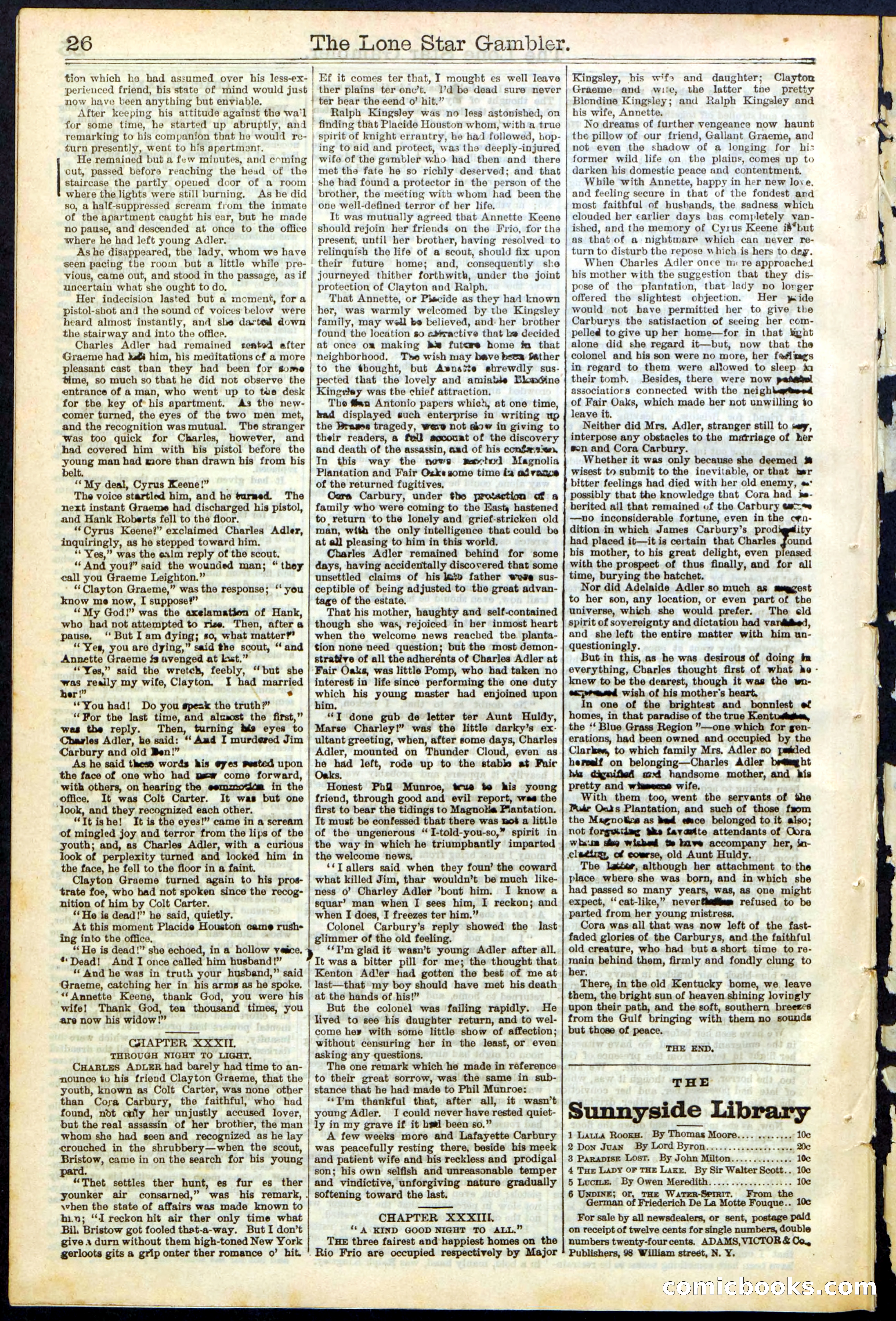
A restored page from Pulp Fiction, 1882. Page through the whole issue in the reader above.
📄 Transcribed text from this page (OCR, searchable)
Machine-transcribed from the original scan — historical spelling and the odd misread are preserved.
| 26 ee tion which he had as:umed over his less-ex- perienced friend, his state of mind would just now have been anything but enviable. After keeping his attitude against the wa'l for some time, he started up abruptly, and remarking to bis companion that he would re- urn presently, went to his apartment. He remained bui a few minutes, and coming cut, passed before reaching the heud of the staircase the partly opened door of a room where the lights were still burning. As he did so, a half-suppressed scream from the inmate of the apartment caught his ear, but he made no pause, and descended at once to the office where he had left young Adler. As he disappeared, the lady, whom ws have seen pacing the room but a little while pre- vious, came out, and stood in the passage, as if uncertain what she ought to do, Her indecision Jasted but a moment, fora pistol-sbot and the sound of voices below were heard almost instantly, and she darted down the stairway and into the office. Charles Adler had remained sented after Graeme had ha him, his meditations cf a more pleasant cast than they had been for some time, so much so that he did not observe the entrance of a man, who went up to tke desk for the key of his apartment. As the new- comer turned, the eyes of the two men met, and the recognition was mutual. Tbe stranger Was too quick for Charles, however, and had covered him with his pistol before the young man had more than drawn bis from bis belt. ““My deal, Cyrus Keene!” The voice startled him, and he turmed. The next instant Graeme had discharged his pistol, and Hank Roberts fell to the floor. ‘Cyrus Keene?” exclaimed Charles Adler, inquiringly, as he stepped toward him. ‘* Yes,” was the eslm reply of the scout. ‘* And you?” said the wounded man; “ they call you Graeme Leighton.” ' “Clayton Graeme,” was the response; know me now, I suppose?” “My God!” was the axelamation of Hank, who had not attempted to rise. Then, aftera pause. ‘ But I am dying; so, what matter?’ “Yes, you are dying,” said the scout, “and Annette Graeme is avenged at kt.” “Yes,” said the wretch, feebly, “but she was really my wife, Clayton, I had et her!” ‘“You had! Do you speak the truth?” ‘For the last time, and alzsost the first,” wes the reply. Then, turning tis eyes to Charles Adler, he said: “Aud I murdered Jim Carbury and old Ben!” As he said thess words his eyes rested upon the face of one who had mew come forward, with others, on hearing the eemmodém in the office, It was Colt Carter. It was but one “you look, and they recognized each other. “TItishe! It is the eyes!” came in a scream of mingled joy and terror from the lips of the youth; and, as Charles Adler, with a curious look of perplexity turned and looked him in the face, he fell to the floor in a faint. Clayton Graeme turned again to his pros- trate foe, who bad not spoken since the recog- nition of him by Colt Carter. ** He is dead!” he said, quietly. At this moment Placide Houston came rush- ing into the office. ‘*‘ He is dead!” she echoed, in a hollow veace, - **Dead! And I once called him husband!” “And he was in truth your husband,” said ‘Graeme, catching her in his arms as he spoke, “Annette Keene, thank God, you were his wife! Thank God, ten thousand times, you are now his widow!” CAIAPTER XXXII THROUGH NIGHT TO LIGAT, CHARLES ADLER had barely had time to an- nouncs to his friend Clayton Graeme, that the youth, known as Colt Carter, was none other than Cora Carbury, the faithful, who had found, ndt cally her unjustly accused lover, but the real assassin of her brother, the man whom she had seen and recognized as he lay crouched in the shrubbery—when the scout, Bristow, came in on the search for his young “Thet settles ther hunt, es fur es ther younker air consarned,” was his remark, when the state of affairs was made known to bin; ‘1 reckon hit air ther only time what Bil. Bristow got fooled that-a-way. But I don’t give 2 durn without them high-toned New York gerloots gits a grip onter ther romance o’ hit. Lhe Lone Star Gambier. Ef it comes ter that, I mought es well leave ther plains ter onc’t. Wd be dead sure never ter hear the eend 0’ hit.” Ralph Kingsley was no less astonished, on | finding that Placide Houston whom, with ‘a true | spirit of knight errantry, he had followed, hop- | ing to aid and protect, was the deeply-injured wife of the gambler who had then and there met the fate he so richly deserved; and that she had found a protector in the person of the brother, the meeting with whom had been the one well-defined terror of her life. It was mutually agreed that Annette Keene should rejoin her friends on the Frio, for the present, until her brother, having resolved to relinquish the life of a scout, should fix upon their future home; and, consequently she journeyed thither forthwith, under the joint protection of Clayton and Ralph. That Annette, or Phecide as they had known her, was warmly welcomed by the Kingsley family, may weal be believed, and: her brother found the location so atrractive that Le decided at once om making bw futare home im that neighborhood. Tse wish may beve bere father to the thought, but Asnsette shrewdly sus- pected that the lovely and amiabse Bicadine Kingrley was the chief attraction. The #an Antonio papers which, at one time, kad displayed such enterprise in writing up the Brasss tragedy, were not aow in giving to their readers, a fell accouat of the discovery and death of the assassin, aud of his confas%e, In this way the nows mearctux] Magnolia Plantation and Fair Ozkesome time ia advance of the returned fugitives. Cera Carbury, under the protaction af a family who were coming to the Easts hastened to return to the lonely and grief-stricken old man, with the only intelligence that could be at all pleasing to him in this world. Charles Adler remained behind for some days, having accidentally discovered that some unsettled claims of his lew father wove sus- ceptible of being adjusted to the great advan- tage of the estate. That his mother, haughty and self-contained though she was, rejoiced in her inmost heart when the welcome news reached the planta- tion none need question; but the most demon- strative of all the adherents of Charles Adler at Fair Oaks, was little Pomp, who had taken no interest in life since performing the one duty which his young master had enjoined upon him. “IT done gub de letter ter Aunt Huldy, Marse Charley!” was the little darky’s ex- ultant greeting, when, after some days, Charles Adler, mounted on Thunder Cloud, even as he had left, rode up to the stab at Puic Oaks. Honest Pb Munroe, tewe te his young friend, through good and evil report, wae the first to bear the tidings to Magnolia Piantation. It must be confessed that there was mos a little of the ungenerous “ I-told-you-so,” spirit in the way in which he triumphantly imparted the welcome news, ‘*T allers said when they foun’ the coward what killed Jim, thar wouldn’t be much like- ness 0’ Charley Adler ’bout him. I know a squar’ man when I sees him, I reckon; and when I does, I freezes ter him.” Colonel Carbury’s reply showed the last glimmer of the old feeling. ‘*T’m glad it wasn’t young Adler after all. It was a bitter pill for me; the thought that Kenton Adler had gotten the best of me at last—that my boy should have met his death at the hands of his!” But the colonel was failing rapidly. He lived to see his daughter return, and to wel- come hey with some little show of affection; without censuring her in the least, or even asking any questions. The one remark which he made in reference to their great sorrow, was the same in sub- stance that he had made to Phil Munroe: ‘‘I’m thankful that, after all, it wasn’t young Adler. I could never have rested quiet- ly in my grave if it bmi been so.” A few weeks more and Lafayette Carbury was peacefully resting there, beside his meek and patient wife and his reckless and prodigal son; his own selfish and unreasonable temper and vindictive, unforgiving nature gradually softening toward the last. CHAPTER XXXIII ‘© 4 KIND GOOD NIGHT TO ALL.” THE three fairest and happiest homes on the _Rio Frio are occupied respectively by Major RR sa ie Kingsley, bis wifs and daughter; Clayton Graeme and, wiie, the latter tne pretiy Blondine Kingsley; and Ralph Kingsley and his wife, Annette. No dreams of further vengeance now haunt the pillow of our friend, Gallant Graeme, and not even the shadow of a longing for hi- former wild life on the plains, comes up to darken bis domestic peace and contentment, While with Annette, bappy in her new love. and feeling secure in that of the fondest and most faithful of husbands, the sadness which clouded ber earlier days bas completely van- ished, and the memory of Cyrus Keene is*but as that of a nightmare which can never re- turn to disturb the repose which is hers to day. When Charles Adler once ni re approached his mother with the suggestion that they dis- pose of the plantation, that lady no lorger offered the slightest objection. Her yeide would not bave permitted her to give the Carburys the satisfaction of seeing her com- pelled to give up her home—for in that keht alone did she regard it—but, now that the colonel and his son were no more, ber fo#l tags in regard to them were allowed to sleep ia their tomb. Besides, there were now petwiel associatiors connected with the neighberteed of Fair Oaks, which made ber not unwilling to leave it. Neither did Mrs, Adler, stranger still to may, interpose any obstacles to the matriage of her gon and Cora Carbury. Whether it was only because she deemed & wisest to submit to the inevitable, or that ter bitter feelings had died with her old enemy, » possibly that the knowledge that Cora had ie- herited ail that remained of the Carbury es —no inconsiderable fortune, even in the crn- dition in which James Carbury’s prodigedity had placed it—it is certain that Charles Jound his mother, to his great delight, even pleased with the prospect of thus finally, and for all time, burying the hatchet. Nor did Adelaide Adler so much as suggest to her son, any location, or even part of the universe, which she would prefer. The eld spirit of sovereignty and dictation had vandied, and she left the entire matter with him un- questioningly. But in this, as he was desirous of doing im everything, Charles thought first of what he- knew to be the dearest, though it was the wn- eajprawed wish of his mother's heart, In one of the brightest and bonniest ef homes, in that paradise of the true Kentudhgha, the ‘‘ Blue Grass Region ”"—one which for gen- erations, had been owned and occupied by the Clarkes, to which family Mrs. Adler so pakded hervalf on belonging—Charles Adler beéight bis azx4 handsome mother, and his pretty and wimeeene wife. With them too, went the servants of the Pudr Ont s Plantation, and such of those fsom the Magnotca as bed emce belonged to it also; not forgwitiag the favantte attendants of Cora whem sieg wished te have accompany her, in- cladisgy, of cowrse, old Aunt Huldy. The latter, although her attachment to the place. where ‘she was born, and in which she had passed so many years, was, as one might expect, ‘‘cat-like,” never@haiiam refused to be parted from her young mistress. Cora was all that was now left of the fast- faded glories of the Carburys, and the faithful old creature, who had but ashort time to re- main behind them, firmly and fondly clung to her. There, in the old Kentucky bome, we leave them, the bright sun of heaven shining lovingly upon their path, and the soft, southern breezes from the Gulf bringing with them no sounds but those of peace. THE 1 Latta Rooxs. By Thomas MOO@O. 6s caves “0s 2 Don Juan By Lord Byron............0+.- «e+. | 3 Parapise Lost. By John Milton.............. 10c 4 Tue Lapy OF THE Lake. By Sir Walter Scott.. 10c 5 Lucmse. By Owen Meredith...............-... 10¢ 6 UNDINE; Om, THE WaTeR-Serit. From the German of Friederich De La Motte Fouque.. 10c For sale by all newsdealers, or sent, postage paid on receipt of twelve cents for single numbers, double numbers twenty-four cents. ADAMS, VICTOR & oes: Publishers, 98 William streét, N. Y. Gomiicbdooks