
Pulp Fiction, 1882 · page 24 of 28
Beadle's New York Dime Library, No. 195 — page 24: what you’re looking at
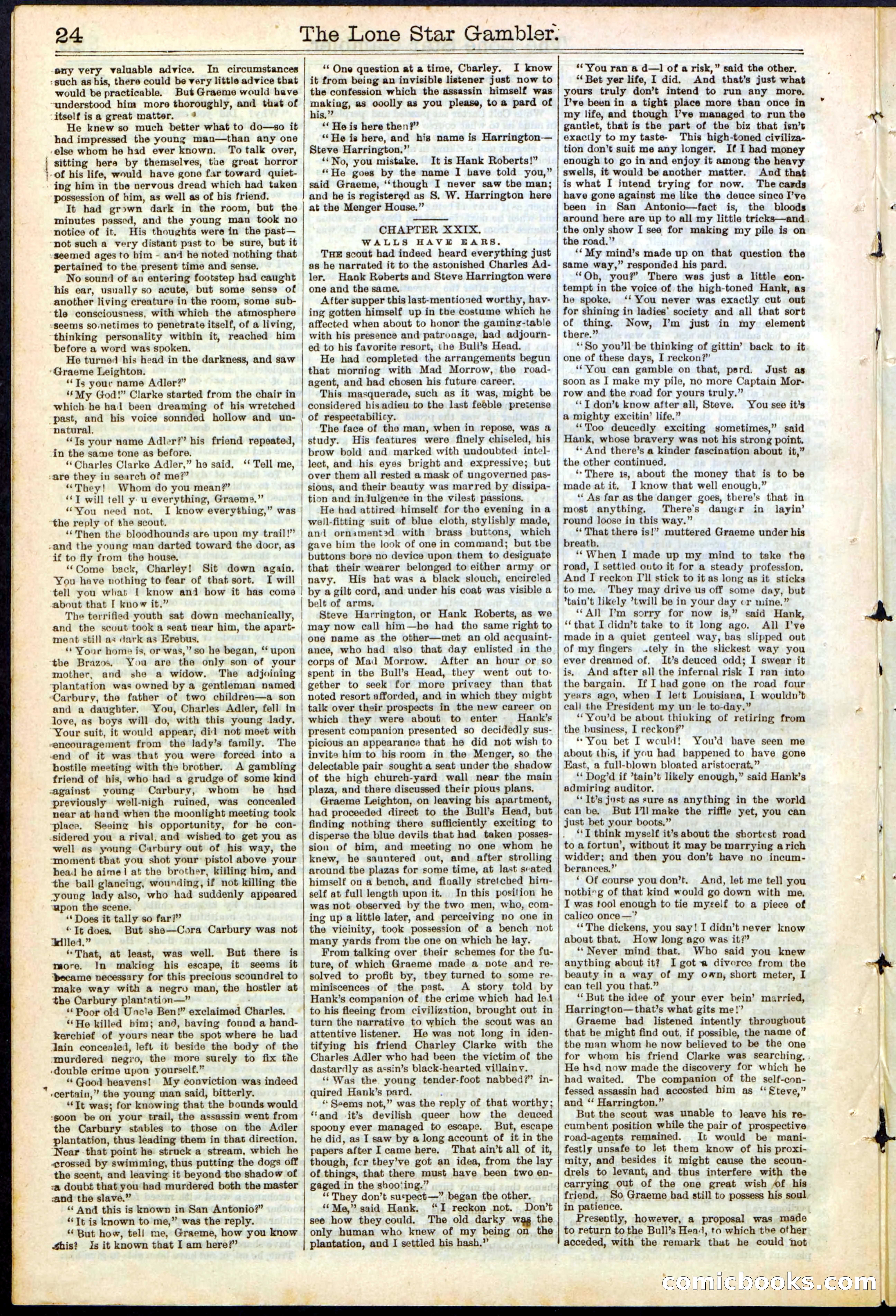
A restored page from Pulp Fiction, 1882. Page through the whole issue in the reader above.
📄 Transcribed text from this page (OCR, searchable)
Machine-transcribed from the original scan — historical spelling and the odd misread are preserved.
24 etry very valuable advice. In circumstances :such as bis, there could be very little advice that would be practicable. But Graeme would bave ~understood him more thoroughly, and that of ‘itself isa great matter. °° He knew so much better what to do—so it had impressed the young man—than any one ‘else whom he had ever known. To talk over, sitting here by themselves, the great horror | of his life, would have gone far toward quiet- ing him in the nervous dread which had taken possession of him, as well as of bis friend. It had grown dark in the room, but the minutes passed, and the young man took no notice of it. His thoughts were in the past— ‘not such a very distant past to be sure, but it -seemed ages to him - and he noted nothing that pertained to the present time and sense. No sound of an entering footstep had caught his ear, usually so acute, but some senses of another living creature in the room, some sub- ‘tle consciousness, with which the atmosphere -seems sometimes to penetrate itself, of a living, ‘thinking personality witbin it, reached him before a word was spoken. | He turned his head in the darkness, and saw | ‘Graeme Leighton. | ‘‘Ts your name Adler?” ‘‘My God!” Clarke started from the chair in which he hai been dreaming of his wretched past, and his voice sonnded hollow and un- natural. ‘Ts your name Adler?” his friend repeated, in the same tone as before. ‘‘Charles Clarke Adler,” he said, -are they in search of me?” “They! Whom do you mean?” ! ‘‘T will tell y u everything, Graeme.” “You need not. I know everything,” was \. “the reply of the scout. ‘‘Then the bloodhounds are upon my trail!’ ** Tell me, if to fly from the house, ‘Come back, Charley! You have nothing to fear of that sort. Sit down again. The Lone Star Gambler: i SE a ‘‘ One question at a time, Charley. I know it from being an invisible listener just now to the confession which the assassin himself was making, as coolly as you please, toa pard of his,” ‘‘ He is here then?” ‘He is here, and his name is Harrington— Steve Harrington.”’ ‘‘No, you mistake. It is Hank Roberts!” “He goes by the name I bave told you,” said Graeme, ‘‘though I never saw the man; and he is registered as 8S. W. Harrington here at the Menger House.” CHAPTER XXIX. WALLS HAVE EARS. Tue scout bad indeed heard everything just as he narrated it to the astonished Charles Ad- ler. Hank Roberts and Steve Harrington were one and the same. After supper this last-mentioxed worthy, hav- ing gotten himself up in the costume which he affected when about to honor the gaming-table with his presence and patronage, had adjourn- ed to his favorite resort, the Bull’s Head. He had completed the arrangements begun that morniog with Mad Morrow, the road- agent, and had chosen his future career. This masquerade, such as it was, might be considered his adieu to the last feéble pretense of respectability. The face of the man, when in repose, was a study. His features were finely chiseled, his brow bold and marked with undoubted intel- lect, and his eyes bright and expressive; but over them all rested a mask of ungoverned pas- sions, and their beauty was marred by dissipa- tion and indulgence in the vilest passions. He bad attired himself for the evening ina well-fitting suit of blue cloth, stylishly made, ani ornament3d with brass buttons, which -and the young man darted toward the door, as | gave him the look of one in command; but the buttons bore no device upon them to desiguate that their wearer belonged to either army or I will | navy. His bat was a black slouch, encircled ‘a tell you what [| know and bow it has come | by a gilt cord, and under his coat was visible a about that [I know it.” The terrified youth sat down mechanically, and the scout took a seat near him, the apart- i ment still as dark as Erebus. ‘* Your home is, or was,” so he began, ‘* upon the Brazos. You are the only son of your mother, and she a widow. The adjoining | plantation was owned by a gentleman named “Carbury, the father of two children—a son | and a daughter. You, Charles Adler, fell in love, as boys will do, with this young Jady. “Your suit, it would appear, did not meet with | encouragement from the lady’s family. The end of it was that you were forced into a hostile meeting with the brother. A gambling friend of bis, who had a grudge of some kind against young Carbury, whom he _ had previously well-nigh ruined, was concealed | near at hand when the moonlight meeting took i. ‘place. Sesing his opportunity, for he con- | sidered you a rival, and wished to get you as well as young Carbury out of his way, the ‘moment that you shot your pistol above your bead he aime! at the brother, killing him, and the ball glancing, wounding, if not killing the ‘young lady also, who had suddenly appeared ‘upon the scene. ‘Does it tally so far?’ “Tt does. But she—Cora Carbury was not killed.” “That, at least, was well. But there is more. In makiog his escape, it seems it ‘ecame necessary for this precious scoundrel to make way with a negro man, the hostler at the Carbury plantation—” wk ‘Poor old Uncle Ben!” exclaimed Charles. ‘He killed bim; and, baving found a hand- kerchief of yours near the spot where he had Jain concealed, left it beside the body of the ‘murdered negro, the more surely to fix the ‘double crime upon yourself.” | , “Good beavens! My conviction was indeed certain,” the young man said, bitterly. “Tt was; for knowing that the bounds would ‘soon be on your trail, the assassin went from the Carbury stables to those on the Adler plantation, thus leading them in that direction. ‘Near that point he struck a stream, which he crossed by swimming, thus putting the dogs off the scent, and leaving it beyond tho shadow of -a doubt that you had murdered both the master and the slave.” } “ And this is known in San Antonio?” | ‘‘Tt is known to me,” was the reply. “ But how, tell me, Graeme, how you know #his? Is it known that I am here?” — —EEE belt of arms. Steve Harrington, or Hank Roberts, as we may now call him—he had tho same right to ove name as the other—met an old acquaint- ance, who had also that day enlisted in the corps of Mad Morrow. After an hour or so spent in the Bull’s Head, they went out to- gether to seek for more privacy than that noted resort afforded, and in which they might talk over their prospects in the new career on which they were about to enter Hank’s present companion presented so decidedly sus- picious an appearance that he did not wish to invite him to his room in the Menger, so the delectable pair sought a seat under the shadow of the high church-yard wall near the main plaza, and there discussed their pious plans. Graeme Leighton, on leaving bis apartment, had proceeded direct to the Bull’s Head, but finding nothing there sufficiently exciting to disperse the blue devils that had taken posses- sion of him, and meeting no one whom he knew, he sauntered out, and after strolling around the plazas for some time, at last seated bimself on a bench, and fisally stretched him- self at full length upon it. In this position he was not observed by the two men, who, com- ing up a little later, and perceiving no one in the vicinity, took possession of a bench not many yards from the one on which he lay. From talking over their schemes for the fu- ture, of which Graeme made a note and re- solved to profit by, they turned to some re- miniscences of the past. A story told by Hank’s companion of the crime which had lei to his fleeing from civilization, brought out in turn the narrative to which the scout was an attentive listener. He was not long in iden- tifying his friend Charley Clarke with the Charles Adler who had been the victim of the dastardly as assin’s black-hearted villainy. ‘‘ Was the young tender-foot nabbed?’ in- quired Hank’s pard. ** Seems not,” was the reply of that worthy; ‘‘and it’s devilish queer how the deuced spoony ever managed to escape. But, escape he did, as I saw by a long account of it in the papers after [came here. That ain’t all of it, though, fcr they’ve got an idea, from the lay of things, that there must have been two en- gaged in the shoo'ing.” ‘‘ They don’t suspect—” began the other. “Me,” said Hank. “I reckon not. Don’t see how they could. The old darky wag the only human who knew of my being on the plantation, and I settled his hash,” rr ee ‘*'You ran a d—1 of a risk,” said the other. ** Bet yer life, I did. And that’s just what yours truly don’t intend to run any more, I’ve been in a tight place more than once in my life, and though I’ve managed to run the gantiet, that is the part of the biz that isn’s exactly to my taste- This high-toned civiliza- tion don’t suit me any longer, If I had money enough to go in and enjoy it among the heavy swells, it would be another matter. And that is what I intend trying for now. The cards have gone against me like the deuce sinco I’ve been in San Antonio—fact is, the bloods around here are up to all my little tricks—and. the only show I see for making my pile is on the road.” ‘My mind’s made up on that question the same way,” responded his pard. “Ob, you?” There was just a little eon- tempt in the voice of the high-toned Hank, as he spoke, ‘‘ You never was exactly cut out for shining in ladies’ society and all that sort of thing. Now, I’m just in my element there.” ‘So you’ll be thinking of gittin’ back to it one of these days, I reckon?” ‘*You can gamble on that, pard. Just as soon as I make my pile, no more Captain Mor- row and the road for yours truly.” ‘‘T don’t know after all, Steve. a mighty excitin’ life.” “Too deucedly exciting sometimes,” said Hank, whose bravery was not his strong point. ‘** And there’s a kinder fascination about it,” the other continued, ‘There is, about the money that is to be made at it, I know that well enough,” ‘As far as the danger goes, there’s that in most anything. There's danger in layin’ round loose in this way.” ‘* That there is!” muttered Graeme under his breath, ‘‘When I made up my mind to take the road, I settled onto it for a steady profession, And I reckon Ill stick to it as long as it sticks tome. They may drive us off some day, but *tain’t likely ’twill be in your day cr mine.” ‘‘All I'm sorry for now is,” said Hank, ‘‘that I didn’t take to it long ago. All I've made in a quiet genteel way, bas slipped out of my fingers .ctely in the slickest way you ever dreamed of. It’s deuced odd; I swear it is. And after all the infernal risk I ran into the bargain. If I bad gone on the road four years ago, when I lett Louisiana, I wouldn’t call the President my un le to-day.” *You’d be about thinking of retiring from the business, I reckon?’ * You bet I weuld! You’d have seen me about this, if you had bappened to have gone East, a full-blown bloated aristocrat,” ‘* Dog’d if ’tain’t likely enough,” said Hank’s admiring auditor. ** It’s just as sure as anything in the world can be, But I'll make the riffle yet, you can just bet your boots,” ‘*T think myself it’s about the shortest road to a fortun’, without it may be marrying arich widder; and then you don’t have no incum- berances.” ‘ Of course youdon’t. And, let me tell you notbing of that kind would go down with me. I was tool enough to tie myself to a piece of calico once —’ ‘“The dickens, you say! I didn’t never know about that. How long ago was it?” ‘‘ Never mind that. Who said you knew anything about it? I got a divorce from the beauty in a way of my own, short meter, I cap tell you that.” ‘But the idee of your ever bein’ married, Harrington—that’s what gits me!” Graeme had listened intently throughout that he might find out, if possible, the name of the man whom he now believed to be the one for whom his friend Clarke was searching, . He hed now made the discovery for which he had waited. The companion of the self-con- fessed assassin had accosted him as ‘“‘€teve,” and ‘‘ Harrington.” But the scout was unable to leave his re- cumbent position while the pair of prospective road-agents remained. It would be mani- festly unsafe to let them know of his proxi- mity, and besides it might cause the scoun- drels to levant, and thus interfere with the carrying out of the one great wish ~f his friend. So Graeme had still to possess his soul in patience. Presently, however, a proposal was made to return tothe Bull’s Head, to which the other acceded, with the remark thut he could not You see it's Eomilecbooks (C CC)