
Pulp Fiction, 1882 · page 23 of 28
Beadle's New York Dime Library, No. 195 — page 23: what you’re looking at
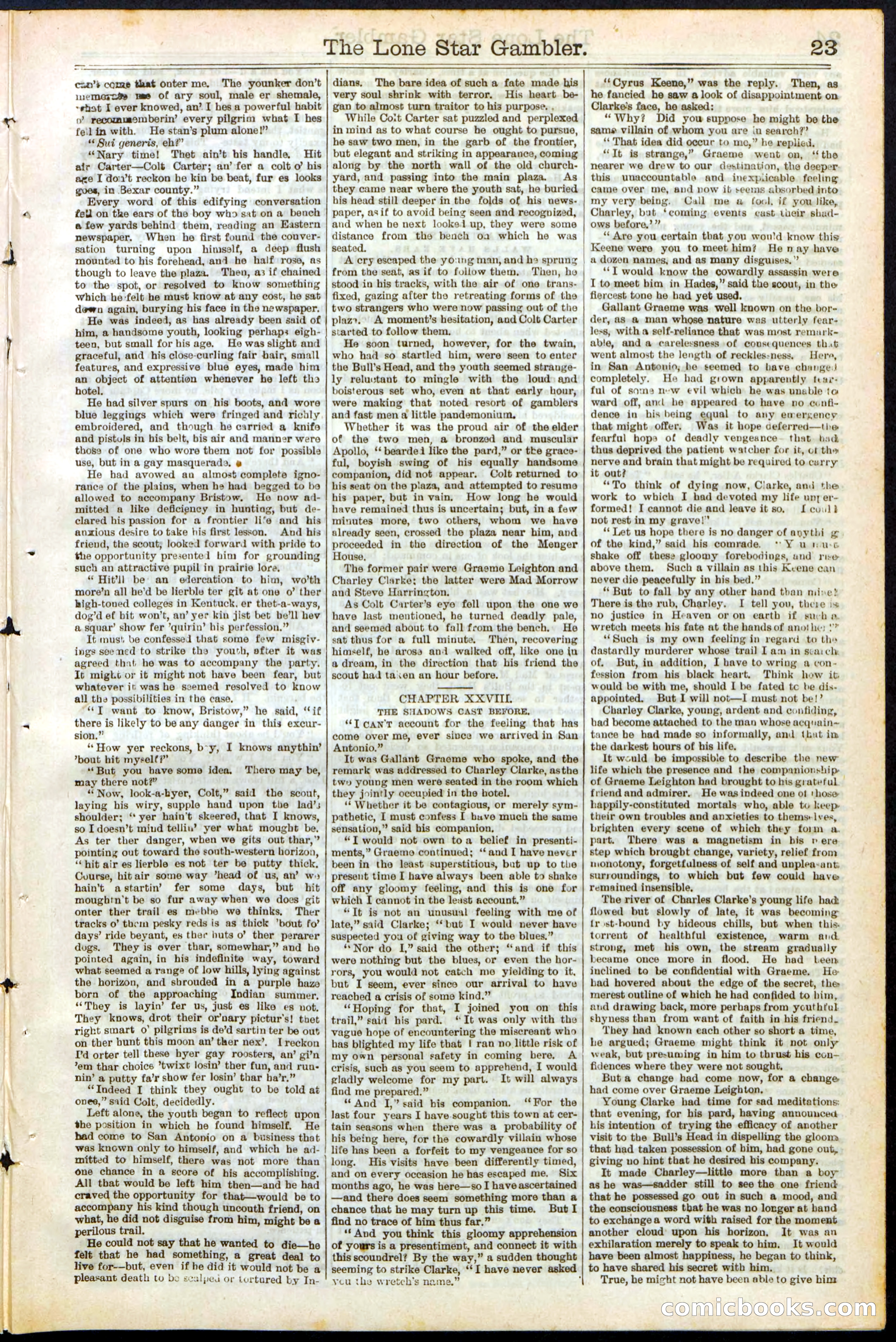
A restored page from Pulp Fiction, 1882. Page through the whole issue in the reader above.
📄 Transcribed text from this page (OCR, searchable)
Machine-transcribed from the original scan — historical spelling and the odd misread are preserved.
\ The Lone Star Gambler. 23 _ - a can’s come that onter me. The younker don’t inemosat mee of ary soul, male er shemale, ~shat I ever knowed, an’ I hes a powerful habit © recomueemberin’ every pilgrim what I hes dians, The bare idea of such a fate made his very soul shrink with terror. His heart be- gan to almost turn traitor to his purpose. . While Coit Carter sat puzzled and perplexed ‘‘Cyrus Keene,” was the reply. Then, as he fancied he saw a look of disappointment on Clarke's face, he asked: “Why? Did yow suppose he might be the feil in with. He stan’s plum alone!” in mind as to what course he ought to pursue, | same villain of whom you are in search?’ ¢ “ Sui generis, eh?” he saw two men, in the garb of the frontier, ‘* That idea did occur to mo,” he replied, ‘““Nary time! Thet ain’t his handle. Hit | but elegant and striking in appearance, coming “It is strange,” Graeme went on, ‘tho air Carter—Colt Carter; an’ fer a colt o’ his | along by the north wall of the old church- | nearer we drew to our destination, the deeper age I don’t reckon he kin be beat, fur es looks | yard, and passing into the main plaza. As | this unaccountable and inexpiicable feeling goes, in Bexar county.” they came near where the youth sat, he buried | came over me, and now ib seems absorbed into Every word of this edifying conversation | his head still deeper in the folds of his news- | my very being. Call me a fool, if you like, | “ fe on the ears of the boy who sat on a bench | paper, asif to avoid being seen and recognized, | Charley, but ‘coming events cast .ueir shad- | e few yards behind them, reading an Eastern newspaper. When he first found the conver- sation turning upon himself, a deep flush mounted to his forehead, and he half rose, as though to leave the plaza. Then, a3 if chained to the spot, or resolved to know something which he-felt he must know at any cost, he sat dewn again, burying his face in the newspaper. He was indeed, as has already been said of him, a handsome youth, looking perhaps eigh- teen, but small for his age. He was slight and graceful, and his close-curling fair bair, small features, and expressive blue eyes, made him an object of attention whenever he left tho hotel. He had silver spurs on his boots, and wore blue leggings which were fringed and richly embroidered, and though he carried a knife and pistuls in bis belt, bis air and manner were those of one who wore them not for possible use, buf in a gay masquerads, @ He bad avowed an almost complete igno- rance of the plains, when he had begged to be allowed to accompany Bristow. He now ad- mitted a like deficiency in huntiag, but de- clared his passion for a frontier li‘e and his anxious desire to take his first lesson. And his friend, the scout; looked forward with pride to the opportunity presented him for grounding such an attractive pupil in prairie lore, “ Hitll be an edercation to him, wo’th more’n all be’d be lierble ter git at one o’ ther high-toned colleges in Kentuck. er thet-a-ways, dog’d ef bit won't, an’ yer kin jist bet be’ll hev a squar’ show fer ’quirin’ his perfession,” It must be confessed that some few misgiv- ings seemed to strike the youth, efter it was agreed that he was to accompany the party. It might or it might not bave been fear, but whatever it was he scemed resolved to know all the possibilities in the case, *‘T want to know, Bristow,” he said, “if there is likely to be any danger in this excur- sion.” “How yer reckons, b-y, I knows anythin’ ’bout hit myself?” ‘But you have some idea, There may be, may there not?” “Now, look-a-byer, Colt,” said the scout, laying his wiry, supple hand upon the lad’; shoulder; “ yer hain’t skeered, that I knows, so I doesn’t miud tellin’? yer what mought be, As ter ther danger, when we gits out thar,” pointing out toward the south-western horizon, ‘Chit air es lierble es not ter be putty thick, Course, hitair some way "head of us, an’ wy hain’t astartin’ fer some days, but hit moughtn't be so fur away when we does git onter ther trail es mebbe we thinks, Ther tracks o’ them pesky reds is as thick ‘bout fo’ days’ ride beyant, es ther huts o’ ther perarer dugs. They is ever thar, somewhar,” and he pointed again, in his indefinite way, toward what seemed a range of low hills, lying against the horizon, and sbrouded in a purple haze born of the approaching Indian summer, ‘“‘They is layin’ fer us, just es like es not, They knows, drot their or’pary pictur's! thet right smart o’ pilgrims is de’d sartin ter be out on ther bunt this moon an’ ther nex’. [reckon I'd orter tell these byer gay roosters, an’ gi’n ’em thar choice ’twixt losin’ ther fun, and run- nin’ a putty fa’r show fer losin’ thar ha’r,” “Indeed I think they ought to be told at ones,” said Colt, decidedly. Left alone, the youth began to reflect upon the position in which he found himself. He had come to San Antonio on a business that was known only to himself, and which he ad- mitted to himself, there was not more than one chance in a score of his accomplishing. All that would be left him then—and he had craved the opportunity for that—would be to accompany his kind though uncouth friend, on what, he did not disguise from him, might be a perilous trail. He could not say that he wanted to die—hoe felt that he had something, a great deal to live for-—but, even if he did it would not be a pleasant death to bo scalped or tortured by In- and when be next looked up, they were some distance from the bench oa which he was seated. A cry escaped the yong man, and he sprung from the seat, as if to follow them, Then, hoe stood in his tracks, with the air of one trans- fixed, gazing after the retreating forms of the two strangers who were now passing out of the plaz?. A moment’s hesitation, and Colt Carter started to follow them. He soon turned, however, for the twain, who had so startled him, were seen to enter the Bull’s Head, and the youth seemed strange- ly reluctant to mingle with the loud and boisterous set who, even at that early hour, were making that noted resort of gamblers and fast men a little pandemonium, Whether it was the proud air of the elder of the two men, a bronzed and muscular Apollo, ‘* beardei like the pard,” or the grace- ful, boyish swing of his equally handsome companion, did not appear. Colt returned to his seat on the plaza, and attempted to resume his paper, but in vain. How long he would have remained thus is uncertain; but, in a few minutes more, two others, whom we have already seen, crossed the plaza near him, and proceeded in the direction of the Menger House, The former pair were Graeme Leighton and Charley Clarke; the latter were Mad Morrow and Steve Harrington. As Colt Carter’s eye fell upon the one we have last mentioned, he turned deadly pale, and seemed about to fall from the bench. He sat thus for a full minute. Then, recovering himself, he arosa and walked off, like one ju a dream, in the direction that his friend the scout had ta:en an hour before. CHAPTER XXVIIL THE SHADOWS CAST BEFORE, ‘T can't account for the feeling that has come over me, ever sivce we arrived in San Antonio.” It was Gallant Graeme who spoke, and the remark was addressed to Charley Clarke, asthe tw» young men were seated in the room which they jointly oecupied in the botel. ‘* Whether it be contagious, or merely sym- pathetic, I must confess [ buve much the same sensatiou,” said bis companion, “T would not own toa belief in presenti- ments,” Graemo continued; ‘‘and I have never been in the least superstitious, but up to the present time I have always been able to shake off any gloomy feeling, and this is one for which [ cannot in the least account.” “Tt is not an unusual feeling with me of late,” said Clarke; ‘‘but I would never have suspected you of giving way to the blues.” ‘**Nor do I,” said the other; ‘and if this were nothing but the blues, or even the hor- rors, you would not catch me yielding to it, but I seem, ever since our arrival to have reached a crisis of some kind.” “Hoping for that, I joined you on this trail,” said his pard. “It was only with the vague hope of encountering the miscreant who bas blighted my life that | ran no little risk of my own personal safety in coming bere, A crisis, such as you seem to apprehend, I would gladly welcome for my part. It will always find me prepared.” “And I,” said his companion. “For the last four years I have. sought this town at cer- tain seasons when there was a probability of his being here, for the cowardly villain whose life has been a forfeit to my vengeance for so long. His visits have been differently timed, and on every occasion he has escaped me, Six months ago, he was here—so I have ascertained —and there does seem something more than a chance that he may turn up this time. ButI find no trace of him thus far.” ‘And you think this gloomy apprehension of yours is a presentiment, and connect it with this scoundrel? By the way,” a sudden thought seeming to strike Clarke, ‘I have never asked ycu the wretch’s name,” ows before,’ ” “Are you certain that you would know this Keene were you to meet him? He nay have a dozen names, and as many disguises.” ‘*T would know the cowardly assassin were I to meet bim in Hades,” said the scout, in the fiercest tone he bad yet used. Gallant Graeme was well known on the bor- der, as @ man whose nature was utterly fear- less, with a self-reliance that was most remark- able, and a carelessness of consequences that went almost the length of reckles-ness, | Here, in San Antonio; be seemed to bave change! completely. He had grown apparently tear- ful of some new evil which he was unable ta ward off, ancl be appeared to have no confi- dence in his being equal to any emergency that might offer. Was it hope ceferred—the fearful hope of deadly vengeance- that. bad thas deprived the patient watcher for it, of the nerve and brain that might be required to curry it out? “To think of dying now, Clarke, and the work to which I had devoted my life unr er- formed! I cannot die and leave it so, [cult not rest in my grave!" ‘“* Let us hope there is no danger of anythi ¢ of the kind,” said his comrade. * Y u tiouse shake off these gloomy forebodings, und rve above them. Such a villain as this Keene can never die peacefully in his bed.” * But to fall by any other hand than mine? There is the rub, Charley. I tell you, there is no justice in Heaven oron earth if such a wretch meets his fate at the hands of anothe: !* “Such is my own feeling in regard to the dastardly murderer whose trail I am in scaicly of. But, in addition, I have to wring a con- fession from his black heart, Think how it would be with me, should I be fated te be dis- appointed. But I will not—I must not be!’ Charley Clarke, young, ardent and confiding, had become attached to the man whose acquain~ tance be had made so informally, and (but im the darkest hours of bis life. It would be impossible to describe the new life which the presence and the companionship. of Graeme Leighton had brought to his grateful friend and admirer. He was indeed one ot 'hose happily-constituted mortals who, able to keep their own troubles and anxieties to thems+|ves, brighten every scene of which they form a. part. There was a magnetism in bis vr ere step which brougbt change, variety, relief from monotony, forgetfulness of self and unpleasant, surroundings, to which but few could have remained insensible, The river of Charles Clarke's young life had flowed but slowly of late, it was becoming tr st-bound by hideous chills, but when this. torrent of healthful existence, warm and strong, met his own, the stream gradually became once more in flood. He had lLeen inclined to be confidential with Graeme. He had hovered about the edge of the secret, the merest outline of which he had confided to him, and drawing back, more perbaps from youthful shyness then from want of faith in his friend. They had known each other so short a time, he argued; Graeme might think it not only weak, but presuming in him to thrust his con— fidences where they were not sought, But a change bad come now, for a change had come over Graeme Leighton, Young Clarke had time for sad meditations: that evening, for his pard, having announced his intention of trying the efficacy of another visit to the Bull’s Head in dispelling the gloom that had taken possession of him, had gone out, giving uo hint that he desired his company. It made Charley—little more than a boy as he was—sadder still to see the one friend that he possessed go out in such a mood, and the consciousness that he was no longer at band to exchange a word with raised for the moment another cloud upon his horizon, It was an exhilaration merely to speak to him, It would have been almost happiness, he began to think, to have shared his secret with him. True, he micht not have been able to give him SS) CORMIE OOO