
Pulp Fiction, 1882 · page 22 of 28
Beadle's New York Dime Library, No. 195 — page 22: what you’re looking at
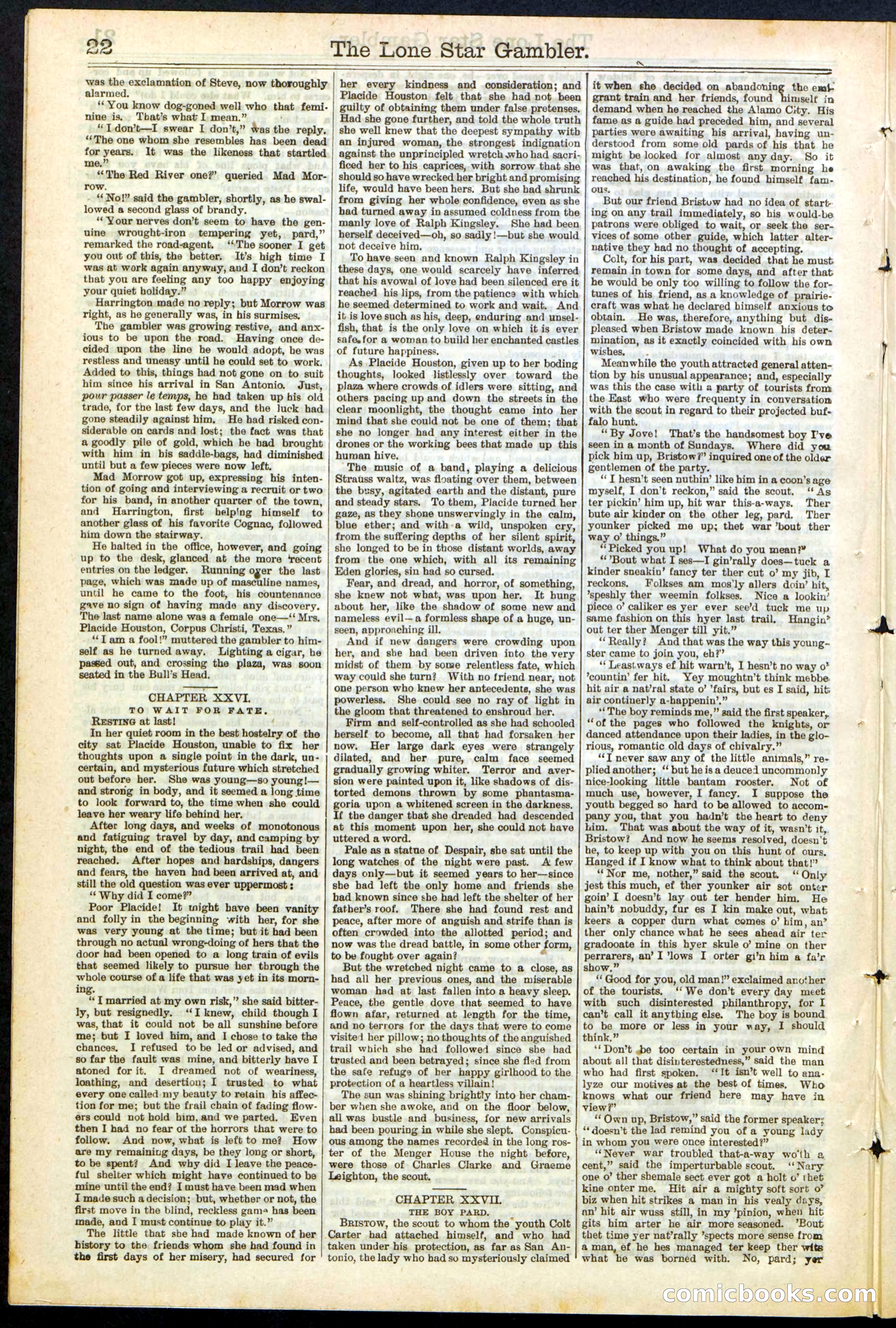
A restored page from Pulp Fiction, 1882. Page through the whole issue in the reader above.
📄 Transcribed text from this page (OCR, searchable)
Machine-transcribed from the original scan — historical spelling and the odd misread are preserved.
The Lone Star Gambler. was the exclamation of Steve, now thoroughly alarmed. ** You know dog-goned well who that femi- nine is. Tbat’s what I mean.” “I.don’t—I swear I don’t,” was the reply. “The one whom she resembles has been dead for years. It was the likeness that startled me,” “The Red River one?’ queried Mad Mor- row. “‘ No!” said the gambler, shortly, as he swal- lowed a second glass of brandy. “Your nerves don’t seem to have the gen- uine wrought-iron tempering yet, pard,” remarked the road-agent. ‘*The sooner I get you out of this, the better. It’s high time I was at work again anywuy, aud I don’t reckon that you are feeling any too happy enjoying your quiet holiday.” Harrington made no reply; but Morrow was right, as he generally was, in his surmises, The gambler was growing restive, and anx- ious to be upon the road. Having once de- | cided upon the line he would adopt, be was restless and uneasy until he could set to work. Added to this, things had not gone on to suit him since his arrival in San Antonio. Just, pour passer le temps, he had taken up his old trade, for the last few days, and the luck had gone steadily against him, He had risked con- siderable on cards and lost; the fact was that a goodly pile of gold, which be bad brought with him in bis saddle-bags, had diminished until but a few pieces were now left. Mad Morrow got up, expressing his inten- tion of going and interviewing a recruit or two for his band, in another quarter of the town, and Harrington, first belping himself to another glass of his favorite Cognac, followed him down the stairway. He halted in the office, however, and going up to the desk, glanced at the more ‘recent entries on the ledger. Running oger the last page, which was made up of masculine names, until he came to the foot, his countenance gave no sign of having made any discovery. The last name alone was a female one—*‘ Mrs, Placide Houston, Corpus Christi, Texas.” ““T am a fool!” muttered the gambler to him- self as he turned away, Lighting a cigar, he passed out, and crossing the plaza, was soon seated in the Bull’s Head. CHAPTER XXVI. TO WAIT FOR FATE. RESTING at last! In her quiet room in the best hostelry of the city sat Placide Houston, unable to fix her thoughts upon a single point in the dark, un- certain, and mysterious future which stretched out before her. She was young—so young!— and strong in body, and it seemed a long time to look forward to, the time when she could - leave her weary life behind her. After long days, and weeks of monotonous and fatiguing travel by day, and camping by night, the end of the tedious trail had been reached. After hopes and hardships, dangers and fears, the haven had been arrived at, and still the old question was ever uppermost ; “* Why did I come?” Poor Placide! It might bave been vanity and folly in the beginning with her, for she was very young at the time; but it had been through no actual wrong-doing of hers that the door had been opened to a long train of evils that seemed likely to pursue her through the whole course of a life that was yet in its morn- ing. “{ married at my own risk,” she said bitter- ly, but resignedly. ‘I knew, child though I was, that it could not be all sunshine before me; but I loved him, and I chose to take the chances. I refused to be led or advised, and so far the fault was mine, and bitterly have I atoned forit. I dreamed not of weariness, loathing, and desertion; I trusted to what every one called: my beauty to retain his affec- tion for me; but the frail chain of fading flow- érs could not hold bim, and we parted. Even then I had no fear of the horrors that were to follow. And now, what is left to me? How are my remainiug days, be they long or short, to be spent? And why did I leave the peace- ful shelter which might have continued to be mine until the end? I must have been mad when I made such a decision; but, whether or not, the first move in the blind, reckless gam* has been made, and I must continue to play it.” The little that she had made known of ber history to the friends whom she had found in the first days of her misery, had secured for her every kindness and consideration; and Placide Houston felt that she had not been guilty of obtaining them under false pretenses. Had she gone further, and told the whole truth she well knew that the deepest sympathy witb an injured woman, the strongest indignation against the unprincipled wretch who had sacri- ficed her to his caprices, with sorrow that she should so have wrecked her bright and promising life, would have been hers. But she bad shrunk from giving her whole confidence, even as she bad turned away in assumed coldness from tbe manly love of Ralph Kingsley. She had been herself deceived—oh, so sadly !—but she would not deceive him. To have seen and known Ralph Kingsley in these days, one would scarcely have inferred that his avowal of love had been silenced ere it reached his lips, from the patiencs with which he seemed determined to work and wait. And it is love such as his, deep, enduring and unsel- fish, that is the only love on which itis ever safe.for a woman to build her enchanted castles of future happiness. As Placide Houston, given up to her boding thoughts, looked listlessly over toward the plaza where crowds of idlers were sitting, and others pacing up and down the streets in the clear moonlight, the thought came into her mind that she could not be one of them; that she no longer had any interest either in the drones or the working bees that made up this human hive. The music of a band, playing a delicious Strauss waltz, was floating over them, between the busy, agitated earth and the distant, pure and steady stars. To them, Placide turned her gaze, as they shone unswervingly in the calm, blue ether; and witha wild, unspoken cry, from the suffering depths of her silent spirit, she longed to be in those distant worlds, away from the one which, with all its remaining Eden glories, sin had so cursed. Fear, and dread, and horror, of something, she knew not what, was upon her. It bung about her, like the shadow of some new and nameless evil—a formless shape of a huge, un- seen, approaching ill, And if new dangers were crowding upon her, and sbe had been driven into the very midst of them by some relentless fate, which way could she turn? With no friend near, not one person who knew her antecedents, she was powerless. She could see no ray of light in the gloom that threatened to enshroud her. Firm and self-controlled as she had schooled herself to become, all that had forsaken her now. Her large dark eyes were strangely dilated, and her pure, calm face seemed gradually growing whiter. Terror and aver- sion were painted upon it, like shadows of dis- torted demons thrown by some phantasma- goria upon a whitened screen in the darkness. If the danger that she dreaded had descended at this moment upon her, she could not have uttered a word. Pale as a statue of Despair, she sat until the long watches of the night were past. A few days only—but it seemed years to her—since she had left the only home and friends she bad known since she had left the shelter of her father’s roof. There she had found rest and peace, after more of anguish and strife than is often crowded into the allotted period; and now was the dread battle, in some other form, to be fought over again? But the wretched night came to a close, as had all her previous ones, and the miserable woman had at last fallen into a heavy sleep. Peace, the gentle dove that seemed to have flown afar, returned at length for the time, and no terrors for the days that were to come visite’ her pillow; no thoughts of the anguished trail which she had followed since she had trusted and been betrayed; since she fled from the safe refuge of ber happy girlhood to the protection of a heartless villain! The sun was shining brightly into her cham- ber when she awoke, and on the floor below, all was bustle and business, for new arrivals had been pouring in while she slept. Conspicu- ous among the names recorded in the long ros- ter of the Menger House the night before, were those of Charles Clarke and Graeme Leighton, the scout. CHAPTER XXVIL THE BOY PARD, ~~ Bristow, the scout to whom the youth Colt Carter had attached himself, and who had taken under his protection, as far as San An- tonio, the lady who bad so mysteriously claimed gee a, . same fashion on this hyer last trail, it when she decided on abandoning the emt- grant train and her friends, found himself in demand when he reached the Alamo City. His fame as a guide had preceded him, and several parties were awaiting his arrival, having un- derstood from some old pards of his that he might be looked for almost any day. So it was that, on awaking the first. morning he reached his destination, he found himself fam- ous. But our friend Bristuw had no idea of start- ing on any trail immediately, so his would-be patrons were obliged to wait, or seek the ser- vices of some other guide, which latter alter- native they had no thought of accepting. Colt, for his part, was decided that he must remain in town for some days, and after that he would be only too willing to follow the for- tunes of his friend, as a knowledge of prairie- craft was what he declared himself anxious to obtain. He was, therefore, anything but dis- pleased when Bristow made known his deter- mination, as it exactly coincided with his own wishes, ; Meanwhile the youth attracted general atten- tion by his unusual appearance; and, especially was this the case with a party of tourists from the East who were frequenty in conversation with the scout in regard to their projected buf- falo hunt. “By Jove! That’s the handsomest boy I’ve seen in a month of Sundays. Where did you pick him up, Bristow?” inquired one of the older gentlemen of the party. “‘ T hesn’t seen nuthin’ like him in a coon’s age myself, I don’t reckon,” said the scout. ‘As ter pickin’ him up, hit war this-a-ways. Ther bute air kinder on the other leg, pard. Ther younker picked me up; thet war ’bout ther way o’ things.” “Picked you up! What do you mean?” * Bout what I ses—I gin’rally does—tuck a kinder sneakin’ fancy ter ther cut o’ my jib, I reckons, Folkses am mos'ly allers doin’ hit, ’speshly ther weemin folkses. Nice a lookin’ piece o’ caliker es yer ever see’d tuck me up Hangin” out ter ther Menger till yit.” ‘Really? And that was the way this young- ster came to join you, ch?” ‘* Leastways ef hit warn’t, I hesn’t no way o’ ’countin’ fer hit. Yey moughtn’t think mebbe. hit air a nat’ral state o’ ’fairs, but es I said, hit air continerly a-happenin’,” ‘The boy reminds me,” aaid the first speaker, “of the pages who followed the knights, or danced attendance upon their ladies, in the glo- rious, romantic old days of chivalry.” ““T never saw any of the little animals,” re- plied another; ‘‘ but he isa deuced uncommonly nice-looking little bantam rooster. Not of much use, however, I fancy. I suppose the youth begged so hard to be allowed to accom- pany you, that you hadn’t the heart to deny him, That was about the way of it, wasn’t it, Bristow! And now he seems resolved, doesn’t he, to keep up with you on this hunt of ours, Hanged if I know what to think about that!” ‘Nor me, nother,” said the scout. ‘“ Only jest this much, ef ther younker air sot onter goin’ I doesn’t lay out ter hender him. He hain’t nobuddy, fur es I kin make out, what keers a copper durn what comes o’ him, an’ ther only chance what he sees ahead air ter gradooate in this hyer skule o’ mine on ther perrarers, an’ I ‘lows I orter gi’n him a fa’r show.” ** Good for you, old man!” exclaimed anvther of the tourists. ‘‘We don’t every day meet with such disinterested philanthropy, for I can’t call it anything else. The boy is bound to be more or less in your way, I should think.” ‘* Don’t «be too certain in yourown mind about all that disinterestedness,” said the man who had first spoken. ‘It isn’t well to ana- lyze our motives at the best of times. Who knows what our friend here may have in view?” “ Own up, Bristow,” said the former speaker; “doesn’t the lad remind you of a young lady in whom you were once interested?” “‘Never war troubled that-a-way wo'th a cent,” said the imperturbable scout. ‘‘Nary one o’ ther shemale sect ever got a holt o’ thet kine onter me, Hit air a mighty soft sort 0” biz when hit strikes a man in his vealy days, an’ hit air wuss still, in my ’pinion, when hit gits him arter he air more seasoned. ‘Bout thet time yer nat’rally ’spects more sense from aman, ef he hes managed ter keep ther wits what he was borned with. No, pard; yer ad Connicooolks (a{o)