
Pulp Fiction, 1882 · page 21 of 28
Beadle's New York Dime Library, No. 195 — page 21: what you’re looking at
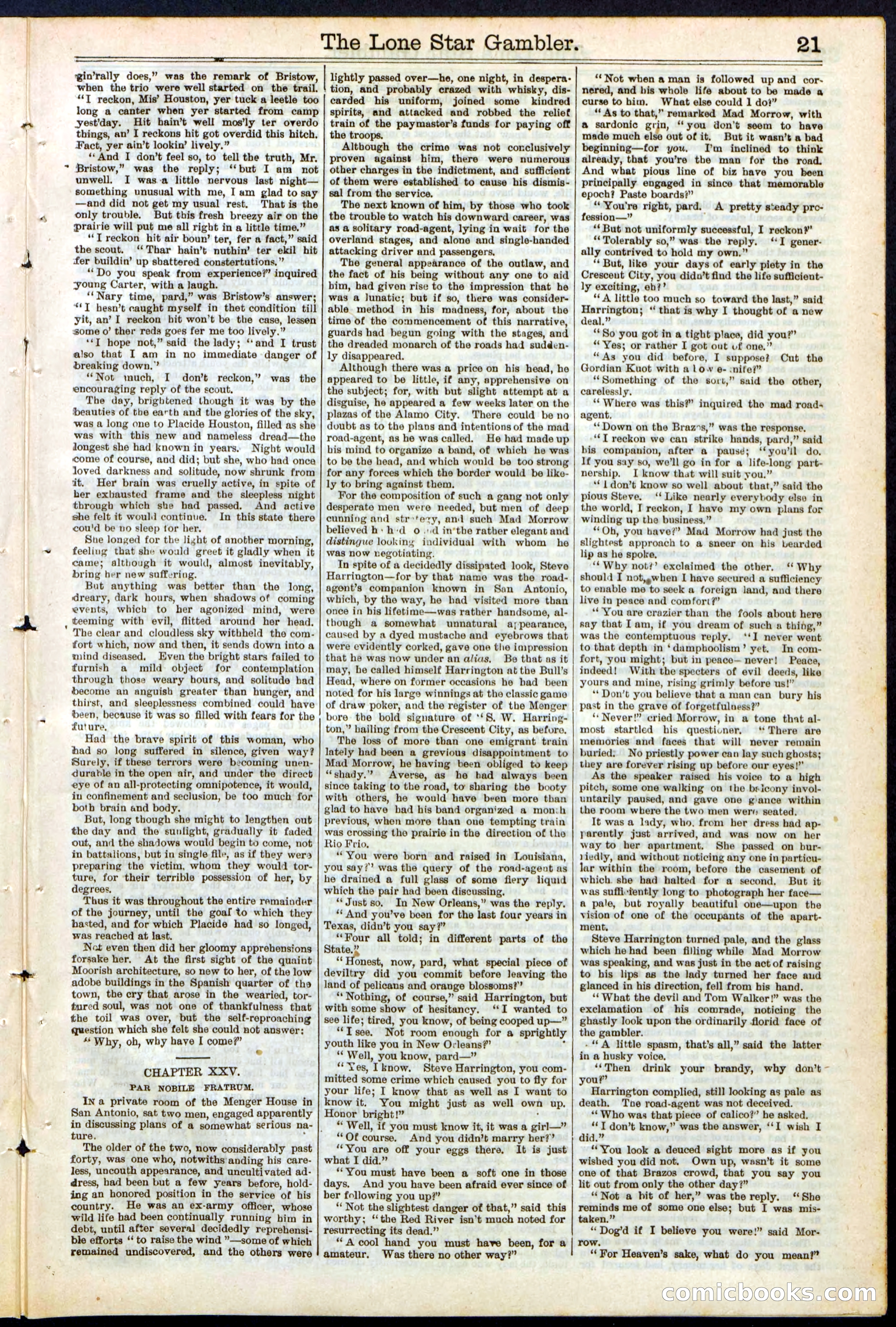
A restored page from Pulp Fiction, 1882. Page through the whole issue in the reader above.
📄 Transcribed text from this page (OCR, searchable)
Machine-transcribed from the original scan — historical spelling and the odd misread are preserved.
< ' 4 gin’rally does,” was the remark of Bristow, when the trio were well started on the trail. “‘T reckon, Mis’ Houston, yer tuck a leetle too long a canter when yer started from camp yestiday. Hit bhain’t well mos’ly ter overdo things, an’ I reckons hit got overdid this hitch, Fact, yer ain’t lookin’ lively.” ‘‘And I don’t feel so, to tell the truth, Mr. Bristow,” was the reply; “but I am not unwell. I was a little nervous last night— something unusual with me, I am glad to say —and did not get my usual rest. That is the only trouble. But this fresh breezy air on the prairie will put me all rigbt in a little time.” “T reckon hit air boun’ ter, fer a fact,” said the scout. “Thar hain’t nuthin’ ter ekil hit fer buildin’ up shattered constertutions, ” ‘*Do you speak from experience?” inquired young Carter, with a laugh. ‘‘Nary time, pard,” was Bristow’s answer; “*T hesn’t caught myself in thet condition till yit, an’ I reckon hit won't be the case, lessen some 0’ ther reds goes fer me too lively.” ‘*T hope not,” said the lady; ‘‘and I trust also that I am in no immediate danger of breaking down.” “Not much, I don’t reckon,” was the encouraging reply of the scout. The day, brightened though it was by the beauties of the earth and the glories of the sky, was a long one to Placide Houston, filled as she was with this new and nameless dread—the longest she had known in years. Night would come of course, and did; but she, who had once loved darkness and solitude, now shrunk from it. Her brain was cruelly active, in spite of her exhausted frame and the sleepless night through which she had passed. And active she felt it woul continue. In this state there cou'd be no sleep for her. She longed for the light of another morning, feeliug that she would greet it gladly when it came; although it would, almost inevitably, bring ber new suffering. But anything was better than the long, dreary, dark hours, when shadows of coming events, which to her agonized mind, were , teeming with evil, flitted around her head. The clear and cloudless sky withheld the com- fort which, now and then, it sends down into a mind diseased. Even the bright stars failed to furnish a mild object for contemplation through those weary hours, and solitude had become an anguish greater than hunger, and thirst, and sleeplessness combined could have been, because it was so filled with fears for the future, Had the brave spirit of this woman, who had so long suffered in silence, given way? Surely, if these terrors were becoming unen- durable in the open air, and under the direct eye of an all-protecting omnipotence, it would, in confinement and seclusion, be too much for botb brain and body. But, long though she might to lengthen out the day and the sunlight, gradually it faded out, and the shadows would begin to come, not in battalions, but in single file, as if they wers preparing the victim, whom they would tor- ture, for their terrible possession of her, by degrees, Thus it was throughout the entire remainder of the journey, until the goaf to which they hasted, and for which Placide had so longed, was reached at last. Net even then did her gloomy apprehensions forsake her. At the first sight of the quaint Moorish architecture, so new to her, of the low adobe buildings in the Spanish quarter of tho town, the cry that arose in the wearied, tor- tured soul, was not one of thankfulness that the toil was over, but the self-reproaching question which she felt she could not answer: “Why, oh, why have I come?” CHAPTER XXYV. PAR NOBILE FRATRUM. IN a private room of the Menger House in San Antonio, sat two men, engaged apparently in discussing plans of a somewhat serious na- |. ture. The older of the two, now considerably past forty, was one who, notwiths anding his care- less, uncouth appearance, and uncultivated ad- dress, had been but a few years before, hold- ing an honored position in the service of his country. He was an ex-army officer, whose wild life had been continually running him in debt, until after several decidedly reprehensi- ble efforts “‘ to raise the wind "—some of which remained undiscovered, and the others were lightly passed over—he, one night, in despera- tion, and probably crazed with whisky, dis- carded his uniform, joined some kindred spirits, and attacked and robbed the relief train of the paymaster’s funds for paying off the troops. Altbough the crime was not conclusively proven against him, there were numerous other charges in the indictment, and sufficient of them were established to cause his dismis- sal from the service. The next known of him, by those who took the trouble to watch his downward career, was as a solitary road-agent, lying in wait for the overland stages, and alone and single-handed attacking driver and passengers, The general appearance of the outlaw, and the fact of his being without any one to aid bim, had given rise to the impression that he was a Junatic; but if so, there was consider- able method in his madness, for, about the time of the commencement of this narrative, guards had begun going with the stages, and the dreaded monarch of the roads had sudden- ly disappeared. Although there was a price on his head, he appeared to be little, if amy, apprehensive on the subject; for, with but slight attempt at a disguise, he appeared a few weeks later on the plazas of the Alamo City. There could be no doubt as to the plans and intentions of the mad road-agent, as he was called. He had made up his mind to organize a band, of which he was to be the head, and which would be too strong for any forces which the border would be like- ly to bring against them. For the composition of such a gang not only desperate men were needed, but men of deep cunniog and stretervy, and such Mad Morrow believed h: h-d od in’the rather elegant and distingue looking individual with whom he was now negotiating. In spite of a decidedly dissipated look, Steve Harrington—for by that name was the road- agent’s companion known in San Antonio, which, by the way, he had visited more than once in his lifetime—was rather handsome, al- though a somewhat unnatural ay pearance, caused by a dyed mustache and eyebrows that were evidently corked, gave one the impression that he was now under an alias, Be that as it may, he called himself Harrington at the Bull’s Head, where on former occasions he had been noted for his large winnings at tho classic game of draw poker, and the register of the Menger bore tbe bold signature of ‘' 8. W. Harring- ton,” bailing from the Crescent City, as befure, The loss of more than one emigrant train lately had been a grevious disappointment to Mad Morrow, he having been obliged to keep “shady.” Averse, as he had always been since taking to the road, to sharing the booty with others, he would have been more than glad to have had his band organized a mon:h previous, when more than one tempting train was crossing the prairie in the direction of the Rio Frio, ‘You were born and raised in Louisiana, you say?” was the query of the road-agent as he drained a full glass of some fiery liquid which the pair had been discussing. ** Just so. In New Orleans,” was the reply. ** And you’ve been for the last four years in Texas, didn’t you say?” “Four all told; in different parts of the State.” Ps Honest, now, pard, what special piece of deviltry did you commit before leaving the land of pelicans and orange blossoms?” “Nothing, of course,” said Harrington, but with some show of hesitancy. ‘I wanted to see life; tired, you know, of being cooped up—” “‘Tsee. Not room enough for a sprightly youth like you in New Orleans?’ , ** Well, you know, pard—” “Yes, Iknow. Steve Harrington, you com- mitted some crime which caused you to fly for your life; I know that as well as I want to know it. You might just as well own up. Honor bright!” ; “ Well, if you must know it, it was a girl—” “Of course. And you didn’t marry ber?” “You are off your eggs there. It is just what I did.” **You must have been a soft one in those days. And you have been afraid ever since of ber following you up?” ‘* Not the slightest danger of that,” said this worthy; ‘the Red River isn’t much noted for resurrecting its dead.” The Lone Star Gambler. i eee 21 ** Not when a man is followed up and cor- nered, and his whole life about to be made a curse to him. What else could 1 do?” ** As to that,” remarked Mad Morrow, with a sardonic grin, “you don't seem to have made much else out of it. But it wasn’t a bad beginning—for you. I’m inclined to think already, that you’re the man for the road. And what pious line of biz have you been principally engaged in since that memorable epoch? Paste boards?” “You're right, pard. A pretty steady pro- fession—” ‘But not uniformly successful, I reckon?” “‘Tolerably so,” was the reply. ‘I gener- ally contrived to hold my own.” ‘* But, like your days of early piety in the Crescent City, you didn’t find the life sufficient- ly exciting, eh?’ ‘A little too much so toward the last,” said Harrington; “ that is why I thought of a new deal,” ‘“*So you got in a tight place, did you?” “Yes; or rather I got out of one.” “As you did before, I suppose? Gordian Kuot with a low e- :nife?” ‘Something of the sort,” said the other, carelessly. ** Where was this?’ inquired the mad roads agent. ‘**Down on the Brazs,” was the response, ‘IT reckon we can strike hands, pard,” said bis companion, after a pausd; ‘you'll do, If you say so, we'll go in for a life-long part- nership. I know that will suit you.” ‘1 don’t know so well about that,” said the pious Steve. ‘‘ Like nearly everybody else in the world, I reckon, I have my own plans for winding up the business,” **Ob, you have?” Mad Morrow had just the slightest approach to a sneer on his Learded lip as he spoke, ‘‘Why not?’ exclaimed the other. ‘“ Why should I not,,when I have secured a sufficiency to enable me to seek a foreign land, and there live in peace and comfort?” ‘You are crazier than the fools about here say that Tam, if you dream of such a thitg,” was the contemptuous reply. ‘‘I never went to that depth in ‘damphoolism’ yet. In com- fort, you might; but in peace— never! Peace, indeed! With the specters of evil deeds, like yours and mine, rising grimly before us!” ‘** Don’t you believe that a man can bury his past in the grave of forgetfulness?” ‘* Never!” cried Morrow, in a tone that al- most startled his questioner, ‘“ There are memories and faces that will never remain buried; No priestly power can lay such ghosts; they are forever rising up before our eyes!” As the speaker raised his voice to a high pitch, some one walking on the bsicony invol- untarily paused, and gave one giance within the room where the two men were seated. It was a lady, who, from her dress had ap- parently just arrived, and was now on her way to her apartment, She passed on bur- iedly, and without noticing any one in particu- lar within the room, before the casement of which. she had halted for a second, But it was suffiviently long to photograph her face— a pale, but royally beautiful one—upon the vision of one of the occupants of the apart- ment. Steve Harrington turned pale, and the glass which he had been filling while Mad Morrow was speaking, and was just in the act of raising to bis lips as the lady turned her face and glanced in his direction, fell from his hand. ‘* What the devil and Tom Walker!” was the exclamation of his comrade, noticing the ghastly look upon the ordinarily florid face of the gambler. -“A little spasm, that’s all,” said the latter in a husky voice. ‘“‘Then drink your brandy, why don’t you?” Harrington complied, still looking as pale as death. The road-agent was not deceived. ‘*Who was that piece of calico?” he asked. “I don’t know,” was the answer, ‘‘I wish I did.” “You look a deuced sight more as if you wished you did not. Own up, wasn’t it some one of that Brazos crowd, that you say you lit out from only the other day?” “Not a bit of her,” was the reply. ‘She reminds me of some one else; but I was mis- taken.” “ Dog’d if I believe you were!” said Mor- Cut the **A cool hand you must have been, for a | row. amateur. Was there no other way?” ‘For Heaven’s sake, what do you mean?” ANU SS) (E(0) JOO (EO) ——— $$ _