
Pulp Fiction, 1882 · page 20 of 28
Beadle's New York Dime Library, No. 195 — page 20: what you’re looking at
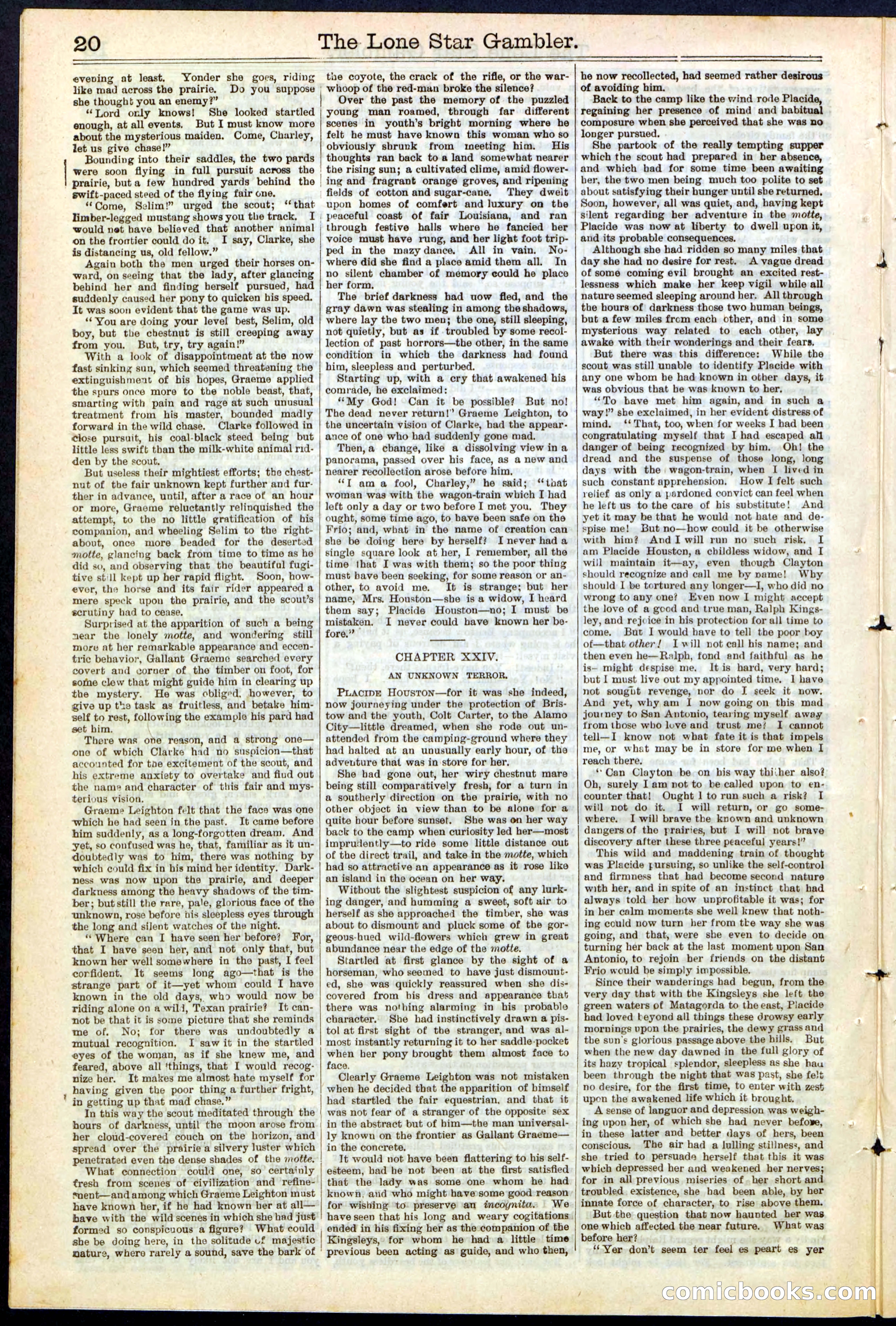
A restored page from Pulp Fiction, 1882. Page through the whole issue in the reader above.
📄 Transcribed text from this page (OCR, searchable)
Machine-transcribed from the original scan — historical spelling and the odd misread are preserved.
20 eveving at least. like mad across the prairie. she thought you an enemy?” “Lord only knows! She looked startled enough, at all events. But I must know more about the mysterious maiden, Come, Charley, let us give chase!” Bounding into their saddles, the two pards were soon flying in full pursuit across the prairie, but a few hundred yards behind the swift-paced steed of the flying fair one. “Come, Selim!” urged the scout; ‘that limber-legged mustang shows you the track, I would net have believed that another animal on the frontier could do it. I say, Clarke, she is distancing us, old fellow.” Again both the men urged their horses on- ward, on seeing that the lady, after glancing behind her and finding herself pursued, had suddenly caused her pony to quicken his speed. It was soon evident that the game was up. ‘‘-You are doing your level best, Selim, old boy, but the chestnut is still creeping away from you. But, try, try again!” With a look of disappointment at the now fast sinking sun, which seemed threatening the extinguishment of his hopes, Graeme applied the spurs once more to the noble beast, that, smarting with pain and rage at such unusual treatment from his master, bounded madly forward in the wild chase, Clarke followed in Close pursuit, his coal-black steed being but little less swift than the milk-white animal rid- den by the scout. But useless their mightiest efforts; the chest- nut of the fair unknown kept further and fur- ther in advance, until, after a race of an hour or more, Graeme reluctantly relinquished the attempt, to the no little gratification of his companion, and wheeling Selim to the right- about, once more beaded for the deserted motte, glancing back from time to time as he did so, and observing that the beautiful fugi- tive still kept up her rapid flight. Soon, how- ever, the horse and its fair rider appeared a mere speck upon the prairie, and the scout’s scrutiny had to cease, Surprised at the apparition of such a being near the lonely motte, and wondering still more at her remarkable appearance and eccen- tric behavior, Gallant Graeme searched every covert and gorner of the timber on foot, for sorhne clew that might guide him in clearing up the mystery. He was obliged, however, to give up the task as fruitless, and betake him- self to rest, following the example his pard had set him. | Yonder she goes, riding Do you suppose = or There was one reason, and a strong one— one of which Clarke had no suspicion—that | accounted for the excitement of the scout, and his extreme anxiety to overtake and fiud out | the name and character of this fair and mys- t terious vision, Graeme Leighton felt that the face was one which he had seen in the past. It came before him suddenly, as a long-forgotten dream. And yet, so confused was he, that, familiar as it un- doubtedly was to him, there was nothing by which could fix in his mind her identity. Dark- ness was now upon the prairie, and deeper darkness among the heavy shadows of the tim- ber; butstill the rare, pale, glorious face of the unknown, rose before iis sleepless eyes through the long and siJent watches of the night. ‘“Where can I have seen her before? For, that I have seen her, and not only that, but known her well somewhere in the past, I feel corfident. It seems long ago—that is the strange part of it—yet whom could I have known in the old days, who would now be riding alone on a wild, Texan prairie? It can- not be that it is some picture that she reminds me of. No; for there was undoubtedly a mutual recognition. I saw it in the startled eyes of the woman, as if she knew me, and feared, above all 'things, that I would recog- nize her. It mates me almost hate myself for having given the poor thing a further fright, in getting up that mad chase.” In this way the scout meditated through the | hours of darkness, until the moon arose from her cloud-covered couch on the horizon, and | spread over the prairie a silvery luster which penetrated even the dense shades of the mofte. What connection could one, so certainly fresh from scenes of civilization and refine- *nent—and among which Graeme Leighton must have known her, if he had known ber at all— bave with the wild scenes in which she had just formed so conspicuous a figure? What could | she be doing here, in the solitude uf majestic " mature, where rarely a sound, save the bark of The Lone Star Gambler. the coyote, the crack of the rifle, or the war- _ whoop of the red-man broke the silence? Over the past the memory of the puzzled young man roamed, through far different scenes in youth’s bright morning where he felt he must have known this woman who so obviously shrunk from teeting him. His thoughts ran back to a land somewhat nearer the rising sun; a cultivated clime, amid flower- ing and fragrant orange groves, and ripening fields of cotton and sugar-cane, They dweit upon homes of comfert and luxury on the peaceful coast of fair Louisiana, and ran through festive halls where he fancied her voice must have rung, and her light foot trip- ped in the mazydance, All in vain. No- where did she find a place amid them all. In no silent chamber of memory could he place her form. The brief darkness had uow fled, and the gray dawn was stealing in among the shadows, where lay the two men; the one, still sleeping, not quietly, but as if troubled by some recol- lection of past horrors—the other, in the same condition in which the darkness had found him, sleepless and perturbed. Starting up, with a cry that awakened his comrade, he exclaimed: ‘*My God! Can it be possible? But no! The dead never return!’ Graeme Leighton, to the uncertain vision of Clarke, bad the appear- ance of one who had suddenly gone mad. Then, a cbange, like a dissolving view in a panorama, passed over his face, as a new and nearer recollection arose before him, ‘“‘T am a fool, Charley,” he said; woman was with the wagon-train which I had left only a day or two beforeI met you. They ought, some time ago, to bave been safe on the Frio; and, what in the name of creation can she be doing here by herself? I never had a single square look at her, I remember, all the CS “tbat time that I was with them; so the poor thing must bave been seeking, for some reason or an- other, to avoid me. It is strange; but her name, Mrs. Houston—sbe is a widow, I heard them say; Placide Houston—no; I must be mistaken. I never could bave known her be- fore.” CHAPTER XXIV. AN UNKNOWN TERROR, PLActipE Hovuston—for it was she indeed, now journeying under the protection of Bris- tow and the youth, Colt Carter, to the Alamo City—little dreamed, when she rode out un- attended from the camping-ground where they had halted at an unusually early hour, of the adventure that was in store for her. She bad gone out, her wiry chestnut mare being still comparatively fresh, for a turn in a southerly direction on the prairie, with no other object in view than to be alone for a quite hour before sunset. She was on her way back to the camp when curiosity led her—most impruiently—to ride some little distance out of the direct trail, and take in the motte, which had so attractive an appearance as it rose like an island in the ocean on her way. Without the slightest suspicion of any lurk- ing danger, and humming a sweet, soft air to herself as she approached the timber, she was about to dismount and pluck some of the gor- geous-hued wild-flowers which grew in great abundance near the edge of the motte. Startled at first glance by the sight of a horseman, who seemed to have just dismount- ed, she was quickly reassured when she dis- covered from his dress and appearance that there was nothing alarming in his probable character. She had instinctively drawn a pis- tol at first sight of the stranger, and was al- most instantly returning it to her saddle-pocket when her pony brought them almost face to face. Clearly Graeme Leighton was not mistaken when he decided that the apparition of bimself had startled the fair equestrian, and that it was not fear of a stranger of the opposite sex in the abstract but of bim—the man universal- ly known on the frontier as Gallant Graeme— in the concrete, | Jt would not have been flattering to his self- esteem, had be not been at the first satisfied that the lady was some one whom he had known, atid who might havessome good reason for wishing ‘to. preserve an incoynita. We have seen that his long and weary cogitations: ended in his fixing her as the companion of the Kingsleys, for whom he had a little time ‘previous been acting as guide, and who then, | he now recollected, had seemed rather desirous of avoiding him. Back to the camp like the wind rode Placide, regaining her presence of mind and babitual composure when she perceived that she was no longer pursued, She partook of the really tempting supper which the scout had prepared in her absence, and which bad for some time been awaiting ber, the two men being much too polite to set about satisfying their bunger until sbe returned, Soon, however, all was quiet, and, having kept silent regarding her adventure in the motte, Placide was now at liberty to dwell upon it, and its probable consequences. Although she had ridden so many miles that day she had no desire for rest. A vague dread of some coming evil brought an excited rest- lessness which make her keep vigil while all nature seemed sleeping around her. All through the hours of darkness those two human beings, but a few miles from each other, and in some mysterious way related to each other, lay awake with their wonderings and their fears. But there was this difference: While the scout was still unable to identify Placide with any one whom be had known in other days, it was obvious that be was known to her. “To bave met him again, and in such a way!” she exclaimed, in her evident distress of mind. ‘That, too, when for weeks I had been congratulating myself that I had escaped alt danger of being recognized by him. Oh! the dread and the suspense of those long, long days with the wagon-train, when I lived in such constant apprehension. How I felt such relief as only a pardoned convict can feel when he left us to the care of bis substitute! And yet it may be that he would not hate and de- spise me! But no—how could it be otherwise with him? And I will run no such risk, I am Placide Housten, a childless widow, and I will maintain it—ay, even though Clayton should recognize and call me by pame! Why should I be tortured any longer—lI, who did no wrong to any one? Even now I might aecept the love of a geod and true man, Ralph Kings- ley, and rejcice in his protection for all time to come. But I would have to tell the poor boy of—that other! Iwill not call his name; and then even he—Ralph, fond and faithful as he is— might despise me. It is hard, very hard; but I must live out my appointed time. 1 have not sougut revenge, nor do J seek it now. And yet, why am I now going on this mad journey to San Antonio, tearing myself away from those who love and trust me? I cannot tell—I know not what fate it is that impels me, or what may be in store for me when I reach there. ‘Can Clayton be on his way thicher also? Oh, surely Iam not to be called upon to en- counter that! Ought 1 to run such a risk? I will not do it. I will return, or go some- where. I will brave the known and unknown dangers of the prairies, but I will not brave discovery after these three peaceful years!” This wild and maddening train of thought was Placide pursuing, so unlike the self-control and firmness that had become second nature with her, and in spite of an instinct that had always told her how unprofitable it was; for in ber calm moments she well knew that noth- ing could now turn her from tke way she was going, and that, were she even to decide on turning her back at the Jast moment upon San Antonio, to rejoin ber friends on the distant Frio would be simply impossible, Since their wanderings had begun, from the very day that with the Kingsleys she left the green waters of Matagorda to the east, Placide had loved beyond all things these drowsy early mornings vpon the prairies, the dewy grass and the sun's glorious passage above the hills. But when the new day dawned in the full glory of its hazy tropical splendor, sleepless as she hau _been through the night that was past, she felt no desire, for the first time, to enter with zest upon the awakened life which it brought, A sense of languor and depression was weigh- ing upon her, of which she had never befove, in these latter and better days of hers, been conscious. The air had a lulling stillness, and she tried to persuade herself that this it was which depressed her and weakened her nerves; for in all previous miseries of. her short and troubled existence, she had been able, by her innate force of character, to rise above them. But the question that now haunted her was one which affected the near future. What was before her? ‘* Yer don’t seem ter feel es peart es yer Goim E S (E(0)| IOO