
Pulp Fiction, 1882 · page 19 of 28
Beadle's New York Dime Library, No. 195 — page 19: what you’re looking at
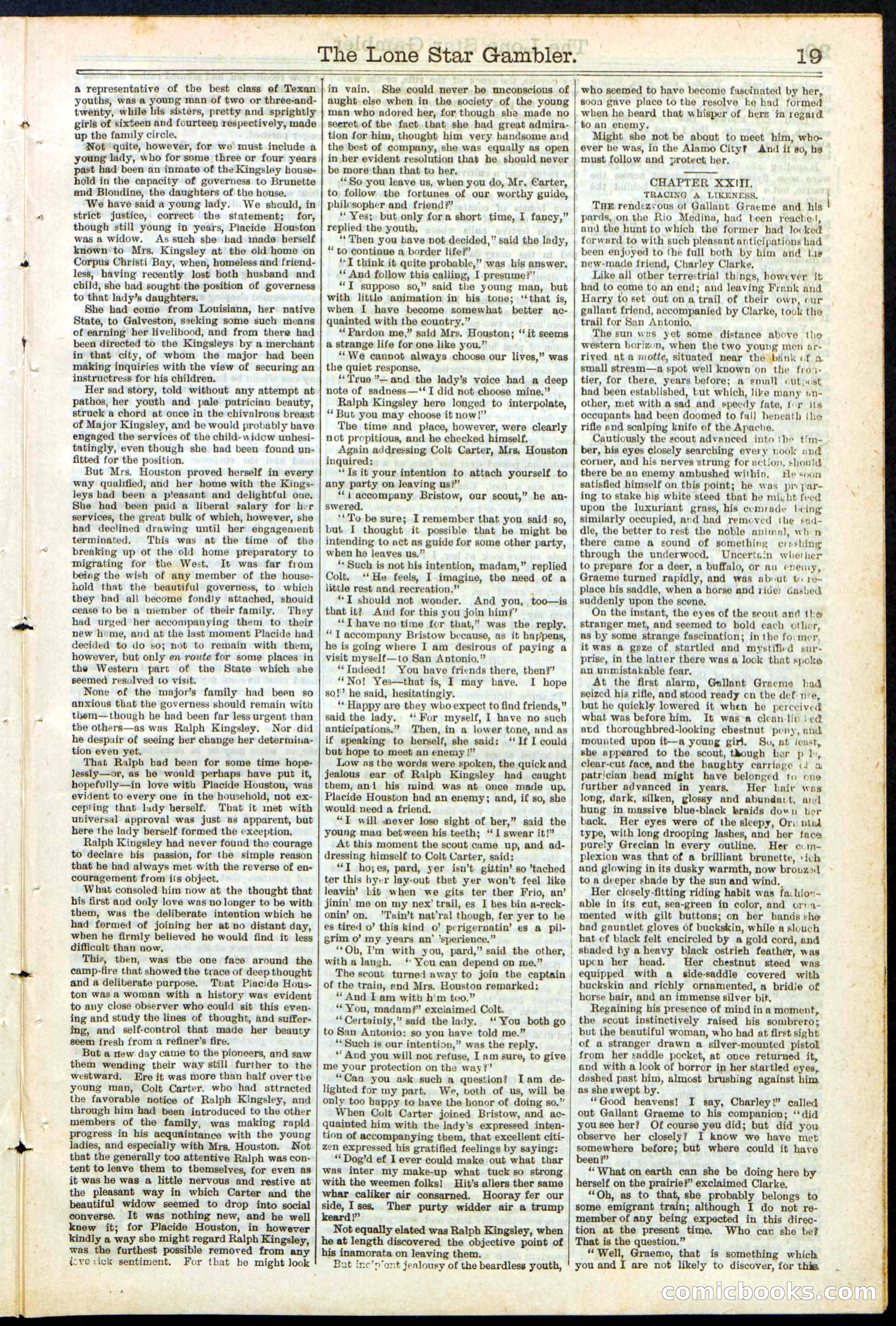
A restored page from Pulp Fiction, 1882. Page through the whole issue in the reader above.
📄 Transcribed text from this page (OCR, searchable)
Machine-transcribed from the original scan — historical spelling and the odd misread are preserved.
a representative of the best class of Texan youths, was a young man of two or three-and- twenty, while his sisters, pretty and sprightly girls of sixteen and fourteen respectively, made up the family circle. Not quite, however, for we must include a young lady, who for some three or four years past had been an inmate of the Kingsley bhouse- hold in the capacity of governess to Brunette end Blondine, the daughters of the house, We have said a young lady. We should, in strict justice, correct the statement; for, though still young in years, Placide Houston was a widow. As such she had made herself known to Mrs. Kingsley at the old home on Corpus Christi Bay, when, homeless and friend- less, having recently lost both husband and child, she had sought the position of governess to that lady’s daughters. She had come from Louisiana, her native State, to Galveston, sseking some such means of earning her livelibood, and from there had been directed to the Kingsleys by a merchant in that city, of whom the major had been making inquiries with the view of securing an instructress for his children. Her sad story, told without any attempt at pathos, her youth and pale patrician beauty, struck a chord at once in the chivalrous breast of Major Kingsley, and be would probably have engaged the services of the child- widow unhesi- tatingly, even though she had been found un- fitted for the position. But Mrs. Houston proved herself in every way qualified, and her home with the Kings- leys bad been a p'easant and delightful one. Sbe had been paid a liberal salary for her services, the great bulk of which, however, she had declined drawing until her engagement terminated. This was at the time of the breaking up of the old home preparatory to migrating for the West. It was far from beiag the wish of any member of the house- hold that the beautiful governess, to which they bad all become fondly attached, should cease to be a member of their family. They had urged her accompanying them to their new home, and at the last moment Placide had cGecided to do so; not to remain with them, however, but only en route for some places in the Western part of the State which she seemed resolved to visit. None of the major’s family had been so anxious that the governess should remain with them—though he had been far less urgent than the others—as was Ralph Kingsley. Nor did he despair of seeing ber change her determina- tion even yet. That Ralpb bad been for some time hope- Jessly—or, as he would perhaps have put it, hopefully—in love with Placide Houston, was evident to every one in the household, not ex- cepting that ludy herself. That it met with universal approval was just as apparent, but here the lady berself formed the exception. Ralph Kingsley had never found the courage to declare bis passion, for the simple reason that he bad always met with the reverse of en- couragement from ils object. What consoled him now at the thought that bis first and only love was no longer to be with them, was the deliberate intention which he had formed of joining ber at no distant day, when he firmly believed he would find it less difficult than now. Thir, then, was the one face around the camp-fire that showed the trace of deep thought and a deliberate purpose. That Piacide Hous- ton was a woman with a history was evident to any close observer who could sit this even- ing and study the lines of thought, and suffer- ing, and self-control that made her beauty seem fresh from a refiner’s fire. But a new day came to the pioneers, and saw them wending their way still further to the westward. Ere it was more than half over tie young man, Colt Carter. who had attracted the favorable notice of Ralph Kingsley, and through him had been introduced to the other members of the family, was making rapid progress in his acquaintance with the young ladies, and especially with Mrs, Houston. Not that the generally too attentive Ralph was con- tent to leave them to themselves, for even as it was he was a little nervous and restive at the pleasant way in which Carter and the beautiful widow seemed to drop into social converse. It was nothing new, and he well knew it; for Placide Houston, in however kindly a way she might regard Ralph Kingsley, was the furthest possible removed from any icve:ick sentiment. For that he might look The Lone Star Gambler. ase in vain. She could never be unconscious of | who seemed to have become fascinated by her, aught else when in the society of the young | soon gave place to the resolve be had formed man who adored her, for though sha made no seeret of the fact that she had great admira- tion for him, thought him very bandsome and the best of company, she was equally as open in her evident resolution that he should never be more than that to her. “So you leave us, when you do, Mr. Carter, to follow the fortunes of our worthy guide, philesopher and friend?’ “Yes; but only fora short time, I fancy,” replied the youth, “Then you have not decided,” said the lady, “ to continue a border life?” “TI think it quite probable,” was his answer. ‘* And follow this calling, I presume?’ “T suppose so,” said the young man, but with little animation in bis tone; ‘that is, when I have become somewhat better ac- quainted with the country.” “Pardon me,” said Mrs. Houston; ‘it seems a strange life for one like you.” ““We cannot always choose our lives,” was the quiet response, “True "— and the lady’s voice had a deep note of sadness—‘‘ I did not choose mine,” Ralph Kingsley here longed to interpolate, ** But you may choose it now!” The time and place, however, were clearly not propitious, and he checked himself, Again addressing Colt Carter, Mrs, Houston inquired; ‘Is it your intention to attach yourself to any party on Jeaving us?” “1 accompany Bristow, our scout,” he an- swered. | ‘“To be sure; I remember that you said so, but I thought it possible that he might be intending to act as guide for some other party, when he leaves us.” ** Such is not bis intention, madam,” replied Colt, ‘Hw feels, I imagine, the need of a little rest and recreation.” ; “I should not wonder. And you, too—is that it? Aud for this you join him?’ ‘‘T have no time for that,” was the reply. “IT accompany Bristow because, as it happens, he is going where I am desirous of paying a visit myself—to San Antonio.” **Tndeed! You have friends there, then?” “No! Yes—that is, I may have. I hope so!’ he said, hesitatingly. ‘** Happy are they who expect to find friends,” said the lady. ‘‘ For myself, 1 have no such anticipations.” Then, in a lower tone, und as if speaking to berself, she said; ‘If I could but hope to meet an enemy !” Low as the words were spoken, the quick and jealous ear of Ralph Kingsley had caught them, ani his mind was at once made up. Placide Houston bad an enemy; and, if so, she would need a friend. “T will mever lose sight of her,” said the young man between his teeth; “1 swear it!” At this moment the scout came up, and ad- dressing himself to Colt Carter, said: “T hojyes, pard, yer isn’t gittin’ so ’tached ter this hyer lay-out thet yer won't feel like leavin’ bit when we gits ter ther Frio, an’ jinin' me on my nex’ trail, es I bes bin a-reck- onin’ on. ‘Tsin’t nat’ral though, fer yer to be es tired o’ this kind o’ perigernatin’ es a pil- grim 0’ my years an’ ’sperience.” ‘*Ob, ’'m with you, pard,” said the other, with a laugh. ‘ You can depend on me,” The scout turned away to join the captain of the train, end Mrs. Houston remarked: “And I am with h'm too.” “You, madam?” exciaimed Colt. ‘* Certainly,” said the lady. to San Antonio: so you have told me.” ** Such is our intention,” was the reply. ‘And you will not refuse, I am sure, to give me your protection on the way?’ “Can you ask such a question? Lam de- lighted for my part. We, voth of us, will be only too bappy to have the honor of doing so.” When Colt Carter joined Bristow, and ac- quainted him with the lady’s expressed inten- tion of accompanying them, that excellent citi- zen expressed his gratified feelings by saying: “‘Dog’d ef I ever could make out what thar was inter my make-up what tuck so strong with the weemen folks! Hit’s allers ther same whar caliker air consarned. Hooray fer our side, I ses, Ther purty widder air a trump keard!” Not equally elated was Ralph Kingsley, when he at length discovered the objective point of his inamorata on leaving them. But inc'n’ent jealousy of the beardless youth, ‘You both go , when he heard that whisper of hers im regard tO an enemy. Might she not be about to meet him, who- ever he was, in the Alamo City? And if so, ha must follow and protect ber. CHAPTER XXIII. TRACING A LIKENESS, THE rendezvous of Gallant Graeme and his pards, on the Rio Medina, had been reache, aud the hunt to which the former had locked forward to with such pleasant anticipations had been enjoyed to the full both by him and Lis new-made friend, Charley Clarke, Like all other terrestrial things, however it had to come to an end; and leaving Frank and Harry to set out on a trail of their own, cur | gallant friend, accompanied by Clarke, took the trail for San Antonio, The sun wes yet some distance above tho western horizon, when the two young men ar- rived at a motte, situated near the bank cf a small stream—a spot well known on the fros- tier, for there, years before; a emall cutswst had been established, but which, like many un- other, met with asad and speedy fate, fir its occupants had been doomed to fal] beneath the rifle and scalping knife of the Apache. Cautiously the scout advanced into the tim- ber, his eyes closely searching every nook and coruer, and his nerves strung for uction, shon!d there be an enemy ambushed within, fe soon satisfied himself on this point; he was pri par- ing to stake his white steed that he micht feed upon the luxuriant grass, his comrade being similarly occupied, and had removed the sad- dle, the better to rest the noble animal, wh n there came a sound of something cisshing through the underwocd, Uncertain whether to prepare for a deer, a buffalo, or au eneniy, Graeme turned rapidly, and was about to re- place his saddle, when a horse and vide) dashed suddenly upon the scene, On the instant, the eyes of the scout and the stranger met, and seemed to hold each other, as by some strange fascination; in the fo: mer, it was a goeze of startled and mystifird sur- prise, in the latter there was a look that spoke an unmistakable fear. At the first alarm, Gallant Graeme had seized his rifle, and stood ready on the def ne, but he quickly lowered it when he perceived what was before him. It was-a clean-lin ied acd thoroughbred-looking chestnut pony, and mounted upon it—a young girl. Sv, at ieast, she appeared to the scout, though her p l, clear-cut face, and the haughty carriage «/ a patrician bead might have belonged tu one further advanced in years, Her hair was long, dark, silken, glossy and abunda:t, aril hung in massive blue-black braids down ber back, Her eyes were of the sleepy, Ori: ntul type, with long drooping lashes, and her face purely Grecian In every outline. Her cc m- plexion was that of a brilliant brunette, ich and glowing in its dusky warmth, now brouz»l to a deeper shade by the sun and wind, Her closely-fitting riding habit was fa:hion- able in its eut, sea-green in color, and or- mented with gilt buttons; on her hands she had gauntlet gloves of buckskin, while a slouch hat ef black felt encircled by a gold cord, and shaded by a heavy black ostrieh feather, was upcn her head. Her chestnut steed was equipped with a side-saddle covered with buckskin and richly ornamented, a bridle of horse hair, and an immense silver bit. Regaining his presence of mind in a moment, the scout instinctively raised his sombrero; but the beautiful woman, who had at first sight of a stranger drawn a silver-mounted pistol from her saddle pocket, at once returned it, and with a look of horror in her startled eyes, dashed past him, almost brushing against him as she swept by. ““Good heavens! I say, Charley!” called out Gallant Graeme to his companion; ‘did yousee her? Of course you did; but did you observe her closely? I know we have met somewhere before; but where could it have been?” “What on earth can she be doing here by herself on the prairie?” exclaimed Clarke, “Oh, as to that, she probably belongs to some emigrant train; although I do not re- member of any being expected in this direc- tion at the present time. Who car she be? That is the question.” “Well, Graeme, that is something which you and I are not likely to discover, for thig EORNIEDOOMKS (G@)