
Pulp Fiction, 1882 · page 18 of 28
Beadle's New York Dime Library, No. 195 — page 18: what you’re looking at
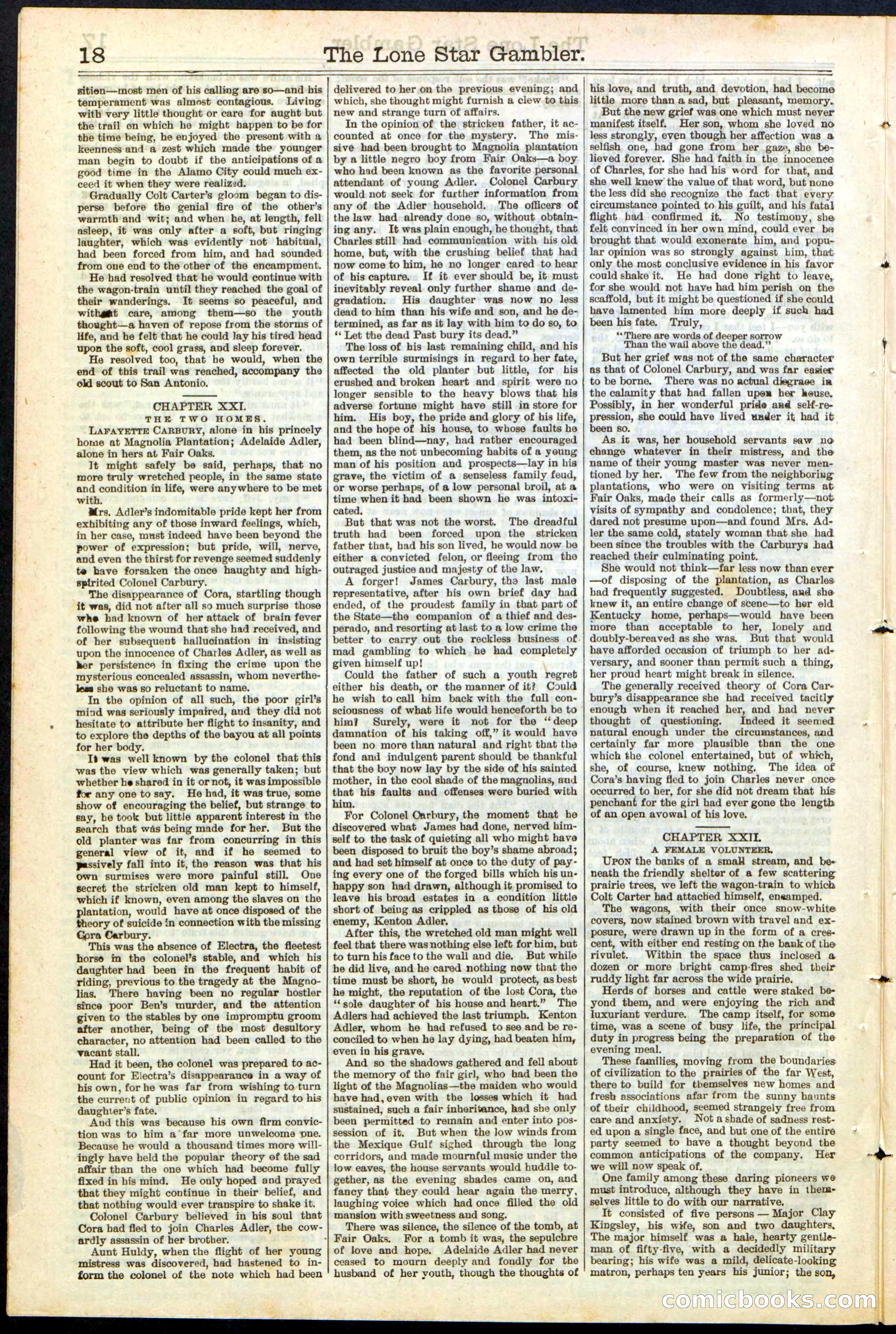
A restored page from Pulp Fiction, 1882. Page through the whole issue in the reader above.
📄 Transcribed text from this page (OCR, searchable)
Machine-transcribed from the original scan — historical spelling and the odd misread are preserved.
18 The Lone Star Gambler. sitien—most men of his calling are so—and bis temperament was almost contagious. Living with very little thought or care for aught but the trail on which he might happen to be for the time being, he enjoyed the present with a keenness and a zest which made the younger man begin to doubt if the anticipations of a good time in the Alamo City could much ex- ceed it when they were realized. Gradually Colt Carter’s gloom began to dis- perse before the genial fire of the other’s warmth and wit; and when he, at length, fell asleep, it was only after a soft, but ringing laughter, which was evidently not habitual, had been forced from him, and had sounded from one end to the other of the encampment. He had resolved that he would continue with the wagon-train until they reached the goal of their wanderings. It seems so peaceful, and withg@at care, among them—so the youth thought—a haven of repose from the storms of life, and he felt that he could lay his tired head upon the soft, cool grass, and sleep forever. He resolved too, that he would, when the end of this trail was reached, accompany the old scout to San Antonio. CHAPTER XXI. THE TWO HOMES. LAFAYETTE CARBURY, alone in his princely home at Magnolia Plantation; Adelaide Adler, alone in hers at Fair Oaks. It might safely be said, perhaps, that no more truly wretched people, in the same state and condition in life, were anywhere to be met with. Mrs. Adler’s indomitable pride kept her from exhibiting any of those inward feelings, which, in her case, must indeed have been beyond the power of expression; but pride, will, nerve, and even the thirst for revenge seemed suddenly te have forsaken the once haughty and high- spirited Colonel Carbury. The disappearance of Cora, startling though it was, did not after all so much surprise those whe had known of her attack of brain fever following the wound that she had received, and of her subsequent hallucination in insisting upon the innocence of Charles Adler, as well as her persistence in fixing the crime upon the mysterious concealed assassin, whom neverthe- less sho was so reluctant to name. In the opinion of all such, the poor girl’s mind was seriously impaired, and they did not hesitate to attribute her flight to insanity, and to explore the depths of the bayou at all points for her body. It was well known by the colonel that this was the view which was generally taken; but whether he shared in it or not, it was impossible for any one tosay. He had, it was true, some show of encouraging the belief, but strange to say, he took but little apparent interest in the search that was being made forher. But the old planter was far from concurring in this general view of it, and if he seemed to passively fall into it, the reason was that his own surmises were more painful still. One secret the stricken old man kept to himself, which if known, even among the slaves on the plantation, would have at once disposed of the theory of suicide in connection with the missing Gora Carbury. This was the absence of Electra, the fleetest horse im the colonel’s stable, and which his daughter had been in the frequent habit of riding, previous to the tragedy at the Magno- lias, There having been no regular hostler since poor Ben’s murder, and the attention given to the stables by one impromptu groom after another, being of the most desultory character, no attention had been called to the vacant stall. Had it been, the colonel was prepared to ac- count for Electra’s disappearance in a way of his own, for he was far frorm wishing to turn the current of public opinion in regard to his daughter’s fate. And this was because his own firm convic- tion was to him afar more unwelcome one, Because he would a thousand times more will- ingly have held the popular theory of the sad affair than the one which had become fully fixed in his mind. He only hoped and prayed that they might continue in their belief, and that nothing would ever transpire to shake it. Colonel Carbury believed in his soul that Cora bad fled to join Charles Adler, the cow- ardly assassin of her brother. Aunt Huldy, when the flight of her young mistress was discovered, had hastened to in- form the colonel of the note which had been delivered to her on the previous evening; and which, she thought might furnish a clew to this new and strange turn of affairs. In the opinion of the stricken father, it ac- counted at once for the mystery. The mis- sive had been brought to Magnolia plantation by a little negro boy from Fair Oaks—a boy who had been known as the favorite personal attendant of young Adler. Colonel Carbury would not seek for further information from any of the Adler household, The officers of the law had already done so, without obtain- ing any. It was plain enough, he thought, that Charles still had communication with his old home, but, with the crushing belief that had now come to him, he no longer cared to hear of his capture. If it ever should be, it must inevitably reveal only further shame and de- gradation. His daughter was now no less dead to him than his wife and son, and he de- termined, as far as it lay with him to do so, to ‘* Let the dead Past bury its dead.” The loss of his last remaining child, and his own terrible surmisings in regard to her fate, affected the old planter but little, for bis crushed and broken heart and spirit were no longer sensible to the heavy blows that his adverse fortune might have still in store for him. His boy, the pride and glory of his life, and the hope of his house, to whose faults he had been blind—nay, had rather encouraged them, as the not unbecoming habits of a young man of his position and prospects—lay in his grave, the victim of a senseless family feud, or worse perhaps, of a low personal broil, at a time when it had been shown he was intoxi- cated. But that was not the worst. The dreadful truth had been forced upon the stricken father that, had his son lived, he would now be either a convicted felon, or fleeing from the outraged justice aud majesty of the law. A forger! James Carbury, tho last male representative, after his own brief day had ended, of the proudest family in that part of the State—the companion of a thief and des- perado, and resorting at last to a low crime the better to carry out the reckless business of mad gambling to which he had completely given himself up! Could the father of such a youth regret either his death, or the manner of it? Could he wish to call him back with the full con- sciousness of what life would henceforth be to him? Surely, were it not for the ‘deep damnation of his taking off,” it would have been no more than natural and right that the fond and indulgent parent should be thankful that the boy now lay by the side of his sainted mother, in the cool shade of the magnolias, and that his faults and offenses were buried with him. For Colonel Oarbury, the moment that he discovered what James had done, nerved him- self to the task of quieting all who might have been disposed to bruit the boy’s shame abroad; and had set himself at once to the duty of pay- ing every one of the forged bills which his un- happy son had drawn, although it promised to leave his broad estates in a condition little short of being as crippled as those of his old enemy, Kenton Adler. After this, the wretched old man might well feel that there was nothing else left for him, but to turn his face to the wall and die, But while he did live, and he cared nothing now that the time must be short, he would protect, as best he might, the reputation of the lost Cora, the “sole daughter of his house and heart.” The Adlers had achieved the last triumph. Kenton Adler, whom he had refused to see and be re- conciled to when he lay dying, had beaten him, even in his grave. And so the shadows gathered and fell about the memory of the fair girl, who had been the light of the Magnolias—the maiden who would have had,even with the losses which it had sustained, such a fair inheritance, had she only been permitted to remain and enter into pos- session of it. But when the low winds from the Mexique Gulf sighed through the long corridors, and made mournful musie under the low eaves, the house servants would huddle to- gether, as the evening shades came on, and fancy that they could hear again the merry, laughing voice which had once filled the old mansion with sweetness and song, There was silence, the silence of the tomb, at - Fair Oaks. For a tomb it was, the sepulchre of love and hope. Adelaide Adler had never ceased to mourn deeply and fondly for the husband of her youth, though the thoughts of his love, and truth, and devotion, had become little more than a sad, but pleasant, memory. But the new grief was one which must never manifest itself. Her son, whom she loved no less strongly, even though her affection was a selfish one, had gone from her gaze, she be- lieved forever. She had faith in the innocence of Charles, for she had his word for that, and she well knew the value of that word, but none the less did she recognize the fact that every circumstance pointed to his guilt, and his fatal flight bad confirmed it. No testimony, she felt convinced in her own mind, could ever be brought that would exonerate him, and popu- lar opinion was so strongly against bim, that only the most conclusive evidence in his favor could shake it. He had done right to leave, for she would not have had him perish on the scaffold, but it might be questioned if she could have lamented him more deeply if such had been his fate. Truly, ‘There are words of deeper sorrow Than the wail above the dead.” But her grief was not of the same character as that of Colonel Carbury, and was far easier to be borne. There was no actual diegraee in the calamity that had fallen upem her heuse, Possibly, in her wonderful pride and self-re- pression, she could have lived under itt had it been so. As it was, her household servants saw no change whatever in their mistress, and the name of their young master was never men- tioned by her. The few from the neighboring plantations, who were on visiting terms at Fair Oaks, made their calls as formerly—not visits of sympathy and condolence; that, they dared not presume upon—and found Mrs, Ad- ler the same cold, stately woman that she had been since the troubles with the Carburys had reached their culminating point. She would not think—far less now than ever —of disposing of the plantation, as Charles had frequently suggested. Doubtless, and she knew it, an entire change of scene—to her eld Kentucky home, perhaps—would have been more than acceptable to her, lonely and doubly-bereaved as she was. But that would have afforded occasion of triumph to her ad- versary, and sooner than permit such a thing, her proud heart might break in silence, The generally received theory of Cora Care bury’s disappearance she had received tacitly enough when it reached her, and had never thought of questioning. Indeed it seemed natural enough under the circumstances, and certainly far more plausible than the one which the colonel entertained, but of which, she, of course, knew nothing. The idea of Cora’s having fled to join Charles never once occurred to her, for she did not dream that his penchant for the girl had ever gone the length of an open avowal of his love. CHAPTER XXII. A FEMALE VOLUNTEER. Upon the banks of a smaH stream, and be- neath the friendly shelter of a few scattering prairie trees, we left the wagon-train to which Colt Carter had attached himself, eneamped. The wagons, with their once snow-white covers, now stained brown with travel and ex- posure, were drawn up in the form of a cres- cent, with either end resting on the bank of the rivulet. Within the space thus inclosed a dozen or more bright camp-fires shed their ruddy light far across the wide prairie. Herds of horses and cattle were staked be- yond them, and were enjoying the rich and luxuriant verdure. The camp itself, for some time, was a scene of busy life, the principal duty in progress being the preparation of the evening meal. These families, moving from the boundaries of civilization to the prairies of the far West, there to build for themselves new homes and fresh associations afar from the sunny haunts of their childhood, seemed strangely free from care and anxiety. Not ashade of sadness rest- ed upon a single face, and but one of the entire party seemed to have a thought beyond the common anticipations of the company. Her we will now speak of, One family among these daring pioneers we must introduce, although they have in them- selves little to do with our narrative. It consisted of five persons — Major Clay Kingsley, his wife, son and two daughters, The major himself was a hale, hearty gentle- man. of fifty-five, with a decidedly military bearing; his wife was a mild, delicate-looking matron, perhaps ten years his junior; the son, Gomilecbooksre (0)