
Pulp Fiction, 1882 · page 17 of 28
Beadle's New York Dime Library, No. 195 — page 17: what you’re looking at
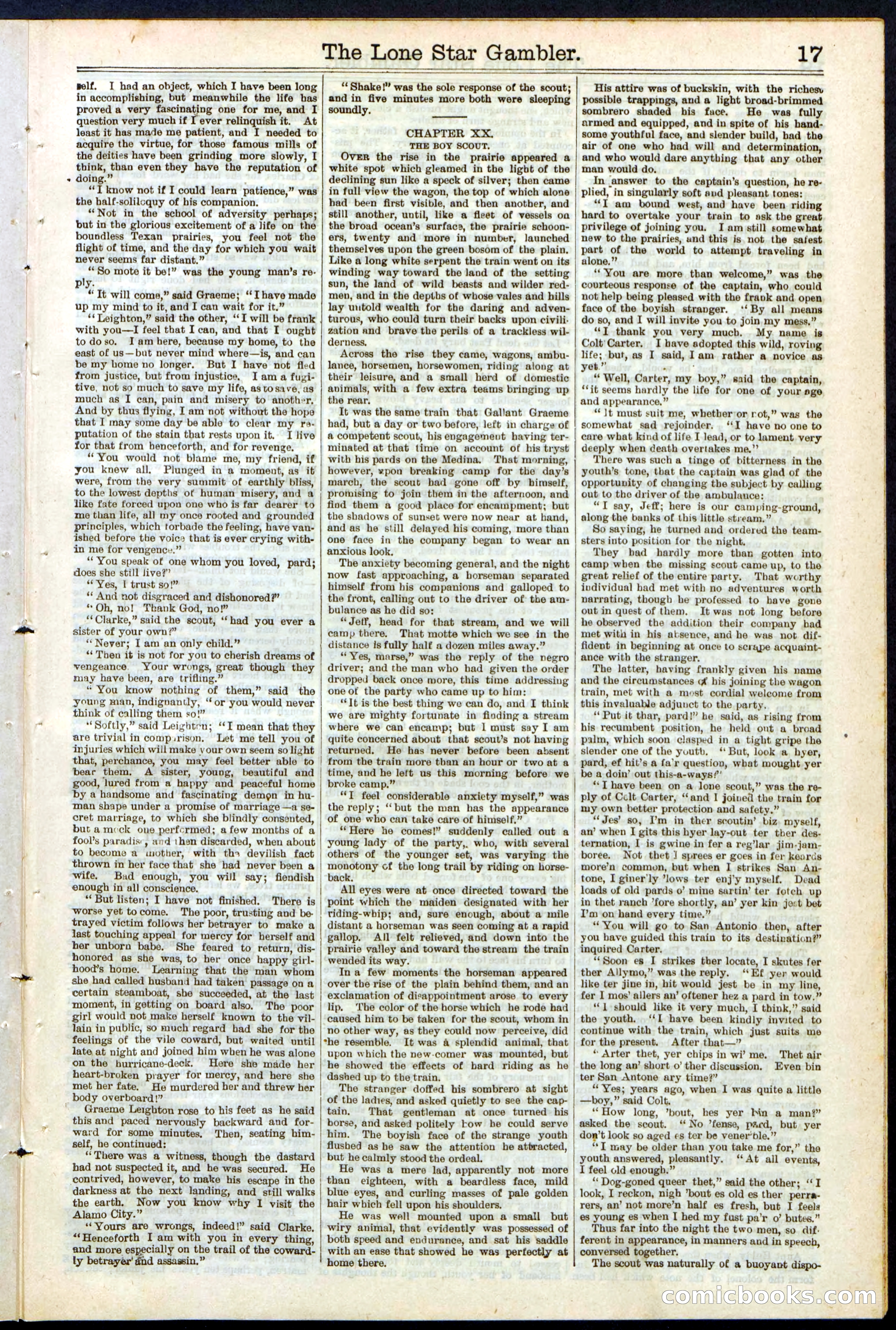
A restored page from Pulp Fiction, 1882. Page through the whole issue in the reader above.
📄 Transcribed text from this page (OCR, searchable)
Machine-transcribed from the original scan — historical spelling and the odd misread are preserved.
The Lone Star Gambler. a pelf. I had an object, which I have been long in accomplishing, but meanwhile the life has proved a very fascinating one for me, and I question very much if I ever relinquish it. At least it has made me patient, and I needed to acquire the virtue, for those famous mills of the deities have been grinding more slowly, I think, than even they have the reputation of doing.” : “TI know not if I could learn patience,” was the balf-solilcquy of bis companion, “Not in the school of adversity perhaps; but in the glorious excitement of a life on the boundless Texan prairies, you feel not the flight of time, and the day for which you wait never seems far distant.” “So mote it be!” was the young man’s re- ply. “Tt will come,” said Graeme; “I have made up my mind to it, and I can wait for it.” ‘*‘ Leighton,” said the other, ‘I will be frank with you—I feel that I can, and that I ought to doso. Iam here, because my home, to the east of us—but never mind where—is, and can be my home no longer. But I have not fled from justice, but from injustice, I am a fugi- tive, not so much to save my life, as tosave, as much as I can, pain and misery to another, And by thus flying, I am not without the hope that I may some day be able to clear my roe- putation of the stain that rests upon it. I live for that from henceforth, and for revenge. “You would not blame me, my friend, if you knew all, Plunged in a moment, as it were, from the very summit of earthly bliss, to the lowest depths of human misery, and a like fate forced upon one who is far dearer to me than life, all my once rooted and grounded principles, which torbade the feeling, have van- ished before the voice that is ever crying with- in me for vengence.” “You speak of one whom you loved, pard; does she still live?” ‘Yes, I trust so!” ** And not disgraced and dishonored?’ * Oh, no! Thank God, no!” ‘“*Clarke,” said the scout, “‘had you ever a sister of your own?” “Never; I am an only child.” “Then it is not for you to cherish dreams of vengeance. Your wrongs, great though they may have been, are trifling.” “ You know nothing of them,” said the young man, indignantly, “or you would never think of calling them so!” Softly,” said Leightrn; “T mean that they are trivial in comp.rison. Let me tell you of injuries which will make your own seem so light that, perchance, you may feel better able to bear them, A sister, young, beautiful and good, lured from a happy and peaceful home by a handsome and fascinating demon in hu- man shape under a promise of marriage —a se- cret marriage, to which she blindly consented, but a mock oue perfcrmed; afew months of a fool’s paradis', and then discarded, when about to become a iwother, with tha devilish fact thrown in her face that she had never been a wife. Bad enough, you will say; fiendish enough in all conscience. ‘ But listen; I have not finished. There is worse yet tocome. The poor, trusting and be- trayed victim follows her betrayer to make a last touching appeal for mercy for herself and her unborn babe. She feared to return, dis- honored as she was, to her once happy girl- hood’s home. Learning that the man whom she had called husband had taken passage on a certain steamboat, she succeeded, at the last moment, in getting on board also. The poor girl would not make herself known to the vil- lain in public, so much regard had she for the feelings of the vile coward, but waited until late at night and joined him when he was alone on the burricane-deck. Here she made her heart-broken prayer for mercy, and here she met her fate. He murdered ber and threw her body overboard!” Graeme Leighton rose to his feet as he said this and paced nervously backward and for- ward for some minutes, Then, seating bim- self, he continued; “There was a witness, though the dastard had not suspected it, and he was secured. He contrived, however, to make his escape in the darkness at the next landing, and still walks the earth, Now you know why I visit the Alamo City.” ‘‘Yours are wrongs, indeed!” said Clarke. “Henceforth I am with you in every thing, and more especially on the trail of the coward- ly betrayér' dnd assassin,” a i i > ee “Shake!” was the sole response of the scout; and in five minutes more both were sleeping soundly, CHAPTER XX, THE BOY SCOUT. Over the rise in the prairie appeared a white spot which gleamed in the light of the declining sun like a speck of silver; then came in full view the wagon, the top of which alone had been first visible, and then another, and still another, until, like a fleet of vessels oa the broad ocean’s surfaca, the prairie schoon- ers, twenty and more in number, launched themselves upon the green bosom of the plain. Like a long white serpent the train went on its winding way toward the land of the setting sun, the land of wild beasts and wilder red- men, and in the depths of whose vales and hills lay witold wealth for the daring and adven- turous, who could turn their backs upon civili- zation and brave the perils of a trackless wil- derness, Across the rise they came, wagons, ambu- lance, horsemen, horsewomen, riding along at their leisure, and a small herd of domestic avimals, with a few extra teams bringing up the rear. It was the same train that Gallant Graeme had, but a day or two before, left in charge of a competent scout, his engagemevt having ter- minated at that time on account of his tryst with his pards on the Medina. That morning, however, »pon breaking camp for the day’s march, the scout bad gone off by himself, promising to join them in the afternoon, and find them a good place for encampment; but the shadows of sunset were now near at hand, and as he still delayed his coming, more than one face in the company began to wear an anxious look. The anxiety becoming general, and the night now fast approaching, a horseman separated himself from his companions and galloped to the front, calling out to the driver of the am- bulance as he did so: “Jetf, head for that stream, and we will camp there. That motte which we see in the distance is fully half a dozen miles away.” “Yes, marse,” was the reply of the negro driver; and the man who had given the order dropped back once more, this time addressing one of the party who came up to him: “‘It is the best thing we can do, and I think this invaluable adjunct to the we are mighty fortunate in finding a stream where we can encamp; but | must say I am quite concerned about that scout’s not having returned. He has never before been absent from the train more than an hour or two at a time, and he left us this morning before we broke camp,” “T feel considerable anxiety myself,” was the reply; “but the man has the appearance of one who can take care of himself,” oo ; | **Here he comes!” suddenly called out a young lady of the party, who, with several monotony cf the long trail by riding on horse- back. All eyes were at once directed toward the point which the maiden designated with her | tiding-whip; and, sure enough, about a mile distant a horseman was seen coming at a rapid gallop. All felt relieved, and down into the prairie valley and toward the stream the train wended its way. In a few moments the horseman appeared over the rise of the plain behind them, and an exclamation of disappointment arose to every lip. The color of the horse which he rode had caused him to be taken for the scout, whom in | no other way, as they could now perceive, did she resemble. It was a4 splendid animal, that upon which the new-comer was mounted, but he showed the effects of bard riding as he dashed up to the train. The stranger doffed his sombrero at sight of the ladies, and asked quietly to see the cap- tain. That gentleman at once turned his borse, and asked politely Low he could serve him. The boyish face of the strange youth flushed as he saw the attention he attracted, but he calmly stood the ordeal. He was a mere lad, apparently not more than eighteen, with a beardless face, mild blue eyes, and curling masses of pale golden hair which fell upon his shoulders. He was well mounted upon a small but wiry animal, that evidently was possessed of both speed and endurance, and sat his saddle with an ease that showed he was perfectly at home there. His attire was of buckskin, with the richesy possible trappings, and a light broad-brimmed sombrero shaded his face. He was fully armed and equipped, and in spite of his band- some youthful face, and slender build, bad the air of one who had will and determination, and who would dare anything that any other man would do. In answer to the captain’s question, he re- plied, in singularly soft avd pleasant tones: “T am bound west, and have been riding hard to overtake your train to ask the great privilege of joining you. I am still somewhat new to the prairies, und this is not the safest part of the world to attempt traveling in alone,” ‘You are more than welcome,” was the courteous response of the captain, who could not help being pleased with the frank and open face of the boyish stranger. ‘‘ By all means do so, and I will invite you to join my mess,” “TI thank you very much. My name is Colt'Carter. I have adopted this wild, roving life; but, as I said, Iam rather a novice as yet.” x . “Well, Carter, my boy,” said the captain, ‘it seems hardly the life for one of your age and appearance,” “It must suit me, whether or rot,” was the somewhat sad rejoinder. ‘I have no one to care what kind of life I lead, or to lament very deeply when death overtakes me,” There was such a tinge of bitterness in the youth’s tone, that the captain was glad of the opportunity of changing the subject by calling out to the driver of the ambulance: “T say, Jeff; here is our camping-ground, along the banks of this little stream,” So saying, he turned and ordered the team- sters into position for the night, They bad hardly more than gotten into camp when the missing scout came up, to the great relief of the entire party. That worthy individual bad met with no adventures worth narrating, though be professed to have gone out in quest of them, It was not long before he observed the addition their company had met with in his absence, and he was. not dif- fident in beginning at once to scrape acquaint- ance with the stranger. The latter, having frankly given his name and the circumstances his joining the wagon train, met with a most cordial welcome from party. “Put it thar, pard!” he said, as rising from his recumbent position, he held ont a broad palm, which soon clasped in a tight gripe the slender one of the youth. “ But, look a hyer, pard, ef hit’s a fa’r question, what mought yer be a doin’ out this-a-ways?’' **T have been on a lone scout,” was the re- ply of Cclt Carter, “and I joined the train for my own better protection and safety,” ‘Jes’ so, I'm in ther scoutin’ biz myself, an’ when I gits this hyer lay-out ter ther des- _ternation, I is gwine in fer a reg’lar jim-jam- others of the younger set, was varying the | i i | boree. Not thet | sprees er goes in fer keards more’n common, but when I strikes San An- tone, I giner'ly ‘lows ter enj'y myself. Dead loads of old pards o’ mine sartin’ ter fotch up in thet ranch ’fore shortly, an’ yer kin jest bet I’m on hand every time.” “You will go to San Antonio then, after you have guided this train to its destination?” inquired Carter. ““Soon es I strikes ther locate, I skutes fer ther Allymo,” was the reply. ‘Ef yer would like ler jine in, bit would jest be in my line, fer 1 mos’ allers an’ oftener hez a pard in tow.” “| should like it very much, I think,” said the youth. ‘‘I have been kindly invited to continue with the train, which just suits me for the present. After that—” “ Arter thet, yer chips in wi’ me, the long an’ short o’ ther discussion. ter San Antone ary time?” “Yes; years ago, when I was quite a little —boy,” said Colt, “How long, ’bout, hes yer bin a man?” asked the scout. ‘“ No ’fense, parcd, but yer don’t look so aged es ter be vener’ble.” “I may be older than you take me for,” the youth answered, pleasantly. ‘At all events, I feel old enough.” “‘ Dog-goned queer thet,” said the other; ‘I look, I reckon, nigh "bout es old es ther perra- rers, an’ not more’n half es fresh, but I feels es young es when I hed my fust pa'r o’ butes,” Thus far into the night the two men, so aif. ferent in appearance, in manners and in speech, conversed ther. The scout was naturally of a buoyant dispo- Thet air Even bin E@ONMIEOOOKS (e6)