
Pulp Fiction, 1882 · page 16 of 28
Beadle's New York Dime Library, No. 195 — page 16: what you’re looking at
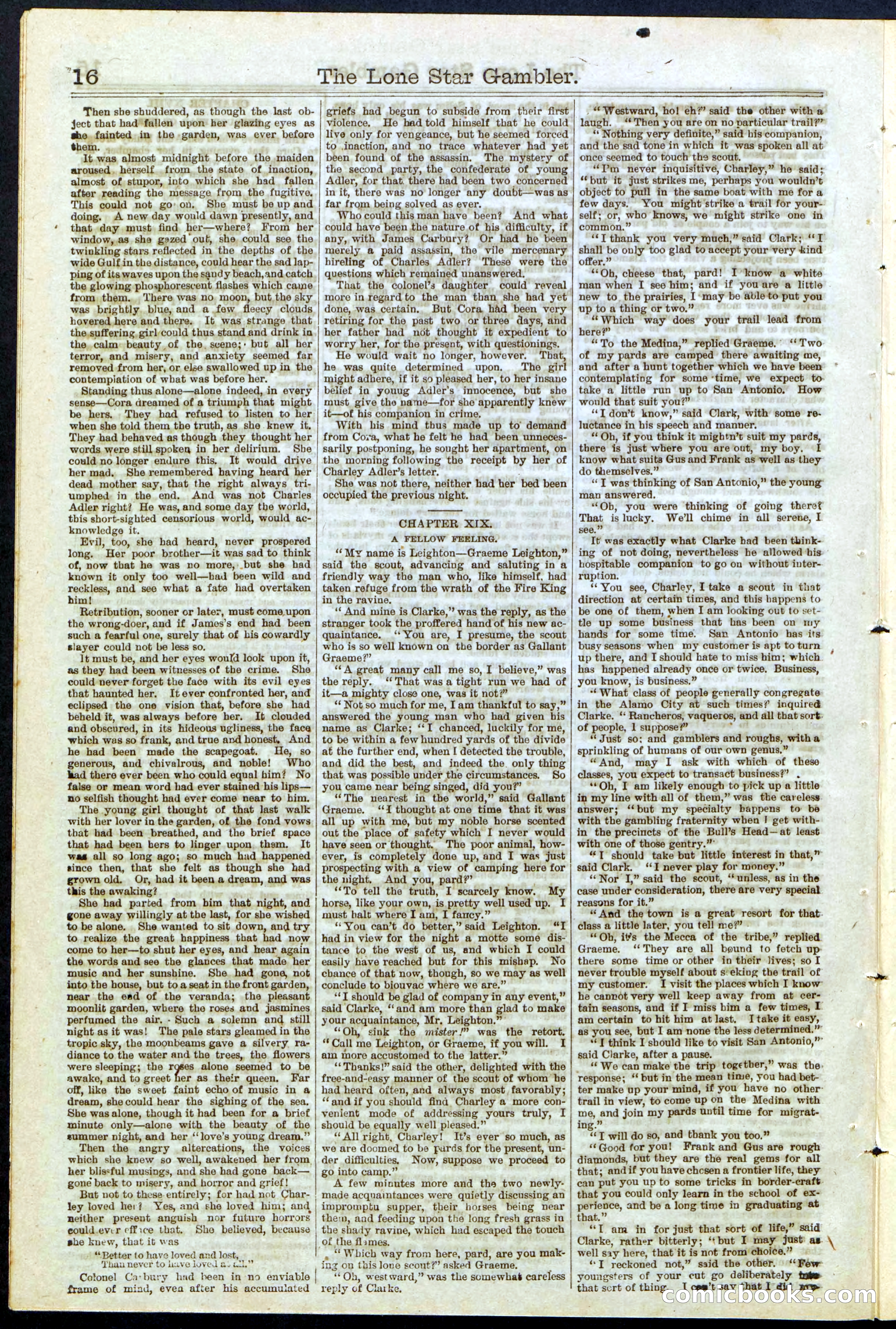
A restored page from Pulp Fiction, 1882. Page through the whole issue in the reader above.
📄 Transcribed text from this page (OCR, searchable)
Machine-transcribed from the original scan — historical spelling and the odd misread are preserved.
| | | 16 Then she shuddered, as though the last ob- fect that had fallen upon her glazing eyes as she fainted im the. garden, was ever before the , St ony almost _ midnight before the maiden aroused. herself fromthe state of inaction, almost of stupor, into which she had fallen after reading the message from, the fugitive, This could not goon, Sbe must be up and doing. A new day would dawn presently, and that day must find her—where? From her window,.as she gezed out, she, could see the twinkling stars reflected in the depths of the wide Gulf in the distance, could hear the sad lap- ping of its waves upon the sandy beach,and catch the glowing phosphorescent flashes which came from, them... There was no. moon, but the sky was brightly. blue, and a few fleecy clouds hovered here and there. It was strange that the,suffering, girlcould thus stand and drink in the,calm beauty of the, svene;: but all her terror, and misery, and anxiety seemed far removed from her, or else swallowed up in the contemplation of what was before her. Standing thus alone—alone indeed, in every sense—Cora dreamed of a triumph that might be hers, They had refused to listen to her when she told them the truth, as she knew it, They had behaved as though they thought her words were still spoken in her delirium. She could no longer endure this, It would drive her mad. She remembered having heard her dead mother say, that the right always tri- umphed in the end. And was not Charles Adler right? He was, and some day the world, this short-sighted censorious world, would ac- knowledge it. Evil, too, she bad heard, never prospered long. ’ Her poor brother—it was sad to think of, now tbat he was no more, but she had known it only too well—had been wild and reckless, and see what a fate had overtaken him! Retribution, sooner or later, must come upon the wrong-doer, and if James’s end had been such a fearful one, surely that of his cowardly slayer could not be less so. lt must be, and her eyes would look upon it, as they had been witnesses of the crime. She could never forget the face with its evil eyes that haunted her. Itever confronted her, and eclipsed the one vision that, before she had beheld it, was always before her. It clouded and obscured, in its hideous ugliness, the face which was so ’ frank, and true and honest, And he had been made the scapegoat. He, so generous, and chivalrous, and noble! Who had there ever been who could equal him? No false or mean word had ever stained his lips— no selfish thought had ever come near to him. The young girl thought of that last walk with her lover in the garden, of the fond vows that had been breathed, and the brief space that had been bers to linger upon, them, It waa all so long ago; so much had happened since then, that she felt as though she had grown old. Or, had it been a dream, and was this the awaking? She had parted from him that night, and gone away willingly at the last, for she wished to be alone. She wanted to sit down, and try to realize the great happiness that now come to her—to shut her eyes, and hear a pa the words and see the glances that made music and her sunshine. She had gone, ae into the house, but toa seat in the front garden, near the ead of the veranda; the pleasant moonlit garden, where the roses and jasmines perfumed the air, - Such a solemn and still night as it was! The pale stars gleamed in the tropic sky, the moonbeams gave a silvery. ra- diance to the water and the trees, the flowers were sleeping; the r alone seemed to be awake, and to greet her as their queen. Far off, like the sweet faint echo of music in a dream, she could hear the sighing of the sea. She was alone, though it had been for a brief minute only—alone with the beauty of the summer night, and her ‘“‘love’s young dream,” Then the angry altercations, the voices which she knew so well, awakened her from her blissful musings, and she had gone back— gone back to misery, and horror and grief! But not to these entirely; for had not Char- ley loved her? Yes, and she loved him; and neither present anguish nor future horrors could.ever effice that. She believed, because she knew, that it was As Better to have loved and lost, Vhau never to iuuve loved: Cotonel Ca:bury had been in no enviable frame of mind, evea after his accumulated Ov Geb The Lone Star Gambler. | Lone Star Gambler. Gambler. i en Se —— griefs had ,begun to subside from their first violence, He had told himself that he could live only for vengeance, but he seemed forced to inaction, and no trace whatever had yet been found of the assassin. The mystery of the second party, the confederate of young Adler, for that. there had been two concerned in it, there was no longer any doubt—was as far from being solved as ever. Who could this man have been? And what could have been the nature of his difficulty, if any, with James Carbury? Or had he been merely a paid assassin, the vile mercenary hireling of Charles Adler? ‘These were the questions which remained unanswered. That the colonel’s daughter could’ reveal more in regard to the man than she had yet done, was. certain. But Cora had been very retiring for the past two or three days, and her father had not thought if expedient to worry her, for the present, with questionings. He would wait no longer, however. That, he was quite determined upon. The girl might adhere, if it so pleased her, to her insane belief in youug Adler's innocence, but she must. give the name—for she apparently knew it—of his companion in crime, With his mind thus made up to demand from Cora, what he felt he had been unneces- sarily postponing, he sought her apartment, on the morning following the receipt by her of Charley Adler’s letter. She was not there, neither had her bed been occupied the previous night. CH APTER XIX. A FELLOW FEELING. “My name is Leighton—Graeme Leighton,” said the scout, advancing and saluting in a friendly way the man who, like himself, had taken refuge from the wrath of the Fire King in the ravine. ‘‘ And mine is Clarke,” was the reply, as the stranger took the proffered hand of his new ac- quaintance. “ You are, I presume, the scout who is so well known on the border as Gallant Graeme?” ‘A great many call me so, I believe,” was the reply. ‘*That wasa tight run we had of it—a mighty close one, was it not?” ‘** Not so much for me, Iam thankful to say,” answered the young man who had given his name as Clarke; ‘‘I chanced, luckily for me, to be within a few hundred yards of the divide at the further end, when [ detected the trouble, and did the best, and indeed the. only thing that was possible under the circumstances. So you came near being singed, did you?” ~ “The nearest in the world,” said Gallant Graeme. ‘I thought at one time that it was all up with me, but my noble horse scented out the place of safety which I never would have seen or thought. The poor animal, how- ever, is completely done up, and I was just prospecting with a view of camping here for the night, And you, pard?’ “To tell the truth, I scarcely know. My horse, like your own, is pretty well used up. I must halt where I am, I fancy.” “You can’t do better,” said Leighton. “TI had in view for the night a motte some dis- tance to the west of us, and which I could easily have reached but for this mishap. No cbance of that now, though, so we may as well conclude to biouvac where we are.” ad should be glad of company in any event,” said Clarke, ‘and am more than glad to make your acquaintance, Mr, Leighton.” “Oh, sink the mister!” was the retort. “Call me Leighton, or Graeme, if you will. I aim more accustomed to the latter.” ‘‘Thanks!” said the other, delighted with the free- -and-easy manner of the scout of whom he had heard often, and always most, favorably; “andif you should find. Charley a more con- venient mode of addressing yours truly, I should be equally well pleased.” “ All right, Charley! It’s ever so much, as we are doomed to be purds for the present, un- der difficulties. Now, suppose we proceed to go into camp.” A few minutes more and the two newly- made acquaintances were quietly discussing an impromptu supper, their horses being near thew, aad feeding upon the long fresh grass iu | the shady ravine, which had escaped the touch of the flames, ‘a “ Which way from here, pard, are you mak- ing on this lone scout?’ asked Graeme. “Oh, westward,” was the somewhaé careless reply of Clarke, “ “eWestward, ho! eh?’ said the other with a laugh. ‘Then you are on no particular trail?” “ Nothing very definite,” said his'companion, and the sad tone in which it was spoken all at once seemed to touch ths scout. “Pm never inquisitive, Charléy,” he said; “but it just strikes me, perhaps you wouldn’t object to pull in the same boat with me for a few days. You might'strike a trail for your- self; or, who knows, we might strike one in common.” “‘T thank you very much,” said Clark; ‘*T shall be only too glad to pig your very kind offer.” **Oh, cheese that, pard! I know a white man when I see him; and if you are a little new to the prairies, I may be able to put you up to a thing or two,” “Which way does your trail lead from here?” “To the Medina,” replied Graeme. ‘Two of my pards are camped there awaiting me, and after a hunt together which we have been contemplating for some ‘time, we expect to take a little run up to San Antonio, How would that suit you?” ‘‘T don’t know,” said Clark, with some re- luctance in his speech and manner, Oh, if you think it mightn’t suit my pards, there is just where you are out, my boy. I know what suits Gus and Frank as well as they do themselves.” “T was thinking of San Antonio,” the young man answered. “Ob, you were thinking of going thereft That islucky. We'll chime in all serene, I see.” It was exactly what Clarke had been think- ing of not doing, nevertheless he allowed his hospitable companion to go on without inter- ruption. ‘* You see, Charley, I take a scout in that direction at ‘certain times, and this happens to be one of them, when I am looking out to set- tle up some business that bas been on my hands for some time. San Antonio has its busy seasons when my customer is apt to turn up there, and I should hate to miss him; which has happened already once or twice. Business, you know, is business.” es What class of people generally congregate in the Alamo City at such times? inquired Clarke. “ Sen ie vaqueros, and all that sort. of people, 1 suppose?” “Just so: and gamblers and roughs, witha sprinkling of humans of our own genus,” “And, may I ask with which of these classes, you expect to transact business?” . ‘Oh, I am likely enough to pick up a little in my line with all of them,” was the careless answer; ‘‘but my specialty bappens to be with the gambling fraternity when | get with- in the precincts of the Burs Head—at least with one of those gentry.” “T should take but little interest in that,” said Clark. ‘I never play for money.” ‘‘Nor I,” said the scout, “unless, as in the case under consideration, there are very special reasons for it.” “Aad the town is a great resort for that. class a little later, you tell me?” - “Oh, it’s the Mecca of the tribe,” replied Graeme. “ They are all bound to fetch up there some time or other in their lives; so I never trouble myself about s‘eking the trail of my customer. I visit the places which I know he cannot very well keep away from at cer- tain seasons, and if I miss him a few times, I am certain to hit him atlast, Itake it easy, as you see, but I am none the less determined.” ‘“*T think I should like to visit San Antonio,’” said Clarke, after a pause. _ “We can make the trip together,” was the. response; *‘ but in the mean time, you had bet- ter make up your mind, if you have no other- trail in view, to come up on the Medina with me, and join my pards until time for migrat- in ” T will do so, and thank you too.” ‘Good for you! Frank and Gus are rough diamonds, but they are the real gems for all that; andif you have chosen a frontier life, they can put you up to some tricks in border-craft. that you could only learn in the school of ex- perience, and be a long time in graduating at that.” ~“T am in for just that sort of life,” said Clarke, rather bitterly; ‘*but I may just: as well say here, that'it is not from’ choice.” “T reckoned not,” said the other. ““Few youngsters of your cut go deliberately tub» that scrt of FG Omi fel ov oo alse “yt (ECO)