
Pulp Fiction, 1882 · page 15 of 28
Beadle's New York Dime Library, No. 195 — page 15: what you’re looking at
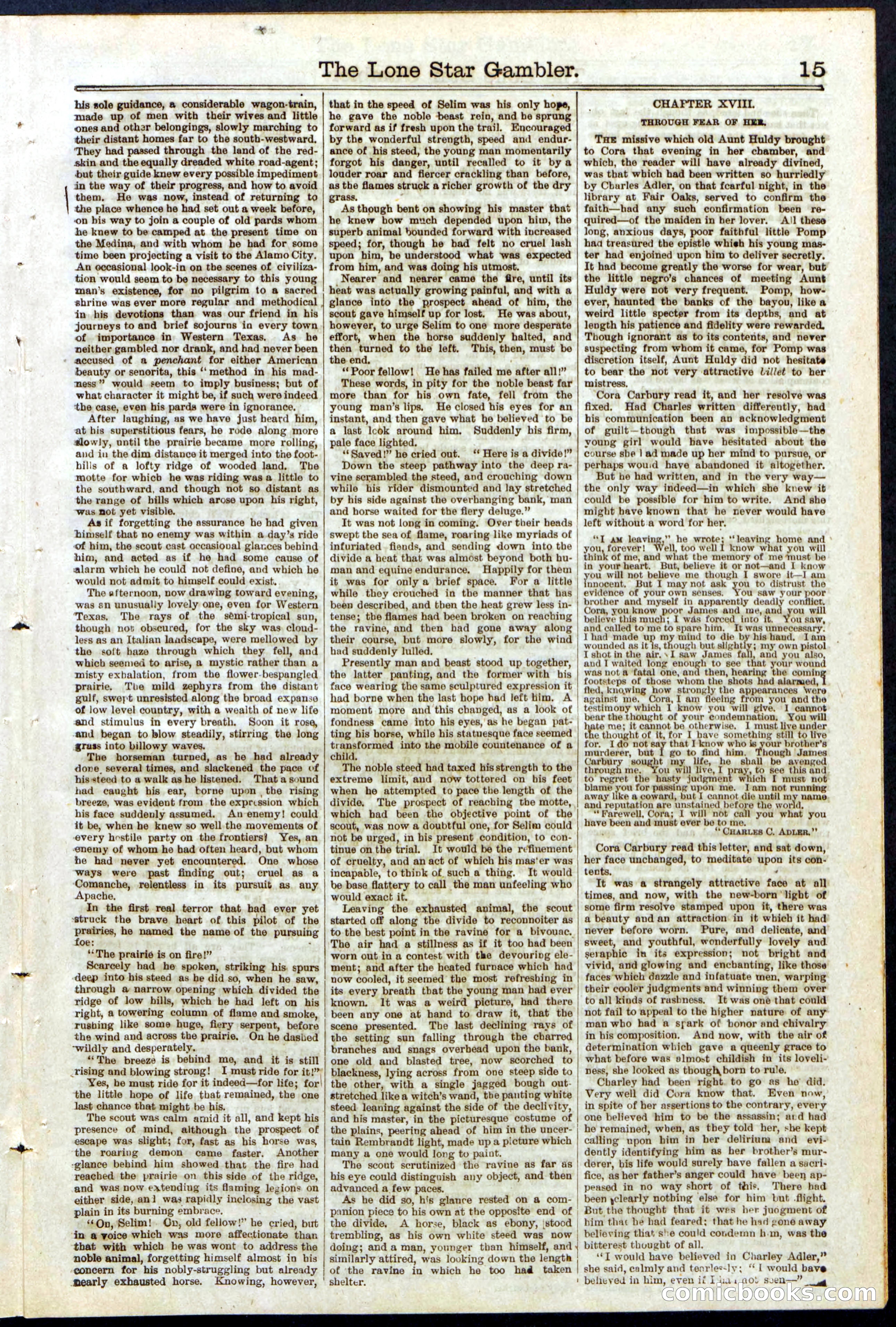
A restored page from Pulp Fiction, 1882. Page through the whole issue in the reader above.
📄 Transcribed text from this page (OCR, searchable)
Machine-transcribed from the original scan — historical spelling and the odd misread are preserved.
—— _rising and blowing strong! The Lone Star Gambler. 15 his sole guidance, a considerable wagon-train, made up of men with their wives and little ones and other belongings, slowly marching to their distant homes far to the south-westward, ‘They had passed through the land of the red- skin and the equally dreaded white road-agent; but their guide knew every possible impediment in the way of their progress, and how to avoid them. He was now, instead of returning to the place whence he had set out a week before, on bis way to join a couple of old pards whom he knew to be camped at the present time on the Medina, and with whom he had for some time been projecting a visit to the Alamo City. An occasional look-in on the scenes of civiliza- tion would seem to be necessary to this young man’s existence, for no pilgrim to a sacred shrine was ever more regular and methodical in his devotions than was our friend in his journeys to and brief sojourns in every town of importance in Western Texas. As he neither gambled nor drank, and had never been accused of a penchant for either American beauty or senorita, this ‘‘ method in his mad- mess” would seem to imply business; but of what character it might be, if such were indeed the case, even his pards were in ignorance. After laughing, as we have just heard him, at his superstitious fears, he rode along more alowly, until the prairie became more rolling, and iu the dim distance it merged into the foot- hills of a lofty ridge of wooded land, The motte for whicb he was riding was a little to the southward, and though not so distant as the range of bills which arose upon his right, was not yet visible. Asif forgetting the assurance he had given himself that no enemy was within a day’s ride of him, the scout cast occasioval glances behind him, and acted as if he had some cause of alarm which he could not define, and which he would not admit to himself could exist, The afternoon, now drawing toward evening, was 6n unusually lovely one, even for Western ‘Texas, The rays of the sémi-tropical sun, though not obseured, for the sky was cloud- less as an Italian landscape, were mellowed by the soft haze through which they fell, and which seemed to arise, a mystic rather than a misty exbalation, from the flower-bespangled prairie. Tbe mild zephyrs from the distant gulf, swe;t unresisted along the broad expanse of low level country, with a wealth of new life and stimulus in every breath. Soon if rose, and began to blow steadily, stirring the long grass into billowy waves. The horseman turned, as he had already done. several times, and slackened the pace of his steed to a walk as he listened. That a sound had caught his ear, borne upon the rising breeze, was evident from the expriession which his face suddenly assumed. An enemy! could it be, when he knew so well the movements of every hostile party on the frontiers? Yes, an enemy of whom he bad often heard, but whom he had never yet encountered. One whose ways were past finding out; Comanche, relentless in its pursuit as any Apache, In the first real terror that had ever yet struck the brave heart of this pilot of the postales, he named the name of the pursuing oe: : ‘The prairie is on fire!” Scarcely had he spoken, striking his. spurs deep into his steed as he did so, when he saw, through @ narrow opening which divided the ridge of low hills, which he had left on his right, a towering column of flame and smoke, rusbing like some huge, fiery serpent, before the wind and across the prairie. On he dasbed -wildly and desperately, “The breeze is bebind me, and it is still Yes, be must ride for it indeed—for lite; for the little hope of life that remained, the one last chance that might be his. The scout was calm amid it all, and kept his presence of mind, although the prospect of escape was slight; for, fast as bis horse was, the roaring demon came faster. Another ‘glance behind him showed that the fire had reached the prairie on this side of the ridge, and was now extending its flaming legions on either side, an] was rapidly inelosing the vast plain in its burning embrace. “On, Selim! . On, old fellow!” he cried, but ‘in a yoice which was more affectionate than that with which he was wont to address the noble animal, forgetting himself almost in his -eoncern for his nobly-struggling but already early exhausted horse. Knowing, however, ' shelter. cruel as a | I must ride for it!” that in the speed of Selim was his only hope, he gave the noble beast rein, and be sprung forward as if fresh upon the trail. Encouraged by the wonderful strength, speed and endur- ance of his steed, the young man momentarily forgot his danger, until recalled to it bya louder roar and fiercer crackling than before, as the flames struck a richer growth of the dry Sie : As though bent on showing his master that he knew bow much depended upon him, the superb animal bounded forward with increased speed; for, though he had felt no cruel lash upon him, be understood what was expected from him, and was doing his utmost. _Nearer and nearer came the fire, until its heat was actually growing painful, and with a glance into the prospect ahead of him, the scout gave himself up for lost. He was about, however, to urge Selim to one more desperate effort, when the horse suddenly halted, and then turned to the left. This, then, must be the end, Seat “Poor fellow! He has failed me after all!” These words, in pity for the noble beast far more than for his own fate, fell from the young man’s lips. He closed his eyes for an instant, and then gave what he believed to be a last lcok around him, Suddenly his firm, pale face lighted. ‘‘Saved!” he cried out. ‘ Here is a divide!” Down the steep pathway into the deep ra- vine serambled the steed, and crouching down while his rider dismounted and lay stretched by his side against the overhanging bank, man and horse waited for the flery deluge.” It was not long in coming. Over their heads | swept the sea of flame, roaring like myriads of infuriated fiends, and sending down into the divide a heat that was almost beyond both hu- man and equine endurance. Happily for them it was for only a brief space. For a little while they crouched in the manner that has been described, and then the heat grew less in- tense; the flames had been broken on reaching the ravine, and then had gone away along their course, but more slowly, for the wind had suddenly lulled. Presently man and beast stood up together, the latter panting, and the former with bis face wearing the same sculptured expression it had borne when the last hope bad left him. A moment more and this changed, as a look ot fondness came into his eyes, as he began pat- ting bis borse, while his statuesque face seemed transformed into the mobile countenance of a c The noble steed had taxed his strength to the extreme limit, and now tottered on bis feet when he attempted to pace the length of the divide, The prospect of reaching the motte, which had been the objective point of the scout, was now a doubtful one, for Selim could not be urged, in his present condition, to con- tinue on the trial. It would be the refinement of cruelty, and an act of which his mas'er was incapable, to think of such a thing. It would be base flattery to call the man unfeeling who would exact it. Leaving the exhausted animal, the scout started off along the divide to reconnoiter as to the best point in the ravine for a bivouac. The air had a stillness as if it too had been worn out in a contest with the devouring ele- ment; and after the heated furnace which had now cooled, it seemed the most refreshing in its every breath that the young man had ever known. It was a weird picture, had there been any one at hand to draw it, that the scene presented. The last declining rays of the setting sun falling through the charred branches and snags overhead upon the bank, one old and blasted tree, now scorched to blackness, lying across from one steep side to the other, with a single jagged bough out- stretched like a witch’s wand, tbe panting white steed leaning against the side of the declivity, and his master, in the picturesque costume of the plains, peering ahead of him in the uncer- tain Rembrandt light, made up a picture which many a one would long to paint. The scout scrutinized the ravine as far as his eye could distinguish any object, and then advanced a few paces. As he did so, his glance rested on a com- panion piece to his own at the opposite end of nn ——_ NS eee the divide, A horse, black as ebony, |stood | trembling, as his own white steed was now doing; and a man, younger than himself, and similarly attired, was looking down the length CHAPTER XVIII THROUGH FEAR OF HER, THE missive which old Aunt Huldy brought to Cora that evening in her chamber, and which, the reader will have already divined, was that which had been written so hurriedly by Charles Adler, on that fearful night, in the library at Fair Oaks, served to confirm the faith—had any such confirmation been re- quired—of the maiden in her lover. A/l these long, anxious days, poor faithful little Pomp had treasured the epistle whieh his young mas- ter had enjoined upon him to deliver secretly. It had become greatly the worse for wear, but the little negro’s chances of meeting Aunt Huldy were not very frequent. Pomp, how- ever, haunted the banks of the bayou, like a weird little specter from its depths, and at length his patience and fidelity were rewarded, Though ignorant as to its contents, and never suspecting from whom it came, for Pomp was discretion itself, Aunt Huldy did not hesitate to bear the not very attractive Lillet to her mistress, ‘Cora Carbury read it, and her resolve was fixed. Had Charles written differently, had his communication been an acknowledgment of guilt—though that was impossible—the voung girl would have hesitated about the course she | ad made up her mind to pursue, or perhaps wouid haye abandoned it altogether. But he had written, and in the very way— the only way indeed—in which she knew it could be possible for him to write. And she might bave known that he never would have left without a word for her. “IT am aving,.. he wrote; “leaving home and you, forever! ell, too well | know what you will think of me, and what the memory of me ‘must be in your heart. But, believe it or not—and I know you will not believe me though I swore it—I am nnocent, But I may not ask you bo distrust the evidence of your own senses. You saw your poor brother and myself in apparently deadly conflict. Cora, you know poor James and me, and you will believe this much; I was forced into it. You saw, and called to me to spare him. It was unnecessary. I had made up - mind to die by his hand, Iam wounded as it is, though but slightly; my own pistol I shot in the air.\I saw James fall, and you also and I waited long enough to see that your wound was not a fatal one, and then, h the ay footsteps of those whom the shots alarmed, fled, knowing how strongly the appearances Were against me, Cora,I am fleeing from you and the testimony which I know you will give. I cannot bear the thought of your condemnation, You will hale me; it cannot be otherwise. I must live under the thought of it, for I bave something still to live for. Ido not that I know who is your brother's murderer, but I go to find him hough James Carbur sougpt may life, he shall be avenged through me ou will live, I , to See this and 1g Ay tO rennet the hasty doltement which I must not blame — for passing upon me. Iam not ru away like a coward, but I cannot die until m and reputation are unstained before the world, “Farewell, Cora; I will not call you what you have been and must ever be to me. ; * OnaRLes C, ADLER,” Cora Carbury read this letter, and sat down, her face unchanged, to meditate upon its con- tents, 4 Tt was a strangely attractive face at all times, and now, with the new-born light of some firm resolve stamped upon it, there was a beauty and an attraction in it which it had Pure, and delicate, and never before worn. sweet, and youthful, wonderfully lovely and seraphic in its expression; not bright and vivid, and glowing and encbanting, like those faces which dazzle and infatuate men, warping their cooler judgments and winning them over to all kinds of rasbness. It was oné that could not fail to appeal to the higher nature of any man who had a spark of honor and chivalry in his composition. And now, with the air of determination which gave a queenly grace to what before was elmost childish in its loveli- ness, she looked as though born to rule. Charley had been right. to go as he did. Very well did Cora know that. Even now, in spite of her assertions to the contrary, every one believed him to be the assassin; ard had he remained, when, as they told her, she kept calling upon him in ber delirium and evi- dently identifying him as her brother’s mur- derer, bis life would surely bave fallen a sacri- fice, as her father’s anger could have been ap- peased in no way short of this. There had been yclearly notbing else for him but . flight. But the thought that it wes her juogment of him thac he had feared; that he had gone away believing that she could condemn h.m, was the bitterest thought of all. ‘‘T would have believed in Charley Adler,” of ‘the ravine in which he too had taken | she said, calmly and tearles-ly; ‘* | would bave »” believed in him, even if Ijia. name v Soen=— Pl S OO (f©) AML (E(0) ee ee