
Pulp Fiction, 1882 · page 14 of 28
Beadle's New York Dime Library, No. 195 — page 14: what you’re looking at
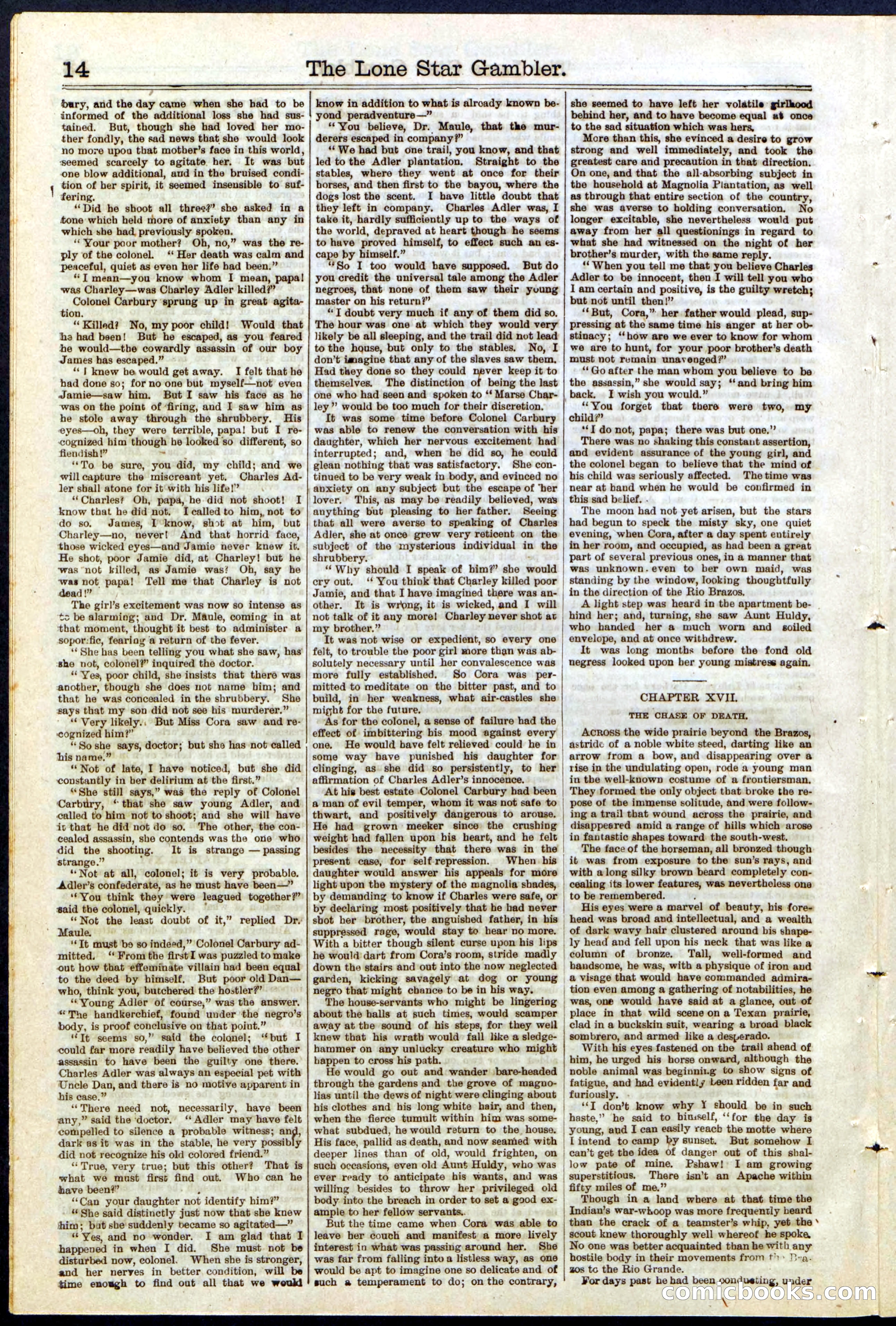
A restored page from Pulp Fiction, 1882. Page through the whole issue in the reader above.
📄 Transcribed text from this page (OCR, searchable)
Machine-transcribed from the original scan — historical spelling and the odd misread are preserved.
TS OT TOE —$——_—— a SS ——————— a ae een = — a ke ae er —_ ' Maule. 14 The —_ Star Gambler. bury, and the day came when she had to be informed of the additional loss she had sus- tained. But, though she had loved her mo- ther fondly, the sad news that she would look no more upoa that mother’s face in this world, seemed scarcely to agitate her. It was but one blow additional, aud in the bruised condi- tion of her spirit, it seemed insensible to suf- fering. “Did he shoot all three?’ she asked in a tone which held more of anxiety than any in which she had, previously spoken. ‘‘ Your poor mother? Oh, no,” was the re- ply of the colonel. ‘ Her death was calm and peaceful, quiet as even her life bad been.” **T mean—you know whom I mean, papa! was Charley—was Charley Adler killed?” Colonel Carbury sprung up in great agita- tion. “ Killed? No, my poor child! Would that ha had been! But he escaped, as you feared he would—the cowardly assassin of our boy James has escaped.” — “| knew be would get away. I felt that he had done so; for no one but myself—not even Jamie—saw him. But I saw his face as he ‘was On the point of ‘firing, and I saw him as he stole away through the shrubbery. His eyes—oh, they were terrible, papa! but I re- cognized him though he looked ‘so different, so fiendish!” aueaae* ‘*To be sure, you did, my child; and we willcapture the miscreant yet. Charles Ad- ler shall atone for it with his life!” ‘‘Charles? Oh, papa, he did not shoot! I know that he did not. Icalled to him, not to do so. James, I know, shot at him, but Charley—no, never! And that horrid face, those wicked eyes—and Jamie never knew it. He shot, poor Jamie did, at Charley! but he ‘was “not killed, as Jamie was! Oh, say he ‘was not papa! Tell me that Charley is not dead !” ) The gir]’s excitement was now so intense as ts be alarming; and Dr. Maule, coming in at that moment, thought it best to administer a sopor:fic, feariag a return of the fever. ‘‘ She has been telling you what she saw, has’ she not, colonel?’ inquired the doctor. “Yes, poor child, she insists that theré was another, though she does not name him; and that he was concealed in the shrubbery. She says that my son did not see his murderer.” “Very likely., But Miss Cora saw and re- cognized him?” “So she says, doctor; but she has not called his name.” ‘Not of late, I have noticed, but she did constantly in ber delirium at the first.” “She still says,” was the reply of Colonel Carbiry, * that she saw young Adler, and called to him not to shoot; and she will have it that he did not do so. The other, the con- cealed assassin, she contends was the one who did the shooting. It is strange — passing strange.” ; “Not at all, colonel; it is very probable. Adler’s confederate, as he must have been—” ‘‘You think they were leagued together?” said the colonel, quickly. ~ “Not the least doubt of it,” replied Drv ‘*Tt must be so indeed,” Colonel Carbury ad- mitted. ‘ From the firstI was puzzled to make out how that ¢ffeminate villain had been equal to the deed by himself. But poor old Dan— who, think you, butchered the hostler?’ ‘“Young Adler of course,” was the answer. “The handkerchief, found under the negro’s body, is proof conclusive on that poiut.” “Tt seems so,” said the colonel; “but I could far more readily have believed the other assassin to have been the guilty one there. Charles Adler was always an especial pet with Uncle Dan, and there is no motive apparent in his case.” “There need not, necessarily, have been any,” said the ‘doctor. “Adler may have felt compelled to silence a probable witness; ang, dark as it was in the stable, he very possibly did not recognize his old colored friend.” “True, very true; but this other? That is what we must first find out. Who can he have been?” OY “Can your daughter not identify him?’ ‘She said distinctly just now that she knew him; bat she suddenly became so agitated—” “Yes, and no wonder. I am glad that I happeved in when I did. She must not be disturbed now, colonel. "When she is stronger, and her nerves in better condition, will be time enough to find out all that we weukd know in addition to what is alroady known be- yond peradventure —” ‘You believe, Dr. Maule, that the mur- derers escaped in company?” ‘* We had but one trail, you know, and that led to the Adler plantation. Straight to the stables, where they went at once for their horses, and then first to the bayou, where the dogs lost the scent. I have little doubt that they left in company. Charles Adler was, I take it, hardly sufficiently up to the ways of the world, depraved at heart though he seems to have proved himself, to effect such an es- cape by himself.” “So I too would have supposed. But do you credit the universal tale among the Adler negroes, that none of them saw their young master on his return?’ “T doubt very much if any of them did so. The hour was one at which they would very likely be all sleeping, and the trail did not lead to the house, but only to the stables. No, I don’t imagine that any of the slaves saw them. Had they done so they could 2 a keep it to themselves. The distinction of being the last one who had seen and spoken to ‘‘ Marse Char- ley” would be too much for their discretion. It was some time before Colonel Carbury was able to renew the conversation with his daughter, which her nervous excitement had interrupted; and, when he did so, he could glean nothing that was satisfactory. She con- tinued to be very weak in body, and evinced no anxiety on any subject but the escape of ‘her lover. This, as may be readily believed, was anything but pleasing to her father. Seeing that all were averse to speaking of Charles Adler, she at once grew very reticent on the subject of the mysterious individual in the shrubbery. ‘ “Why should I speak of him?’ she would ery out. ‘* You think that Charley killed poor Jamie, and that I have imagined there was an- other. It is wrong, it is wicked, and I will not talk of it any more! Charley never shot at my brother.” It was not wise or expedient, so every one felt, to trouble the poor girl more than was ab- solutely necessary until her convalescence was more fully established. So Cora was per- mitted to meditate on the bitter past, and to build, in her weakness, what air-castles she might for the future. ‘As for the colonel, a sense of failure had the effect of imbittering his mood against every one. He would bave felt relieved could he in some way have punished his daughter for clinging, as she did so persistently, to her affirmation of Charles Adler’s innocence. At his best estate Colonel Carbury had been a man of evil temper, whom it was not safe to thwart, and positively dangerous to arouse. He had grown meeker since the crushing weight had fallen upon bis heart, and he felt besides the necessity that there was in the present case, for self-repression. When bis daughter would answer his appeals for more light upon the mystery of the magnolia shades, by demanding to know if Charles were safe, or by declaring most positively that he had never shot her brother, the anguished father, in his suppressed rage, would stay to hear no more. With a bitter though silent curse upon his lips he would dart from Cora’s room, stride madly down the stairs and out into the now neglected garden, kicking savagely at dog or young negro that might chance to be in his way. The house-servants who might be lingering about the balls at such times, would scamper away at the sound of his steps, for they well knew that his wrath would fall like a sledge- hammer on any unlucky creature who might happen to cross his path. ' He would go out and wander bare-headed through the gardens and the grove of magno- lias until the dews of night were clinging about his clothes and his long white hair, and then, | when the fierce tumult within him was some- what subdued, he would return to the house. His face, pallid as death, and now seamed with deeper lines than of old, would frighten, on such occasions, even old Aunt Huldy, who was ever ready to anticipate his wants, and was willing besides to throw her privileged old body into the breach in order to set a good ex- ample to her fellow servants.. But the time came when Cora was able to leave her couch and manifest a more lively interest in what was passing around her. She was far from falling into a listless way, as one would be apt to imagine one so delicate and of such a temperament to do; on the contrary, she seemed to have left her volatile girlhood behind her, and to have become equal at once to the sad situation which was hers, More than this, she evinced a desire to grow strong and well immediately, and took the greatest care and precaution in that direction. On one, and that the all-absorbing subject in the household at Magnolia Plantation, as well as through that entire section of the country, she was averse to holding conversation. No longer excitable, she nevertheless would put away from her all questionings in regard to what she had witnessed on the night of her brother’s murder, with the same reply. ‘* When you tell me that you believe Charles Adler to be innocent, then I will tell you who I am certain and positive, is the guilty wretch; but not until then!” ‘“*But, Cora,” her father would plead, sup- pressing at the same time his anger at her ob- stinacy; ‘how are we ever to know for whom — we are to hunt, for your poor brother’s death must not remain unavenged?’ ‘‘Go after the man whom you believe to be the assassin,” she would say; ‘and bring him back. I wish you would.” “You forget that there were two, my child?” ‘*I do not, papa; there was but one,”’ There was no shaking this constant assertion, and evident assurance of the young girl, and the colonel began to believe that the mind of his child was seriously affected. The time was near at band when he would be confirmed in this sad belief. . The moon had not yet arisen, but the stars had begun to speck the misty sky, one quiet evening, when Cora, after a day spent entirely in her room, and occupied, as had been a great part of several previous ones, in a manner that was unknown.even to ber own maid, was standing by the window, looking thoughtfully in the direction of the Rio Brazos. A light step was heard in the apartment be- hind her; and, turning, she saw Aunt Huldy, who handed her a much worn and soiled envelope, and at once withdrew. It was long months before the fond old negress looked upon ber young mistress again. CHAPTER XVII. THE CHASE OF DEATH, Across the wide prairie beyond the astride of a noble white steed, darting like an arrow from a bow, and disappearing over a rise in the undulating open, rode a young man in the well-known costume of a frontiersman, They formed the only object that broke the re- pose of the immense solitude, and were follow- ing a trail that wound across the prairie, and disappesred amid a range of hills which arose in fantastic shapes toward the south-west. | The face of the horseman, all bronzed though | it was from exposure to the sun’s rays, and | with along silky brown beard completely con- | cealing its lower features, was nevertheless one to be remembered. J His eyes were a marvel of beauty, his fore+ head was broad and intellectual, and a wealth of dark wavy hair clustered around bis shape- _ ly head and fell upon his neck that was like a column of bronze. Tall, well-formed and bandsome, he was, with a physique of iron and _a Visage that would have commanded admira- tion even among a gathering of notabilities, he was, one would have said at a glance, out of place in that wild scene on a Texan prairie, clad in a buckskin suit, wearing a broad black sombrero, and armed like a desperado. With his eyes fastened on the trail ahead of him, he urged his horse onward, although the noble animal was beginnit.g to show signs of fatigue, and had evidently Leen ridden far and furiously. - ‘“‘T don’t know why Y should be in such haste,” he said to biniself, ‘“‘for the day is | young, and I can easily reach the motte where _Lintend tocamp by sunset. But somehow I | can’t get the idea of danger out of this sbal- low pate of mine. Pshaw! I am growing superstitious. There isn’t an Apache within fifty miles of me,” Though in a land where at that time the Indian’s war-whoop was more frequently beard than the crack of a teamster’s whip, yet the ‘ scout knew thoroughly well whereof he spoke No one was better acquainted than be with any hostile body in their movements from f>> D-a- aos to the Rio Grande. Vor days past be had been con uetin der (<0) Ks (E(0) nicho