
Pulp Fiction, 1882 · page 13 of 28
Beadle's New York Dime Library, No. 195 — page 13: what you’re looking at
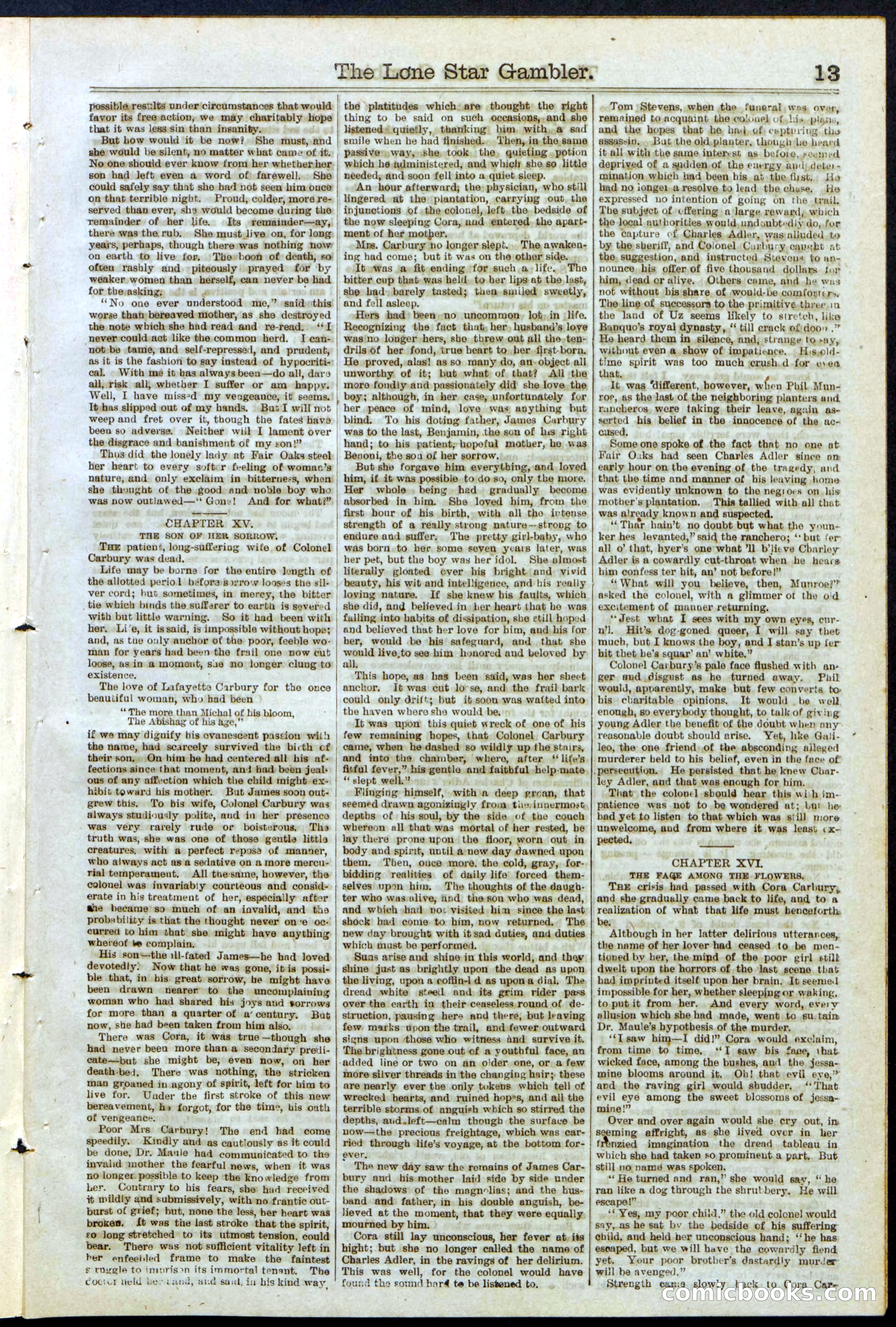
A restored page from Pulp Fiction, 1882. Page through the whole issue in the reader above.
📄 Transcribed text from this page (OCR, searchable)
Machine-transcribed from the original scan — historical spelling and the odd misread are preserved.
The Lone Star Gambler. possible. results under circumstances that would | the platitudes which are thought the right favor its freeaction; we may charitably hope | thing to be said on such occasions,,and she that it was less sin than insaniby. But how would it be now? She must, and te. she would be silent, no matter what came of it. _ passive. way, she took the, quie listened quietly, thanking him, with,.a sad smile when he had finished... Then, in the,same potion No one should ever know from her whetberher., which he administered, and whielr she so little son had Jeft even a word of) farewell. could safely say that she bad not seen him ouce on that terrible night. Proud, colder, more re- served than ever, sha would become during the remainder of her life. | Sbe | needed; and soon fell into a quiet sleep. An hour afterward; the physician, who still lingered at the plantation, carrying out. the injunctions of .the colonel, left, the bedside of Its vemainder—ay, , the now sleeping Cora, and entered. the apart- there was the. rub. She must Jive on, for long ment of her mother, ’ years, perhaps, though there was nothing now on earth to live for, often rashly and -piteously prayed for by | Mns. Carbury no longer slept. The, awaken- The»boon of death, so | ing had come; but it was on the other side. , It owas ‘a fit.ending for such a life. ~The weaker women than herself, can never be had | bitter cup that was held, to ber lips at the last, for the,asking; r : “No one ever understood me,” saidthis worse that: bereaved mother, as she destroyed the note which she had read and re-read. ‘I never could act like the common herd. I ean- not- be tame, and self-repressed, and prudent, } she bad: barely tasted; then smiled sweetly, and fell asleep. usd wi clase Hers had been no uncommon lot, in life. Recognizing the fact that, her, husband’s love was no longer hers, she threw out all the, ten- drils of her fond, true beart to ber first-born, as it is the fashion to say instead of hypocriti--- He proved, alas! asso many do, an- object all cal. With me it bas always beea—do all, dara all, risk all, whether I suffer or am happy. Well, I have missed my vengeance, if seems. It-has slipped out of my hands, Bust I will not weep and fret over it, though the fates have unworthy of it; but what of that? All the more fondly and passionately did she love the | boy; although, in her case, unfortunately for been so adverse. Neither wiil I lament over | the disgrace and banishment of my son!” her peace of mind, love wax avything but blind. To his doting father, James Carbury was to the last, Benjamin, the son of lis right hand; to his patient; hopeful mother, he was Thus did the lonely lady at Fair Oaks steel | Benoni, the soa of her sorrow, her heart to every softcr feeling of woman’s nature, and only exclaim in bitterness, when she theught of the good and noble boy who was now outiawed—‘t Gone! And for what?” CHAPTER XV. THE SON OF HER SORROW. Tae patient, long-suffering wife of Colonel Carbury was dead, Life may be borne for the entire Jength of | the allotted perio. before s .rrow looses the sil- tie which binds the sufferer to earth is severed with but little warning. So it had been with her. Li’e, it issaid, is impossible without hope; and, as tue ouly anchor of the poor, feeble wo- man for years had been the frail one now cut loose, as in a moment, sae no longer clung to existence. The love of Lafayette Carbury for the once beautiful woman, who bad been “The more than Michal of his bloom, The Abishag of his age,” if we may dignuify bis evanescent passion wiih the name, had scarcely survived the birth of their son,, On him he had centered all his af- fections since that moment, and had been jeal+ ous of any affection which the child might -ex- hibit toward his mother. But James soon out- grew this. To bis wife, Colonel Carbury was always studiously polite, and in her presence was very rarely rude or boisterous, Ths truth was, she was one of those gentle little creatures, with a perfect repose of manner, who always act as a sedative on a more mercu- rial temperament. All thesame, however, the colonel was invariably courteous and consid- erate in his treatment of her, especially after aie became so much of an invalid, and tho probs bility is that the thought never one oc- curred to him that sbe might have anything whereof # complain, His son the ill-fated James—he had loved devotedly: Now that he was gone, itis possi- ble that, in bis great sorrow, be might have been drawn nearer to the uncomplaining woman who had shared his joys aud sorrows for more than a quarter of a’ century, But now, she had been taken from him also, There was Cora, it was true —though she had never been more than a secondary preii- cate—but she might be, even now, on her death-bed. There was nothing, the stricken man groaned in agony of spirit, left for bim to live for. Under the first stroke of this new bereavement, h» forgot, for the time, bis onth of vengeance. Poor Mrs Carbury! The end had come speedily. Kindly and as cautiously as it could be done, Dr. Manie had communicated to the invalid mother the fearful news, when it was n0 longer possible to keep the knowledge from Ler. Contrary to his fears, she had received it mildiy and submissively, with no frantic out- burst of grief; but, none the less, her heart was broken. {t was tie last stroke that the spirit, so long stretched to its utmost tension, could bear. There was not sufficient vitality left in ber enfeeiled frame to make the faintest s rigele to im»prison its immortal tenant. The Coctur tteld bes iand, and sail, in bis kind way, - \ But she forgave him everytbing, and loved him, if it was possibie to do so, only the more. Her whole . being had gradually become absorbed in him. Sbe loved him, from the first bour of his birth, with all the ivtense strength of a really strong nature—strong to endure and suffer, The pretty girl-baby, who was born. to her some seven years later, was her pet, but the boy was her idol. She almost literally gloated over his bright and vivid | beauty, his wit and intelligence, and bis really ver cord; but sometimes, in merey, the bitter | | | loving nature. If she knew his faults, which she did, ang believed in her heart that he was falling into habits of dissipation, sbe etill hoped and believed that her love for bim, and his for her, would be his safeguard, and that she would live,to see him hvnored and beloved by all. This hope, as has been said, was her sheet anchor. It was cut lose, and the frail bark could only drift; but if soon was watted into the haven where she would be, It was upon this quiet wreck of one of his few remaining hopes, that Colonel Carbury came, when he dashed so wildly up the stnirs, and into the chamber, where, after *‘ life’s fitful fever,” his gentle and faithful help-mate «slept well.” | wt? Neo cull atl Flinging himself, with a deep grean, that seemed drawn agonizingly from. tive,innermost depths of his soul, by the side of the couch whereon all that was mortal of her rested, be lay there prone upon the floor, worn out in body and spirit, until a new day dawned upon them. Then, ouce more, the cold, gray, for- bidding realities of daily life forced them- selves vpon him. The thoughts of the daugh- ter who was.alive, ind the son who was dead, and which had nox visited him since the last shock had come to him, now returned, The new day brought with it sad duties, and duties } which must be performed. Suas arise and shine in this world, and thay shine just as brightly upon the dead as upon the living, upon a coflin-ld as upona dial, The dread white steed and its grim rider pass over the earth in their ceaseless round of de- struction, pausing here and there, but leaving few marks upon the trail, and fewer outward signs upon ‘those who witness and survive it. The brightness gone out of a youthful face, an ‘added line or two on an o'der one, or a few more silver threads in the changing hair; these are nearly ever the only tukens which tell of wrecked hearts, and ruined hopes, and all the terrible storms of anguish which so stirred the depths, aud.left—calm though the surface be now—the precious freightage, which was car- ried through life’s voyage, at the bottom for- ever, The new day saw the remains of James Car- bury and his mother laid side by side under the shadows of the magnolias; and the bus- band and father, in his double anguish, be- lieved at the moment, that they were equally, mourned by bim. Cora still lay unconscious, her fever at, its hight; but she no longer called the name of Charles Adler, in the ravings of her delirium. This was well, for the colonel would have found the sound hard te be listened to. | 13 et eee 0 se -_—-— Tom | Stevens, when the funeral wes over, remained to acquaint the colonel) of his, plans, and the hopes that he had, of coptrriug the assassin, . But the old. planter, though Le heard it all with the same interest as before, reemed deprived of a sudden,of the euergy ani) dete - mination which had been his ait the fist, Iie had no iongel a resolve to lead the chuse, He expressed no intention of going on the trail. The subject of offering a large reward, which the local authorities would, undoubtediy do, for the Capture of Charles Adler, was alluded to by: the sheriff, and Colonel. Curbury.capgbt at the, suggestion, and instructed Stevens to an- nounce, his offer of five thousand dollars tur hip, dead or aliye. Others came, and he wus not without bis share of would-be comfoyters. The line of successors to the primitive three in the land of Uz seems likely to stretch, like Banquo’s royal dynasty, “ till erack of door .” He heard them in silence, and, strange to say, without even a show of impatience. H)s,0ld- time spirit was too much crush.d for e.ea that, lt was ‘different, however, when Phil. Mun- roe, as the last of the neighboring planters and rancheros, were taking their leave, again as- serted his belief in the innocence of the ac- Some one spoke of the fact that no one at Fair Oaks had seen Charles Adler since om early hour on the evening of the tragedy, and that the time and manner of his leaving home was evidently unknown to the negioes on_ his mother's plantation. | This tallied with all that was already known and suspected. ‘‘Thar hain’t no doubt but what the youn- ker hes levanted,” said the ranchero; ‘but fer all o’ that, hyer’s one what ’ll b’licve Charley Adler is a cowardly cut-throat when he hears him confess ter hit, an’ not before!” “What will you believe, then, Munroe?’ asked the colonel, with a glimmer ot the o'd excitement of manner returning. “Jest what I sees with my own eyes, cur- n’l. Hit’s dog-goned queer, I will say thet much, but I knows the boy, and I stan’s up fer bit thet be’s squar’ an’ white,” Colonel Carbury’s pale face flushed with an- ger aud disgust as he turned away. Phil would, apparently, make but few converts to his charitable opinions. It would _be well enough, so everybody thought, to talk of giving young Adler the benefit of the doubt when any: reasonable doubt should arise, Yet, hke Guaji- leo, the one friend of the absconding alleged murderer beld to his belief, even in the face of .persecution. He persisted that he knew Char- ley Adler, and that was enough for him. That the colovel sbould hear this with im- patience was not to be wondered at; Lut he bad yet to listen to that which was s({ill more unwelcome, and from where it was least «x- pected, } hia! CHAPTER XVI THE FAGE AMONG THE FLOWERS, TRE crisis had passed with Cora Carbury, and she gradually came back to life, and to a realization of what that life must benceforth Although in her latter delirious utterances, the name of her lover had ceased to be men- tioned by her, the mind of the poor girl still dwelt upon the horrors of the last scene that had imprinted itself upon her brain. It seemet impossible for her, whether sleepingor waking, to put it from her. And every word, every allusion which she had made, went to su.tain Dr. Maule’s hypothesis of the murder. ‘“‘Tsaw him—I did!” Cora would exclaim, from time to time, “I saw bis face, that wicked face, among the bushes, and the jessa- mine blooms around it. Ob! that evil eye,” and the raving girl would shudder, ‘That evil eye among the sweet blossoms of jessa- mine!” “ Over and over again would she cry out, im ming affright, as she lived over in her frénzied imagination the dread tableau in which she bad taken so prominent a part,. But still no namd was spoken, ‘‘ He turned and ran,” she would gay, “ he ran like a dog through the shrubbery, He will escape!” , ‘* Yes, my poor chiid,” the old colonel would say,as he sat by the bedside of his suffering ebild, and held ber unconscious hand; ‘‘he has escaped, but we will have the cowardly fiend yet. Your poor brother’s dastardly murder will be avenged.” Strength ‘GO m icbookssco