
Pulp Fiction, 1882 · page 12 of 28
Beadle's New York Dime Library, No. 195 — page 12: what you’re looking at
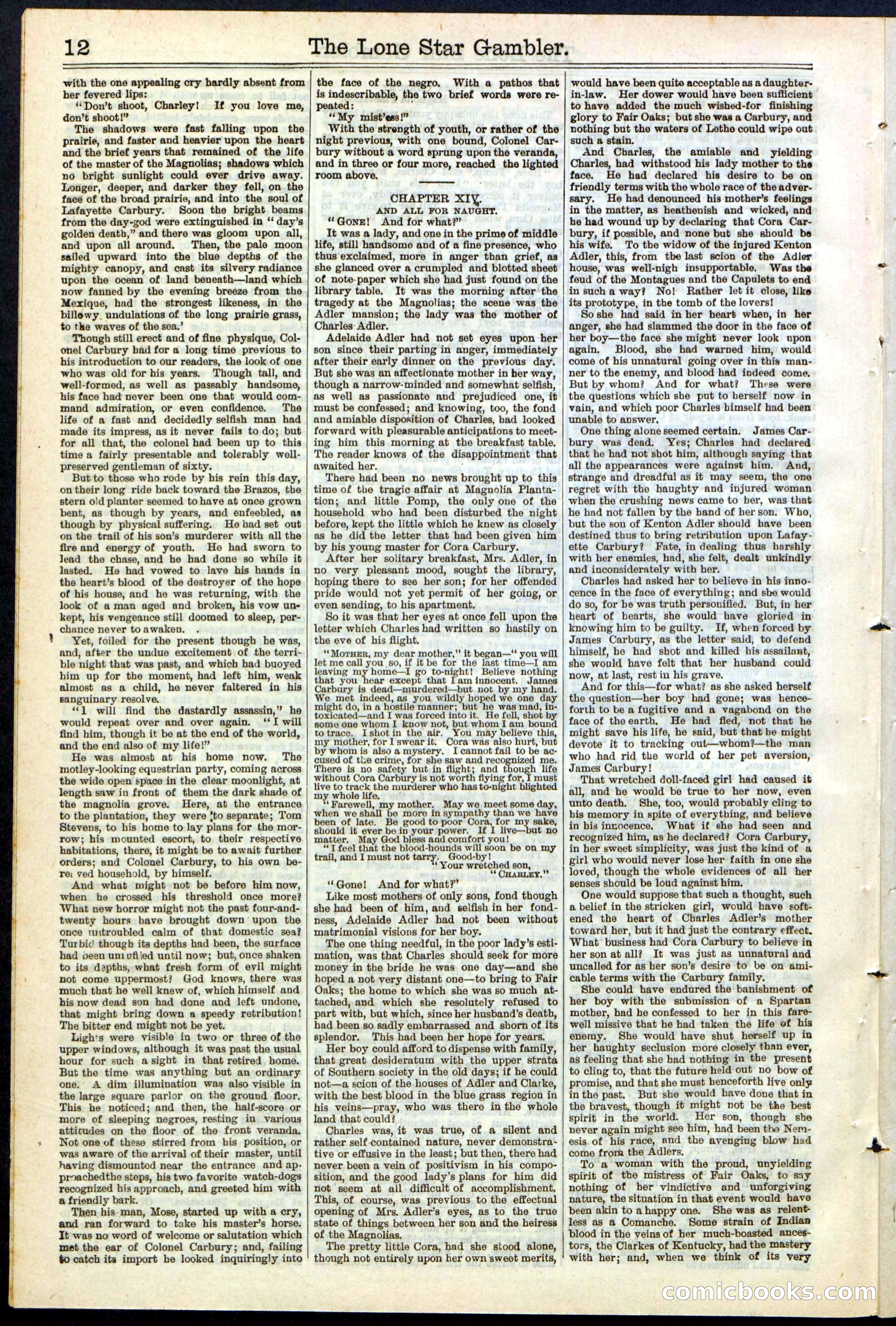
A restored page from Pulp Fiction, 1882. Page through the whole issue in the reader above.
📄 Transcribed text from this page (OCR, searchable)
Machine-transcribed from the original scan — historical spelling and the odd misread are preserved.
— SS Cee a a eS — 12 The Lone Star Gambler. with the one appealing cry hardly absent from her fevered lips: ‘Don’t shoot, Charley! don’t shoot!” The shadows were fast falling upon the prairie, and faster and heavier upon the heart and the brief years that remained of the life of the master of the Magnolias; shadows which no bright sunlight could ever drive away. Longer, deeper, and darker they fell, on the faeé of the broad prairie, and into the soul of Lafayette Carbury. Soon the bright beams from the day-god were extinguished in “ day’s golden death,” and there was gloom upon all, and upon all around. Then, the pale moon sailed upward into the blue depths of the mighty canopy, and cast its silvery radiance upon the ocean of land beneath—land which now fanned by the evening breeze from the Mexique, had the strongest likeness, in the billowy. undulations of the long prairie grass, to the waves of the sea.’ Though still erect and of fine physique, Col- onel Carbury bad for a long time previous to his introduction to our readers, the look of one who was old for his years. Though tall, and well-formed, as well as passably handsome, his face had never been one that would com- mand admiration, or even confidence. The life of a fast and decidedly selfish man had made its impress, as it never fails to do; but for all that, the colonel had been up to this time a fairly presentable and tolerably well- preserved gentleman of sixty. But to those who rode by his rein this day, on their long ride back toward the Brazos, the stern old planter seemed to have at once grown bent, as though by years, and enfeebled, as though by pbysical suffering. He bad set out on the trail of his son’s murderer with all the fire and energy of youth. He had sworn to Jead the chase, and he had done so while it lasted. He had vowed to lave his hands in the heart’s blood of the destroyer of the hope of his house, and he was returning, with the look of aman aged and broken, his vow un- kept, his vengeance still doomed to sleep, per- chance never toawaken. . Yet, foiled for the present though he was, and, after the undue excitement of the terri- ble night that was past, and which had buoyed him up for the moment, had left him, weak almost as a child, he never faltered in his sanguinary resolve, ‘‘] will find the dastardly assassin,” he would repeat over and over again. ‘I will find him, though it be at the end of the world, and the end also of my life!” He was almost at his home now. The motley-looking equestrian party, coming across the wide open space in the clear moonlight, at length saw in front of them the dark shade of the magnolia grove. Here, at the entrance to the plantation, they were 'to separate; Tom Stevens, to his home to lay plans for the mor- row; his mounted escort, to their respective habitations, there, it might be to await further orders; and Colonel Carbury, to his own be- re: ved household, by himself. And what might not be before him now, when he crossed his threshold once more? What new horror might not the past four-and- twenty hours have brought down upon the once twitroubled calm of that domestic sea? Turbic though its depths had been, the surface had een univfiled until now; but, once shaken to its dapths, what fresh form of evil might not come uppermost? God knows, there was much that he well knew of, which himself and his now dead son had done and left undone, that might bring down a speedy retribution! The bitter end might not be yet. Lights were visible in two or three of the upper windows, although it was past the usual hour for such asight in that retired home. But the time was anything but an ordinary one. A dim illumination was also visible in the large square parlor on the ground floor, This he noticed; and then, the half-score or more of sleeping negroes, resting in various atticudes on the floor of the front veranda, Not one of these stirred from bis position, or was aware of the arrival of their master, until having dismounted near the entrance and ap- proachedthe steps, his two favorite watch-dogs recognized his approach, and greeted him with a friendly bark. Then his man, Mose, started up with a cry, and ran forward to take his master’s horse, It was no word of welcome or salutation which met the ear of Colonel Carbury; and, failing to catch its import he looked inquiringly into If you love me, the face of the negro, With a pathos that is indescribable, the two brief words were re- peated: “My mist’ess!” With the strength of youth, or rather of the night previous, with one bound, Colonel Car- bury without a word sprung upon the veranda, and in three or four more, reached the lighted room above, CHAPTER XIY. AND ALL FOR NAUGHT. **GonE! And for what?’ It was a lady, and one in the prime of middle life, still handsome and of a fine presence, who thus exclaimed, more in anger than grief, as she glanced over a crumpled and blotted sheet of note-paper which she had just found on the library table. It was the morning after the tragedy at the Magnolias; the scene was the Adler mansion; the lady was the mother of Charles Adler. Adelaide Adler had not set eyes upon her son since their parting in anger, immediately after their early dinner on the previous day. But she was an affectionate mother in her way, though a narrow-minded and somewhat selfish, as well as passionate and prejudiced one, it must be confessed; and knowing, too, the fond and amiable disposition of Charles, bad looked forward with pleasurable anticipations to meet- ing him this morning at the breakfast table, The reader knows of the disappointment that awaited her. There had been no news brought up to this time of the tragic affair at Magnolia Planta- tion; and little Pomp, the only one of the household who had been disturbed the night before, kept the little which he knew as closely as he did the letter that had been given him by his young master for Cora Carbury. After her solitary breakfast, Mrs. Adler, in no very pleasant mood, sought the library, hoping there to see her son; for her offended pride would not yet permit of her going, or even sending, to his apartment. So it was that her eyes at once fell upon the letter which Charles had written so hastily on the eve of his flight. ‘‘Morner, my dear mother,” it began—‘“‘ you will let me call you so, if it be for the last time—I am leaving my home—I go to-night! Believe nothing that you hear except that [am innocent. James Carbury is dead—murdered—but not by my hand. We met indeed, as you wildly hoped we one day might do, in a hostile manner; but he was mad, in- toxicated—and I was forced into it. He fell, shot by some one whom I know not, but whom Iam bound to trace. Ishotin the air. You may believe this, my mother, for 1 swear it. Cora was also hurt, but by whom is also a mystery. I cannot fail to be ac- cused of the crime, for she saw and recognized me. There is no safety but in flight; and though life without Cora Carbury is not worth flying for, I must live to track the murderer who has to-night blighted my whole life. ‘Farewell, my mother. May we meet some day, when we shall be more in sympathy than we have been of late. Be good to poor Cora, for my sake, should it ever be in your power. If I live—but no matter. May bless and comfort you! “T feel that the blood-hounds will soon be on my trail, and I must not ania patie by 7 sath waa ** CHARLE ‘Gone! And for what?” Like most mothers of only sons, fond though she had been of him, and selfish in her fond- ness, Adelaide Adler bad not been without matrimonial visions for her boy. The one thing needful, in the poor lady’s esti- mation, was that Charles should seek for more money in the bride he was one day—and she hoped a not very distant one—to bring to Fair Oaks; the home to which she was so much at- tached, and which she resolutely refused to part with, but which, since her husband’s death, had been so sadly embarrassed and shorn of its splendor. This had been her hope for years. Her boy could afford to dispense with family, that great desideratum with the upper strata of Southern society in the old days; if he could not—a scion of the houses of Adler and Clarke, with the best blood in the blue grass region in his veins—pray, who was there in the whole land that could? Charles was, it was true, of a silent and rather self-contained nature, never demonstra- tive or effusive in the least; but then, there had never been a vein of positivism in his compo- sition, and the good lady’s plans for him did not seem at all difficult of accomplishment, This, of course, was previous to the effectual opening of Mrs. Adler’s eyes, as to the true state of things between her son and the heiress of the Magnolias, The pretty little Cora, had she stood alone, though not entirely upon her own sweet merits, y.”’ would have been quite acceptable as a daughter- in-law. Her dower would have been sufficient to have added the much wished-for finishing glory to Fair Oaks; but she was a Carbury, and nothing but the waters of Lethe could wipe out such a stain. And Charles, the amiable and yielding Charles, had withstood his lady mother to the face. He had declared his desire to be on friendly terms with the whole race of the adver- sary. He had denounced his mother’s feelings in the matter, as heathenish and wicked, and he had wound up by declaring that Cora Car- bury, if possible, and none but she should be his wife. To the widow of the injured Kenton Adler, this, from tbe last scion of the Adler house, was well-nigh insupportable. Was the feud of the Montagues and the Capulets to end in such a way? No! Rather let it close, like its prototype, in the tomb of the lovers! Soshe had said in her heart when, in her anger, she had slammed the door in the face of her boy—the face she might never look upon again. Blood, she had warned him, would come of his unnatural going over in this man- ner to the enemy, and blood had indeed come, But by whom? And for what? These were the questions which she put to herself now in vain, and which poor Charles bimself had been unable to answer, One thing alone seemed certain. James Car- bury was dead. Yes; Charles had declared that he had not shot him, although saying that all the appearances were against him. And, strange and dreadful as it may seem, the one regret with the haughty and injured woman when the crushing news came to her, was that he bad not fallen by the hand of her son. Who, but the son of Kenton Adler should have been destined thus to bring retribution upon Lafay- ette Carbury? Fate, in dealing thus harshly with her enemies, had, she felt, dealt unkindly and inconsiderately with her. Charles had asked her to believe in his inno- cence in the face of everything; and she would do so, for be was truth personified. But, in her heart of hearts, she would have gloried in knowing him to be guilty. If, when forced by James Carbury, as the letter said, to defend himself, he had shot and killed his assailant, she would have felt that her husband could now, at last, rest in his grave. And for this—for what? as she asked herself the question—her boy had gone; was hence- forth to be a fugitive and a vagabond on the face of theearth, He had fled, not that he might save his life, he said, but that be might devote it to tracking oult—whom?—the man who had rid the world of her pet aversion, James Carbury! That wretched doll-faced girl had caused it all, and he would be true to her now, even unto death. She, too, would probably cling to his memory in spite of everytbing, and believe in bis innocence. What if she had seen and recognized him, as he declared? Cora Carbury, in her sweet simplicity, was just the kind of a girl who would never lose her faith in one she loved, though the whole evidences of all her senses should be loud against him. One would suppose that such a thought, such a belief in the stricken girl, would have soft- ened the heart of Charles Adler’s mother toward her, but it had just the contrary effect. What business had Cora Carbury to believe in her son at all? It was just as unnatural and uncalled for as her son’s desire to be on ami- cable terms with the Carbury family. She could have endured the banishment of her boy with the submission of a Spartan mother, had he confessed to her in this fare- well missive that he had taken the life of his enemy. She would have shut herself up in her haughty seclusion more closely than ever, as feeling that she had nothing in the present to cling to, that the future held out no bow of promise, and that she must henceforth live only in the past. But she would have done that in the bravest, though it might not be the best spirit in the world. Her son, though she never again might see him, had been the Nem- esis of his race, and the avenging blow had come frora the Adlers, To a woman with the proud, unyielding spirit of the mistress of Fair Oaks, to say nothing of her vindictive and unforgiving nature, the situation in that event would have been akin to ahappy one. She was as relent- less as a Comanche. Some strain of Indian blood in the veins of her much-boasted ances- tors, the Clarkes of Kentucky, had the mastery with her; and, when we think of its very EONNIE KOOKS (E(0)