
Pulp Fiction, 1882 · page 11 of 28
Beadle's New York Dime Library, No. 195 — page 11: what you’re looking at
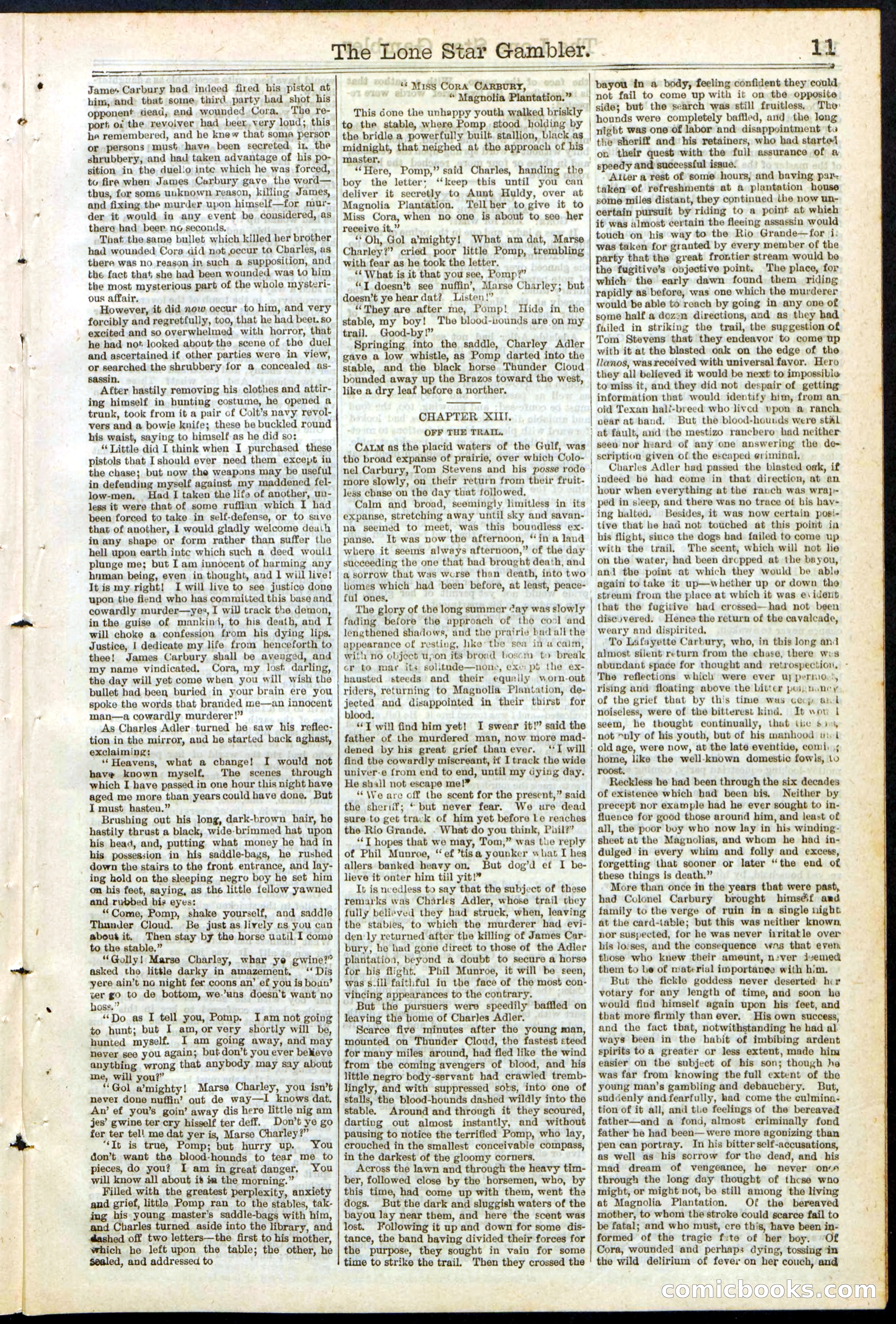
A restored page from Pulp Fiction, 1882. Page through the whole issue in the reader above.
📄 Transcribed text from this page (OCR, searchable)
Machine-transcribed from the original scan — historical spelling and the odd misread are preserved.
The Lone Star Gambler. —_—— ee -—™ James Carbury had indeed fired bis pistol at him, and that some, third party had shot his opponent dead, end wounded Cora, ~The re- port o: the revolver had beer, very loud; this he remembered, and he knew that soma persor or persons ‘must have been secreted, ix. the shrubbery, and had taken advantage of his po- sition in the duel‘o inte which he was forced, tu fire when James Carbury gave the word— thus, for soms unknown reason, killing James, and fixing the murder upon himself—for mur- der it would in any event be considered, as there had beer. no seconds. That; the same bullet which killed ber brother had wounded Cors did not occur ta Charles, as there was no reason in such a supposition, and the fact that she bad been wounded was to him the most mysterious part of the whole mysteri- ous affair. However, it did now occur to him, and very forcibly and regretfully, too, that he had beet. so excited and so overwhelmed with horror, that he had not looked about the scene of the duel and ascertained if other parties were in view, or searched the shrubbery for a concealed as- sassin. After hastily removing his clothes and attir- ing himself in hunting costume, he opened a trunk, took from it a pair of Colt’s navy revol- vers and a bowie knife; these be buckled round his waist, saying to himself as he did so: ‘‘ Little did I think when I purchased these pistols that I should ever need them except in the chase; but now the weapons may be useful in defending myself against my maddened fel- low-men, Had I taken the life of another, un- less it were that of some ruffian which I had been forced to take in self-defense, or to suve that of another, 1 would gladly welcome death in any shape or form rather than suffer the hell upon earth inte which such a deed would plunge me; but I am innocent of harming any hnman being, even in thought, and 1 will live! It is my right! I will live to see justice done upon the fiend who has committed this base and cowardly murder—yes, I wil) track the demon, in the guise of mankind, to his death, and I will choke a confession from his dying lips. Justice, | dedicate my life from henceforth to thee! James Carbury shall be avenged, and my name vindicated. Cora, my lost darling, the day will yet come when you will wish the bullet had been buried in your brain ere you spoke the words that branded me—an innocent man—a cowardly murderer!” As Charles Adler turned he saw his reflec- tion in the mirror, aud he started back aghast, exclaiming: ‘‘ Heavens, what a change! I would not have known myself. The scenes through which I have passed in one hour this night have aged me more than years could have done, But I must hasten.” Brushing out his long, dark-brown hair, he hastily thrust a black, wide-brimmed hat upon his head, and, putting what money he had in his possession in his saddle-bazs, he rushed down the stairs to the front entrance, and lay- ing hold on the sleeping negro boy he set him on his feet, saying, as the little fellow yawned and rubbed biz eyes: “Come, Pomp, shake yourself, and saddle Thunder Cloud. Be just as lively as you can about it. Then stay by the horse uatil I como to the stable.” “Golly! Marse Charley, whar ye gwine?” asked the little darky in amazement, ‘‘ Dis yere ain’t no night fer coons an’ ef you is boun’ wer go to de bottom, we-’uns doesn’t want no boss.” “Do as I tell you, Pomp. Iam not going to hunt; but I am,or very shortly will be, hunted myself. I am going away, and may never see you again; but don’t you ever believe anything wrong that anybody may say about me, will you?” “Gol a’mighty! Marse Charley, you isn’t never done nuffin’ out de way—l knows dat, An’ ef you’s goin’ away dis here little nig am jes’ gwine ter cry hisself ter deff. Don’t ye go fer ter tel! me dat yer is, Marse Charley?” “It is true, Pomp; but hurry up. You don’t want the blood-hounds to tear me to pieces, do you? I am in great danger. You will know all about is ia the morning.” Filled with the greatest perplexity, anxiety and grief, little Pomp ran to the stables, tak- ing his young master’s saddle-bags with him, and Charles turned aside into the library, and dashed off two letters—the first to his mother, which he left upon the table; the other, he Sealed, and addressed to ‘* Miss Cora CARBURY, “ Magnolia Plantation.” This done the unhappy youth walked briskly to the stable, where Pomp stood holding by the bridle a powerfully built. stallion, black as midnight, that neighed at the approach of his master. ‘‘Here, Pomp,” said Charles, handing the boy the letter; “‘keep this until you can deliver it secretly to Aunt Huldy, over at Magnolia Plantation. Tellher to give it to Miss Cora, when no one is about to see her receive it,” ‘* Oh, Gol a’mighty! What am dat, Marse Charley?” cried poor little Pomp, trembling with fear as he took the letter. ‘‘ What is it that you see, Pomp?” “JT doesn’t see nuffin’, Marse Charley; but doesn’t ye hear dat? Listen!” “They are after me, Pomp! MHide in the stable, my boy! The blood-Lounds are on my trail. Good-by!” Springing into the saddle, Charley Adler gave a low whistle, as Pomp darted into the stable, and the black horse Thunder Cloud bounded away up the Brazos toward the west, like a dry leaf before a norther. CHAPTER XIII, OFF THE TRAIL. Cam as the placid waters of the Gulf, was tho broad expanse of prairie, over which Colo- nel Carbury, Tom Stevens and his posse rode more slowly, on their return from their fruit- less chase on the day that followed, Calm and broad, seemingly limitless in its expanse, stretching away until sky and savan- na seemed to meet, was this boundless ex- panse. It was now the afternoon, “in a land where it seems always afternoon,” of the day succeeding the one that had brought death, and a sorrow that was worse than death, into two lLomes which had been before, at least, peace- ful ones, The glory of the long summer @ay was slowly fading before the approach of the cool and lengthened shadows, and the prairie bad all the appearance of resting, like the sea in u calm, with no object upon its broad bosem to break cr to mar its solitude—none, exe: pt the ex- hausted steeds and their equeily worn-out riders, returning to Magnolia Plantation, de- jected and disappointed in their thirst for blood. “JT will find him yet! I swear it!” said the father of the murdered man, now more mad- dened by his great grief thanever. ‘I will find the cowardly miscreant, it I track the wide univer-e from end to end, until my dying day. He shall not escape me!” ‘We are off the scent for the present,” said the sheriff; “ but never fear. We ure dead sure to get track of him yet before Le reaches the Rio Grande. . What do you think, Piil?” ‘‘T hopes that we may, Tom,” was tle reply of Phil Munroe, “ef ’tisa younker » hat I hes allers banked heavy on. But dog’d ef I be- lieve it onter him till yit!” It is needless to say that the subject of these remarks was Charles Adler, whose trail they fully believed they had struck, when, leaving the stables, to which the murderer had evi- den! ly returned after the killing of James Car- bury, he had gone direct to those of the Adler plantation, beyond a doubt to secure a horse for his flight. Phil Munroe, it will be seen, was sill faithful in the face of the most con- vincing appearances to the contrary. But the pursuers were speedily baffled on leaving the home of Charles Adler. Scarce five minutes after the young man, mounted on Thunder Cloud, the fastest steed for many miles around, had fled like the wind from the coming avengers of blood, and his little negro body-servant had crawled tremb- lingly, and with suppressed sobs, into one of stalls, the blood-hounds dashed wildly into the stable. Around and through it they scoured, darting out almost instantly, and without pausing to notice the terrified Pomp, who lay, crouched in the smallest conceivable compass, in the darkest of the gloomy corners. Across the lawn and through the heavy tim- ber, followed close by the horsemen, who, by this time, had come up with them, went tha dogs. But the dark and sluggish waters of the bayou lay near them, and here the scent was lost. Following it up and down for some dis- tance, the band having divided their forces for the purpose, they sought in vain for some time to strike the trail. Then they crossed the side; but the search was still fruitless, Pe IPS Fe bayou in a body, feeling confident they could not fail to come up with it on the opposite eB" hounds were completely baffled, and the long night was one of labor and disappointment te the sheriff and his retainers, who had starte4 on their quest with the full assurance of a speedy and successful issue. Alter a rest of some hours, and baving par. taken of refreshments at a plantation house some miles distant, they continued Lhe now un- | certain pursuit by riding to a point at whieh it was almost certain the fleeing assassin would touch on his way to the Rio Grande—for i: was taken for granted by every member of the party that the great frontier stream would be the fugitive’s objective point. The place, for which the early dawn found them riding rapidly as before, was one which the murderer would be able to reach by going in any one of some half a dozen directions, and as they had — fuiled in striking the trail, the suggestion of Tom Stevens that they endeavor to come up with it at the blasted oak on the edge of the llanos, was received with universal favor. Hero they all believed it would be next to impossible to miss it, and they did not despair of getting information that would identify him, from an. old Texan hali-breed who lived vpon a ranch vear at band. But the blood-hounds were stil at fault, and the mestizo rancbero had neither seeo nor heard of any one answering the de- scription given of the escaped @riminal. Charles Adler had passed the blasted oak, if indeed he had come in that direction, at an hour when everything at the ranch was wra)- | péd in sleep, and there was no trace ot bis hav- ing halted. Besides, it was now certain posi- tive that he had not touched at this point ia bis flight, since the dogs bad failed to come up with the trail. The scent, which will not lie on the water, had been dropped at the bayou, ani the point at which they would be able again to take it up—whether up or down the stream from the place at which it was e\ ident that the fugitive bad crossed—had not been diseyvered. Hence the return of the cavalcade, weary and dispirited, To Lafayette Carbury, who, in this long and almost silent return from the chase, there wes aburdant space for thought and retrospection, - The reflections which were ever uy perme’, rising and floating above the bitter puip none y of the grief that by this time was cep ant noiseless, were of the bitterest kind. It wou | seem, he thought continually, that ihe sin, not “nly of his youth, but of his manhood uit old age, were now, at the late eventide, comi, 5 home, like the well-known domestic fowls, to roost. Reckless he had been through the six decades of existence which had been bis. Neither by precept nor example had he ever sought to in- fluence for good those around him, and least of all, the poor boy who now lay in his winding- sheet at the Magnolias, and whom he had in- dulged in every whim and folly and excess, forgetting that sooner or later “the end of these things is death.” More than once in the years that were past, had Colonel Carbury brought himsé@f{ ard family to the verge of ruin in a single night at the card-table; but this was neither known, nor suspected, for he was never iiritatle over his losses, and the consequence wns that even those who knew their ameunt, never jivemed them to be of material importanee with him. But the fickle goddess never deserted hir votary for any Jength of time, and soon he would find himself again upon his feet, and that more firmly than ever. His own success, and the fact that, notwithstanding he had al ways been in the habit of imbibing ardent spirits toa greater or less extent, made hina easier on the subject of his son; though he was far from knowing the full extent of the young man’s gambling and debauchery. But, suddenly and fearfully, had come the culmina- tion of it all, and tle feelings of the bereaved father—and a fond, almost criminally fond father he had been— were more agonizing than pen can portray. In his bitter self-accusations, as well as his sorrow for the dead, and his mad dream of vengeance, he never on‘A through the long day thought of thcse who might, or might not, be still among the living at Magnolia Plantation. Of the bereaved mother, to whom the stroke could scarce fail to be fatal; and who must, cre this, have been in- formed of the tragic f:ite of her boy. of Cora, wounded and perhaps dying, tossing im the wild delirium of fever on her couch, and MICOOOKS (f(©) (E(@)