
Pulp Fiction, 1877 · page 3 of 28
Beadle's Dime Library No. 18 — page 3: what you’re looking at
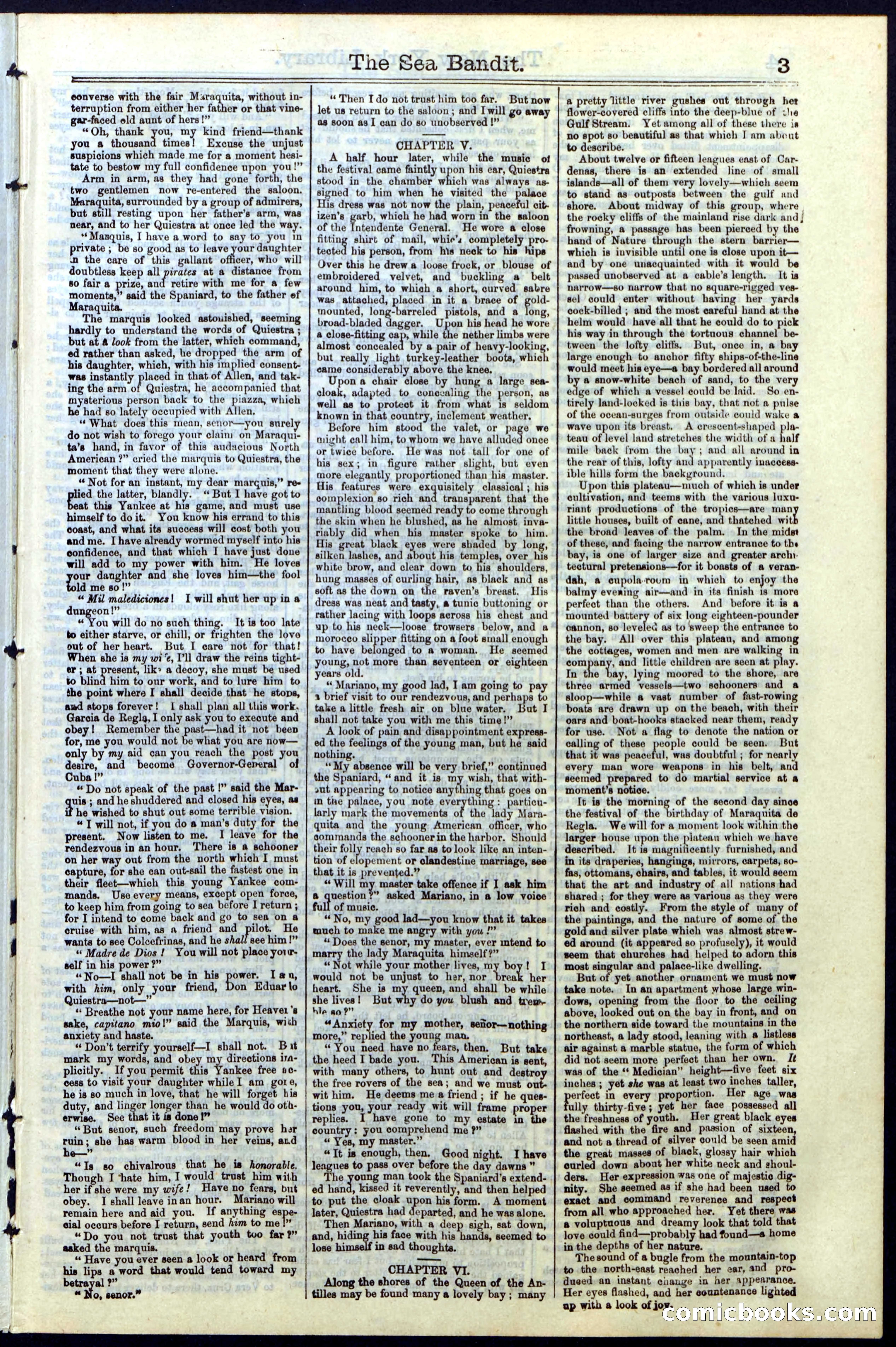
A restored page from Pulp Fiction, 1877. Page through the whole issue in the reader above.
📄 Transcribed text from this page (OCR, searchable)
Machine-transcribed from the original scan — historical spelling and the odd misread are preserved.
——ooooaeseaeaeaeeee__e_—oeei_wwwwwawanaanaRpjlTqe=~wooooeeeeeeeeee eee 33 converse with the fair Maraquita, without in- terruption from either her father or that vine- gar-faced old aunt of hers!” “Qh, thank you, my kind friend—thank you a thousand times! Excuse the unjust suspicions which made me for a moment hesi- tate to bestow my full confidence upon you!” Arm in arm, as they had gone forth, the ‘two gentlemen now re-entered the saloon. Maraquita, surrounded by a group of admirers, but still resting upon her father’s arm, was near, and to her Quiestra at once led the way. ** Manquis, I have a word to say to you in private ; be so good as to leave your daughter n the care of this gallant officer, who will doubtless keep all pirates at a distance from so fair a prize, and retire with me for a few moments,” said the Spaniard, to the father ef Maraquita. The marquis looked astouished, seeming hardly to understand the words of Quiestra ; but at & look from the latter, which command, ed rather than asked, he dropped the arm of his daughter, which, with his implied consent- was instantly placed in that of Allen, and tak- ing the arm of Quiestra, he accompanied that mysterious person back to the piazza, which he had so lately oceupied with Allen, “What does this mean, senor—you surely do not wish to forego your claim’ on Maraqui- ta’s hand, in favor of this audacious North American ?” cried the marquis to Quiestra, the moment that they were alone. “ Not for an instant, my dear marquis,” re- peed the latter, blandly. “ But I have got to at this Yankee at his game, and must use himself to doit. You know his errand to this coast, and what its success will cost both you and me. I have already wormed myself into his confidence, and that which I have just done will add to my power with him. He loves our danghter and she loves him—the fool ld me so!” “ Mil malediciones | dungeon!” “ You will do no such thing. It is too late to either starve, or chill, or frighten the love out of her heart. But I care not for that! When she is my wi ®, I’ll draw the reins tight- er ; at present, lik» a decoy, she must be used to blind him to our work, and to lure him to the point where I shall decide that he stops, aud stops forever! 1 shall plan all this work, Garcia de Reglg, I only ask you to execute and obey! Remember the past—had it not been for, me you would not be what you are now— only by my aid can you reach the post you desire, and become Governor-General of Cuba!” é “Do not speak of the past !” said the Mar- uis ; and he shuddered and closed his eyes, as if he wished to shut out some terrible vision. “T will not, if you do a man’s duty for the present. Now listen to me. I leave for the rendezvous in an hour. There is a schooner on her way out from the north which I must capture, for she can out-sail the fastest one in their fleet-—which this young Yankee com- mands. Use every means, except open force, to keep him from going to sea before I return ; for I intend to come back and go to sea on a cruise with him, as a friend and pilot. He wants to see Colcefrinas, and he shall see him!” “ Madre de Dios! You will not place your- self in his power ?” “ No—I shall not be in his sae Ian, with him, only your friend, Don Eduarto Quiestra—not—” Breathe not your name here, for Heaven's sake, capitano mio!” said the Marquis, with anxiety and haste. “ Don’t terrify yourself—I shall not. Bit mark my words, and obey my directions ira- plicitly. If you permit this Yankee free ue- cess to visit yur daughter while Il am gore, he is so much in love, that he will forget his duty, and linger longer than he would do oth- erwise. See that it is done!” “But senor, such freedom may prove her ruin; she has warm blood in her veins, and he—” “Ts so chivalrous that he is honorable. Though I ‘hate him, I would trust him with her if she were my wife ! Have no fears, but obey. I shall leave inan hour. Mariano will remain here and aid you. If anything es cial occurs before I return, send him to me |” “Do you not trust that youth too far?” asked the marquis. . “ Have you ever seen a look or heard from his lips a word that would tend toward my pega! io “No, senor.” I will shut her up in a The Sea Bandit. “ Then Ido not trust him too far. But now let us return to the saloon ; and I will go away as soon as I can do so unobserved !” CHAPTER V. A half hour later, while the music of the festival came faintly upon his ear, Quiestra stood in the chamber which was always as- signed to him when he visited the palace His dress was not now the plain, peaceful cit. izen’s garb, which he had worn in the saloon of the atedanta General. He wore a close fitting shirt of mail, whie’s completely pro- tected his person, from his neck to his hips Over this he drew a loose frock, or blouse of embroidered velvet, and buckling a belt around him, to which a short, curved sabre was attached, placed in it a brace of gold- mounted, long-barreled pistols, and a long, broad-bladed dagger. Upon his head he wore a close-fitting cap, while the nether limbs were almost concealed by a pair of heavy-looking, but really light turkey-leather boots, which eame considerably above the knee, Upon a chair close by hung a large sea- cloak, adapted to conevaling the person, as well as to protect it from what is seldom known in that country, inclement weather, Before him stood the valet, or page we might call him, to whom we have alluded once or twice before. He was not tall for one of his sex; in figure rather slight, but even more elegantly proportioned than his master. His features were exquisitely classical ; his complexion so rich aad transparent that the mantling blood seemed ready to come through the skin when he blushed, as he almost inva- riably did when his master spoke to him. His great black eyes were shaded by long, silken lashes, and about his temples, over his white brow, and clear down to his shoulders, hung masses of curling hair, as black and as soft as the down on the raven’s breast. His dress was neat and tasty, a tunic buttoning or rather lacing with loops across his chest and up to his neck—loose trowsers below, and a moroceo slipper fitting on a foot small enough to have atk to a woman. He seemed young, not more than seventeen or eighteen years old. “Mariano, my good lad, Iam going to pay 2 brief visit to our rendezvous, and perhaps to take a little fresh air on blue water. But I shall not take you with me this time!” A look of pain and disappointment express- ed the feelings of the young man, but he said nothing. ‘My absence will be very brief,” continued the Spaniard, “and it is my wish, that with- out appearing to notice anything that goes on in the palace, you note everything: particu- larly mark the movements of the lady Mara- quita and the young American officer, who commands the schoonerin the harbor. Should their folly reach so far as to look like an inten- tion of elopement or clandestine marriage, see that it is prevented.” “Will my master take offence if I ask him ® question?” asked Mariano, in a low voice full of music. “No, my good lad—you know that it takes much to make me angry with you !” “Does the senor, my master, ever intend to my the lady Maraquita himself?” “Not while your mother lives, my boy! I would not be unjust to her, nor Pex her heart. She is my queen, and shall be while she lives! But why do you blush and trem- hie ao?” “Anxiety for my mother, seior—nothing more,” replied the young man, “You need have no fears, then. But take the heed I bade you. This American is gent, with many others, to hunt out and destro the free rovers of the sea; and we must ou wit him. He deems me a friend ; if he ques- tions you, your ready wit will frame proper replies. I have gone to my estate in Ihe country: you comprehend me ?” “ Yes, my master.” “Tt is enough, then. Good night. I have leagues to pass over before the day dawns ” he young man took the Spaniard’s extend- ed hand, kissed it reverently, and then helped to put the cloak upon his form. A moment later, Quiestra had departed, and he was alone. Then Mariano, with a deep sigh, sat down, and, hidi his face with his ds, seemed to lose hi in sad thoughts. CHAPTER VI. Along the shores of the Queen of the An- tilles may be found many a lovely bay; many 3 , ees oe ees a pretty little river gushes out throvgh her flower-covered cliffs into the deep-blue of che Gulf Stream. Yet among all of these there is no spot so beautiful as that which I am abeut to describe. About twelve or fifteen leagues east of Car- denas, there is an extended line of small islands—all of them very lovely—which seem to stand as outposts between the gulf and shore. About midway of this group, where _ the rocky cliffs of the mainland rise dark and} frowning, a passage has been pierced by the hand of Nature through the stern barrier— which is invisible until one is close upon it— and by one unaequainted with it would be passed unobserved at a cable’s length. It is narrow—so narrow that no square-rigged ves- sel could enter without having her yards cock-billed ; and the most careful hand at the helm would have all that he could do to pick his way in through the tortuous channel be- tween the lofty cliffs. But, once in, a bay large enough to anchor fifty ships-of-the-line would meet his eye—a bay bordered all around by a snow-white beach of sand, to the very edge of which a vessel could be laid. So en- tirely land-locked is this bay, that not a pulse of the ocean-surges from outside could wake a wave upon its breast. A crescent-shaped pla- teau of level land stretches the width of a half mile back from the bay; and all around in the rear of this, lofty and apparently inaccess- ible hills form the background. Upon this plateau—much of which is under cultivation, and teems with the various luxu- riant productions of the te man little houses, built of cane, and thatched wit the broad leaves of the palm. In the midst of these, and facing the narrow entrance to the bay, is one of larger size and greater archi tectural pretensions—for it boasts of a veran- dah, a cupola-roum in which to enjoy the balmy eveaing air—and in its finish 1s more perfect than the others. And before it is a mounted battery of six long eighteen-pounder cannon, 80 leveled as to ‘sweep the entrance to the bay. All over this plateau, and among the cottages, women and men are walking in company, and little children are seen at play. In the ba , lying moored to the shore, are three armed vessels—two schooners and a sloop—while a vast number of fast-rowing boats are drawn up on the beach, with their oars and boat-hooks stacked near them, ready for use. Not a flag to denote the nation or calling of these people could be seen. But that it was peaceful, was doubtful ; for nearly every man wore weapons in his belt, and seemed prepared to do martial service at a moment’s notice. It is the aeatade of the second day since the festival of the birthday of Maraquita de Regla. We will for a moment look within the larger house upon the plateau which we have described. It is magnificently furnished, and in its draperies, ings, mirrors, carpets, so- fas, ottomans, chairs, and tables, it would seem that the art and industry of all nations had shared ; for they were as various as they were rich and costly. From the style of many of the paintings, and the nature of some of the gold and silver plate which was almost strew- ed around (it appeareri so profusely), it would seem that churches had helped to adorn this most singular and palace-like dwelling. But of yet another ornament we must now take note. In an apartment whose large win- dows, opening from the floor to the ceiling above, looked out on the bay in front, and on the northern side toward the mountains in the northeast, a lady stood, leaning with a listless air against a marble statue, the form of which did not seem more perfect than her own. It was of the ‘‘ Medician” height—five feet six inches ; yet she was at least two inches taller, rfect in every portion. Her age was ully thirty-five; yet her face possessed all the freshness of youth. Her great black eyes flashed with the fire and passion of sixtee and not a thread of silver could be seen ami the great masses of black, glossy hair which curled down about her white neck and shoul- ders. Her expression was one of majestic di nity. She seemed as if she had been used exact and command reverence and respect from all who approached her. Yet there was a voluptuous and dreamy look that told that love could find—probably had found—a home in the depths of her nature. The sound of a bugle from the mountain-top to the north-east reached her ear, 3nd pro- dueed an instant change in her appearance. Her eyes flashed, and her countenance lighted S) (e (0) mean = COMIEHOO * ~