
Pulp Fiction, 1877 · page 4 of 28
Beadle's Dime Library No. 18 — page 4: what you’re looking at
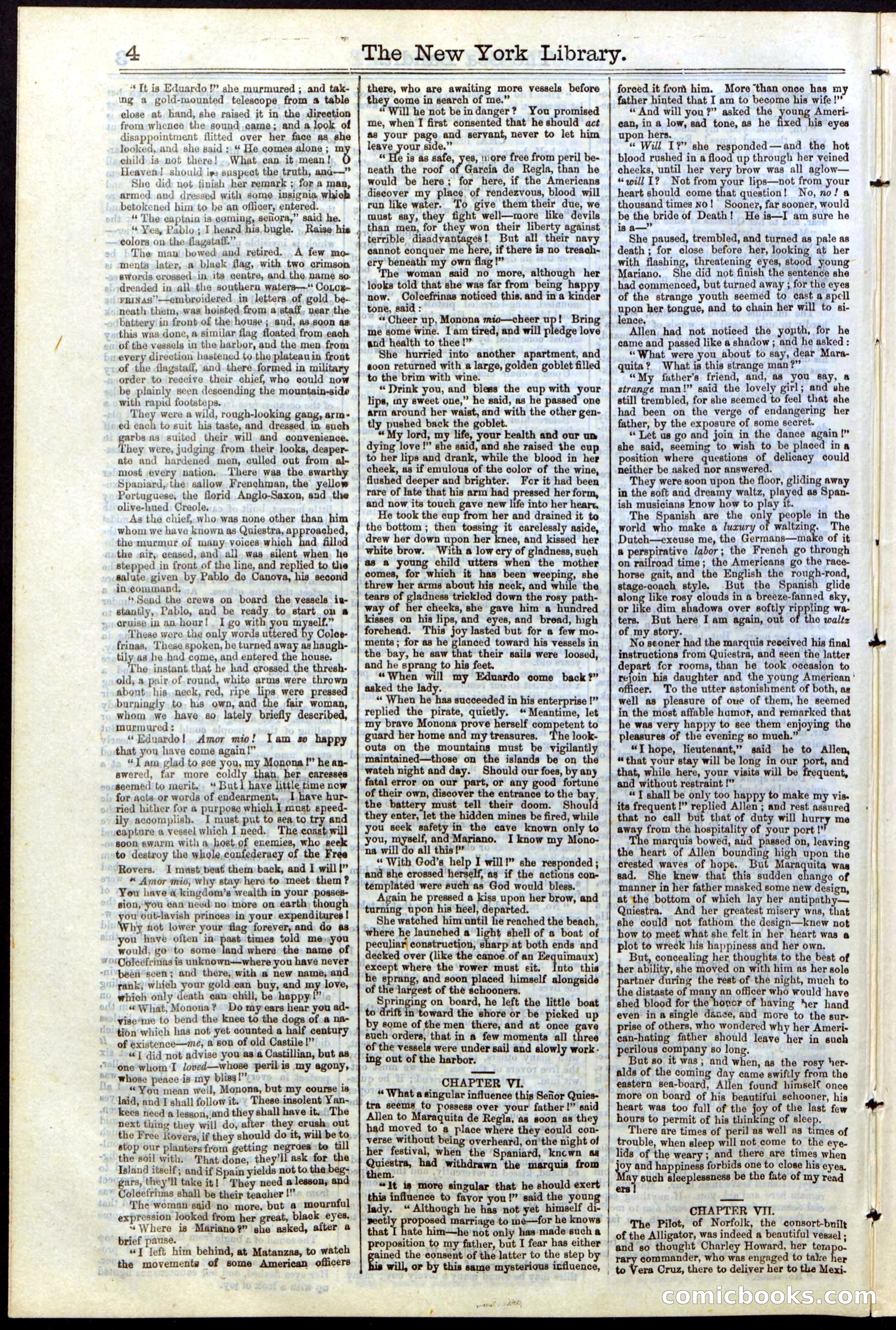
A restored page from Pulp Fiction, 1877. Page through the whole issue in the reader above.
📄 Transcribed text from this page (OCR, searchable)
Machine-transcribed from the original scan — historical spelling and the odd misread are preserved.
~ 4. ‘* Tt is Eduardo!” she murmured; and tak- ing a gold-mounted telescope from a table close at hand, she raised it in the direetion from whence the sound came; and a look of disappointment flitted over her face as she looked, and she said ; “ He comes alone ; m child is not there! .What.can. it mean! > Heaven! should ips suspect the truth, ang—” She did not finish her remark ; for a maa, armed and dressed with some insignia which betokened him to be an officer, entered. “ The captain is. coming, senora,” said he. “ Yes, Pablo; I heard his, bugle. colors on the-flagstaff.” The man bewed and retired. .A few mo ments later, a black flag, with two crimson swords crossed. in its centre, and the name se dreaded in all. the southern waters—‘ Cotcs- rRinas’—embroidered in letters of, gold. be- neath them, was hoisted from a/staff, near the battery in front of the; house ; and, as,soon as this was done, a similar flag floated from each of the vessels in the harbor, and the men from every direction hastened to.the plateauin front of the flagstaff, and there formed in military order to receive their chief, who eould now be plainly seen descending the mountain-side with rapid footsteps. ‘They were a wild, rough-looking gang, arm- ed cach to suit his taste, and dressed in such garbs as suited their will and convenience. ‘They were, judging from their looks, desper- ate and hardened men, culled out from al- most every nation, ‘There was the, swarthy Spaniard, the sallow Frenchman, the yellow Portuguese, the florid Anglo-Saxon, and the olive-lhued Creole, As the chief, who. was none other than him whom we have known as Quiestra, approached, the murmur of many voices which had filled the air, ceased, and all was silent when he stepped in front, of the line, and replied to the saluie given by Pablo de Canova, his second in:¢ommand, Send the crews on board the vessels iv- stantly,, Pablo, and be ready to start on a cruise ia an hour! . I go with you myself.” These were the only words uttered by Colee- frinas, These spoken, he turned away as haugh- tily as he had come, and entered the house. The instant.that he had crossed the thresh- old; a pair of. round, white arms were thrown abont his, neck, red, ripe lips were pressed burningly to his own, and the fair woman, whom we have so lately briefly described, murmured : “Eduardo! Amor mio! Iam so happy that you have come again!” “] am glad to see you, my Monona!” he an- awered, far more coldly than, her. caresses seemed to merit. “ Buti have little time now for acts or words of endearment,. Ihave hur- ried hither for a purpose which must epeed- ily accomplish. I must,put to sea to try and capture a vessel which I need. The const will soon swarm with a host.of enemies, who seek to destroy the whole,confederacy of the Free Rovers. 1 must) beat them back, and I will!” “ Amor mio, why stay here to meet them ? You have a kingdom’s wealth in your posses- sion, you can nevd no more on earth though you out-lavish princes in your expenditures ! Why not lower your flag forever, and do as, you have often in past times told me you would, go to some d where the name of ‘'Ooleefrinas is unknown—where you have never beéii seen; and there, with a new name, and rank; which your gold can buy, and my love, which only death ean chill, be happy!” » “What, Monona? Do my ears hear you ad- vise‘me to bend the knee to the dogs of a na- tion which has not yet counted a century of existence—me, a son of old Castile!” “{ did not advise you as a Castilian, but as one whom I loved—whose ‘perilbis my agony, “whose peace is my bliss!" “You mean weil, Monona, but my course is laid, and I shall follow it. | These insolent Yan-.,; kees need a lesgon,.and ra | shall have it.The next thing they will do, after they crush, out the Free Rovers, if they should do it, will be to stop our plantersfrom getting negroes ite till the soil with. That done, they’ll ask for the. IsJand itself; andif Spain yields not to the beg- ars, they'll take it! They need a lesson, and Colésirhins shall be their teacher !” The woman said no more, but 4 mournful expression looked from her great, black eyes. “Where is Mariano?” she asked, after a brief pause. “J left him behind, at Matanzas, to watch the movements of some American officers ~The New York Library. they come in search of me.” “Will he not beindanger? You promised me, when I first consented that he should act as your p and servant, never to let him leave your side.” “ He is as safe, yes, more free from peril be- neath the roof of Garcia de Regla, than he would be here; for here, if the Americans discover my place of rendezvous, blood will ran like water. ‘To give them their due, we must say, they fight well—more like devils than men, for they won their liberty against terrible Alsadvanieads ! But all their navy cannot conquer me here, if there is no treach- ery beneath my own flag!” e woman said no more, although her looks told that she was far from being happy now. Colcefrinas noticed this, and in a kinder tone, said : “Cheer up, Monona mio—cheer up! Bring me gome Wine. I am tired, and will pledge love and health to thee!” She hurried into another apartment, and soon returned with a large, golden goblet filled to the brim with wine. “Drink you, and bless the cup with your lips, uy sweet one,” he said, as he passed one arm around her waist, and with the other gen- tly pushed back the goblet. “ My lord, my life, your kealth and our um dying love!” she said, and she raised the cup to her lips and drank, while the blood in her cheek, as if emulous of the color of the wine, flushed deeper and brighter. For it had been rare of late that his arm had pressed her form, and now its touch gave new life into her hears, He took the cup from her and drained it to the bottom ; then tossing it carelessly aside, drew her down upon her knee, and kissed her white brow. With a low cry of gladness, such as a young child utters when the mother comes, for which it has been weeping, she threw her arms about his neck, and while the tears of ip geen trickled down the rosy path- way of her cheeks, she gave him a hundred kisses on his lips, and eyes, and bread, high forehead. This joy lasted but for a few mo- ments ; for as he glanced toward his vessels in the bay, he saw that their sails were loosed, and he sprang to his feet. “When will my Eduardo come back?” asked the lady. “ When he has succeeded in his enterprise !” replied the pirate, quietly. “Meantime, let my brave Monona A herself competent to guard her home and my treasures. The look- outs on the mountains must be vigilantly maintained—those on the islands be on the wateh night and day. Should our foes, by any fatal error on our part, or any good fortune of their own, discover the entrance to the bay, the battery must tell their doom. Should they enter, let the hidden mines be fired, while you seek safety in the cave known only to you, myself, and Mariano. I know my Mono- “ With God’s help I will!” she responded ; and she crossed herself, ag if the actions con- templated were such as God would bless. Again he pressed a kiss upon her brow, and turning upon his hee), departed. She watched him until he reached the beach, where he launched a light shell of a boat of pecning construction, sharp at both ends and ecked over (like the canoe of an Eequimaux) except where the rower must eit. Tnto this he sprang, and soon placed himself alongside of the largest of the schooners. Springing on board, he left the little boat to ‘toward the shore or be picked up by some of the men there, and at once gave such orders, that in a few moments all t of the vessels were under sail and slowly work: ing out of the harbor. _ CHAPTER VI. “ What a singular influence this Senor Quies- tra seems to possess over your father!” said Allen to Maraquita de Regla, as soon as they had moved to a place where they ¢ould con- verse without being overheard, on'the night of ‘na will do all this!” her festival, when the Spaniard, kncwn sa are had withdrawn the marquis from em. “It is more singular that he should exert this influence to favor you!” said the young lady. “Although he has not yet himeelf di- pect] os ene marriage to me—for he knows that I hate him—he not only has:made such a proposition to my father, but I fear has either ined the consent of the latter to the step by is will, or by this same mysterious influence, _ there, who are awaiting more vessels before forced it from him. More “than once has my father hinted that I am to become his wife!” “And will you ?” asked the young Ameri- can, in a low, sad tone, as he fixed his eyes upon hers. “ Will I?” she responded—and the hot blood rushed in a flood up through her veined cheeks, until her very brow was all aglow— “will 1? Not from your lips—not from your heart should come that question! No, no! a thousand times No! Sooner, far sooner, would be the bride of Death! He is—I am sure he is a<_’" She paused, trembled, and turned as pale as death ; for close before her, looking at her with flashing, threatening eyes, stood young Mariano. She did not finish the sentence she had commenced, but turned away ; for the eyes of the strange youth seemed to cast a spell ppan her tongue, and to chain her will to si- ence, Allen had not noticed the yonth, for he came and passed like a shadow ; and he asked : “What were you about to say, dear Mara- quita? What is this strange man?” “My father’s friend, and, as you say, a strange man!” said the lovely girl; and whe still trembled, for she seemed to feel that she had been on the verge of endangering her father, by the exposure of some secret. _ “Let us go and join in the dance again!” she said, seeming to wish to be placed ina position where questions of delicacy could neither be asked nor answered. They were soon upon the floor, gliding away in the soft and dreamy waltz, played as Span- ish musicians Enow how to play if. The Spanish are the only people in the world who make a luxury of waltzing. The Dutch—excuse me, the Germans—make of it a perspirative labor; the French go through on sadhised time; the Americans go the race- horse gait, and the English the rough-rond, stage-coach style. But the Spanish glide along like rosy clouds in a breeze-fanned sky, or like dim shadows over softly rippling wa- ters. But here I am again, out of tho waltz of my story. No sconer had the marquis received his final instructions from Quiestra, and seen the latter depart for rooms, than he took occasion to oin his daughter and the young American ' re officer. To the utter astonishment of both, as well as pleasure of oue of them, he seemed in the most affable humor, and remarked that he was very happy to see them enjoying the pleasures of the evenirg so much.” “T hope, lieutenant,” said he to Allen, “that your stay will be long in our port, and that, while here, your visits will be frequent, and without restraint !” “T shall be only too happy to make my vis. its frequent !” replied Allen ; and rest assured that no call but that of duty will hurry me atey from the hospitality of your port !’ e marquis bowed, aud passed on, leaving the heart of Allen bounding high upon the crested waves of hope. But Maraquita was sad. She knew that this sudden change of manner in her father masked some new design, at the bottom of which lay her antipathy— Quiestra. And her greatest misery was, that she could not fathom the design—knew not how to meet what she felt in her heart was a plot to wreck his happiness and her own. But, concealing her, thoughts to the best of her mye k she moved on with him as her sole partner during the rest of the night, much to the distaste of many an officer who would have shed blood for the honor of having er hand even in asingle dance, and more to the sur- rise of others, who wondered why her Ameri- ean-hating father should leave her in euch perilous company so long, But so it was; and when, as the rosy her- alds of the coming day came swiftly from the | eastern sea-board, Allen found himself once more on board of his beautiful schooner, his heart was too full of the ey of the last few hours to permit of his thinking of sleep. There are times of peril as well as times of trouble, when sleep will not come to the eye- lids of the weary; and there are times when joy and happiness forbids one to close his eyeg, ay such sleeplessness be the fate of my read ers CHAPTER VII. The Pilot, of Norfolk, the consort-built of the Alligator, was indeed a beautiful vessel ; _ and so thought Charley Howard, her terapo- rary commander, who was engaged to take her to era Cruz, there to deliver her to the Mexi- ——————————— Gomilcbooks.co (E cS Sa ae