
Pulp Fiction, 1877 · page 2 of 28
Beadle's Dime Library No. 18 — page 2: what you’re looking at
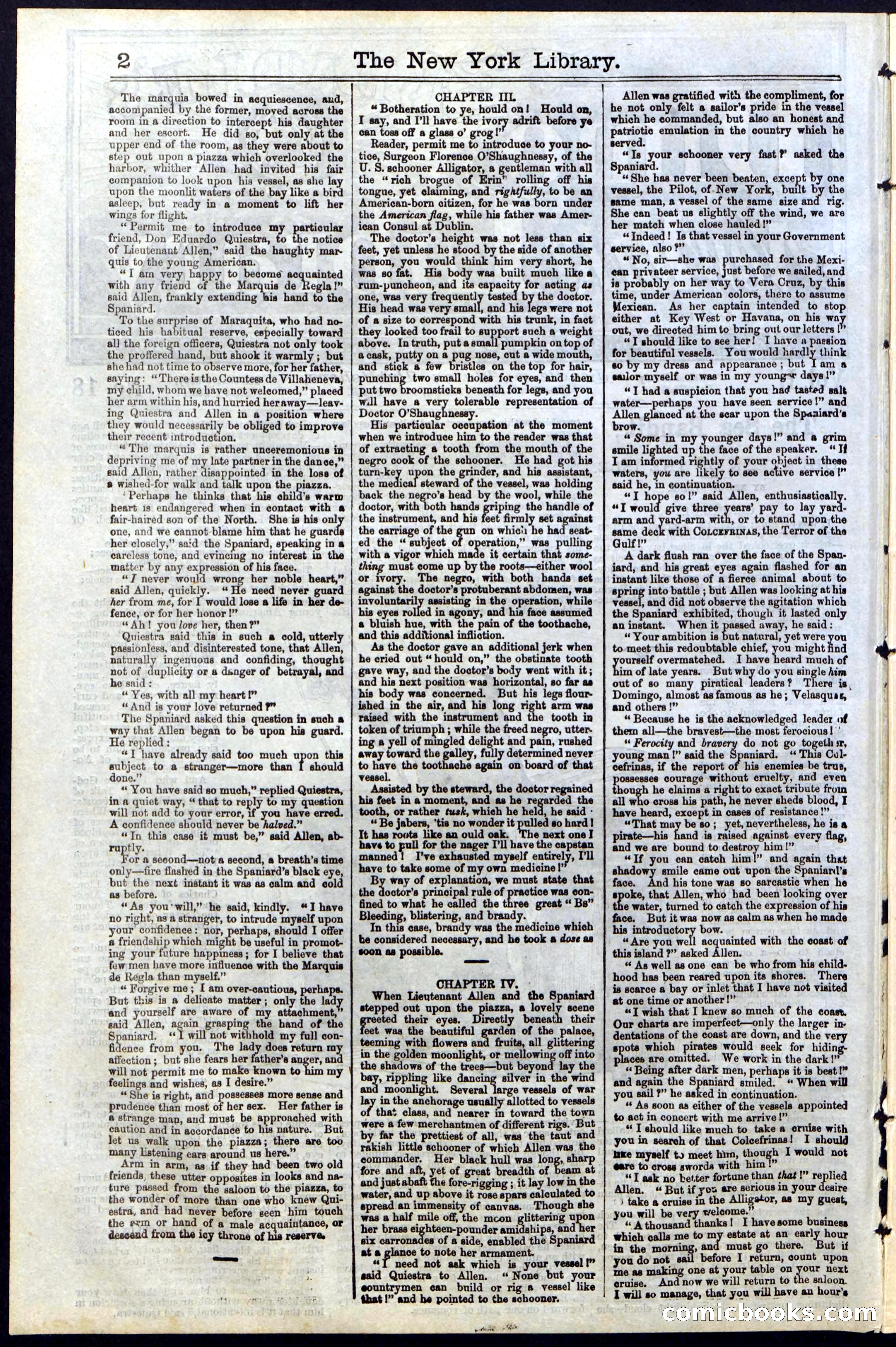
A restored page from Pulp Fiction, 1877. Page through the whole issue in the reader above.
📄 Transcribed text from this page (OCR, searchable)
Machine-transcribed from the original scan — historical spelling and the odd misread are preserved.
2 The New York Library. The ee bowed in acquiescence, and, accompanied by the former, moved across the room in @ direction to intercept his daughter and her escort. He did so, but only at the upper end of the room, as they were about to step out upon a piazza which overlooked the harbor, whither Allen had invited his fair companion to look upon his vessel, as she lay upon the moonlit waters of the bay like a bird asleep, but ready in a moment to lift her wings for flight. “Permit me to introduce my particular friend, Don Eduardo Quiestra, to the notice of Lieutenant Allen,” said the haughty mar quis to, the young aye “T am very ha to become uainted with any friend of the Marquis deRegls mM said Allen, frankly extending his hand to the Spaniard. To the surprise of Maraquita, who had no-~ ticed his habitual reserve, especially toward al] the foreign officers, Quiestra not only took the orédtaned hand, but shook it warmly ; but she had not fime to observe more, for her father, saying: “Thereis the Countess de Villaheneva, my child, whom we have not weleomed,” placed her arm within his, and hurried heraway—leav- ing Quiestra and Allen in a position where they would necessarily be obliged to improve their recent introduction, “The marquis is rather unceremonious in depriving me of my late partner in the dance,” said Allen, rather Abs tinted in the loss of ® wished-for walk and talk upon the piazza. ‘Perhaps he thinks that his child’s warm heart is endangered when in contact with a fair-haired son of the North. She is his onl one, and we cannot-blame him that he goartl her closely,” said the Spaniard, speaking in a careless tone, and evincing no interest in the matter by any expression of his face. “J never would wrong her noble heart,” said Allen, pen " He need never guard her from me, for I would lose a life in her de- fence, or for her honor!” “Ah! you love her, then?” Quiestra said this in such a cold, utterly passionless, and disinterested tone, that Allen, naturally ingenuous and confiding, thought not of duplicity or a danger of betrayal, and he said : “ Yes, with all my heart!” “ And is vour love returned ?” The Spaniard asked this question in such a way that Allen began to be upon his guard. He replied : “T have already said too much upon this Ph to a stranger—more than I should one.” “ You have said so much,” replied Quiestra, in a quiet way, “ that to reply to my question will not add to your error, if you have e A confidence should never be halved.” “Tn this case it must be,” said Allen, ab- ruptly. or a seoond—not a second, a breath’s time only—fire flashed in the Spaniard’s black eye, but the next instant it was as calm and cold as before. “As you'will,” he said, kindly. “I have no right, as a stranger, to intrude myself upon your confidence: nor, perhaps, should I offer a friendship which might be useful in promot- ing your future happiness; for I believe that few men have more influence with the Marquis de Regla than myself.” “ Forgive me; [ am over-cautious, perhaps. But this is a delicate matter; only the lady and yourself are aware of my attachment,” said Allen, ~— grasping the hand of the Spaniard. ‘I will not withhold my full con- filence from you. The ney does return m affection; but she fears her father’s anger, an will not permit me to make known to him my feelings and wishes, as I desire.” “She is right, and possesses more sense and pradence than most of her sex. Her father is & strange man, aud must be approached with caution and in accordance to his nature. But Jet us walk upon the piazza; there are too many Listening ears around us here.” Arm in arm, as if they had been two old friends, these utter opposites in looks and na- ture passed from the saloon to the piazza, to the wonder of more than one who knew Qui- estra, and had never before seen him touch the exm or hand of a male acquaintance, or descend from the icy throne of his reserves CHAPTER IIL “ Botheration to ye, hould on! Hould on, I say, and I'll have the ivory adrift before ye can toss off a glass o’ grog!’ Reader, permit me to introduce to your no- tice, Surgeon Florence O’Shaughnessy, of the U. S. schooner Alligator, a gentleman with all the “rich brogue of Erin” rolling off his tongue, yet claiming, and rightfully, to be an American-born citizen, for he was born under the American flag, while his father was Amer- ican Consul at Dublin. The doctor’s height was not less than six feet, yet unless he stood by the side of another person, you would think him very short, he was so fat. His body was built much like a rum-puncheon, and its capacity for acting as one, was very frequently tested by the doctor. His head was very small, and his legs were not of a size to correspond with his trunk, in fact they looked too frail to enpport such a weight above. In truth, put asmall pumpkin ontop of a cask, putty on a pug nose, cut a wide mouth, and stick a few bristles on the top for hair, punching two emall holes for eyes, and then put two Coessiattalen beneath for legs, and you w.ll have a very tolerable representation of Doctor O’Shaughnessy. His particular occupation at the moment when we introduce him to the reader was that of extracting a tooth from the mouth of the negro cook of the schooner. He had got his enaey Bs go the grinder, and his assistant, the medical steward of the vessel, was holding back the negro’s head by the wool, while the doctor, with both hands griping the handle of the instrument, and his feet firmly set against the carriage of the on whici: he had seat- ed the “ subject of operation,” was pulling with a vigor which e it certain that some- thing must come up by the roots—either wool or ivory. The negro, with both hands set against the doctor’s protuberant abdomen, was involuntarily assisting in the operation, while his eyes rolled in agony, and hia face assumed a bluish hue, with the pain of the toothache, and this additional infliction. As the doctor gave an additional jerk when he cried out “hould on,” the obstinate tooth gave way, and the doctor’s body went with it; and his next position was horizontal, so far as his body was concerned. But his legs flour ished in the air, and his long right arm was raised with the instrument and the tooth in token of triumph ; while the freed negro, utter. ing a yell of mingled delight and pain, rushed away dywaed the galley, fully determined never eve ggg again on board of that vease Assisted by the steward, the doctor regained his feet in a moment, and as he re d the tooth, or rather tusk, which he held, he said - “ Be jabers, ‘tis apse Ne a ee te: It has roots like an ould oak. The next one! have to for the nager I’ll have the capstan manned! I’ve exhausted myself entirely, PU have to take some of my own medicine!’ By way of explanation, we must state that the doctor’s principal rule of practice was con- fined to what he called the three great “ Bs” Bleeding, blistering, and brandy. In this case, brandy was the medicine which be considered necessary, and he took a dose as soon as possible. | CHAPTER IV. » When Lieutenant Allen and the Spaniard stepped out upon the piazza, a lovely scene ted their eyes. Directly beneath their eet was the beautiful en of the palace, teeming with flowers fruits, all glittering in the golden moonlight, or mellowing off into the shadows of the trees—but beyond lay the Dey rippling like dancing silver in the wind and moonlight. Several e vessels of war lay in the anchorage us ‘allotted to vessels of that class, and nearer in toward the town were 4 few merchantmen of different rigs. But by far the prettiest of all, was the taut and rakish a i aati which pie iy commander. Her hull was long, fore and aft, yet of great breadth of boar at and just abaft the fore-rigging ; it lay low in the water, and up above it rose spars calculated to spread an immensity of canvas. Though she mend arte off, the — ce n er brass eighteen-pounder amidships, and her six eutvdiaidig of ie aille: enabled the. Spaniard at rf nvr to note her armament. “T need not ask which is your vessel!” eaid Quiestra to Allen. “None but your eountrymen can build or rig a vessel like that!” and he pointed to the schooner. Allen was gratified with the compliment, for he not only felt a sailor’s pride in the vessel which he commanded, but also an honest and patriotic emulation in the country which he served. “Ts your schooner very fast?’ asked the Spaniard. “She has never been beaten, except by one vessel, the Pilot, of. New York, built by the same man, a vessel of the same size and rig. She can beat us slightly off the wind, we are her match when close hauled!” “Indeed! Is that vessel in your Government service, also?” “No, sir—she was purchased for the Mexi- can privateer service, just before we sailed, and is probably on her way to Vera Cruz, by this time, under American colors, there to assume Mexican. As her captain intended to stop either at Key West or Havana, on his wa out, we directed him to bring out our letters |” “T should like to see her! I have a passion for beautiful vessels. You would hardly think so by my dress and appearance ; but Tam a sailor myself or was in my young~t days!” “T had a suspicion that you had tasted salt water—perhaps you have seen service!” and Allen glanced at the scar upon the Spaniard’s brow. “ Some in my younger dave !” and a grim emile lighted up the face of the speaker. “If Iam a ee rightly of your object in these waters, you are likely to see active service |” said he, in continuation. “T hope so!” said Allen, enthusiastically. “T would give three years pay to lay yard- arm and yard-arm with, or to stand upon the same deck with Coicrrnrinas, the Terror of the Gulf!” A dark flush ran over the face of the Span- iard, and his great eyes again flashed for an instant like those of a fierce animal about to spring into battle ; but Allen was looking at his vessel, and did not observe the agitation which the Spaniard exhibited, though it lasted only an instant. When it passed away, he said: “Your ambition is but natural, yet were you to meet this redoubtable chief, you might find ourself overmatched. I have heard much of im of late years. But why do you single him out of so many piratical leaders? There is, Domingo, almost as famous as he; Velasquag, and others !” “ Because he is the acknowledged leader of them all—the bravest—the moat ferocious! ' “ Ferocity and rea do not go togeth sr, young man!” gaid the Spaniard. ‘ This Cul- cefrinas, if the report of his enemies be true, possesses courage without cruelty, and even though he claims a right to exact tribute froin all who cross his path, he never sheds blood, I have heard, except in cases of resistance!” “That may be so; yet, nevertheless, he is a pirate—his hand is raised against every flag, and we are bound to destroy him!” “If you can catch him!” and again that shadowy smile came out upon the Spaniaril’s face. be his tone was so sarcastic when he spoke, that Allen, who had been looking over the water, turned to catch the expression of his face. But it was now as calm as when he made his introductory bow. “Are you well acquainted with the coast of this island ?”’ asked Allen. “As well as one can be who from his child. hood has been reared upon its shores. There is scarce a bay or inlet that I have not visited at one time or another!” “JT wish that I knew so much of the coast. Our charts are imperfect—only the larger in dentations of the coast are down, and the very spots which pirates would seek for hiding- cso are omitted. We work in the dark!” “ Being after dark men, perhaps it is best!” and again the Spaniard smiled. “ When will ou sail ?” he asked in continuation. “* As soon as either of the vessels appointed to act in concert with me arrive!” “TI should like much to take a ornise with you in search of that Colcefrinas! I should xe myself t meet hima, though I would not @are to cross swords with him : “T ask no better fortune than ¢hat |” replied Allen. “ But if you are serious in your esire > take a cruise in ae Alligator, as my guest, ou Wi very veicome. i “ - pin is Posi tt I have some business which calls me to my estate at an early hour in the morning, and must go there. But if you do not sai before I return, count upon me as making one at your table on your next cruise. And now we will return to the saloon. I will so manage, that you will have an hour's EComicbooks.co