
Pulp Fiction, 1877 · page 1 of 28
Beadle's Dime Library No. 18 — page 1: what you’re looking at
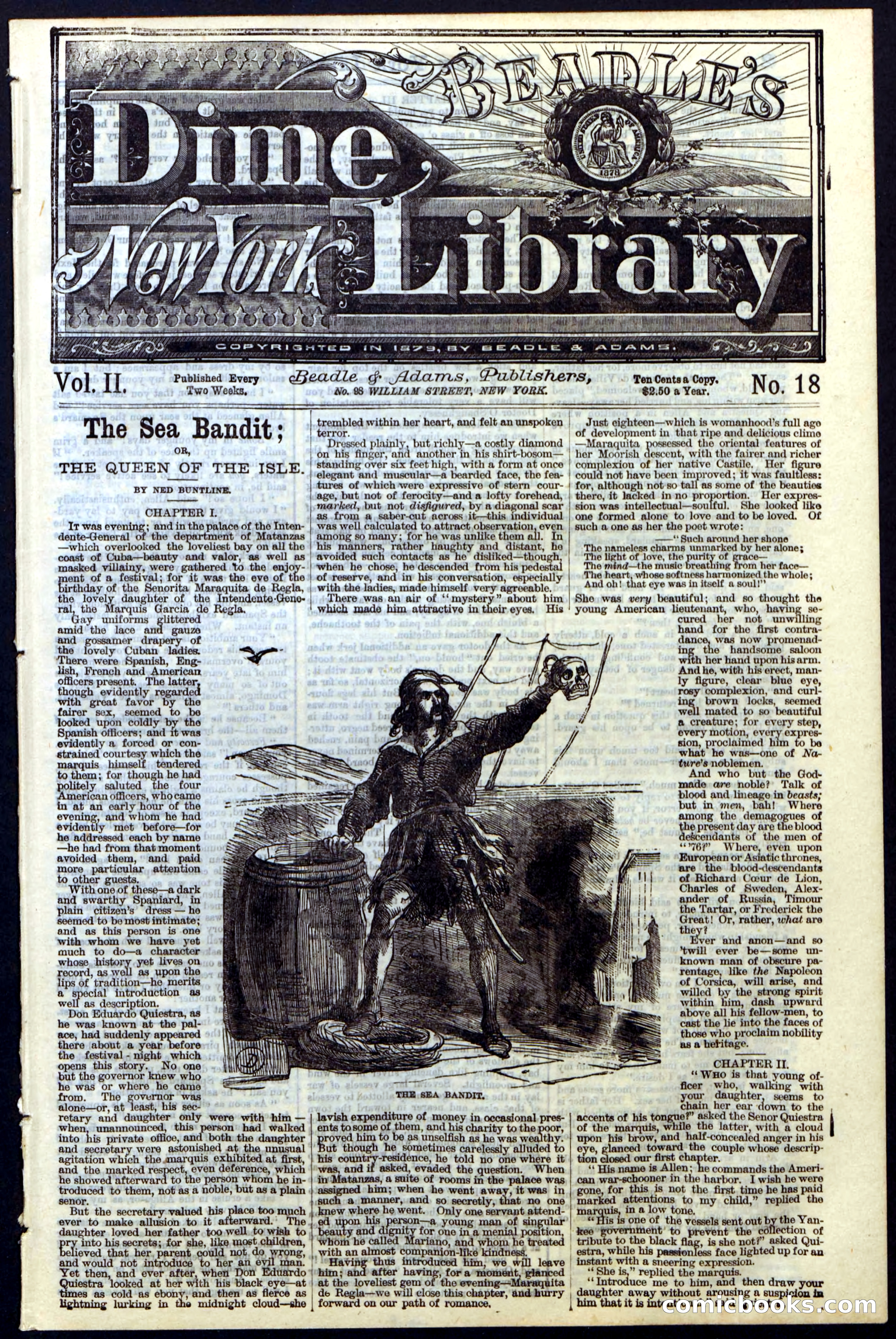
A restored page from Pulp Fiction, 1877. Page through the whole issue in the reader above.
📄 Transcribed text from this page (OCR, searchable)
Machine-transcribed from the original scan — historical spelling and the odd misread are preserved.
i | | J is f* * < el 3 + re. 2 = = z a HM i ANNI \ inl we it “i a y \Y 8 : - {¢c ape i a J . 2 ty ra ¥ i \ > ia of a = = ~se tee ee ee Two Weeks, —— andit ; THE QUEEN OF THE ISLE. BY NED BUNTLINE. CHAPTER IL It was evening; and in the palace of the Inten- dente-General of the yn ee of Matanzas —which overlooked the loveliest bay on all the coast of Cuba—beauty and valor, as well as | masked villainy, were gathered to the ay, ent of a festival; for it was the eve of the irthday of the Senorita Maraquita de Regla, the lovely daughter of the Intendente-Gene- ral, the Marquis Garcia de Regla. Gay uniforms glittered amid the lace and gauze and oe drapery of the lovely Cuban ladies. ‘There were Spanish, Eng- lish, French and American officers present. The latter, though evidently regarded with great favor by the fairer sex, seemed to be looked upon coldly by the Spanish officers; and 1t was evidently a forced or con- strained courtesy which the marquis himself tendered to them; for though he had politely saluted the four American officers, whocame in at an early hour of the evening, and whom he had evidently met before—for he addressed each by name —he had from that moment avoided them, and more particular attention to other guests, With one of these—a dark and swarthy 8 d, in plain citizen’s dress — he seemed to be most intimate; end as this person is one with whom we have yet much to do—a character whose papa | yet lives on record, as well as upon the ih lips of tradition—he. merits Wi a special introduction as be Wie Se well as description. ‘ MWA Don Eduardo Quiestra, as uh} he was known at the pal- ace, had suddenly ap there about a year before the festival- night which . opens this story, No. one but the governor knew who he was or where he came from. The governor was alone—or, at least, his sec- ” retary and daughter only were with him — when, unannounced, this Bae had walked into his private office, and both the danghter and secretary were astonished at the unusual agitation which the amarquis exhibited at first, and the marked res even deference, which he showed Mtrarinrd to the person whom he in- troduced to them, not as a noble, but as a plain senor. But the secretary valued his place too much ever to make allusion to it daughter loved her father too well to wish to pry into his secrets; for she, like most.children, ieved that her, parent hi hy 4 AE QUANG VANTREAN Yet then, and ever after, when Don estra looked at her with his black eye—at es as cold as ebony, and then as flerce as lightning lurking in midnight cloud—she separ acl na 10% Crome idecnar . case ee ambaln Weed! 6 — ie {tilt bbe ‘ es cSOorwrRiGHn tre w2 | stanc Serenity) yeenaangye net Pan af re ees iy wear NLL Nhs | \f rs chee | | i MY i Iie I i 3 WAT ey rward.’ The! ed =< pe a So Rey Taps stems . - a. x nia aa - ee ae sinful ys mn tal EO S) _— = Mid | \* . . ) . ; . ‘2, . x Lae ih i} i) im™m No. 8 WILLIAM STREET, NEW YORK. (avo, @vr BEADLE & A O AA RA SS Published Every cBeadle ¢. Adams, Publishers, ch Ne tril" ee Ten Centsa Copy. $2.50 a Year, trembled within her heart, and felt anunspoken | Just eighteen—which is womanhood’s full ago terror. Dressed plainly but richly—a costly diamond on his finger, and another in his shirt-bosom— tures of which were expressive of stern cour- age, but not of ferocity—and a lofty forehead, marked, but not disfigured, by a diagonal scar as from a saber-cut across it-—this individual was well calculated to attract observation, even among so many; for he was unlike them all. In his manners, rather haughty and distant, he avoided such contacts as he disliked—though when he chose, he descended from his pedestal of reserve, and in his conversation, especially ling over six feet high, with a form at once elegant and muscular—a bearded face, the fea- SE of development in that ripe and delicious climo —Maraquita possessed the oriental features of her Moorish descent, with the fairer and richer complexion of her native Castile. Her figure could not have been improved; it was faultless: for, although not so tall as some of the beauties there, it lacked in no proportion. Her expres- sion was intellectual—soulful. She looked like one formed alone to love and to be loved. Of such a one as her the poet wrote: ——* Such around her shone The nameless charms unmarked by her alone; The os Sp of love, the purity of haces The mind—the music breathing from her face— The heart, whose softness harmonized the whole; And oh! that eye was in itself a soul!” There, was an air of ‘‘mystery” about him | She was very beautiful; and so thought the hich made him attractive in | with the ladies, made himself very agreeable. Ww. (\ AL 4 | yyw! il | | , (4) eS es / his — ™ = 4 ih) Rov \ \ —— lavish expenditure of money in occasional. pres- ents tosome of them, and his charity to the poor, “pAb him to be as unselfish as he was wealth’ ‘ ut though he sometimes carelessly alluded his country-residence, he told no one where it and if asked, evaded the question. en in Matanzas, a suite of rooms in the palace was him; when he went away, it was in such a manner, and so secretly, that no one Jdmew where he went. Only one SRR t pitend. eb Laps young man_.of singular bea by and gn’, for one owt menial position aul whorn he called o, and whom he treated not. do, wrong, | with an almost companion-like kindness. ~ and would not introduce her an evil than: duardo | him; an Ha after ss for a momen at the loveliest gem o de Regla—we will close this chapter, and hurry forward on our path of romance, eir eyes. His ' young American lieutenant, who, having se- cured her not unwilling hand for the first contra- dance, was now promenad- ing the handsome saloon with her hand upon his arm. And he, with his erect, man- ly figure, clear blue eye, rosy complexion, and curl- brown locks, seemed well mated to so beautiful a creature; for every step, every motion, ory expres- sion, proclaimed him to be what he was—one of Na- twre’s noblemen. And who but the God- made are noble? Talk of blood and lineage in beasts; but in men, bah! Where among the demagogues of we present day are the blood e&cendants of the men of ‘767’ Where, even upon ames 8 nor Asiatic thrones, are e blood-lescendants of Richard Cour de Lion, Charles of Sweden, Alex- ander of Russia, Timour the Tartar, or Frederick the Great! Or, rather, what are rime ver and anon—and 50 ‘twill ever be—some un- known man of obscure pa- rentage, like the Napoleon of Corsica, will arise, and willed by the strong spirit within him, dash upward above all his fellow-men, to cast the lie into the faces of those who proclaim nobility as a hefitage. CHAPTER II. “Wo is that young of- ficer who, walking with your daughter, seems to chain her ear down to the accents of his ef” asked the Senor Quiestra of the marquis, while the latter, with a cloud upon his brow, and half-concealed anger in his eye, glanced toward the couple whose descrip- tion closed our first chapter. ‘‘ His name is Allen; he commands the Ameri- can war-schooner in the harbor. I wish he were gone, for this is not the first. time he has paid marked attentions to my child,” replied the m is, in a low tone. “His poe a the vessels sent ould ae Yan- kee t bapa ent’ to vent the ection of tribute to the black fay is she not?” asked Qui- _estra, while his pansies face lighted up for an thus introduced him, we will leave | ’ r— the evening—M: uita | instant with a sneering expression. ‘“* She is,” replied the marquis. “Introduce me to him, and then draw daughter away without “ita ey. suspicion im \ him that it is int at’ 4) \ DOKS= EO