
Pulp Fiction, 1877 · page 14 of 28
Beadle's Dime Library No. 18 — page 14: what you’re looking at
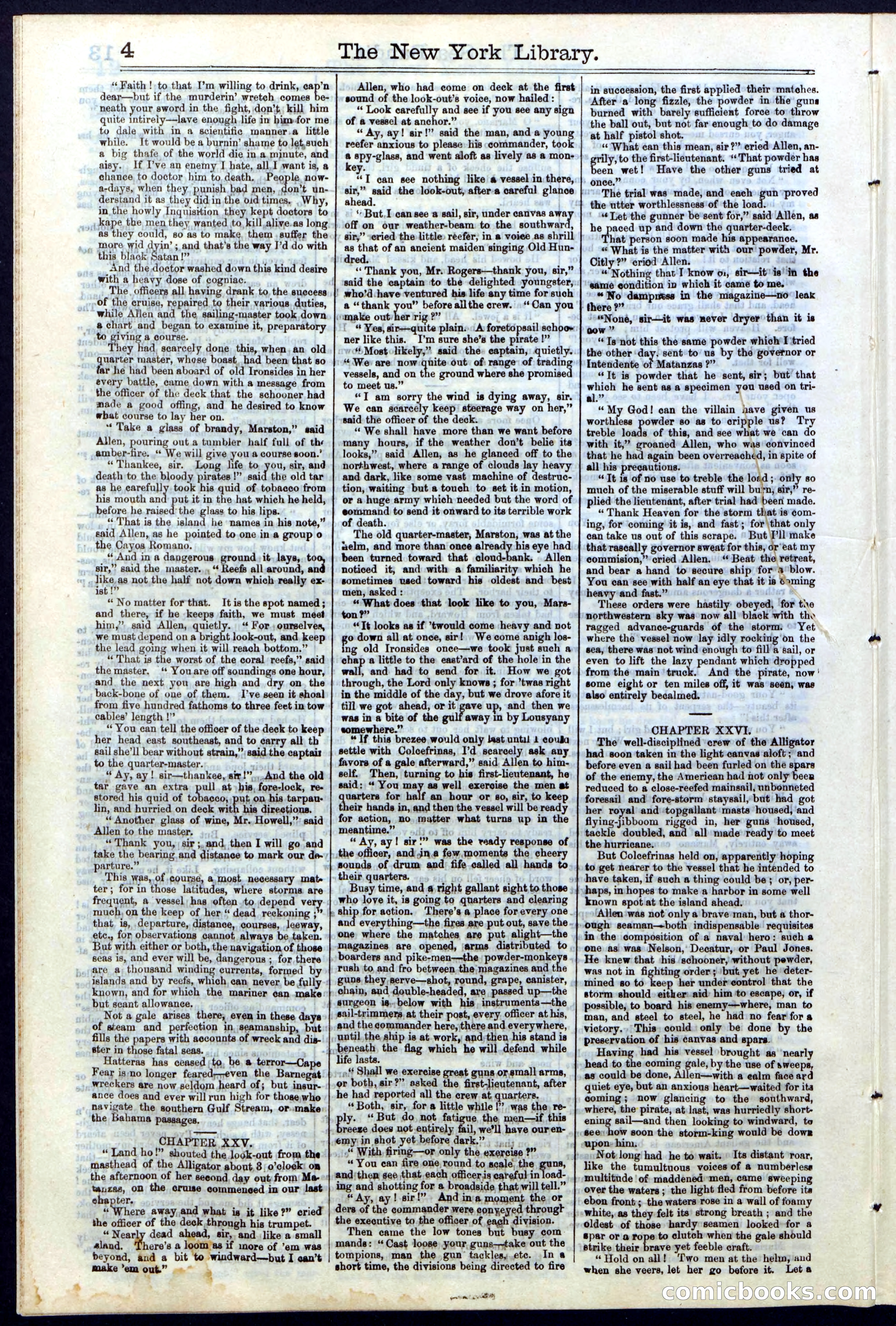
A restored page from Pulp Fiction, 1877. Page through the whole issue in the reader above.
📄 Transcribed text from this page (OCR, searchable)
Machine-transcribed from the original scan — historical spelling and the odd misread are preserved.
Se Sse = ss STE Te . a = SSS RRS -—— —_ _——— -_ Te 2 SS Se EE oe == —= _— a RT A eee -- ~~ —— aes 4. - “Faith! to that I’m willing to drink, eap’n dear—but if the murderin’ wreteh comes be- neath your sword in the fight, don’t, kill him quite intirely—lave enough life in bimfor me to dale with in a scientific manner.a little while. It would be a burnin’ shame to let.such a big thafe of the world die in a minute, and aisy. If I’ve an enemy I hate, all, want is, a chance to doctor him to. death. People now- a-days, when they punish bad men, don’t un- derstand it as they did in the oid times, . Why, in the howly Inquisition they kept doctors to _, kape the men they wanted to, kill alive.as long as they could, so as to make, them suffer the . More wid dyin’; and that’s the way J’d do with this black Satan!” And the doctor washed down this kind desire with a heayy dose of cogniac. The. officers all having drank to. the suecess of the cruise, repaired to their various. duties, while Allen and the sailing-master took down @ chart and began to examine it, preparatory to giving a course. hey had, searcely done this, when, an old querer master, whose boast. had been that so ar he had been aboard of old Ironsides in her every battle, came down with a message from the officer of the deck that the schooner had made a good offing, and he desired to know what course to lay her on. “Take a glass of brandy, Marston,” said Allen, pouring out a tumbler half full of the amber-fire. “ We will give you a course soon.’ “ Thankee, sir. Long life to you, sir, and death to the bloody pirates!” said the old tar as he carefully took his quid of tobacco from his mouth and put it in the hat which he held, before he Cape the glass to his lips. “ That is the island he names in his note,” said Allen, as he pointed to one in a group o the Cayos Romano. “ And in a dangerous ground it. lays,. to sir,” said the master. , “ Reefs all around, an dike as not the half not down which really ex- ist !” “ No matter forthat. It is the spot named ; and there, if he keeps faith, we must meet him,’ said Allen, quietly. “ For, ourselves, we must depend on a bright look-out, and kee the lead going when it will reach bottom.” “ That is the worst of the coral reefs,” said the master, “ Youare off soundings one hour, and the next you are high and dry on. the back-bone of one of them. I’ve seen it shoal from five hundred fathoms to three feet in tow cables’ length !” “You can tell the officer of the deck to keep her head east southeast, and to carry all th sail she’ll bear without strain,”) said the captair to the quarter-master. J “ Ay, ay! sir—thankee, sm!” And the old tar gave an extra pull at his, fore-lock, re- stored his quid of tobacco, put on his tarpau- lin, and hurried on deck with his directions. “Another glass of wine, Mr. Howell,’ said - Allen to the master. “Thank you, sir ;,and, then I will go and take the bearing and distance to mark our de-) parture.” |, .% This was, of course, a most. necessary mat. ter ; for in those latitudes, where storms are frequent, a vessel has often to depend very much, on the keep of her “ dead reekoning ;” that is, departure, distance, courses, leeway, etc,, for observations cannot always be, taken. But with either or both, the navigation of those seas is, and ever will be, dangerous ; for there are a thousand winding currents, formed by islands and by reefs, which can, never, be fully known, and for which the mariner ean make but scant allowance, Not a gale arises there, even in these days of steam and perfection in, seamanship, but fills the papers with accounts of wreck and dis- ster in those fatal seas. ; Hatteras has ceased to, be a terror—Cape Fear ismo longer feared--even the Barnegat wreckers are now seldom heard of; but insur- ance does and ever will run high for thoae,who navigate the southern Gulf Stream, or.make: the Bahama passages, 7 CHAPTER XXV. “ Land ho!” shouted the look-out from the masthead of the Alligator about, 8 o’cloek: om the afternoon of her seeond day out from Ma: tanzes, on the cruise commenced in our last ohapter. : «Where away, and what ig it like?” cried the officer of the deck throngh his trumpet. “ Nearly dead sir, and like a small d. ere’s & | if more of ’em was beyond, and a bit to windward—but I can’t make em out.” -* 2 _ breeze does not entirely vemy in shot yet before dark.” The New York Allen, who had come on deck at the first sound of the look-out’s voice, now hailed : “ Look carefully and see if you see any sign of a vessel at anchor.” “ Ay, ay! sir!” said the man, and a youn reefer anxious to please his commander, too ° spy-glass, and went aloft as lively as a mon- ey. uy can see nothing like a vessel in there, sir,” said the look-out, after-a careful glance | ahead. * But.I can see a sail, sir, under canvas awa off on our weather-beam to the southward, sir,” seried the little. reefer, in a voiee as shrill as that of an ancient maiden singing Old Hun- dred. “Thank you, Mr. Rogers—thank you, sir,” said the captain to the delighted youngster, | who’d have ventured his life any time for such a “thank you” before ailthe crew. ‘Can you vumake out her rig ?” . * Yes, sir—q ner like this. I’m sure she’s the pirate !” ‘Most likely,” said the. captain, quietly. “ We are now gnite out of: range of aad vessels, and on the ground where she promise to meet us.” “T am sorry the wind is dying away, sir. We can scarcely keep steerage way on her,” said the officer of the deck. ‘‘ We shall have more than we want before many hours, if the weather don’t belie its looks,” said Allen, as he glanced off to the northwest, where a range of clouds lay heavy and dark, like some vast machine of destruc- tion, waiting but a touch to set it in motion, or a huge army which needed but the word of eommand to send it onward to its terrible work of death. The old quarter-master, Marston, was at the aelm, and more than once already his eye had been turned toward that denhhanis Allen noticed it, and with a familiarity which he sometimes used toward his oldest and best men, asked : “ What does that look like to you, Mars- ton ?” “Tt looks as if *twould come heavy and not o down all at once, sir! We come anigh los- ng old Ironsides once—we took just such a chap a little to the east’ard of the hole in the wall, and had to send for it. How we got through, the Lord only knows ; for ’twas right in the middle of the day, but we drove afore it till we got ahead, or it gave up, and then we was in a bite of the gulf away in by Lousyany somewhere.” “ If this brezee would only last until 1 couda settle with Colcefrinas, I’d searcely ask any favors of a gale afterward,” said Allen to him- self. Then, turning to his first-lieutenant, he said: “ You may as well exercise the men at uartera for half an hour or so, sir, to keep eir hands in, and then the vessel will be ready for action, no matter what turns up in the meantime.” =|, % “ Ay, ay! sir‘” was the ready response of the officer, and.jn.a few. moments the cheery sounds of drum and fife called all hands to their quarters. uo | Busy time, and 4 right gallant sight to those | who love it, is going to qnarters and clearing » 8hip for action. There’s a place for every one. and everything—the fires are put out, save the. one where the matches are put alight—the magazines are opened, jarms distributed to _ boarders and pike-men—the powder-monkeys rush to and fro between the magazines and the guns they serve—shot, round, grape, canister, chain, and double-headed, are passed up—the surgeon ig..below with his instruments—the _sail-trimmers at their post, every. officer at his, and the commander here, there and everywhere, until the ship is at. work, and;then his stand is }obeneath the flag which he will defend while life oom f _of Shall we exercise great guns or.gmall arms, or both, sir?” asked fhe. A sa tit after he had reported all the crew at quarters. “Both, sir, for a little while !” was the re- ly. ‘But do not fatigue the men—if this il, we'll have ouren- “ With, firmg—or only the exercise ?” “You can fire one round to scale, the guns, and then see that each officer.is careful in load- ing and shotting for a broadside that will tell.” “Ay, ay! sir!” And ina moment the or ders of the commander were conyeyed througt the exeentive to the officer of aan division. Then came the low tones but busy com. mands: “Cast loose your, guns--take out the tompions, man the gun tackles,.etc. In @ short time, the divisions being directed to fire nm oe a) Library. uite plain. A foretopsail schoo» in succession, the first applied their matches. After a long fizzle, the powder in the guns burned with barely sufficient force to throw the ball out, but not far enough to do damage at half pistol shot. ‘¢ What can this mean, sir?” eried Allen, an- grily, to the first-lieutenant. ‘That powder has een wet! Have the other guns tried at once.” The trial was made, and each gun proved the utter worthlessness of the bind “Let the gunner be sent for,” said Allen, as he paced up and down the quarter-deck. hat person soon made his appearance. «“ What is the matter with our powder, Mr. Citly ?” criod Allen. vbeh sla “Nothing that I know o1, sir—it'is''in the samé condition iv which it came to me. “No dampness in the magazine—no leak - there ?”” '“Noné, sir—it was never dryer than it is oow »” “Ts not this the same powder which I ‘tried the other day. sent to us by the governor or Intendente of Matanzas ?” : “It is powder that he sent, sir; but that which he sent as a specimen you used on tri- al.”’ “My God! can the villain have given us worthless powder so as to cripple us? Try treble loads of this, and see what we can do with it,” groaned Allen, who was convinced that he had again been overreached, in spite of all his pregautions. ‘‘ Tt 1s of no use to treble the load ;. only so much of the miserable stuff will bun, sir,” re- plied the lieutenant, after trial had been made. “ Thank Heaven for the storm that is ¢om- ing, for coming it is, and fast ; Cott only can take us out of this scrape. But Pll make that rascally governor sweat for this, or eat my commision,” cried Allen. ‘ Beat the retreat, and bear a hand to secure ship for’s blow. You can see with half an eye that it is 6oming heavy and fast.” cis These orders were hastily obeyed, for tie northwestern sky was now all black with tho ragged advance-guards of the storm: © Yet where the vessel now lay idly rocking'on the sea, there was not wind enough to fill a sail, or even to lift the lazy pendant which dropped from the main truck. And the pirate, now! some eight or ten miles off, it was seen, was also entirely becalmed. CHAPTER XXVI. The well-disciplined crew of the Alligator had soon taken in the light canvas aloft; and before even a sail had been furled on the spars of the enemy, the American had not only bees reduced to a close-reefed mainsail, unbonneted foresail and fore-sterm staysail, but had got her royal and topgallant masts housed, and flying-jibboom rigged in, her guns ‘housed, tackle doubled, and all made ready to meet the hurricane. But Colcefrinas held on, apparently hoping to get nearer to the vessel that he intended to } have taken, if such a thing could be; or, per- haps, in hopes to make a harbor in some well known spot at the island ahead. Allen was not only a brave man, but a thor- ough seaman—both indispensable requisites in the composition of a naval hero: such a one as was Nelson, Decatur, or Paul Jones. He knew that his schooner, without pewder, was not in fighting order; ‘but yet he deter- mined so to iat her under control that the storm should either aid: him ‘to escape, or, if possible, to board his’ enemy—where, man to man, and steel to steel, he had no fear fora victory. This. could only be done by the preservation of his canvas and spars. Having had his vessel brought as ‘nearly head to the coming gale, by the use of sweeps, as could be done, Allen—with a ealm face ard quiet eye, but an anxious heart—waited for ita coming; now glancing to the southward, where, the pirate, at last, was hurriedly short- ening sail—and then looking to windward, to see how soon the storm-king would be dowr upon hi Not long had he to wait. Its distant roar, like the tumultuous voices of a numberless multitude of maddened men, came sweeping over the waters ; the light fled from before ite _ebon front; the waters rose in a wall of foamy white, as they felt its strong breath ; and the oldest of those hardy seamen looked for a spar or a rope to clutch when the gale should etrike their neti yet feeble craft. “ Hold on all! Two men at the helm, and when she veers, let her go before it. Leta GEomircbooks €O