
Pulp Fiction, 1877 · page 15 of 28
Beadle's Dime Library No. 18 — page 15: what you’re looking at
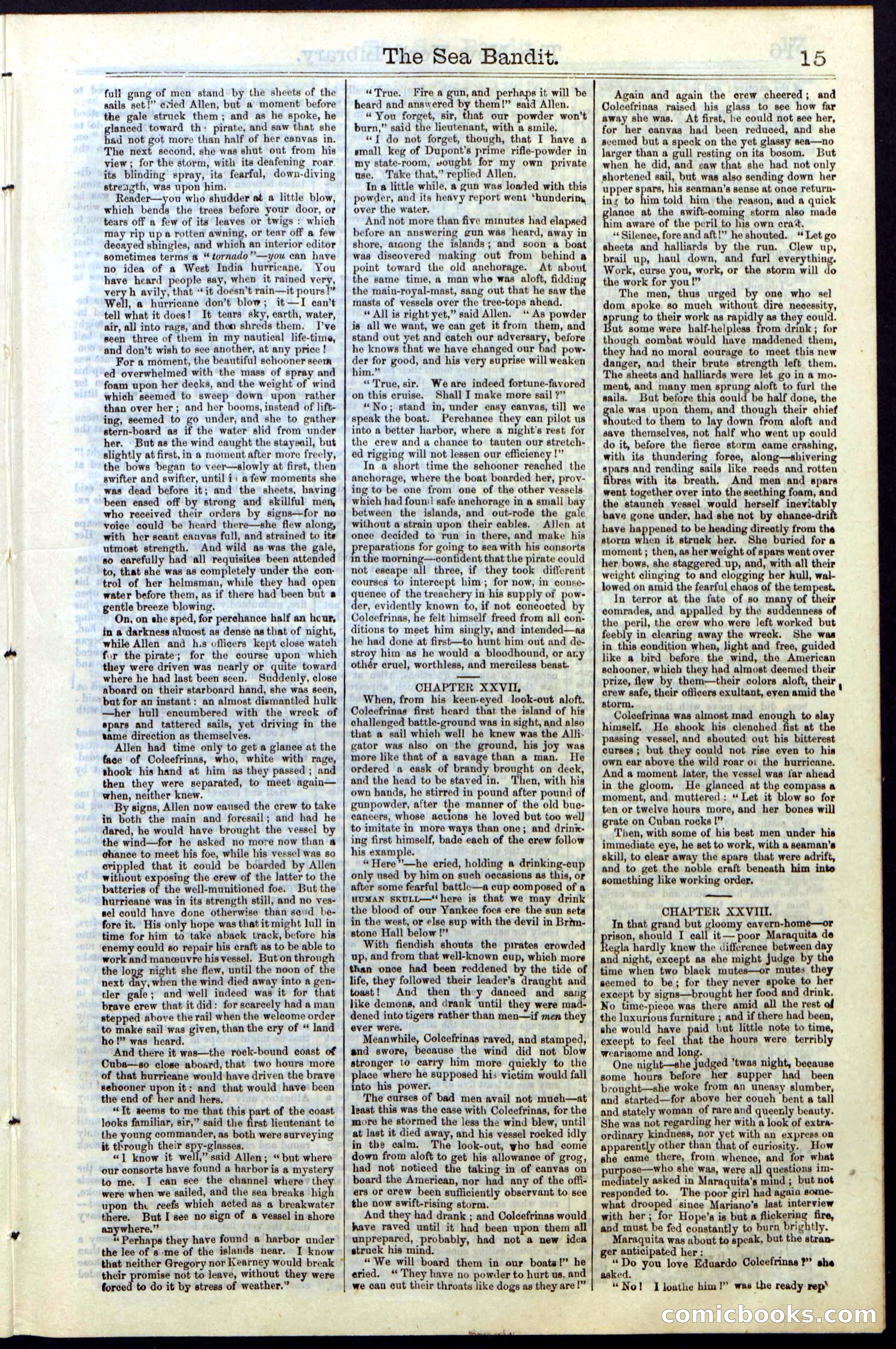
A restored page from Pulp Fiction, 1877. Page through the whole issue in the reader above.
📄 Transcribed text from this page (OCR, searchable)
Machine-transcribed from the original scan — historical spelling and the odd misread are preserved.
ee eee — «-~—-—— te me oe full gang of men stand by the sheets of the sails set!’ evied Allen, but a moment before the gale struck them; and as he spoke, he glanced toward th: pirate, and saw that she had not got more than half of her canvas in. The next second, she was shut out from his view ; for the storm, with ite deafening roar its blinding spray, its fearful, down-diving streagth, was upon him. Reader—you who shudder at a little blow, which bends the trees before your door, or tears off a few of its leaves or twigs : which may rip up a rotten awning, or tear off a few decayed shingles, and which an interior editor sometimes terms a “tornado”’—you can have no idea of a Weet India hurricane. You have heard people say, when it rained very, very h avily, that it doesn’t rain—it pours!” Well, a hurricane don’t blow; it—I can’t tell what it does! It tears sky, earth, water, air, all into rags, and then shreds them. I’ve seen three of them in my nautical life-time, and don’t wish to see another, at any price ! For a moment, the beautiful schooner seem ed overwhelmed with the mass of spray and foam upon her decks, and the weight of wind which seemed to sweep down upon rather than over her; and her booms, instead of lift- ing, seemed to go under, and she to gather stern-board as if the water slid from under her. But as the wind caught the staysail, but slightly at first,in a moment after more freely, the bows began to veer—slowly at first, then awifter and swifter, until i: afew moments she was dead before it; and the sheets, baving been eased off by strong and skillful men, who received their orders by signs—for no voice could be heard there—she flew along, with her scant canvas full, and strained to ite utmost strength. And wild as was the gale, so carefully had ‘all requisites been attended to, that she was as completely under the con- trol of her helmsman, while they had open water before them, as if there had been but a gentle breeze blowing. On, on she sped, for perchance half an hour, in a darkness almost as dense as that of night, while Allen and h.s officers kept close watch fur the pirate; for the course upon which they were driven was nearly or quite toward where he had last been seen. Suddenly, close aboard on their starboard hand, she was seen, but for an instant: an almost dismantled hulk —her hull encumbered with the wreck of spars and tattered sails, yet driving in the tame direction as themselves. Allen had time only to get a glance at the face of Colcefrinas, who, white with rage, shook his hand at him as they passed ; and then they were separated, to meet again— when, neither knew. By signs, Allen now caused the crew to take in both the main and foresail; and had he dared, he would have brought the vessel by the wind—for he asked no more now than a chance to meet his foe, while his vessel was so crippled that it could be boarded by Allen without exposing the crew of the latter to the batteries of the well-munitioned foe. But the hurricane was in its strength still, and no ves- sel could have done otherwise than seid be- fore it. His only hope was that it might lull in time for him to take aback track, before his enemy could so repair his craft as to be able to work and manwuvre his vessel. But on through the long night she flew, until the noon of the next ‘3 ms the wind died away into a gen- tler gale; and well indeed was it for that brave crew that it did: for scarcely had a man stepped above the rail when the weleome order to make sail was given, than the ery of “ land ho!” was heard. And there it was—the rock-bound coast of Cuba—so close aboard, that two hours more of that hurricane would have driven the brave sehooner se it: and that would have been the end of her and hers, “Tt aeems to me that this part of the coast looks familiar, sir,” said the first lieutenant te the young commander, as both were surveying it through their s ee “] know it well,” said Allen; “but where our consorts have found a harbor is a mystery to me. J ean see the channel where ’ the were when we sailed, and the sea breaks high upon the reefs which acted as a breakwater there. But I see no sign of a@ vessel in shore anywhere.” . “Perhaps they have found a harbor under the lee of s me of the islands near. I know that neither Gregory nor Kearney would break their promise not to leave, without they were teased’ to do it by stress of weather.” The Sea Bandit. “True. Fire a gun, and perhaps it will be heard and answered by them!” said Allen. “You forget, sir, that our powder won't burn,” said the lieutenant, with a smile. “f do not forget, though, that I have a small keg of Dupont’s prime rifle-powder in my state-room, wought for my own private use. Tike that,” replied Allen, In a little while, a gun was loaded with this powder, and its heavy report went ‘hunderim, over the water. And not more than five minutes had elapsed before an answering gun was heard, away in shore, armong the islands; and soon a boat was discovered making out from behind a point toward the old anchorage. At about the same time, a man who was aloft, fidding the main-royal-mast, sang out that he saw the masts of vessels over the tree-tops ahead. “ All is right yet,” said Allen. ‘ As powder is all we want, we can get it from them, and stand out yet and catch our adversary, before he knows that we have changed our bad pow- der for good, and his very suprise will weaken him.” “True, sir. Weare indeed fortune-favored on this cruise. Shall I make more sail ?” “No; stand in, under easy canvas, till we speak the boat. Perchance they ean pilot us into a better harbor, where a night's rest for the erew and a chance to tauten our stretch- ed rigging will not lessen our efficiency !” In a short time the schooner reached the anchorage, where the boat boarded her, prov- ing to be one from one of the other vessels which had foun! safe anchorage in a small bay between the islands, and out-rode the gale without a strain upon their cables. Allen at onee decided to run in there, and make his reparations for going to sea with his consorts in the nti Ep war that the pirate could not eseape all three, if they took different courses to intercept him; for now, in conse- = of the treachery in his supply of pow- er, evidently known to, if not pL a, by Coleefrinas, he felt himself freed from all eon- ditions to meet him singly, and intended—as he had done at fitch beat him out and de- stroy him as he would a bloodhound, or ary othér cruel, worthless, and merciless beast. CHAPTER XXVII, When, from his keen-eyed look-out aloft. Coleefrinas first heard that the island of his challenged battle-ground was in sight, and also that a sail which well he knew was the Alli- gator was also on the ground, his joy was more like that of a ds, than a man. He y ordered a cask of brandy brought on deck, and the head to be staved in. en, with his own hands, he stirred in pound after pound of gunpowder, after the manner of the old bue- caneers, Whose acuions he loved but too well to imitate in more ways than one; and drink- ing first himself, bade each of the crew follow his example. “Here”—he cried, holding a drinking-cup only used by him on such occasions as this, or after some fearful battleo—a cup composed of a HUMAN SKULL—* here is that we may drink the blood of our Yankee foes ere the sun seta in the west, or else sup with the devil in Brim- stone Hall below !” With fiendish shouts the pirates crowded up, and from that well-known eup, which more than once had been reddened by the tide of life, they followed their leader's draught and toast! And then they danced and sang like demons, and drank until they were mad- dened into tigers rather than men—if men they ever were. Meanwhile, Colcefrinas raved, and stamped, and swore, because the wind did not blow stronger to carry him more quickly to the place where he supposed his victim would fall into his power. The curses of bad men avail not much—at least this was the case with Colcefrinas, for the more he stormed the less the wind blew, until at last it died away, and his vessel rocked idly in the calm. The look-out, who had come down from aloft to get his allowance of grog, had not noticed the taking in of canvas on board the American, nor had any of the offi- ers or crew been sufliciently observant to see the now swift-rising storm. And they had drank ; and Colcefrinas would. have raved until it had been upon them all unprepared, probably, had not a new idea struck his mind. “We will board them in our boats!” he eried. “They have no powder to hurt us, and we can cut their throats like dogs as they are!” —— ee Oe 15 Again and again the erew cheered; and Colcefrinas raised his glass to see how far away she was. At first, le could not see her, for her canvas had been reduced, and she avemed but a speck on the yet glassy sea—no larger than a gull resting on its bosom. But when he did, and saw that she had not only shortened sail, but was also sending down her upper spars, his seaman’s sense at once return- ing to him told him the reason, and a quick lance at the swift-coming storm also made fim aware of the peril to his own cra‘t. ‘« Silence, fore and aft!” he shouted. “Let go sheets and halliards by the run. Clew up, brail up, haul down, and furl everything. Work, curse you, work, or the storm will ts the work for you!” The men, thus urged by one who sel dom spoke so much without dire necessity, eprung to their work as rapidly as they could. ut some were half-helpless from drink; for though combat would have maddened them, they had no moral courage to meet this new danger, and their brute strength left them. The sheets and halliards were let go in a mo- ment, and many men sprung aloft to furl the sails. But before this could be half done, the ale was upon them, and though their chief shouted to them to lay down from aloft and save themselves, not half who went up could do it, before the fierce storm came crashing, with its thundering force, along—shivering spars and rending sails like reeds and rotten fibres with its breath, And men and spars went together over into the seething foam, and the staunch vessel would herself inevitabl bave gone under, had she not by shanee-drif have happened to be heading directly from the storm when it struck her. She buried fora moment ; then, as her weight of spars went over her bows, she staggered up, and, with all their weight clinging to and clogging her hull, wal- lowed on amid the fearful shacs of the tempest, In terror at the fate of so many of their comrades, and appalled by the suddenness of the peril, the crew who were left worked but feebly in clearing away the wreck. She was in this condition when, light and free, guided like a bird before the wind, the American schooner, which they had almost deemed their prize, flew by them—their colors aloft, their crew safe, their officers exultant, even amid the storm. Coleefrinas was almost mad enough to slay himself. He shook his clenched fist at the passing vessel, and shouted out his bitterest curses ; but they could not rise even to his own ear above the wild roar ot the hurricane. And a moment later, the vessel was far ahead in the gloom. He glanced at the compass a moment, and muttered: “ Let it blow so for ten or twelve hours more, and her bones will grate on Cuban rocks |” Then, with some of his best men under his immediate eye, he set to work, with a seaman’s skill, to clear away the spars that were adrift, and to get the noble craft beneath him into something like working order. _—_—_— CHAPTER XXVIII. In that grand but gloomy cavern-home—or rison, should I call it— poor Maraquita de Re la hardly knew the difference between day and night, except as she might Judge by the time when two black mutes—or mutes they seemed to be; for they never spoke to her except by signs—brought her food and drink, No time-piece was there amid all the rest of the luxurious furniture ; and if there had been, she would have paid but little note to time, except to feel that the hours were terribly wearisome and long. One fait aha tn ged twas night, because some hours before her supper had been brought—she woke from an uneasy slumber, and started—for above her couch bent a tall and stately woman of rare and queenly beauty. She was not regarding her with a look of extra- ordinary kindness, nor yet with an express.on apparently other than that of curiosity. How oa came there, from whence, and for what purpose—who she was, were all questions im- mediately asked in Maraquita’s mind ; but not responded to. The poor girl had agaia some- what drooped since Mariano’s last interview with her; for Hope's is but a figkenns fire, and must be fed constantly to burn brightly. faraquita was about to speak, but the stran- ger anticipated her: _ arti dnd “Do you love Eduardo Colcefrinas ?” she asked. “No! I loathe him!” was the ready rep’ GOmIGE 700 <S ® , oe co