
Pulp Fiction, 1877 · page 13 of 28
Beadle's Dime Library No. 18 — page 13: what you’re looking at
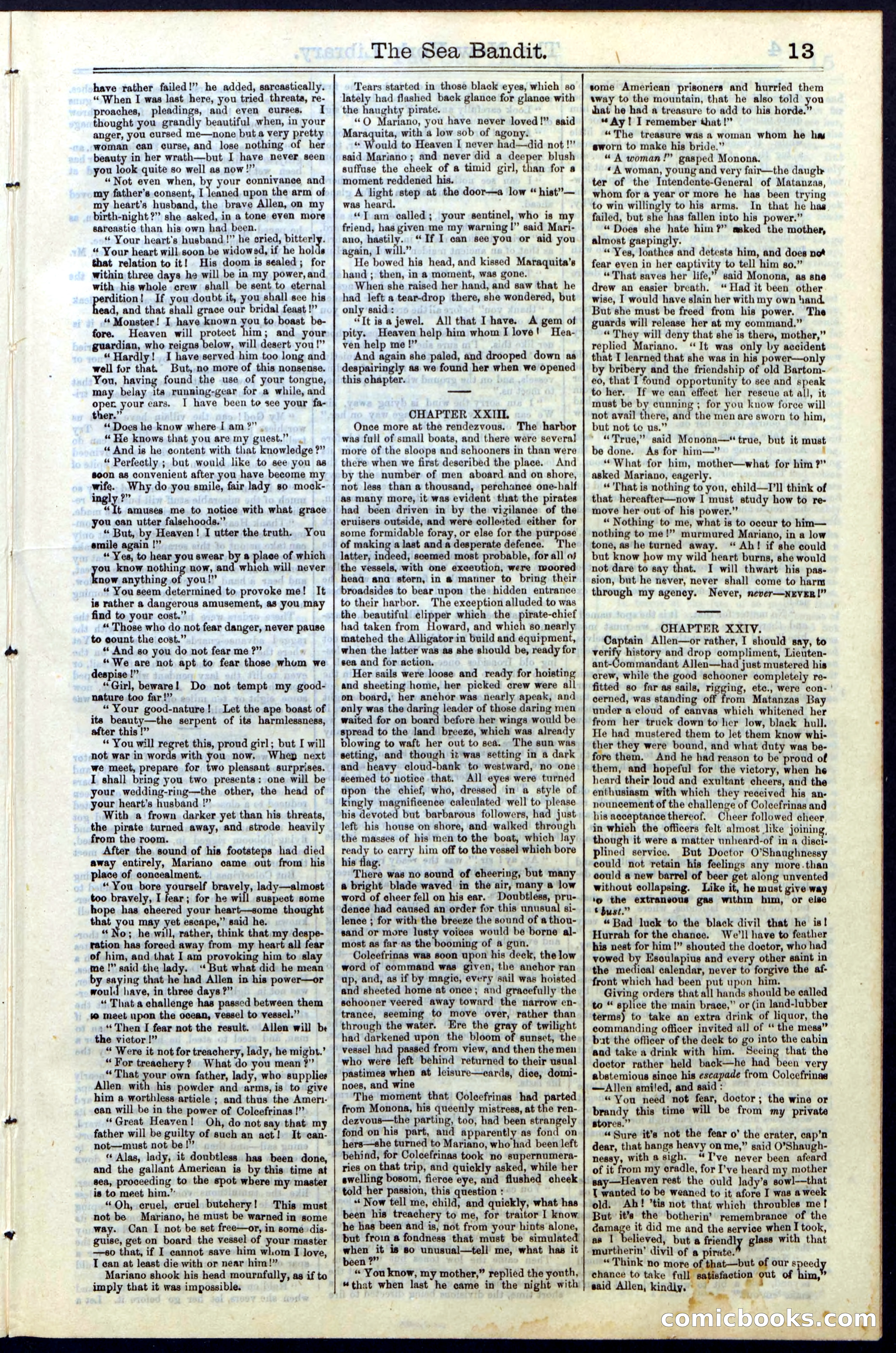
A restored page from Pulp Fiction, 1877. Page through the whole issue in the reader above.
📄 Transcribed text from this page (OCR, searchable)
Machine-transcribed from the original scan — historical spelling and the odd misread are preserved.
have rather failed!” he added, sarcastically. “When I was last here, you tried threats, re- proaches, pleadings, and even curses, I thought you grandly beautiful when, in your anger, you cursed me—none but a very pretty woman can curse, and lose nothing of her beauty in her wrath—but I have never seen you look quite so well as now!” “Not even when, by your connivance and my father’s consent, aie upon the arm of my heart’s husband, the brave Allen, on my birth-night ?” she asked, in a tone even more sarcastic than his own had been. “ Your heart's husband!” he cried, agony “ Your heart will.soon be widowed, if he holds that relation to it! His doom is sealed; for within three days he will be in my power, and with his whole crew shall be sent to eternal rdition! If you doubt it, you shall see his ead, and that shall grace our bridal feast!” ‘“* Monster! I have known you to boast be- fore. Heaven will protect him; and your rdian, who reigns below, will desert you!” “Hardly! I have served him too long and well fur that. But, no more of this nonsense. You, having found the use of your tongue, may belay ita running-gear for a while, and oper your ears. I have been to see your fa- ther.’ ‘Does he know where I am?” . “He knows that you are my guest.” “ And is he content with that knowledge ?” “ Perfectly ; but would like to see you as soon as convenient after you have become my wife. Why do you smile, fair lady so mock- Ba 6 sist “It amuses me to notice with what grace you can utter falsehoods.” “ But, by Heaven! I utter the truth. You emile again |” “ Yes, to hear you swear by a place of which ou know nothing now, and which will never now anything of. you!” “ You seem determined to provoke me! It is rather a dangerous amusement, as you may find to your cost.” ) “‘ Those who do not fear danger, never pause to sount the cost.” “ And so you do not fear me ?” : “We are not apt to fear those whum we despise !”” “Girl, beware! Do not tempt my good- nature too far!” “Your good-nature! Let the ape boast of its beauty—the serpent of its harmlessness, after this !” “ You will regret this, proud girl; but I will not war in words with you now. .Whep next we meet, prepare for two pleasant surprises. I shall bring you two presents: one will be your wedding-ring—the other, the head of your heart’s husband |” With a frown darker yet than his threats, the pirate turned away, and strode heavily from the room. After the sound of his footsteps had died away entirely, Mariano came out from his place of concealment. “You bore yourself bravely, lady—almost too bravely, I fear; for he will suspect some hope has cheered your heart—some thought that you may yet escape,” said he. “No; he will, rather, think that my des ration has forced away from my heart all fear of him, and that I am provoking him to slay me !” said the lady. ‘“‘ But what did he mean by saying that he had Allen in his power—or would have, in three days?” “ That a challenge has passed between them © meet upon the ocean, vessel to vessel.” :* Then I fear not the result. Allen will be the victor !” “ Were it not for treachery, lady, he might.’ “For treachery? What do you mean ?” “That your own father, lady, who supplies Allen with his powder and arms, is to give him a worthless article ; and thus the Ameri- can will be in the power of Colcefrinas !” “Great Heaven! Oh, do not say that my father will be guilty of such an act! It can- not—must not be !” “ Alas, lady, it doubtless has been done, and the gallant American is by this time at sea, proceeding to the spot where my master is to meet him.” “Oh, cruel, cruel butchery! This must not be Mariano, he must be warned in some way. Can I not be set free—or, in some dis- guise, get on board the vessel of your master —so that, if I cannot save him whom I love, T can at least die with or near him!” Mariano shook his head mournfully, as if to imply that it was impossible. The Sea Bandit. Tears started in those black eyes, which so lately had flashed back glance for glance with the haughty pirate. “© Mariano, you have never loved!” said Maraquita, with a low sob of agony. “ Would to Heaven | never had—did not !” said Mariano; and never did a deeper blush suffuse the cheek of a timid girl, than for a moment reddened his. A light step at the door—a low “ hist”— was heard. “T am called; your sentinel, who is m friend, has given me my warning!” said Mari- ano, hastily. “If I can see you or aid you again, I will.” He bowed his head, and kissed Maraquita’s hand; then, in a moment, was gone. When she raised her hand, and saw that he had left a tear-drop there, she wondered, but only said “It is a jewel. All that Ihave. A gem of pity. Heaven help him whom I love! Hea- ven help me !” And again she paled, and drooped down as despairingly as we found her when we opened this chapter. CHAPTER XXIIL Once more at the rendezvous. The harbor was full of small boats, and there were several] more of the sloops and schooners in than were there when we first described the place. And by the number of men aboard and on shore, not less than a thousand, perchance one-half as many more, it was evident that the pirates had been driven in by the vizilance of the cruisers outside, and were collested either for some formidable foray, or else for the purpose of making a last and a desperate defence. The latter, indeed, seemed most probable, for all aj the vessels, with one excevtion, were moored heaa ana stern, in @ manner to bring their broadsides to bear upon the hidden entrance to their harbor. The exception alluded to was the beautiful clipper which the | pirate-chief had taken from Howard, and which so nearly matched the Alligator in build and equipment, when the latter was as she should be, ready for sea and for action. Her sails were loose and ready for hoisting and sheeting home, her picked crew were all on board, her anchor was nearly apeak, and only was the daring leader of those daring men waited for on board before her wings would be spread to the land breeze, which was already blowing to waft her out to sea. The sun was setting, and though it was setting in a dark and heavy cloud-bank to westward, no one seemed to notice that. All eyes were turned upon the chief, who, dressed in a style of kingly magnificence caleulated well to please his devoted but barbarous followers, had just left his house on shore, and walked through the masses of his men to the boat, which lay ready to carry him off to the vessel which bore his flag. There was no sound of cheering, but many a bright blade waved in the air, many a low word of cheer fell on his ear. Doubtless, pru- dence had caused an order for this unusual si- lence ; for with the breeze the sound of a thou- sand or more lusty voices would be borne al- most as faras the booming of a gun. Coleefrinas was soon upon his deck, the low word of command was given, the anchor ran up, and, as if by magic, every sail was hoisted and sheeted home at once; and gracefully the schooner veered away toward the narrow en- trance, seeming to move over, rather than through the water. Ere the gray of twilight had darkened upon the bloom ot sunset, the veasel had d from view, and then the men who were left behind returned to their usual pastimes when at leisure—cards, dice, domi- noes, and wine The moment that Coleefrinas had parted from Monona, his queenly mistress, at the ren- dezvous—the parting, too, had been strangely fond on his part, and apparently as fond on hers—she turned to Mariano, who had been left behind, for Colcefrinas took no supernumera- ries on that trip, and quickly asked, while her swelling told her passion, this question : “ Now tell me, child, and quickly, what has been his treachery to me, for traitor I know. he has been and is, not from your hints alone, but froin a fondness that must be simulated when it is so unusual—tell me, what has it been ?” “ You know, my mother,” replied the youth, “that when last he came in the night with nett - é m, fieree eye, and flushed cheek. . PE at. a ¥ some American prisoners and hurried them wway to the mountain, that he also told you that he had a treasure to add to his horde.” “ Ay! I remember shat!” “The treasure was a woman whom he ha sworn to make his bride.” “ A woman!” gasped Monona. ‘A woman, young and very fair—the daugl ter of the Intendente-General of Matanzas, whom for a year or more he has been trying to win willingly to his arms. In that he has failed, but she has fallen into his power.” “Does she hate him?” asked the mother, almost gaspingly. “Yes, loathes and detests him, and does not fear even in her captivity to tell him so.” “That saves her life,” said Monona, as sne drew an easier breath. “Had it been other wise, I would have slain her with my own hand. But she must be freed from his power. The guards will release her at my command.” at ee a deny that she is there, mother,” replied Mariano. “It was only by accident that I learned that she was in his power—onl by bribery and the friendship of old Bartom- eo, that I found opportunity to see and speak to her. If we can effect her rescue at all, it must be by cunning ; for you know force will not avail there, ail the men are sworn to him, but not to us.” ' “True,” said Monona—*“ true, but it must be done. As for him—” . “What for him, mother—what for him?” asked Mariano, eagerly. “That is nothing to you, child—I’ll think of that hereafter—now I must study how to re- move her out of his power.” “ Nothing to me, what is to occur to him— nothing to me!” murmured Mariano, in a low tone, as he turned away. “ Ah! if she could but know how 7 wild heart burns, she would not dare to say that. I will thwart his pas- sion, but he never, never shall come to harm through my agency. Never, never—nxver!” CHAPTER XXTV. Captain Allen—or rather, I should say, to shi history and drop compliment, Lieuten- ant-Commandant Allen—had just mustered his crew, while the good schooner completely re- fitted so far as sails, rigging, ete., were con- ' cerned, was standing off from Matanzas Bay under a cloud of canvas which whitened her from her truck down to her low, black hull. He had mustered them to let them know whi- ther they were bound, and what duty was be- fore them. And he had reason to be proud of them, and hopeful for the victory, when he heard their loud and exultant cheers, and the enthusiasm with which they received his an- nouncement of the challenge of Colcefrinas and his acceptance thereof. Cheer followed cheer. in which the officers felt almost like joining, though it were a matter unheard-of in a disci- plined service. But Doctor O'Shaughnessy could not retain his feelings any more.than could a new barrel of beer get along unvented without collapsing. Like it, he must give way ‘o sate? extraneous gas within him, or else 4 2.” “Bad luck to the black divil that he is! Hurrah for the chance. We'll have to feather his nest for him!” shouted the doctor, who had vowed by Esoulapius and every other saint in the medical calendar, never to forgive the af- front which had been put upon him. Giving orders that all hands should be called to “ splice the main brace,” or (in land-lubber terms) to take an extra drink of liquor, the commanding officer invited all of “ the mess” bat the officer of the deck to go into the cabin and take a drink with him. Seeing that the doctor rather held back—he had been very abstemious since his escapade from Colcefrinag —Allen smiled, and said : “You need not fear, doctor; the wine or brandy this time will be from my private stores.” “Sure it’s not the fear o’ the crater, cap’n dear, that hangs heavy on me,” said O’Shaugh- nessy, with a sigh. “T’ve never been afeard of it from my cradle, for I’ve heard my mother say—Heaven rest the ould lady’s sowl—that ‘T wanted to be weaned to it afore I was a week old. Ah! ’tis not that which throubles me! But it’s the botherin’ remembrance of the damage, did me and the service when I took, ae | leved, but a friendly glass with that -murtherin’ divil of a pirate. “Think no more at—but of our speedy 5 re to take fu faction t of him,” eal en, kindly. ~ . .cO ‘comic 100