
Pulp Fiction, 1877 · page 31 of 32
Beadle's Dime Library No. 16 — page 31: what you’re looking at
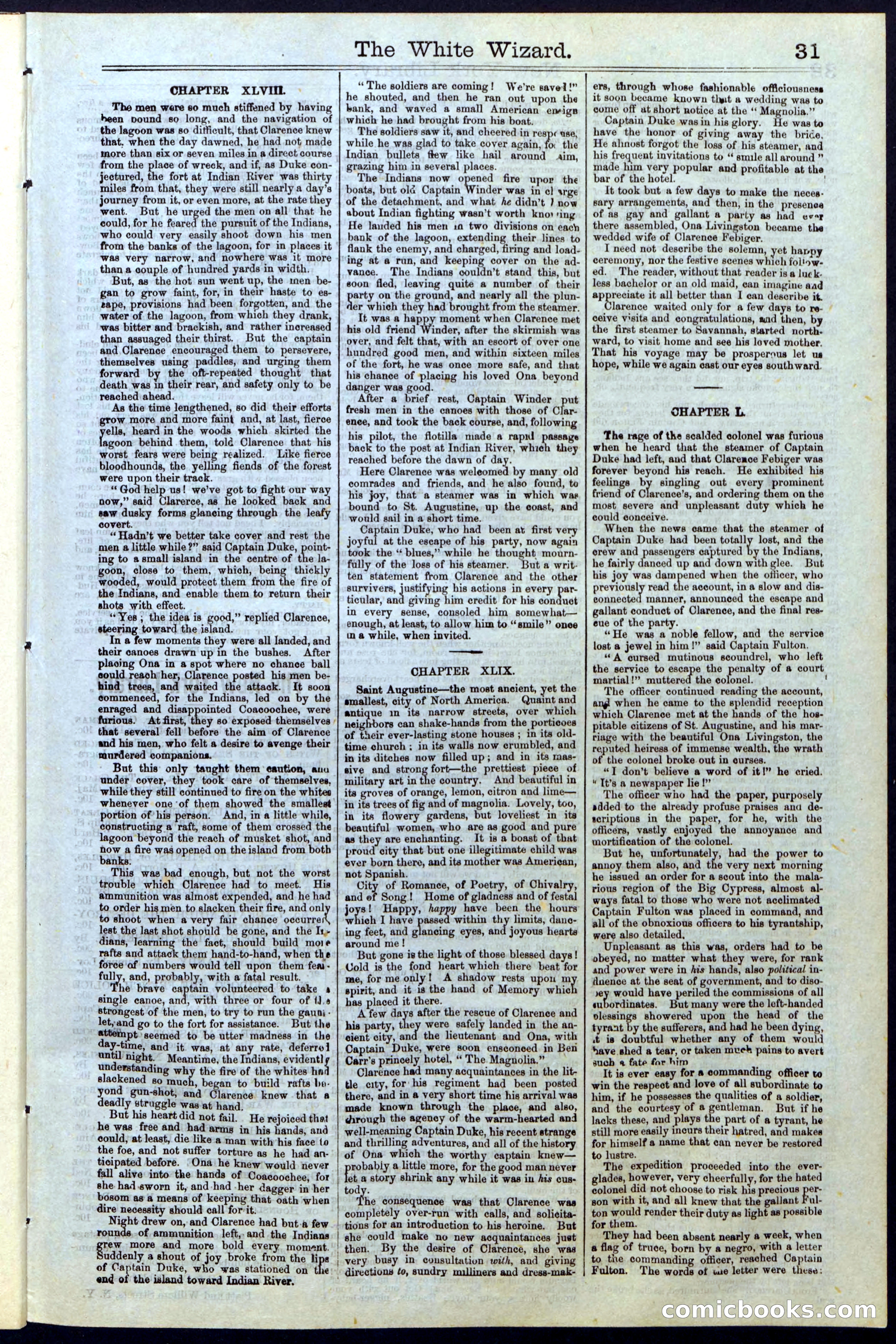
A restored page from Pulp Fiction, 1877. Page through the whole issue in the reader above.
📄 Transcribed text from this page (OCR, searchable)
Machine-transcribed from the original scan — historical spelling and the odd misread are preserved.
CHAPTER XLVIIIL The men were so much stiffened by having heen pound so long, and the navigation of the lagoon was so difficult, that Clarence knew that. when the day dawned, he had not made more than six or seven miles in a direct course from the place of wreck, and if, as Duke con- jectured, the fort at Indian River was thirty miles from that, they were still nearly a day’s journey from it, or even more, at the rate they went. But he urged the men on all that he could, for he feared the pursuit of the Indians, who could very easily shoot down his men from the banks of the lagoon, for in places it was very narrow, and nowhere was it more than a couple of hundred yards in width. But, as the hot sun went up, the men be- gan to grow faint, for, in their haste to es- bape, provisions had been forgotten, and the water of the lagoon, from which they drank, was bitter and brackish, and rather increased than assuaged their thirst. But the captain and. Clarence encouraged them to persevere, themselves using paddles, and urging them forward by the oft-repeated thought that death was in their rear, and safety only to be reached ahead. As the time lengthened, so did their efforts grow more and more faint and, at last, fierce ells, heard in the woods which skirted the agoon behind them, told Clarence that his worst fears were being realized. Like fierce bloodhounds, the yelling fiends of the forest were upon their track. “God help us! we've got to fight our way now,’ said rerce, a8 he looked back and saw dusky forms glancing through the leafy covert. ; “Hadn’t we better take cover and rest the men a little while?” said Captain Duke, point- ing to asmall island in the centre of the la- goon, close to them, which, being thickly wooded, would protect them from the fire of the Indians, and enable them to return their shots with effect. “Yes ; the idea is good,” replied Clarence, steering toward the island. In a few moments they were all landed, and their canoes drawn up in the bushes. After placing Ona in a spot where no chance ball could reach’her, Clarence posted his men be- hind trees, and waited the attack. It soon commenced, for the Indians, led on by the enraged and disappointed Coacoochee, were furious. At first, they so exposed themselves that several fell before the aim of Clarence and his men, who felt a desire to avenge their rmourdered companions. But this only taught them eaution, anu under cover, they took care of themselves, while they still continued to fire on the whites whenever one ‘of them showed the smallest portion of his person. And, in a little while, constructing a raft, some of them crossed the lagoon beyond the reach of musket shot, and _ how a fire was opened on the island from both banks. This was bad enough, but not the worst trouble which Clarence had to meet. His ammunition was almost expended, and he had to order his men to slacken their fire, and onl to shoot when a very fair chance odtignat lest the last shot should be gone, and the It» dians, learning the fact, should build move rafts and attack them hand-to-hand, when the force of numbers would tell upon them fen- fay and, probably, with a fatal result. _ The brave captain volunteered to take 4 single canoe, and, with three or four of {J.s strongest of the men, to try to run the gauni- let»and go to the fort for assistance. But the attempt seemed to be utter madness in the -time, and it was, at any rate, deferrod poor night. Meantime, the Indians, evident) f ta erstanding why the fire of the whites hn slackened so much, began to build rafts bo- yond gun-shot, and Clarence knew that a deadly struggle was at hand. But his heart did not fail. He rejoiced that he was free and had arms in his hands, and could, at least, die like a man with his face to the foe, and not suffer torture as he had an- ticipated before. Ona he knew would never fall alive into the hands of Coacoochee, for she had sworn it, and-had -her dagger in her bosom as a means of keeping that oath when dire necessity should call forit. Night drew on, and Clarence had but-a few rounds,.of ammunition left,,and the Indians ‘ew more and more bold every moment. uddenly a shout of joy broke from the lips of Captain Duke, who was stationed on the end of the island toward Indian River. — The | White Wizard. “The soldiers are coming! We're savel!” he shouted, and then he ran out upon the bank, and waved a small American emign which he had brought from his boat. The soldiers saw it, and cheered in resp¢ ase, while he was glad to take cover again, fo the Indian bullets flew like hail around aim, grazing him in several places. The Indians now opened fire upor the boats, but old Captain Winder was in cl) sarge of the detachment, and what he didn’t } now about Indian fighting wasn’t worth knov sing He lauded his men io two divisions on each bank of the lagoon, extending their lines to flank the enemy, and charged, firing and load- ing at a run, and keeping cover on the ad- vance. The Indians couldn’t stand this, but soon fled, leaving quite a number of their party on the ground, and nearly all the plun- er which they had brought from the steamer. It was a happy moment when Clarence met his old friend Winder, after the skirmish was over, and felt that, with an escort of over one hundred good men, and within sixteen miles of the fort, he was once more safe, and that his chance of placing his loved Ona beyond danger was good. After a brief rest, Captain Winder put fresh men in the canoes with those of Clar- enee, and took the back course, and, following his pilot, the flotilla made a rapxl passage back to the post at Indian River, which they reached before the dawn of day. Here Clarence was mclonstetat by many old comrades and friends, and he also found, to his joy, that a steamer was in which was bound to St. Augustine, up the coast, and would sail in a short time. Captain Duke, who had been at first very joyful at the eseape of his party, now again took the “ blues,” while he thought mourn- fully of the loss of his steamer. But a writ- ten statement from Clarence and the other survivers, justifying his actions in every par- ticular, A giving him eredit for his conduct in every sense, consoled him somewhat— enough, at least, to allow him to “smile” onee in a while, when invited. a CHAPTER XLIX. Saint Augustine—the most ancient, yet the smallest, city of North America. Quaint and antique im its narrow streets, over which neighbors can shake-hands from the porticoes of their ever-lasting stone houses ; in its old- time church ; in its walls now erumbled, and in its ditches now filled up; and in its mas- sive and strong fort—the prettiest piece of military art inthe country, And beautiful in its groves of orange, lemon, citron and lime— in its trees of fig and of magnolia. Lovely, too, in its flowery gardens, but loveliest in its beautiful women, who are as good and pure as they are enchanting. It is a boast of that proud city that but one illegitimate child was ever born there, and its mother was American, not Spanish. City of Romance, of Poetry, of Chivalry, and of Song! Home of gladness and of festa] joys! Happy, ha which I have passed within thy limits, dane- ing feet, and glancing eyes, and joyous hearts around me! But gone is the light of those blessed days! Vold is the fond heart which there beat for me, for me only! A shadow rests upon my. spirit, and it is the hand of Memory whic has placed it there. A few days after the rescue of Clarence and his party, ey were safely landed in the an- cient city, and the lieutenant and Ona, with Captain Duke, were scon ensconced in Ben Carr's princely hotel, “ The Magnolia.” Clarence had many acquaintances in the lit- tle city, for his regiment had been posted there, and in a very short time his arrival was made known through the place, and also, <chrough the agency of the warm-hearted and well-meaning Captain Duke, his recent strange and thrilling adventures, and all of the history of Ona which the worthy captain knew— robably a little more, for the good man never eta story shrink any while it was in his cus- tody. Phe consequence was that Clarence was completely over-run with calls, and solicita- tions for an introduction to his heroine. But she could make no new acquaintances just then. By the desire of Clarence, she was very busy in consultation with, and giving . directions ¢o, sundry mulliners and dress-mak- have been the hours’ 31 ers, through whose fashionable officiousness it soon became known tht a wedding was to come off at short notice at the “ Magnolia.” Captain Duke was in his glory. He was to have the honor of giving away the bride, He alinost forgot the loss of his steamer, and his frequent invitations to “ smile all around ” made him very popular and profitable at the bar of the hotel. It took but a few days to make the neces- sary arrangements, and then, in the presenee of as gay and gallant a party as had ever there assembled, Ona Livingston became the wedded wife of Clarence Pebiger. I need not describe the solemn, yet happy ceremony, nor the festive scenes which follow- ed. The reader, without that reader is a luck. less bachelor or an old maid, can imagine aad el er pe it all better than I can describe it. eee larence waited only for a few days to re- | ceive visits and congratulations, and then, by the first steamer to Savannah, started north. ward, to visit home and see his loved mother. That his voyage may be prosperous let us hope, while we again cast our eyes southward. OHAPTER L. The rage of the scalded colonel was furious when he heard that the steamer of Captain Duke had left, and that Clarence Febiger was forever beyond his reach. He exhibited his feelings by singling out every prominent friend of Clarence’s, and ordering them on the most severe and unpleasant duty which he could conceive. When the news came that the steamer of Captain Duke had been ees lost, and the crew and passengers captured by the Indians, he fairly danced up and down with glee. But his joy was PEP: when the oflicer, who previously read the account, in a slow and dis- hens fev ery announced the escape and gallant conduct of Clarence, and the final res- cue of the party. “He was a noble fellow, and the service lost a jewel in him!” said Captain Fulton. “A cursed mutinous scoundrel, who left the service to escape the martial!” muttered the colonel. The officer continued reading the account, when he came to the splendid reception which Clarence met at the hands of the hos- pitable citizens of St. Augustine, and his mar- riage with the beautiful Ona Livingston, the reputed heiress of immense wealth, the wrath of the colonel broke out in curses. “T don’t believe a word of it!” he cried. “ It’s a newspaper lie !” The officer who had the paper, purposely added to the already profuse praises ana de- scriptions in the paper, for he, with the officers, vastly enjoyed the annoyance and mortification of the colonel. But he, Te tae ake had the power to annoy them also, and the very next morning he issued an order for a scout into the mala- rious region of the Big Cypress, almost al- ways fatal to those who were not acclimated Captain Fulton was placed in command, and all of the obnoxious officers to his tyrantship, were also detailed, Unpleasant as this was, orders had to be obeyed, no matter what they were, for rank and power were in his hands, also political in- ilnence at the seat of government, and to diso- yey would have periled the commissions of all subordinates. But many were the left-handed olessings showered upon the head of the tyrant by the sufferers, and had he been dying, is doubtful whether any of them would have shed a tear, or taken much pains to avert such @ fate for him ' It is ever easy for a commanding officer to win the respect and love of all subordinate to him, if he possesses the qualities of a soldier, and the courtesy of a gentleman. But if he lacks these, and plays the part of a tyrant, he still more easily incurs their hatred, and makes for himself a name that can never be restored to lustre. The expedition proceeded into the ever- glades, however, very cheerfully, for the hated colonel did not choose to risk his precious per- son with it, and all knew that the gallant Ful- ton would render their duty as light as possible for them. They had been absent nearly a week, when a flag of truee, born by a negro, with a letter enalty of a court t (e(e) to the commanding officer, reached Captain Fulton. The words of we letter were these: comicbooks 2