
Pulp Fiction, 1877 · page 32 of 32
Beadle's Dime Library No. 16 — page 32: what you’re looking at
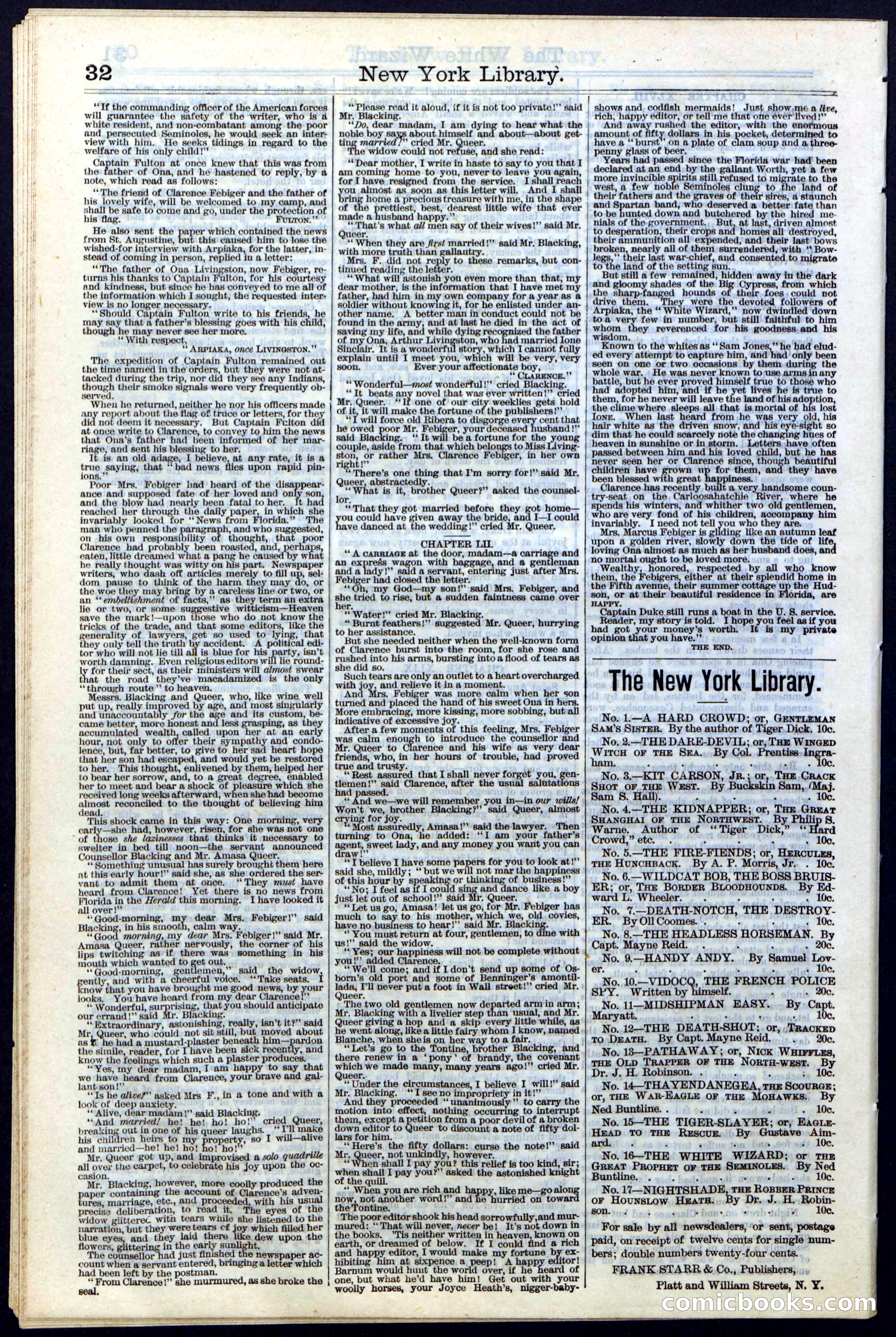
A restored page from Pulp Fiction, 1877. Page through the whole issue in the reader above.
📄 Transcribed text from this page (OCR, searchable)
Machine-transcribed from the original scan — historical spelling and the odd misread are preserved.
“If the commanding officer of the American forces will guarantee the safety of the writer, who is 4 white resident, and non-combatant among the poor and persecuted Seminoles, he would seek an inter- view with him. He seeks tidings in regard to the welfare of his only child!” Captain Fulton at once knew that this was from the father of Ona, and he hastened to reply, by a note, which read as follows: “The friend of Clarence Febiger and the father of his lovely wife, will be welcomed to my camp, and shall be safe to come and go, under the protection of his flag. Turon.”* He also sent the paper which contained the news from St. Augustine, but this caused him to lose the wished-for interview with Arpiaka, for the latter, in- stead of coming in person, replied in a letter: “The father of Ona paving, now Febiger, re- turns his thanks to Captain Fulton, for his courtesy and kindness, but since he has conveyed to me all of the information which I sought, the requested inter- view is no longer necessary. ‘*Should Captain Fulton write to his friends, he may say that a father’s blessing goes with his child, though he may never see her more. ** With respect, ** ARPIAKA, once LIVINGSTON.” The expedition of Captain Fulton remained out the time named in the orders, but they were not at- tacked during the trip, nor did they see any Indians, ii their smoke signals were very frequently ob- served, When he returned, neither he nor his officers made any report about the flag of truce or letters, for they did not deem it necessary. But Captain Felton did at once write to Clarence, to convey to him the news that Ona’s father had been informed of her mar- riage, and sent his blessing to her, It is an old adage, I believe, at any rate, it is a true saying, that “bad news. flies upon rapid pin- ions.” Poor Mrs. Febiger had heard of the disappear- ance and supposed fate of her loved and only son and the blow had nearly been fatal to her. It had reached her through the daily paper, in which she invariably looked for ‘‘ News from Florida.” The man who penned the paragraph, and who suggested, on his own responsibility of thought, that poor Clarence had probably been roasted, and, perhaps, eaten, little dreamed what a pang he caused by what he really thought was witty on his part. Newspaper writers, who dash off articles merely to fill up, sel- dom pause to think of the harm they may do, or the woe they may bring by a careless line or two, or an ‘embellishment of facts,’ as they term an extra lie or two, or some suggestive witticism—Heaven save the mark!—upon those who do not know the tricks of the trade, and that some editors, like the generality of lawyers, get so used to lying, that they only tell the ron accident. A political edi- tor who will not lie till is blue for his partys isn’t worth damning. Even religious editors will lie round- ly for their sect, as their ministers will a/most swear that the road they’ve macadamized is the only ‘through route” to heaven. , Messrs. Blacking and Queer, who, like wine well put up, really improved by age, and most singularly and unaccountably for the age and its custom, be- came better, more honest and less grasping, as they accumulated wealth called upon her at an early hour, not only to offer their sympathy and condo- lence, but, far better, to give to her sad heart hope that her son had escaped, and would yet be restored to her. This thought, enlivened by them, helped her to bear her sorrow, and, to a great degree, enabled her to meet and bear a shock of pleasure which she received long weeks afterward, when she had become ouners reconciled to the thought of believing him ead, ; This shock came in this way: One morning, very carly—she had, however, risen, for she was not one of those she lazinesses t it necessary to swelter in bed till noon—the servant announced Counsellor Blacking and Mr. Amasa Queer. ‘‘ Something unusual has surely brought them here at this early hour!” said she, as she ordered the ser- vant to admit them at once. “They must have heard from Clarence! Yet there is no news from Florida in the Herald this morning. I have looked it all over!” ‘‘Good-morning, my dear Mrs. Febiger!’’ said Blacking, in his smooth, calm way, “Good morning, my dear Mrs. Febiger!’’ said Mr. Amasa Queer, rather nervously, the corner of his lips twitching as if there was something in his mouth which wanted to get out. ‘*Good-morning, gentlemen,” said the widow ently, and with a cheerful voice. **Take seats. I Enow that you have brought me good news, by your looks. You have heard from my dear Clarence!’ * Wonderful, Se aes that you should anticipate our errand!”’ said . Blacking. : m “Extraordinary, astonishing, really, isn’t it?” said Mr, Queer, who could not sit still, but moved about as * he had a mustard-plaster beneath him—pardon the simile, reader, for I have been sick recently, and know the feelings which such a plaster produces. “Yes, my dear madam, I am happy to say that we have heard from Clarence, your brave and gal- lant son!” ‘Ts he alive?” asked Mrs F., in a tone and with a look of deep anxiety. ** Alive, dear madam!” said Blacking. ‘‘And married/ he! he! ho! ho!’ cried Queer, breaking out in one of his queer laughs.“ I'll make his children heirs to my property, so I will—alive and married—he! he! ho! ho! ho!” Mr. Queer got up, and improvised a solo quadrille all over the carpet, to celebrate his joy upon the oc- casion, Mr. Blacking, however, more coo roduced the inf the account of a ap adven- aper containing ures, marriage, etc., and proc with his usual precise deliberation, to read it. The eyes of the widow glitterec with tears while she listened to the narration, but they were tears of joy which filled her blue eyes, and they laid there like dew upon the flowers, glitte in the early sunlight, The counsellor had just finished the ei re in ac- count when a servant entered, bringing a le which had been left by the postman. ‘From Clarence!’’ she murmured, as she broke the LL — “Please read it aloud, if it is not too private!’’ said Mr. Blacking. “Do, dear madam, I am dying noble boy says about himself and about—about get- ting married /” cried Mr. Queer. e widow could not refuse, and she read: “Dear mother, I write in haste to say to you that I am coming home to you, never to leave you again, for I have resigned from the service. I shall reach ou almost as soon as this letter will. And I shall ring home a precious treasure with me, in the shape of the prettiest, best, dearest little wife that ever made a husband happy.” g “That's what aii men say of their wives!”’ said Mr. ueer, ‘** When they are first married!” said Mr. Blacking, with more truth than gallantry. Mrs. F. did not reply to these remarks, but con- tinued reading the letter. “What will astonish you even more than that, my dear mother, is the information that I have met my father, had him in my own company for a year as a soldier without knowing it, for he enlisted under an- other name. A better man in conduct could not be found in the army, and at last he died in the act of saving my life, and while dying rec the father of my Ona, Arthur Livingston, who married Ione Sinclair. It is a wonderful story, which I cannot fully explain until I meet you, which will be very, very soon. Ever your affectionate boy, ** CLARENCE.”’ ** Wonderful—most wonderful!” cried Blacking. “It beats any novel that was ever written!” cried Mr, Queer. “If one of our city weeklies gets hold of it, it will make the fortune of the publishers!” “T will force old Ribera to disgorge every cent that he owed r Mr. Abe ig your deceased husband!” said Blacking. ‘ It will be a fortune for the young couple, aside from that which belongs to Miss Living- wr or rather Mrs. Clarence Febiger, in her own pp cs There’s one thing that I'm sorry for!” said Mr. Queer, abstractedly. “What is it, brother Queer?”’ asked the counsel- or, “That they got married before they got home— ae could have given away the bride, and I—I could ve danced at the wedding!” cried Mr. Queer. CHAPTER LI. ‘* A CARRIAGE at the door, madam—a carri and an express wagon with baggage, and a gentleman and a lady!”’ said a servant, entering just after Mrs. Febiger had closed the letter. **Oh, my God—my son!” said Mrs. Febiger, and she tried to rise, but a sudden faintness came over er, “Water!” cried Mr. Blacking. “ Burnt feathers !”’ Mr. Queer, hurrying to her assistance. But she needed neither when the well-known form of Clarence burst into the room, for she rose and rushed into his arms, bursting into a flood of tears as she did so. Such tears are only an outlet to a heart overcharged with ie and relieve it in a moment. An . Febiger was more calm when her son turned and pl the hand of his sweet Ona in hers. More embracing, more kissing, more sobbing, but all indicative of excessive joy. After a few moments of this feeling, Mrs. Febiger was calm enough to introduce the counsellor and Mr. Queer to Clarence and his wife as very dear friends, who, in her hours of trouble, had proved true and trusty Wt you, sdlotations _ “Rest assured that I shall never fo tlemen!” said Clarence, after the us had few pene ** And we—we will remember you in—in our wiils/ Won't we, brother Blacking?’’ said Queer, almost erying for joy. *Most assuredly, turning to Ona, he added: ‘Il am your father’s agent, sweet lady, and any money you want you can Ww bh] **T believe I have some ire for you to look at!” said she, mildly; “ but we will not mar the happiness of this hour by ancestn or thinking of business!” **No; I feel as if I could sing and ce like a boy just let out of school!” said Mr. Queer. “Let us go, Amasa! let us go, for Mr. Febiger has much to say to his mother, which we, old. covies, have no ter to hear!" said Mr. Blacking. “You must return at four, gentlemen, to dine with us!" said the widow. ‘** Yes; our happiness will not be complete without you!’’ added Clarence. 7 ‘We'll come; and if I don’t send up some of Os- born’s old port and some of ’s amontil- lada, I'll never put a foot in Wall street!” cried Mr. Queer. The two old gentlemen now cepetred arm in arm; Mr. Blacking with a livelier step than usual, and Mr. Queer giving a hop and a skip every little while, as he went along, like a little fairy whom I know, named Blanche, when sheis on her way to a fair. ‘““Let’s go to the Tontine, brother Blacking, and there renew in a ‘pony’ of brandy, the covenant Gosa we many, many years ago!” cried Mr, ueer., “Under the circumstances, I believe I will!’’ said Mr. Blacking. ‘I see no impropriety in it!” And they proceeded “ unanimously’ to carry the motion into effect, no oce to interrupt them, except a eee from a poor devil of a broken down editor to Queer to discount a note of fifty dol- lars for him. ‘*Here’s the Sty. dollars: curse the note!’’ said Mr. Queer, not y, however. ‘“*When shall I pay you? this relief is too kind, sir; when shail I pay you?” asked the astonished knight of the quill. ‘** When you are rich and happy, like me—go alo now, not another word!” and he Sparried on coward the Tontine. The editor shook his head sorrowfully,and mur- m : “ That will never, never be! It’s not down in the books. ‘Tis neither written in heaven, known on earth, or dreamed of below. If I could find a rich — ha ee I would make ggg oo b Aine ting at sixpence a pee Barnum would hunt the world Over, if he heard of one, but what he’d have him! Get out with your woolly horses, your Joyce Heath’s, nigger-baby- to hear what the | shows and. codfish mermaids! rich, happy editor, or tell me that one ever lived!” And ey rushed the editor, with the enofmous sket, determined to rr i en _ - Amasa!”’ said the lawyer. Then’ amount of have a *“ burst ge glass of beer. fty dollars in his on a plate of clam soup and a three- Just show, 6 a live, ears had passed since the Florida war had been declared at an end by the gallant Worth, yet a few more invincible spirits still refused to migrate to the west, a few noble Seminoles cl their fathers and the graves of th band, who deserved a better fate than and § hel sires, e land of a staunch to be hunted down and butchered by the hired me. nials of the government., But, at last, driven almost to desperation, their crops and their ammunition all expended, and their last’ bows broken, nearly all of them surrendered, with ‘* Bow- legs,” their last war-chief, and consented, to migrate to the land of the setting sun. But still a few remained, hidden away in the dark and gloomy shades of the the charpfanged hounds 0 e drive them. of thelr th homes all destroyed, , from which foes could not y were the devoted followers of Arpiaka, the “‘ White Wizard,”’ now dwindled down toa ve whom wisdom. few in number, but still faithful to him ey reverenced for his goodness and his Known to the whites as ‘Sam Jones,” he had elud- ed every attempt to capture him, and had’ been seen On one or two occasions by them during the whole war. He was never known to use arms in any battle, but he ever proved himself true to those who had adopted him, and if he yet lives he is true to them, for he never will leave the land of his ado 4m 8 los the c Ione. When hair white as the driven snow, and his ey e where sleeps all that is mortal of last heard from he was very old, his e-sight so dim that he could scarcely note the c heaven in sunshine or in storm. Letters have often passed between him and @ hues of his loved child, but he has never seen her or Clarence since, though beautiful children have wn been blessed with: Goa Clarence has recently b v try-seat on the Carloosahatchie River spends his winters, and whither two old gentlemen, who are very fond of his children, accompany him invariably. Mrs. Marcus Febiger is gliding no mortal Wealthy the Fifth honored, respected them, the Febigers either at avenue, their son, or at their beautiful resid summer by their splen I need not tell you who they are. up for them, and they have t he 88 , Y ta very handsome coun- where he like an autumn leaf upon a golden river, slowly down the tide of life loving Ona almost as much as her husband does, an ought to be loved more. all who know ence in Hori ence did home in 6 Hud- rida, are HAPPY. Captain Duke still runs a boat in the U. 8. service. Reader, my story is told. I hope yu feel as if you It is my private had got your money's worth. opinion that you ha ve,” THE END. The New York Library. No. 1.—A HARD CROWD; or, GENTLEMAN Sam’s Sister. By the author of Tiger. Dick, 10c. No, 2.—THE DARE-DEVIL,; or, Tas WinGED WITCH OF THE Ska. By Col. jue ARSON, Jr.; or, THe Crack No. 3.—KIT SHor oF THE West. By Bu Sam 8. Hall). No. 4—THE KIDNAPPER; or, Tax Great SHANGHAI OF THE NORTHWEST. By Philip 8. Warne. Author of “Tiger Dick,” ‘ Hard Crowd,” etc. . ‘ : : . 10c. No. 5.—THE FIRE-FIENDS; or, THE HUNCHBACK. By A. P. Morris, Jr. ward L. Wheeler. No, 7.—DEATH-NOTCH, ER. By Oll Coomes. . No. 8,—THE HEADLESS Capt. Mayne Reid. No. 9.—HANDY ANDY. By Samuel CH POLICE By Ve t. er. No. 10,—VIDOC SPY. Written by No. 11—MIDSHIPMAN EASY. ATH-SHOT; or, ‘TRacKED Maryatt. No. 12—-THE DE . THE FREN “THE DEST HORSEMAN. By 206. to DeatH. By Capt. Mayne Reid. No. 18—PATHAWAY; or, Nick W THE OLD TRAPPER OF THE NORTH-wus?. Dr. J. H. Robinson. , No. 14—-THA YENDANEGEA or, THE WAR-EAGLE OF THE Ned Buntline. . HEAD TO THE ard. No. 16—THE WHITE WIZARD; GREAT PROPHET oF THE SEMINOLES. By . ee Buntline. . No. 17—-NIGHTSHAD oF HounsLow HEATH. PBA fier cous For sale by all No. 15—THE TIGER-SLA Rescug. By Gustave YER; or, Ba . 10. No. 6.—WILDCAT BOB, THE BOSS BRUIS- ER; or, THE BORDER BLOODHOUNDS. By Ed- . 10c. ROY- Lov- - 10c B 0c. THE SCOURGE; HAWKS. By 10c. GLE- Aim- 10c, or THE THE ROBBER PRINCE By Dr. J. HH. Robin- , ‘ 10c. newsdealers, ‘or sent, postage paid, on receipt of twelve cents for single num- bers; double numbers twenty-four cents. FRANK STARR & Co., Publishers, ., Platt and William Streets, N. Y. m (E(©) (C .OO S (E(0) ————— ~~