
Pulp Fiction, 1877 · page 30 of 32
Beadle's Dime Library No. 16 — page 30: what you’re looking at
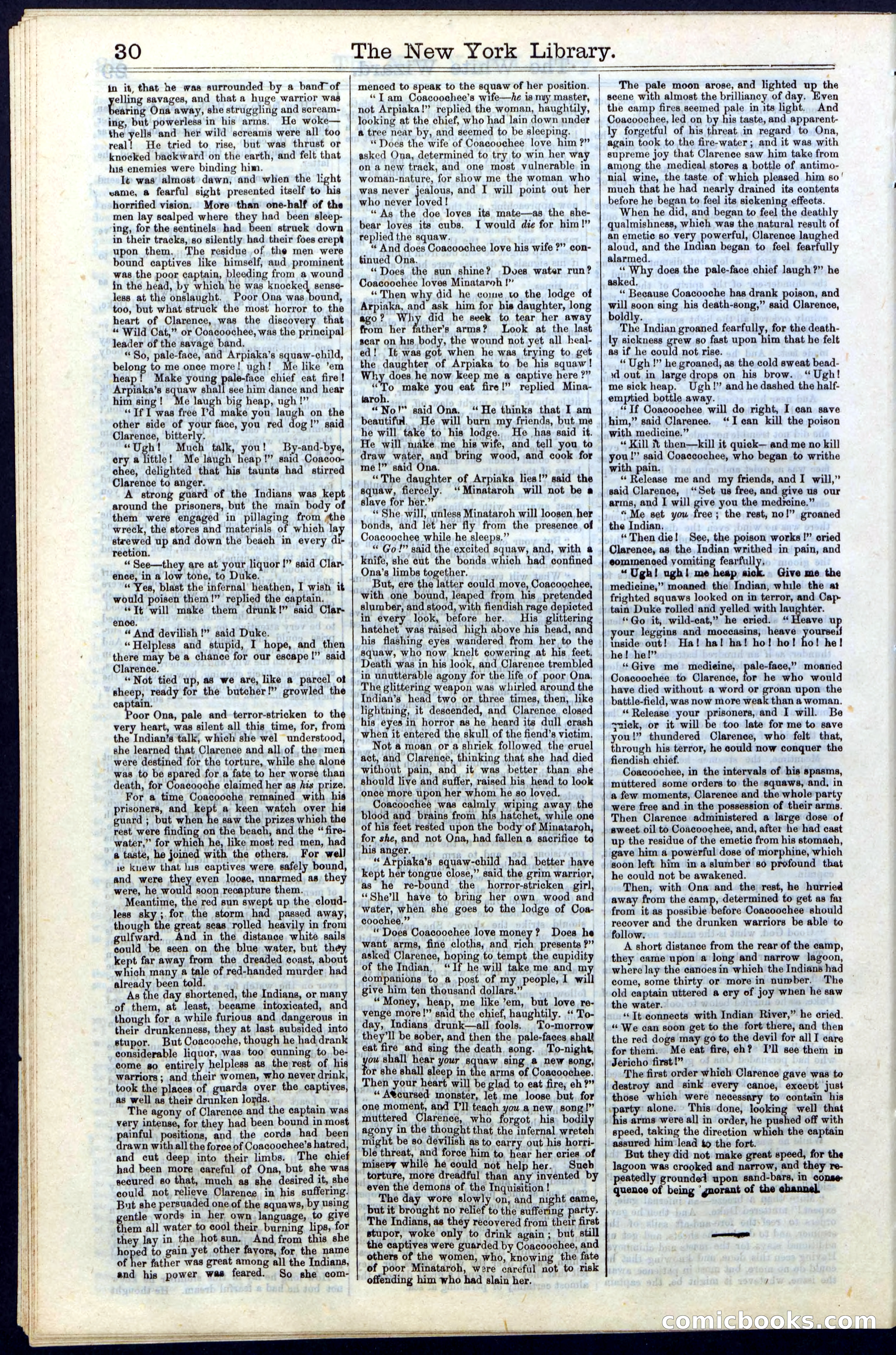
A restored page from Pulp Fiction, 1877. Page through the whole issue in the reader above.
📄 Transcribed text from this page (OCR, searchable)
Machine-transcribed from the original scan — historical spelling and the odd misread are preserved.
4 ' ' if ' ' 30 — in it, that he was surrounded by a band of elling savages, and that a huge warrior was heabini Ona away, she struggling and scream- ing, but powerless in his arms. He woke— the yells and her wild screams were all too ai He tried to rise, but was thrust or knocked backward on the earth, and felt that his enemies were binding him. lé was’ almost dawn, and when the mt wame, @ fearful sight presented itself to his horrified vision. More than one-half of the men lay scalped where they had been sleep- ing, for the sentinels had been struck down in their tracks, so silently had their foes crept upon them. The residue of the men were bound captives like himself, aud prominent was the poor captain, bleeding from a wound in the head, by which he was Bnopked senee- less at the onslaught. Poor Ona was bound, too, but what struck the most horror to the heart of Clarence, was the discovery that “Wild Cat,” or Coacoochee, was the principal leader of the savage band. “So, pale-face, and Arpiaka’s gue ohe SG belong to me once more! ugh! Me like ’em heap! Make young pale-face chief eat fire! Arpiaka’s squaw shall see him dance and hear him sing! Me laugh big heap, ugh !” “Tf Il was free ’'d make you laugh on the other side of your face, you red dog!” said Clarence, bitterly. “Ugh! Much talk, you! By-and-bye, ery a little! Me laugh heap!” said Coacoo- chee, delighted that his taunts had stirred Clarence to anger. A strong guard of the Indians was kept around the prisoners, but the main body of them were engaged in pillaging from sthe wreck, the stores and materials of which lay stewed up and down the beach in every di- rection. “ See—they are at your liquor !” said Clar- ence, in a low tone, to Duke. “Yes, blast the infernal heathen, I wish it | would poisen them!” replied the captain. “Tt will make them drunk!” said Clar- ence. “ And devilish !” said Duke. “Helpless and stupid, I hope, and then there may be a chance for our escape!” said Clarence. “Not tied up, as we are, like a parcel of sheep, ready for the butcher!” growled the captain. oor Ona, pale and terror-stricken to the very heart, was silent all this time, for, from the Indian’s talk, which she wel understood, she learned that Clarence and all, of the men were destined for the torture, while she alone was to be spared for a fate to her worse than death, for Coacooche claimed her ag his prize. For a time Coacooche remained with his prisoners, and kept a keen watch over his guard ; but when he saw the prizes which the rest were finding on the beach, and the “fire- water,” for which he, like most red men, had a taste, he joined with the others. For well ie knew that his captives were. safely bound, and were they even loose, unarmed as they were, he would soon recapture them. Meantime, the red sun swept up the cloud- less sky ;.for the storm had passed away, though the great seas rolled heavily in from guifward. And in the distance white sails could be seen on the blue water, but they kept far away from the dreaded coast, about which many a tale of red-handed murder had already been told. As the day shortened, the Indians, or many of them, at least, became intoxicated, and though for a while furious and dangerous in their drunkenness, they at last. subsided into stupor. But Coacooche, though he had drank considerable liquor, was too cunning) to. be- come go entirely helpless as the rest of his warriors ; and their women, who never drink, took the places of guards over the captives, as well as their drunken lords. The agony of Clarence and the captain was very intense, for they had been bound in most ainful positions, and the cords had been aan with all the force of Coacoochee’s hatred, and cut deep into their limbs. The chief had been more careful of Ona, but she was secured so that, much ag she desired it, she could not relieve Olarence in his suffering. But she persuaded one of the squaws, by using entle words in her own. language, to giyé fon all water to cool their. burning lips, for they lay in the hotsun. And from this she hoped to gain yet other fayors, for the name of hr father was great among all the Indians, and his power was feared. So she com- The New York Library. menced to speak to the squaw of her position. “Tam Coacoochee’s wife—he is my master, not Arpiaka!” replied the woman, haughtily, looking at the chief, who had lain down under a tree near by, and seemed to be sleeping. ‘Toes the wife of Coacouechee love him ?” asked Ona, determined to try to win her way on a new track, and one most vulnerable in woman-nature, for show me the woman who was never jealous, and I will point out her who never loved! “As the doe loves its mate—as the she- bear loves its cubs. I would die for him!” replied the squaw. “ And does Coacoochee love his wife ?” con- tinued Ona. “Does the sun shine? Does water run? Coacoochee loves Minataroh !” “Then why did he come wo the lodge of Arpiaka, and ask him for bis daughter, long ago? Why did he seek to tear her away from her father’s arms? Look at the last scar on his. body, the wound not yet all heal- ed! It was got when he was trying to get the daughter of Arpiaka to be his squaw! Why does he now keep me a captive here ?” “To make you eat fire!” replied Mina- laroh. “No!” said Ona. “He thinks that 1 am beautiful, He will burn my friends, but me he will take to his lodge. He has said it. He will make me his wife, and tell you to draw water, and bring wood, and cook for me !” said Ona. “The daughter of Arpiaka lies!” said the squaw, fiercely. ‘‘Minataroh will not be a slave for her.” “She will, unless Minataroh will loosen her bonds, and let her fly from the presence. of Coacoochee while he sleeps.” “ Go!” said the excited squaw, and, with a knife, she cut the bonds which had confined Ona’s limbs together. But, ere the latter could move, Coacoochee, with one bound, leaped from his. pretended slumber, and stood, with fiendish rage depicted in every look, before her. His glitterin hatchet was raised high above his head, an his flashing eyes wandered from her to the squaw, who now knelt cowering at his feet, Death was in his look, and Clarence trembled in unutterable agony for the life of poor Ona. The glittering weapon was whirled around the Indian’s head two or three times, then, like lightning, it descended, and Clarence. closed his eyes in horror as he heard its dull crash when it entered the skull of the fiend’s victim, Not a moan or a shriek followed the cruel act, and Clarence, thinking that she had died without pain, and it was better than she should live and suffer, raised bis head to look once more upon her whom he so loved. Coacoochee was calmly wiping away the blood and brains from hatchet, while one of his feet rested upon the body of Minataroh, for she, and not Ona, had fallen a sacrifice to his anger. ! “ Arpiaka’s squaw-child had. better have kept her tongue close,” said the grim warrior, as he re-bound the _ horror-stricken_ girl, “She'll have to bring her own. wood and water, when she goes to the lodge of Coa- coochee.” ‘Does Coacoochee love money? Does he want arms, fine cloths, and rich presents ?” asked Clarence, hoping to tempt the cupidity of the Indian, “If he will take me and m companions to a post of my people, I will give him ten thousand dollars.” Money, heap, me like ’em, but love re- venge more!” said the chief, haughtily. ‘ To- day, Indians drunk—all fools. To-morrow they'll be sober, and then the pale-faces shall eat fire and sing the death song. To-night, ou shall hear your squaw sing @ new song, or she shall sleep in the arms of Coacoochee. Then your heart will be glad to eat fire, eh ?” “ A®cursed monster, let. me loose but. for one moment, and I'll teach you a new, song!” muttered Clarence, who forgot his bodil agony in the thought that the infernal miotels might be so devilish as to carry out his horri- ble threat, and force him to hear her cries of misery while hé could not help her. Such torture, more dreadful than any invented by even the demons of the Inquisition! The day wore slowly on, and night came, but it brought no relief to the suffering party. The Indians, as they recovered from their first stupor, woke only to drink again ; but still the captives were guarded by Coacoochee, and others of the women, who, knowing the fate of poor Minataroh, were careful not to risk offending him who had slain her. party alone. This done, lookin : Sr The pale moon arose, and lighted up the scene with almost the brilliancy of day. Even the camp fires seemed pale in its light. And Coacoochee, led on by his taste, and apparent- ly forgetful of his threat. in regard to Ona, again took to the fire-water; and it was with supreme joy that Clarence saw him take from among the medical stores a bottle of antimo- nial wine, the taste of which pleased him so much that he had nearly drained its contents before he began to feel its sickening effects. When he did, and began to feel the deathly qualmishness, which was the natural result of an emetic so very powerful, Clarence laughed aloud, and the Indian began to feel fearfully alarmed. ‘‘ Why does the pale-face chief laugh?” he asked, ‘“‘ Because Coacooche has drank poison, and afer soon sing his death-song,” re Clarence, oldly. The Indian groaned fearfully, for the death- ly sickness grew so fast upon him that he felt as if he could not rise. “Ugh !” he groaned, as the cold sweat bead- «1 out in large drops on his brow. “Ugh! me sick heap. Ugh!” and he dashed the half- emptied bottle away. ‘If Coacoochee will do right, I can save him,” said Clarenee. “I can kill the poison with medicine.” “ Kill it then—kill it quick— and me no kill you!” said Coaccochee, who began to writhe with pain. “ Release me and my friends, and I will,” said Clarence, ‘Set us free, and give us our arms, and I will give you the medreine.” “Me set you free; the rest, no!” groaned the Indian, “Then die! See, the poison works !” cried Clarence, as the Indian writhed in pain, and eommenced yomiting fearfully, “Ugh! ugh! me heap ai Give me the medicine,” moaned the Indian, while the at frighted squaws looked on in terror, and Cap- tain Duke rolled and yelled with laughter. ‘‘Go it, wild-cat,” he eried. “ Heave up our leggins and moccasins, heave yourseif inside out! Ha! ha! ha! ho! ho! ho! he! he! he!” “Give me medieine, pale-face,” moaned Coacoochee to Clarence, for he who would have died without a word or groan upon the battle-field, was now more weak than a woman. “Release your prisoners, and I will. Be | ynieck, or it will be too late for me to save you!” thundered Clarence, who felt that, through his terror, he could now conquer the fiendish chief. Coacoochee, in the intervals of his spasms, muttered some orders to the squaws, and, in a few moments, Clarence and the whole party were free and in the possession of their arms. Then Clarence administered a large dose of aweet oil to Coacoochee, and, after he had cast up the residue of the emetic from his stomach, gave him a powerful dose of morphine, which soon left him ima slumber so profound that he could not be awakened. Then, with Ona and the rest, he hurried away from the aie 4 determined to get as far from it as possible before Coacoochee should recover and the drunken warriors be able to follow. A short distance from the rear of the camp, they came upon a long and narrow lagoon, where lay the canoes in which the Indians had come, some thirty or more in number. old captain uttered a ery of joy when he saw the water. ‘It connects with Indian River,” he cried. “We can soon get to the fort there, and then the red dogs may go to the devil for allI care for them. Me eat fire,eh? I'll see them in Jericho first!” The first order which Clarence gave was to destroy and sink every canoe, excevt just those which were necessary to contuin his well that is arms were all in order, he pushed off with speed, taking the direction which the captain assured him lead to the fort. But they did not make great speed, for the lagoon was crooked and narrow, and they re- peatedly — upon sand-bars, in conse quence of being ‘gnorant of the The