
Pulp Fiction, 1877 · page 23 of 32
Beadle's Dime Library No. 16 — page 23: what you’re looking at
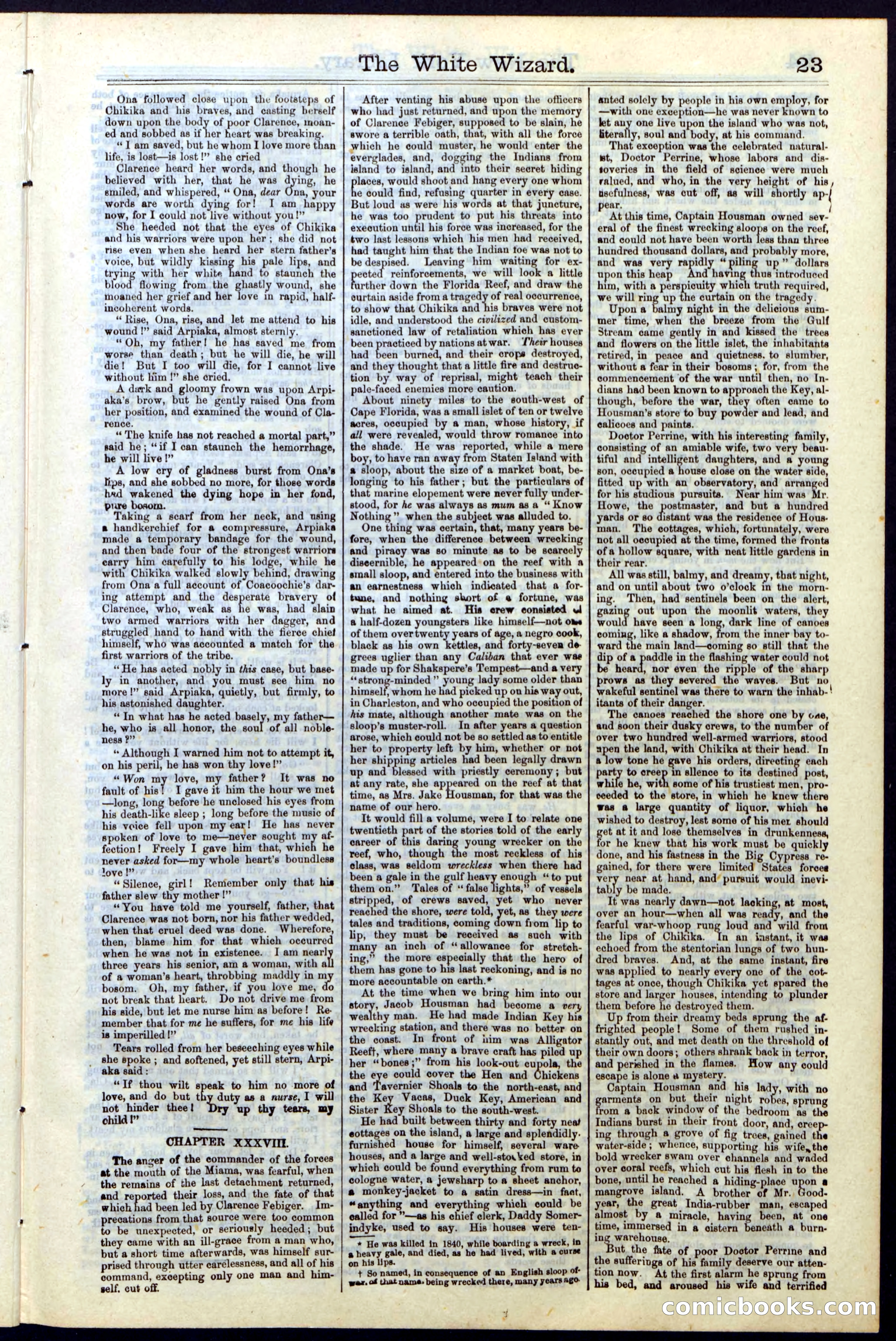
A restored page from Pulp Fiction, 1877. Page through the whole issue in the reader above.
📄 Transcribed text from this page (OCR, searchable)
Machine-transcribed from the original scan — historical spelling and the odd misread are preserved.
ot Ona followed close upon the footsteps of Chikika and his braves, and casting berself down upon the body of poor Clarence, moan- ed and sobbed as if her heart was breaking. “7 am saved, but he whom I love more than life, is lost—is lost !”’ she cried Clarence heard her words, and though he believed with her, that he was dying, he emiled, and whispered, ‘ Ona, dear Ona, your words are worth dying for! I am happy now, for I could not live without you!” She heeded not that the eyes of Chikika and his warriors were upon her; she did not rise even when she heard her stern father’s voice, but wildly G3 his pale lips, and trying with her white hand to staunch the blood flowing from the ghastly wound, she moaned her grief and her love in rapid, half- incoherent words. “ Rise, Ona, rise, and let me attend to his wound !” said Arpiaka, almost sternly, “Oh, my father! he has saved me from worse than death; but he will die, he will die! But I too will die, for I cannot live without lim !” she eried. A durk and gloomy frown was upon Arpi- aka’s brow, but he gently raised Ona from her position, and examined the wound of Cla- rence. “The knife has not reached a mortal part,” said he; “if I can staunch the hemorrhage, he will live!” A low ery of gladness burst from Ona’s lips, and she sobbed no more, for those words had wakened the dying hope in her fond, pure bosom. Taking a scarf from her neck, and using a handkerchief for a compressure, Arpiaka made a temporary bandage for the wound, and then bade four of the strongest warriors carry him carefully to his lodge, while he with Chikika walked slowly behind, drawing from Ona a full account of Coacoochie’s dar- ing attempt and the yee bravery of Clarence, who, weak as he was, had slain two armed warriors with her dagger, and struggled hand to hand with the fierce chief himself, who was accounted a match for the first warriors of the tribe. “He has acted nobly in this case, but base- ly in another, and you must see him no more !”’ said Arpiaka, quietly, but firmly, to his astonished daughter. “In what has he acted basely, my father— he, who is all honor, the soul of all noble- ness ?” « Although I warned him not to attempt it, on his peril, he has won thy love!” “Won my love, my father? It was no fault of his! I gave it him the hour we met —long, long before he unclosed his eyes from his death-like sleep ; long before the music of his veice fell upon my ear! He has never spoken of love to me—never sought my af- fection! Freely I gave him that, which he never asked for—my whole heart's boundless love !” “ Silence, girl! Reniember only that his father slew thy mother !” “You have told me yourself, father, that Clarence was not born, nor his father wedded, when that cruel deed was done. Wherefore, then, blame him for that which oceurred when he was not in existence. I am near! three years his senior, am a woman, with a of a woman’s heart, throbbing maddly in m bosom. Oh, my father, if you love me, do not break that heart. Do not drive me from his side, but let me nurse him as before! Re- member that for me he suffers, for me his life is imperilled |” Tears rolled from her beseeching eyes while she spoke ; and softened, yet still stern, Arpi- aka said : “If thou wilt speak to him no more of love, and do but th duty as a nurse, I will Eee thee! Dry up thy tears, my 0 CHAPTER XXXVIIL The anger of the commander of the forces at the mouth of the Miama, was fearful, when the remains of the last detachment returned, and reported their loss, and the fate of that which had been led by Clarence Febiger. Im- precations from that source were too common to be unexpected, or seriously heeded; but they came with an ill-grace from a man who, but a short time afterwards, was himeelf sur- prised through utter carélessness, and all of his command, excepting only one man and him- self, cut off. The White Wizard. After venting his abuse upon the officers who had just returned, and upon the memory of Clarence Febiger, supposed to be slain, he swore a terrible oath, that, with all the force which he could muster, he would enter the everglades, and, dogging the Indians from island to island, and into their seeret hiding laces, would shoot and hang every one whom e could find, refusing quarter in every case. But loud as were his words at that juncture, he was too prudent to put his threats into execution until his force was increased, for the two last lessons which his men had received, had taught him that the Indian foe was not to be despised. Leaving him waiting for ex- ree reinforcements, we will look a little ‘garages down the Florida Reef, and draw the curtain aside froma rear be real occurrence, to show that Chikika and his braves were not idle, and understood the civilized and custom- sanctioned law of retaliation which has ever been practiced by nations atwar. Their houses had foe burned, and their crops destroyed, and they thought that a little fire and destrue- tion by way of reprisal, might teach their pale-faced enemies more caution. About ninety miles to the south-west of Cape Florida, was a small islet of ten or twelve acres, occupied by a man, whose history, if all were revealed, would throw romance into the shade. He was reported, while a mere boy, to have ran away from Staten Island with s sloop, about the size of a market boat, be- longing to his father; but the particulars of that marine elopement were never fully under- stood, for he was always as mum as a “ Know Nothing” when the subject was alluded to. One thing was certain, that, many years be- fore, when the difference between wrecking and piracy was so minute as to be scarcely diseernible, he appeared’ on the reef with a small sloop, and entered into the business with an earnestness which indicated that a for- tune, and nothing skort of e fortune, was what he aimed at. His crew consisted ol a half-dozen youngsters like himself—not Ome of them overtwenty years of age, a negro cook, black as his own beetles, and forty-seven de- grees uglier than any Caliban that ever wae made up for Shakspere’s Tempest—and a very “strong-minded ” young lady some older than himself, whom he had picked up on his way out, in Charleston, and who oceupied the position of his mate, although another mate was on the sloop’s muster-roll. In after years a question arose, which could not be so settled as to entitle her to property left by him, whether or not her shipping articles had been legally drawn up and blessed with priestly ceremony; but at any rate, she appeared on the reef at that time, as Mrs. Jake Housman, for that was the name of our hero. It would fill a volume, were I to relate one twentieth part of the stories told of the early career of this daring young wrecker on the reef, who, though the most reckless of his class, was seldom wreckless when there had been a gale in the gulf hea enough “to put them on.” Tales of “false lights,” of vessels stripped, of crews saved, yet who never reached the shore, were told, yet, as they were tales and traditions, coming down from lip to lip, they must be received as such with many an inch of “allowance for stretch- ing,” the more especially that the hero of them has gone to his last reckoning, and is no more accountable on earth.* At the time when we bring him into ou story, Jacob Housman had become a v wealthy man. He had made Indian Key his wrecking station, and there was no better on the coast. In front of iim was Alligator Reeft, where many a brave craft has piled up her “bones ;” from his look-out cupola, the the eye could cover the Hen and Chickens and Tavernier Shoals to the north-east, and the Key Vacas, Duck Key, American and Sister Key Shoals to the south-west. He had built between thirty and forty neat eottages on the island, a large and splendidly. furnished house for himself, several ware houses, and a large and well-sto.ked store, in which could be found everything from rum to cologne water, a jewsharp to a sheet anchor, a monkey-jacket to a satin dress—in fact, “anything and eve g which could be called for ’—as his chief clerk, Daddy Somer- indyke, used to say. His houses were ten- * He was killed in 1840, while boarding a wreck, in a heavy gale, and died, as he had lived, with a ourse on his lips. + So named, in consequence of an English sloop of war. of that name: being wrecked there, many years #gO 3 / 23 anted solely by people in his own employ, for —with one exception—he was never known to let any one live upon the island who was not, literally, soul and body, at his command. That exception was the celebrated natural- st, Doctor Perrine, whose labors and dis- soveries in the field of science were much ralued, and who, in the very height of his, usefulness, was cut off, as will shortly ap-| ear, J At this time, Captain Housman owned er.’ eral of the finest wrecking sloops on the reef, and could not have been worth less than three hundred thousand dollars, and probably more, and was very rapidly “piling up” dollars upon this heap And ete us introduced him, with a perspicuity which truth required, we will ring up the curtain on the tragedy. Upon a balmy night in the delicious sum- mer time, when the breeze from the Gulf Stream came gently in and kissed the trees and flowers on the little islet, the inhabitants retired, in peace and quietness. to slumber, without a fear in their bosoms; for, from the commencement of the war until then, no In- dians had been known to approach the Key, al- though, before the war, they often came to Housman’s store to buy powder and lead, and calicoes and paints. Doctor Perrine, with his interesting family, consisting of an amiable wife, two very beau- tiful and intelligent daughters, and a young son, occupied a house close on the water side, fitted up with an observatory, and arranged for his studious pursuits. Near him was Mr. Howe, the postmaster, and but a hundred yards or so distant was the residence of Hous- man. The cottages, which, fortunately, were not all occupied at the time, formed the fronts ofa hollow square, with neat little gardens in their rear. All was still, balmy, and dreamy, that night, and on until about two o’clock in the morn- ing. Then, had sentinels been on the alert, gazing out upon the moonlit waters, they would have seen a long, dark line of canoes coming, like a shadow, from the inner bay to- ward the main land—coming so atill that the dip of a paddle in the flashing water could not be Saath: nor even the ripple of the sharp prows as they severed the waves. But no wakeful sentinel was thére to warn the inhab-! itants of their danger. The canoes reached the shore one by oae, and soon their dusky crews, to the number of over two hundred well-armed warriors, stood npen the land, with Chikika at their head. In a low tone he gave his orders, directing each party to creep in sllence to its destined post, while he, with some of his trustiest men, pro- ceeded to the store, in which he knew there was a large quantity of liquor, which he wished to destroy, lest some of his mer should et at it and lose themselves in drunkenness, or he knew that his work must be quickly done, and his fastness in the Big Cypress re- gained, for there were limited States forces very near at hand, and’ pursuit would inevi- tably be made. It was nearly dawn—not lacking, at most, over an hour—when all was ready, and the fearful war-whoop rung loud and wild from the lips of Chikika. In an iastant, it was echoed from the stentorian lungs of two hun- dred braves. And, at the same instant, fire was applied to nearly every one of the cot- tages at once, though Chikika yet spared the store and larger houses, intending to plunder them before he destroyed them. Up from their dreamy beds sprung the af- frighted people! Some of them rushed in- stantly out, and met death on the threshold of their own doors; others shrank back in terror, and perished in the flames. How any could escape is alone a mystery. Captain Housman and his lady, with no arments on but their night robes, sprung m a back window of the bedroom as the Indians burst in their front door, and, eree ing through a grove of fig trees, gained the water-side ; whence, supporting his wife, the bold wrecker swam over channels and waded over coral reefs, which cut his flesh in to the bone, until he reached a hiding-place upon a mangrove island. A brother of Mr. Good- year, the great India-rubber man, escaped almost by @ miracle, having been, at one time, immersed in a cistern beneath a burn- ing warehouse, ut the fate of poor Doctor Perrine and the sufferings of his family deserve our atten- tion now. his bed, and aroused his wife and terrified — At the first alarm he sprung from GEomiecbooks co 2 « Se (LAI