
Pulp Fiction, 1877 · page 22 of 32
Beadle's Dime Library No. 16 — page 22: what you’re looking at
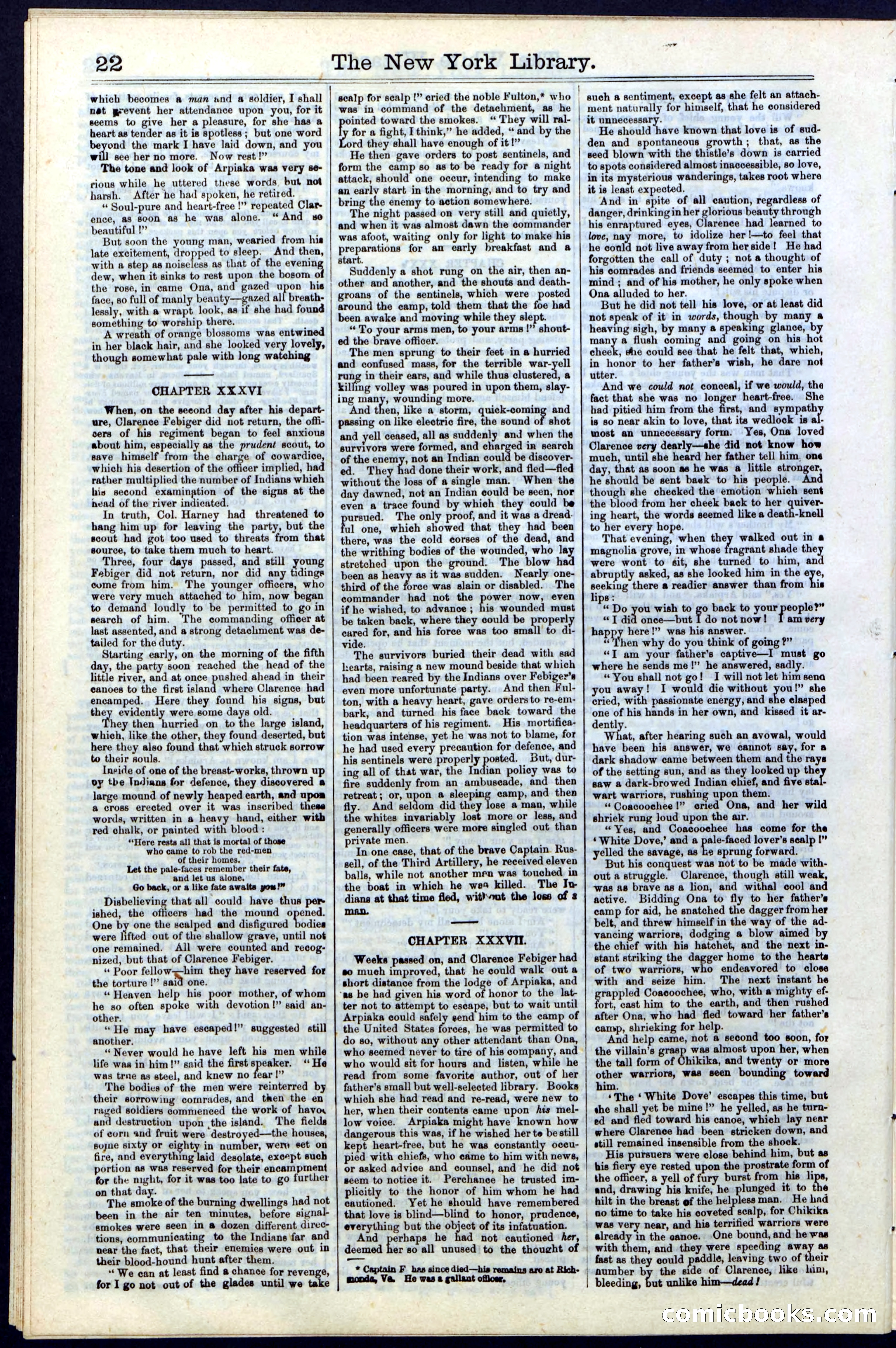
A restored page from Pulp Fiction, 1877. Page through the whole issue in the reader above.
📄 Transcribed text from this page (OCR, searchable)
Machine-transcribed from the original scan — historical spelling and the odd misread are preserved.
—— Set we Oo 7 — - -~- - ee et <> mee eee Se C- ———— — a which becomes a man and a soldier, I shall net grevent her attendance upon you, for it seems to give her a pleasure, for she has a heart as tender as it is spotless; but one word beyond the mark I have laid down, and you will see her no more. Now rest!” The tone and look of Arpiaka was very 8e- rious while he uttered these words but not harsh. After he had spoken, he retired. “ Soul-pure and heart-free !” repeated Clar- ence, as soon as he was alone. “And so beautiful !”’ But soon the young man, wearied from hia late excitement, dropped to sleep. And then, with a step as noiseless as that of the evenin dew, when it sinks to rest upon the bosom o the rose, in came Ona, and gazed upon his face, so full of manly beauty— azed all breath- lessly, with a wrapt look, as if she had found something to worship there. A wreath of orange blossoms was entwined in her black hair, and she looked very lovely, though somewhat pale with long watching OHAPTER XXXVI When, on the seeond day after his depart- ure, Clarence Febiger did not return, the offi- cers of his regiment began to feel anxious about him, especially as the prudent scout, to save himself from the charge of cowardice, which his desertion of the officer implied, had rather multiplied the number of Indians which his second examination of the signs at the nead of the river indicated. In truth, Col. Harney had threatened to hang him up for leaving the party, but the scout had got too used to threats from that source, to take them much to heart. Three, four days passed, and still young Febiger did not return, nor did any tidings evme from him. The younger officers, who were very much attached to him, now began to demand loudly to be permitted to go in search of him. The commanding officer at last assented, and a strong detachment was de- tailed for the duty. Starting early, on the morning of the fifth day, the party soon reached the head of the little river, and at once pushed ahead in their canoes to the first island where Clarence had encamped. Here they found his signs, but ney evidently were some days old. hey then hurried on to the large island, which, like the other, they found deserted, but here they also found that which struck sorrow to their souls. Ineide of one of the breast-works, thrown up oy tbe Indians for defence, they discovered a large mound of newly heaped earth, and upoa a cross erected over it was inscribed these words, written in a heavy hand, either with red chalk, or painted with blood : ‘‘Here rests all that is mortal of those who came to rob the red-men of their homes. Let the pale-faces remember their fate, and let us alone, Go back, or a like fate awaits you!” Disbelieving that all could have thus per ished, the officers had the mound opened. One by one the sealped and disfigured bodies were lifted out of the shallow grave, until not one remained. All were counted and recog- nized, but that of Clarence Febiger. “ Poor fellow—him they have reserved for the torture !’’ said one. “Heaven help his poor mother, of whom he so often spoke with devotion!” said an- other. “He may have escaped!” suggested till another. ‘Never would he have left his men while life was in him!” said the first speaker. “ He was trne as eteel, and knew no fear!” The bodies of the men were reinterred by their sorrowing comrades, and then the en raged soldiers commenced the work of havox and destruction upon the island. The fields of corn and fruit were destroyed—the houses, syne sixty or eighty in number, werw eet on fire, and everything laid desolate, except such portion as was reserved for their encampment for the night, for it was too late to go further on that day. The smoke of the burning dwellings had not been in the air ten minutes, before signal smokes were seen in @ dozen different direc- tions, communicating to the Indians far and near the fact, that their enemies were out in their blood-hound hunt after them. “ We can at least find a chance for revenge, for I go not out of the glades until we take | The New York Libra sealp for sealp !” cried the noble Fulton,* who was in command of the detachment, as he owe toward the smokes. “They will ral- Bees a fight, I think,” he added, “ and by the rd they shall have enough of it!” He then gave orders to post sentinels, and form the camp so as to be ready for a night attack, should one occur, intending to make an early start in the morning, and to try and bring the enemy to action somewhere. The night passed on very still and quietly, and when it was almost dawn the commander was afoot, waiting only for light to make his preparations for an early breakfast and a start. Suddenly a shot rung on the air, then an- other and another, and the shouts and death- groans of the sentinels, which were posted around the eamp, told them that the foe had been awake and moving while they slept. “To your arms men, to your arms !” shout- ed the brave officer. The men sprung to their feet in a hurried and confused mass, for the terrible war-yell rung in their ears, and while thus clustered, a killmg volley was poured in upon them, slay- ing eye wounding more. And then, like a storm, quick-coming and passing on like electric fire, the sound of shot and yell ceased, all as suddenly and when the survivors were formed, and charged in search of the enemy, not an Indian could be discover- ed. They had done their work, and fled—fied without the loss of a single man. When the day dawned, not an Indian could be seen, nor even a trace found by which they could be ursued. The only proof, and it was a dread. ul one, which showed that they had been there, was the cold corses of the dead, and the writhing bodies of the wounded, who la stretched upon the ground. The blow h been as heavy as it was sudden. Nearly one- third of the tne was slain or disabled. The commander had not the power now, even if he wished, to advance ; his wounded must be taken back, where they could be roperly cared for, and his force was too small to di- vide. The survivors buried their dead with sad learts, raising a new mound beside that which had been reared by the Indians over Febiger’s even more unfortunate party. And then Ful- ton, with a heavy heart, gave orders to re-em- bark, and turned his face back toward the headquarters of his regiment. His mortifica- tion was intense, yet he was not to blame, for he had used every precaution for defence, and his sentinels were properly posted. But, dur- ing all of that war, the Indian policy was to fire suddenly from an ambuseade, and then retreat; or, upon & sacpans camp, and then fly. And seldom did they lose a man, while thre whites invariably lost more or less, and generally officers were more singled out than private men. In one case, that of the brave Captain. Rus- sell, of the Third Artillery, he received eleven balls, while not another men was touched in the boat in which he wes killed. The In dians at that time fled, wit)ut the loss of 3 MAD. —_—_---_ CHAPTER XXXVII. Weeks passed on, and Clarence Febiger had so much improved, that he could walk out a short distance from the lodge of Arpiaka, and ‘as be had given his word of honor to the lat- ter not to attempt to eseape, but to wait until Arpiaka could safely send him to the camp of the United States forces, he was permitted to do so, without any other attendant than Ona, who seemed never to tire of his company, and who would sit for hours and listen, while he read from some favorite author, out of her father’s small but well-selected library. Books which she had read and re-read, were new to her, when their contents came upon his mel- low voice. Arpiaka might have known how dangerous this was, if he wished her te bestill kept heart-free, but he was constantly occu- pied with chiefs, who came to him with news, or asked advice and counsel, and he did not seem to notice it. Perchance he trusted im- plicitly to the honor of him whom he had — cautioned. Yet he should have remembered | that love is blind—blind to honor, prudence, everything but the object of its infatuation. And pernape he not cautioned her, deemed her so all unused to the thought of * Captain F has since died—his remains © monda, Va. He was a gallant officer, —— such a sentiment, except as she felt an attach- ment naturally for himself, that he considered it unnecessary. He should have known that love is of sud- den and spontaneous growth; that, as the seed blown with the thistle’s down is carried to spots considered almost inaccessible, 80 love, in its mysterious wanderings, takes root where it is least expected. And in spite of all caution, regardless of danger, drinking in her glorious beauty through his enraptured eyes, Clarence had learned to love, nay more, to idolize her !—to feel that he conld not live away from herside! He had forgotten the call of duty ; not a thought of his comrades and friends seemed to enter his mind ; and of his mother, he only spoke when Ona alluded to her. But he did not tell his love, or at least did not speak of it in words, though by many a heaving sigh, by many a speaking glance, by many a flush coming and going on his hot cheek, #he could see that he felt that, which, in honor to her father’s wish, he dare not utter. And we could not conceal, if we would, the fact that she was no longer heart-free. She had pitied him from the first, and sympath is so near akin to love, that its wedlock is al. wost an unnecessary form. Yes, Ona loved Clarence very dearly—she did not know how much, until she heard her father tell him, one day, that as soon as he was a little stronger, he should be sent baek to his people. d though she checked the emotion which sent the blood from her cheek back to her quiver- ing heart, the words seemed like a death-knell to her every hope. That evening, when they walked out in a magnolia grove, in whose fragrant shade they were wont to sit, she turned to him, and abruptly asked, as she looked him in the eye, seeking there a readier answer than from hi lips : “ Do you wish to g° back to your re rl “T did once—but I do notnow! I am very hoppy here!” was his answer. “Then why do you think of going ?” “TI am your father’s captive—I must go where he sends me!” he answered, sadly. “You shall not go! I will not let him sena you away! I would die without you!” she cried, with passionate energy, and she clasped one of his hands in her own, and kissed it ar- var What, after hearing such an avowal, would have been his answer, we cannot say, for a dark shadow came between them and the rays of the setting sun, and as they looked up the saw a dark-browed Indian chief, and five stal- wart warriors, rushing upon them. “Coacoochee!” eried Ona, and her wild shriek rung Joud upon the air. “Yes, and Coacoochee has come for the ‘White Dove,’ and a pale-faced lover's sealp |” yelled the savage, as ke sprung forward. But his conquest was not to be made with- out a struggle. Clarence, though still weak, ‘was as brave as a lion, and witha] coo] and active. Bidding Ona to fly to her father’s camp for aid, he snatched the dagger from her belt, and threw himeelf in the way of the ad- vancing warriors, dodging a blow aimed by the chief with his hatchet, and the next in- stant striking the dagger home to the hearts of two warriors, who endeavored to close with and seize him. The next instant he ppled Coacoochee, who, with a mighty ef- fort cast him to the earth, and then rushed after Ona, who had fled toward her father’s canyp, shrieking for help. : And help came, not a second too soon, for the villain’s grasp was almost upon her, when the tall form of Chikika, and twenty or more other warriors, was seen bounding toward him. ‘The ‘White Dove’ escapes this time, but the shall yet be mine!” he yelled, as he turn- ed and fled toward his canoe, which lay near where Clarence had been stricken down, and still remained insensible from the shock. His pursuers were close behind him, but as his fiery eye rested upon the prostrate form of the officer, a yell of fury burst from his lips, and, drawing his knife, he ey it to the hilt in the breast ef the helpless man. He had no time to take his aeiee scalp, for Chikika was very near, and his terrified warriors were already in the canoe. One bound, and he was with them, and they were speeding away as fast as they could paddle, leaving two of their number by the side of Clarence, like him, bleeding, but unlike him—dzad ! Eomilecbooks (E(@)