
Pulp Fiction, 1877 · page 24 of 32
Beadle's Dime Library No. 16 — page 24: what you’re looking at
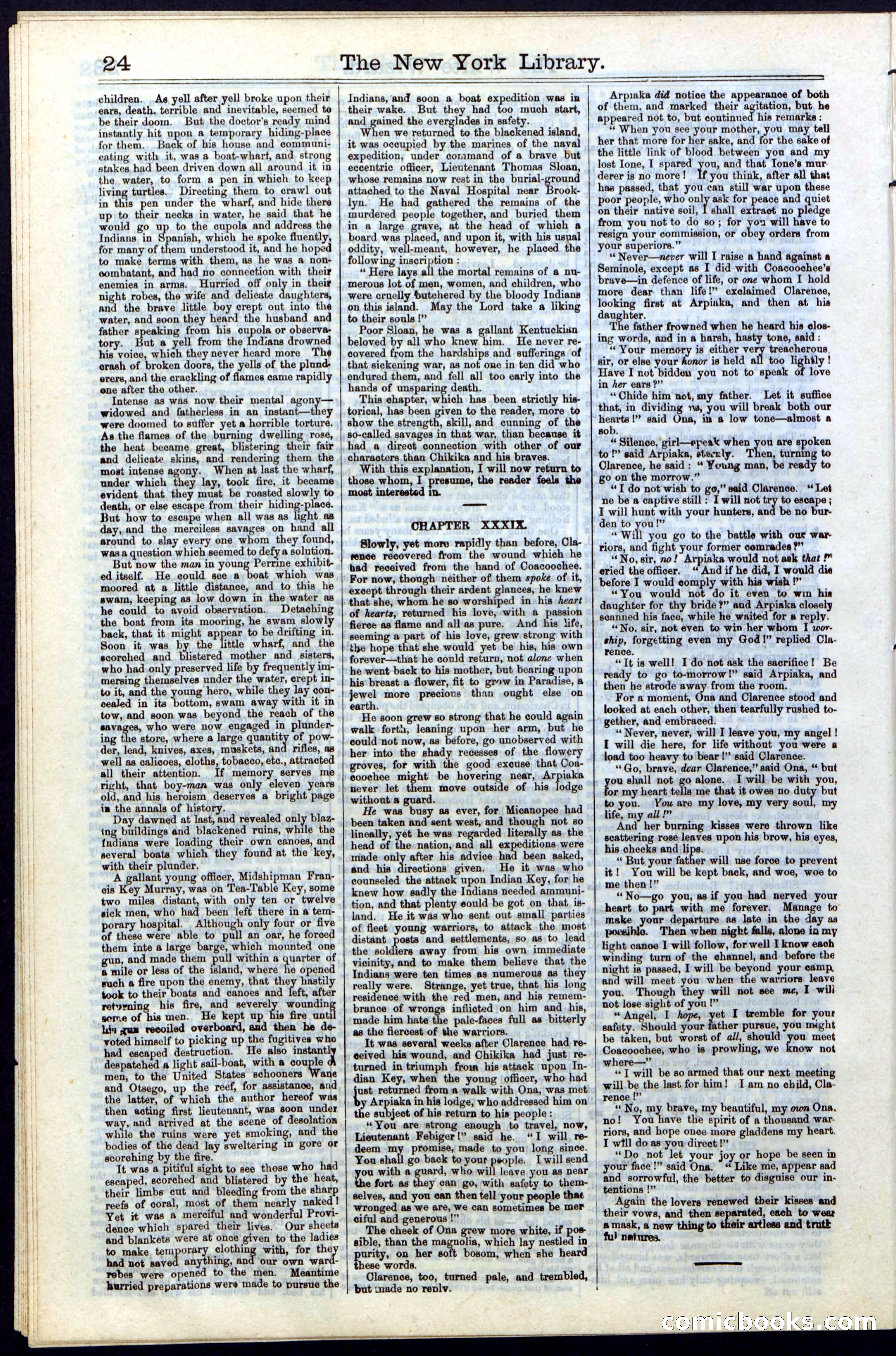
A restored page from Pulp Fiction, 1877. Page through the whole issue in the reader above.
📄 Transcribed text from this page (OCR, searchable)
Machine-transcribed from the original scan — historical spelling and the odd misread are preserved.
| 24 —_—_-—_-—- The New York Librar children. As yell after yell broke upon their ears, death, terrible and inevitable, seemed to be their doom. But the doctor's ready mind instantly hit upon a temporary hiding-place for them. Back of his house and communi- eating with it, was a boat-whart, and strong stakes had been driven down all around it in the water, to form a pen in which to keep living turtles. Directing them to crawl out in this pen under the wharf, and hide there up to their necks in water, he said that he would go up to the cupola and address the Indians in Spanish, which he spoke fluently, for many of them understood it, and he hoped to make terms with them, as he was a non- eombatant, and had no connection with their enemies in arms. _Hurried_ off only in their night robes, the wife and delicate daughters, and the brave little boy crept out into the water, and soon they heard the husband and father speaking from his cupola or observa- tory. But a yell from the Indians drowned his voice, which they never heard more The crash of broken doors, the yells of the plund- erers, and the crackling of flames came rapidly one after the other. Intense as was now their mental agony— widowed and fatherless in an instant—they were doomed to suffer yet a horrible torture. As the flames of the burning dwelling rose, the heat became. great, blistering their fair and delicate skins, and rendering them the most intense agony. When at last the wharf, under which they lay, took fire, it became evident that they must be roasted slowly to death, or else escape from their pay lace. But how to escape when all was as light as day, and the merciless savages on hand all around to slay every one whom they found, was a question which seemed to defy a solution. But now the man in young Perrine exhibit- ed itself. He could see a boat which was moored at a little distance, and to this he swam, keeping as low down in the water as he could to avoid observation. Detaching the boat from its mooring, he swam slowly back, that it might appear to be drifting in. Soon it was by the little wharf, and the scorched and blistered mother and sisters, who had only preserved life by frequently im- mersing themselves under the water, erept in- to it, and the young hero, while they lay con- cealed in its bottom, swam away with it in tow, and soon was beyond the reach of the savages, who were now engaged in plunder- ing the store, where a large quantity of pow- der, lead, knives, axes, muskets, and rifles, as well as calicoes, cloths, tobacco, etc., attracted all their attention. If memory serves me right, that boy-man was only eleven years old, and his heroism deserves a bright page im the annals of history. Day dawned at last, and revealed only blaz- ing buildings and blackened ruins, while the (uaatvauis were loading their own canoes, and several boats which they found at the key, with their plunder. A gallant young officer, Midshipman Fran- cis Key Murray, was on Tea-Table Key, some two miles distant, with only ten or twelve sick men, who had been left there in a tem- porary hospital. Although only four or five of these were able to pull an oar, he forced them inte a large barge, which mounted one gun, and made them pull within a quarter of a mile or less of the island, where he opened such a fire upon the enemy, that they hastily took to their boats and canoes and left, after retvrni his fire, and severely woundin seme of bis men. He kept up his fire un Lis zum recoiled overboard, and then he de- voted himself to picking up the fugitives who had escaped destruction. He also instanth despatched a light sail-boat, with a couple men, to the United States schooners Wane and Otsego, up the reef, for assistance, and the latter, of which the author hereof was then acting first lieutenant, was soon under way, and arrived at the scene of desolation while the ruins were yet smoking, and the bodies of the dead lay sweltering mm gore or scorching by the fire. It was a pitiful sight to see those who had escaped, scorched and blistered by the heat, their limbs cut and bleeding from the sharp reefs of coral, most of them nearly naked! Yet it was a merciful and wonderful Provi- dence which spared their lives. Our sheets and blankets were at once given to the ladies to make tempora clothing with, for the had not saved anything, and our own ward- rebes were opened to the men. Meantime hurried preparations were made to pursue the Indians, and soon a boat expedition was in their wake. But they had too much start, and pound the everglades in safety. When we returned to the blackened island, it was occupied by the marines of the naval expedition, under cormmmand of a brave but eccentric officer, Lieutenant Thomas Sloan, whose remains now rest in the burial-ground attached to the Naval Hospital near Brook- lyn. He had gathers the remains of the murdered people together, and buried them in a large grave, at the head of which a board was placed, and upon it, with his uspal oddity, valent however, he placed the following inscription : “ Here lays all the mortal remains of a nu- merous lot of men, women, and children, who were cruelly butchered by the bloody Indians on this island. May the Lord take a liking to their souls !” Poor Sloan, he was a gallant Kentuckian beloved by all who knew him. He never re- covered from the hardships and sufferings of that sickening war, as not one in ten did who endured them, and fell all too early into the hands of unsparing death. This chapter, which has been strictly his- torical, has been given to the reader, more to show the strength, skill, and cunning of the so-called savages in that war, than because it had a direct connection with other of our characters than Chikika and his braves. With this explanation, I will now return to those whom, I presume, the reader feels the most interested in. CHAPTER XXXIX. Slowly, yet more rapidly than before, Ola- tence recovered from the wound which he had received from the hand of Coacoochee. For now, though neither of them spoke of it, except through their ardent glances, he knew that she, whom he so worshiped in his heart of hearts, returned his love, with a passion fieree as flame and all as pure. And his life, seeming a _ of his love, grew strong with the hope that she would yet be his, his own forever—that he could return, not alone when he went back to his mother, but bearing upon his breast a flower, fit to grow in Paradise, a jewel more precious than ought else on earth. He soon grew so strong that he could again walk forth, leaning upon her arm, but he could not now, as before, go unobserved with her into the shady recesses of the flowery groves, for with the good excuse that Coa- coochee might be hovering near, Arpiaka never let them move outside of his lodge without a He was busy as ever, for Micanopee had been taken and sent west, and though not so lineally, yet he was rded literally as the head of the nation, and all expeditions were made only after his advice been asked, and his directions given. He it was who counseled the attack upon Indian Key, for he knew how sadly the Indians needed ammuni- tion, and that plenty eould be got on that, is- land. He it was who sent out small parties of fleet young warriors, to attack the most distant posts and settlements, so as to lead the soldiers away from his own immediate vicinity, and to make them believe that the Indians were ten times ay numerous as they really were. Strange, yet true, that his long residence with the red men, and his remem- brance of wro inflicted on him and_ his, made him hate the pale-faces full as bitterly as the fiercest of the warriors. It was several weeks after Clarence had re- eeived his wound, and Chikika had just re- turned in triumph from his attack upon In- dian Key, when the young officer, who had ust returned from a walk with Ona, was met by Arpiaka in his lodge, who addressed him on e subject of his return to his people: “You are strong enough to travel, now, Lieutenant Febiger!” said he. “I will re- deem ~~ promise, made to you long since. You shall go back to your people. Iwill send Ate with a guard, who will leave you as pear fort as they can go, with safety to them- selves, and you can then tell your people that wronged as we are, We can sometimes be mer ciful and generous !” The cheek of Ona grew more white, if poe sible, than the magnolia, which lay nestl in urity, on her soft bosom, when she heard ese words. Clarence, too, turned pale, and trembled, but made no renlv. ——s jy. Arpiaka did notice the appearance of both of them, and marked their agitation, but he appeared not to, but continued his remarks : “ When you see your mother, you may tell her that more for her sake, and for the sake of the little link of blood between you and my lost Ione, I spared you, and that Tone’s mur derer is no more! If you think, after all that has passed, that you can still war upon these poor people, who only ask for peace and quiet on their native soil, | shall extraet no pledge from you not to do so; for you will have to resign your commission, or obey orders from your superiors.” “ Never—never will I raise a hand against a Seminole, except as I did with Coacoochee’s brave—in defence of life, or one whom I hold more dear than life!” exclaimed Olarence, looking first at Arpiaka, and then at hie daughter. The father frowned when he heard his elos- ing words, and in a harsh, hasty tone, said : “Your memory is either very treacherous, sir, or else your honor is held all too lightly ! Have I not bidden you not to speak of love in her ears?” “Chide him not, my father. Let it suffice that, in dividing 1a, you will break both our ree) ” gaid Ona, in a low tone—almost a sob. “ Silence, girl—epeak when you are spoken to!’ said Arpiaka, etecrly. Then, turning to Clarence, he said: “ Young man, be ready to go on the morrow.” “T do not wish to go,” said Clarence. “ Let ne be a captive still : I will not try to escape ; I will hunt with your hunters, and be no bur- den to you!” “Will you go to the battle with our war riors, and fight your former comrades ?” “No, sir, no! Arpiaka would not ask that ™ eried the officer. ‘“ And if he did, I would die before I would comply with his wish !” “You would not do it even to win his daughter for thy bride?” and Arpiaka closely scanned his face, while he waited for a reply. “No, sir, not even to win her whom I wor- ship, forgetting even my God!” replied Cla- rence. “Tt is well! I do not ask the sacrifice! Be ready to go to-morrow!” said Arpiaka, and then he strode away from the room. For a moment, Ona and Clarence stood and looked at each other, then tearfully rushed to- gether, and embraced. “Never, never, will I leave you, my angel ! I will die here, for life without you were a load too heavy to bear!” said Clarence. “Go, brave, dear Clarence,” said Ona, “ but ou shall not go alone. I will be with you, r my heart tells me that it owes no duty but to you. You are my love, my very soul, my life, my all!” And her burning kisses were thrown like scattering rose leaves upon his brow, his eyes, his cheeks and ape ‘ But your father will use force to prevent it! You will be kept back, and woe, woe to me then!” “No—go you, as if you had nerved your heart to part with me forever. Manage to make your departure as late in the day as pocsible. Then when night falls, alone ia my light canoe I will follow, for well I know each winding turn of the channel, and before the pe is passed, I will be beyond your camp, and will meet you wher the warriors leave you. Though they will not see me, I will not lose sight of you !” “Angel, I hope, yet I tremble for your safety. Should your father pursue, you might be taken, but worst of all, should you meet Coacoochee, who is prowling, we know not where—” “T will be so armed that our next meeting will be the last for him! Iam no cbild, Cla- rence !”’ “No, my brave, my beautiful, my own Ona, no! You have the spirit of a thousand war- ' riors, and hope onee more gladdens my heart. | I will do as you direct !” “Do not let your joy or hope be seen in our face!” said Ona. “ Like me, appear sad and sorrowful, the better to disguise our in- - tentions !” Again the lovers renewed their kisses and their vows, and then separated, each to wear a mask, a new thing to artless and trutk fu) netures.