
Pulp Fiction, 1881 · page 21 of 32
Beadle's Dime Library No. 152 — page 21: what you’re looking at
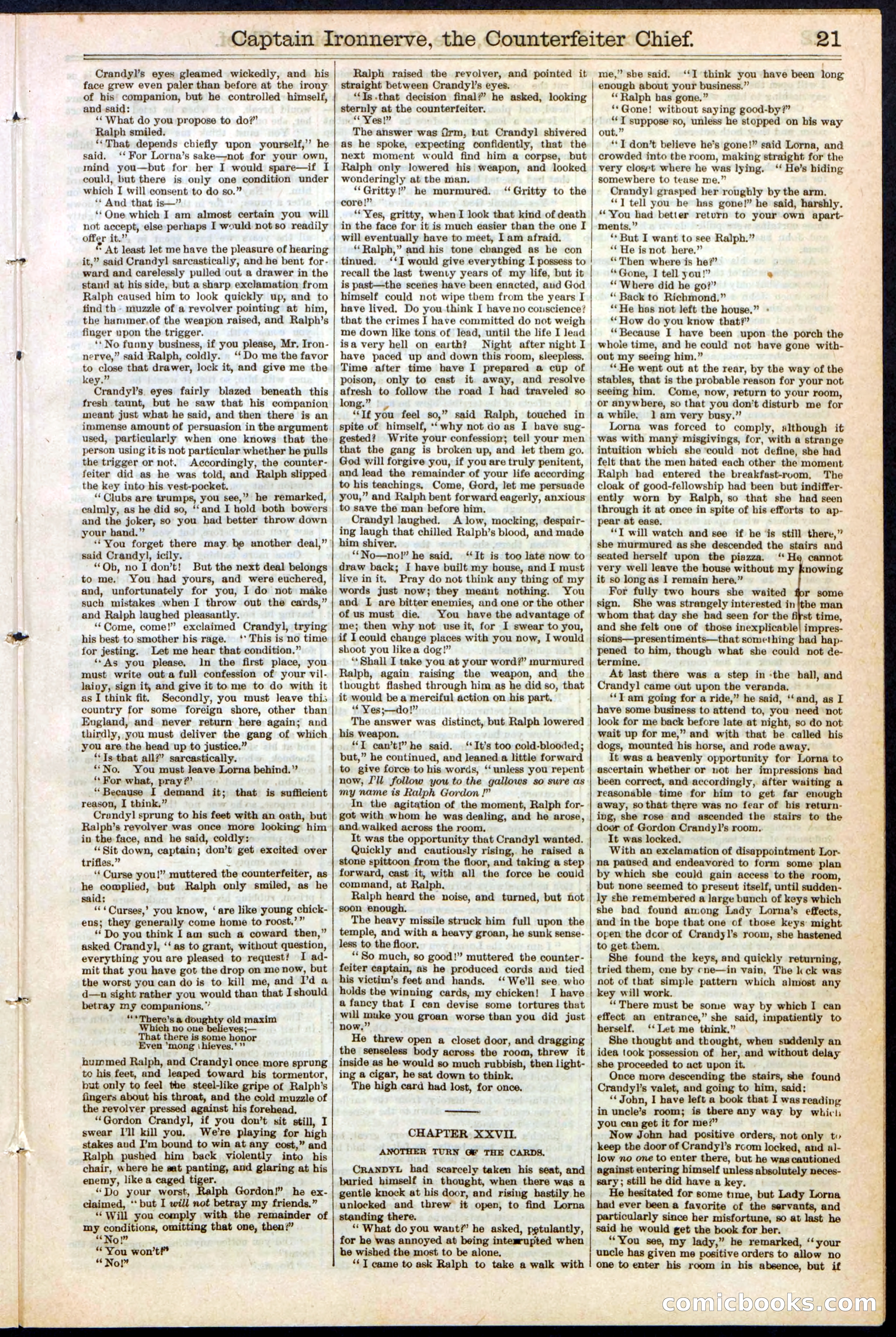
A restored page from Pulp Fiction, 1881. Page through the whole issue in the reader above.
📄 Transcribed text from this page (OCR, searchable)
Machine-transcribed from the original scan — historical spelling and the odd misread are preserved.
' Captain Crandyl’s eyes gleamed wickedly, and his face grew even paler than before at the irony of his companion, but he controlled himself, and said: ‘“ What do you propose to do?” Ralph smiled. ‘*That depends chiefly upon yourself,’’ he said. ‘‘ For Lorna’s sake—not for your own, mind you—but for her I would spare—if I could, but there is only one condition under which I will consent to do so.” ‘* And that is—” ‘*One which I am almost certain you will not accept, else perhaps I would not so readily offer it.” ** At least let me have the pleasure of hearing it,” said Crandy] sarcastically, and he bent for- ward and carelessly pulled out a drawer in the stand at his side, but a sharp exclamation from Ralph caused him to look quickly up, and to find th- muzzle of a revolver pointing at him, the hammer,of the weapon raised, and Ralph’s finger upon the trigger. ‘‘ No funny business, if you please, Mr. Iron- nerve,” said Ralph, coldly. ‘‘ Do me the favor to close that drawer, lock it, and give me the key.” Crandyl’s. eyes fairly blazed beneath this fresh taunt, but he saw that his companion meant just what he said, and then there is an immense amount of persuasion in the argument used, particularly when one knows that the person using itis not particular whether he pulls the trigger or not. Accordingly, the counter- feiter did as he was told, and Ralph slipped the key into his vest-pocket. ‘‘ Clubs are trumps, you see,” he remarked, calmly, as he did so, ‘‘and I hold both bowers and the joker, so you had better throw down your band.” ‘*You forget there may. be another deal,” said Crandy], icily. “Ob, no I don’t! But the next deal belongs to me. You had yours, and were euchered, and, unfortunately for you, I do not make such mistakes when I throw out the cards,” and Ralph laughed pleasantly. ‘‘Come, come!” exclaimed Crandyl, trying his best to smother his rage. ‘* This is no time for jesting. Let me hear that condition.” ‘“As you please, in the first place, you must write outa full confession of your vil- laivy, sign it, and give it to me to do with it as I think fit. Secondly, you must leave this country for some foreign shore, other than England, and never return here again; and thirdly, you must deliver the gang of which you are the head up to justice.” ‘Is that all?’ sarcastically. *‘No. You must leave Lorna behind.” ‘*For what, pray?’ “Because I demand it; that is sufficient reason, I think,” Crondy] sprung to his feet with an oath, but Ralph’s reyolyer was once more looking him in the face, and he said, coldly: “Sit down, captain; don’t get excited over trifles.” . ‘‘ Curse you!” muttered the counterfeiter, as he complied, but Ralph only smiled, as he said; ‘“¢ Curses,’ you know, ‘are like young chick- ens; they generally come home to roost,’” “Do you think Iam such a coward then,” asked Crandyl, ‘‘ as to grant, without question, everything you are pleased to request! I ad- mit that you have got the drop on me now, but the worst you can do is to kill me, and I’d a d—an sight rather you would than that I should betray my companions.” “** There's ld maxim Who ons elven That there is some honor Even ‘mong ihieves.’” hummed Ralph, and Crandyl once more sprung to his feet, and leaped toward his tormentor, but only to feel the steel-like gripe of Ralph's fingers about his throat, and the cold muzzle of the revolver pressed against his forehead, “Gordon Crandyl, if you don’t sit still, I swear I'll kill you. We're playing for high stakes aud I’m bound to win at any cost,” and Ralph pushed him back violently into his chair, where he sat panting, and glaring at his enemy, like a caged tiger. “ De your worst, ‘Ralph Gordon!” he ex- claimed, ‘* but I will not betray my friends.” “Will you comply with the remainder of my conditions, omitting that one, then?” “cc ” “You won’tf* “No!” onnerve, the Counterfeiter. Chief. Ralph raised the revolver, and pointed it straight between Crandyl’s eyes. ‘‘Is.that decision final?’ he asked, looking sternly at the counterfeiter. ai Yes }?? The answer was Orm, but Crandyl shivered as he spoke, expecting confidently, that the next moment would find him a corpse, but Ralph only lowered his weapon, and looked wonderingly at the man. ** Gritty!” he murmured. core!” ‘Yes, gritty, when I look that kind of death in the face for it is much easier than the one I will eventually have to meet, I am afraid. “Ralph,” and his tone changed as be con tinued. ‘‘I would give everything I possess to recall the last twenvy years of my life, but it is past—the scenes have been enacted, aud God himself could not wipe them from the years I have lived. Do you think I have no conscience? that the crimes I have committed do not weigh me down like tons of lead, until the life I lead isa very hell on earth? Night after night I have paced up and down this room, sleepless, Time after time bave I prepared a cup of poison, only to cast it away, and resolve afresh to follow the road I had traveled so long.” it you feel so,” said Ralph, touched in spite of himself, *‘why not do as I have sug- gested? Write your confession; tell your men that the gang is broken up, and let them go. God will forgive you, if you are truly penitent, and lead the remainder of your life according to his teachings, Come, Gord, let me persuade you,” and Ralph bent forward eagerly, anxious to save the man before him. Crandyl laughed. A low, mocking, despair- ing laugh that chilled Ralph’s blood, and made him shiver. **No—no!” he said. “It is too late now to draw back; I have built my house, and I must live init. Pray do not think any thing of my words just now; they meant nothing. You and L are bitter enemies, and one or the other of us must die. You have the advantage of me; then why not use it, for I swear to you, if Icould change places with you now, I would shoot you likea dog!” “Shall I take you at your word?’ murmured Ralph, again raising the weapon, and the thought flashed through him as he did so, that it would be a merciful action on his part. ““ Yes ;—do!”’ The answer was distinct, but Ralph lowered his weapon. “T can’t!” he said. ‘It’s too cold-blooded; but,” he continued, and leaned a little forward to give force to his words, “unless you repent now, I'll follow you to the gallows so sure as my name is Ralph Gordon !” In the agitation of the moment, Ralph for- got with whom he was dealing, and he arose, and. walked across the room. It was the opportunity that Crandyl wanted. Quickly and cautiously rising, he raised a stone spittoon from the floor, and taking a step forward, cast it, with all the force he could command, at Ralph. Ralph heard the noise, and turned, but hot soon enough. The heavy missile struck him full upon the temple, and with a heavy groan, he sunk sense- less to the floor. ‘So much, so good!” muttered the counter- feiter captain, as he produced cords and tied his victim’s feet and hands, ‘We'll see. who holds the winning cards, my chicken! I have a fancy that I can devise some tortures that will muke you groan worse than you did just “Gritty to the | now,” He threw open a closet door, and dragging the senseless body across the room, threw it inside as he would so much rubbish, then light- ing a cigar, he sat down to think. The high card had lost, for once. —_—_—. CHAPTER XXVIL ANOTHER TURN GF THE CARDS. CraNnDYL had scarcely taken his seat, and buried himself in thought, when there was a gentle knock at his door, and rising hastily he unlocked and threw it open, to find Lorna standing there. ‘What do you want?” he asked, petulantly, for he was annoyed at being intesrupted when he wished the most to be alone. ‘*T came to ask Ralph to take a walk with 21 . f me,” sbe said. ‘‘I think you have been long enough about your business.” ‘Ralph has gone.” ‘Gone! without saying good-by?” **] suppose so, unless he stopped on his way out.” ‘I don’t believe he’s gone!” said Lorna, and crowded into tbe room, making straight for the very closet where he was lying. ‘ He’s hiding somewhere to tease me.” Crandy! grasped her roughly by the arm. ‘“‘] tell you he has gone!” he said, harshly. “You had better return to your own apart- ments.” ** But I want to see Ralph.” ‘** He is not here.” “Then where is he?’ “Gone, I tell you!” . “Where did he go?” * Back to Richmond.” *“He has not left the house.” ° “How do you know that?’ “Because I have been upon the porch the whole time, and he could not have gone with- out my seeing him.” “He went out at the rear, by the way of the stables, that is the probable reason for your not seeing him. Come, now, return to your room, or anywhere, so that you don’t disturb me for a while. 1 am very busy.” Lorna was forced to comply, although it was with many misgivings, for, with a strange intuition which she ‘could not define, she had felt that the men hated each other the moment Ralph bad entered the breakfast-room, The cloak of good-fellowship had been but indiffer- ently worn by Ralph, so that she had seen through it at once in spite of his efforts to ap- pear at ease. “T will watch and see if he ‘is still there,” she murmured as she descended the stairs and seated herself upon the piazza. ‘He cannot very well leave the house without my knowing it so longas I remain here.” For fully two hours she waited for some sign. She was strangely interested in ithe man whom that day she had seen for the fitst time, and she felt one of those inexplicable} impres- sions—presentiments—that something bad hap- pened to him, though what she could not de- termine. At last there was a step inthe ball, and Crandyl came out upon the veranda. “‘T am going for a ride,” he said, ‘‘and, as I have some business to attend to, you need not look for me back before late at night, so do not wait up for me,” and with that be called his dogs, mounted his horse, and rode away. It was a heavenly opportunity for Lorna to ascertain whether or not her impressions had been correct, and accordingly, after waiting a reasonable time for him to get far enough away, so that there was no fear of bis return- ing, she rose and ascended the stairs to the doer of Gordon Crandyl’s room. It was locked. With an exclamation of disappointment Lor- na paused and endeavored to form some plan by which she could gain access to the room, but none seemed to present itself, until sudden- ly she remembered a large bunch of keys which she bad found among Lady Lorna’s effects, and in the bope that one of those keys: might open the decor of Crandyl’s room, she hastened to get. them. She found the keys, and quickly returning, tried them, one by cne—in vain, The k ck was not of that simple pattern which almost an key will work. “There must be some way by which I can effect an entrance,” she said, impatiently to herself. ‘‘ Let me think.” She thought and thought, when suddenly an idea took possession of her, and without delay she proceeded to act upon it. Once more descending the stairs, she found Crandyl’s valet, and going to him, said; ‘* Jobn, I have left a book that I was reading in uncle’s room; is there any way by whicl: you can get it for me?” Now John had positive orders, not only tv keep the door of Crandyl’s rcom locked, and al- low no one to enter there, but he was cautioned against entering bimself unless absolutely neces- sary; still he did have a key. He hesitated for some time, but Lady Lorna had ever been a favorite of the servants, and particularly since her misfortune, so at last he said he would get the book for her. “You see, my lady,” he remarked, ‘‘your uncle has given me positive orders to allow no one to enter his room in his absence, but if gs) Gomilchdoo (E(@)