
Pulp Fiction, 1881 · page 20 of 32
Beadle's Dime Library No. 152 — page 20: what you’re looking at
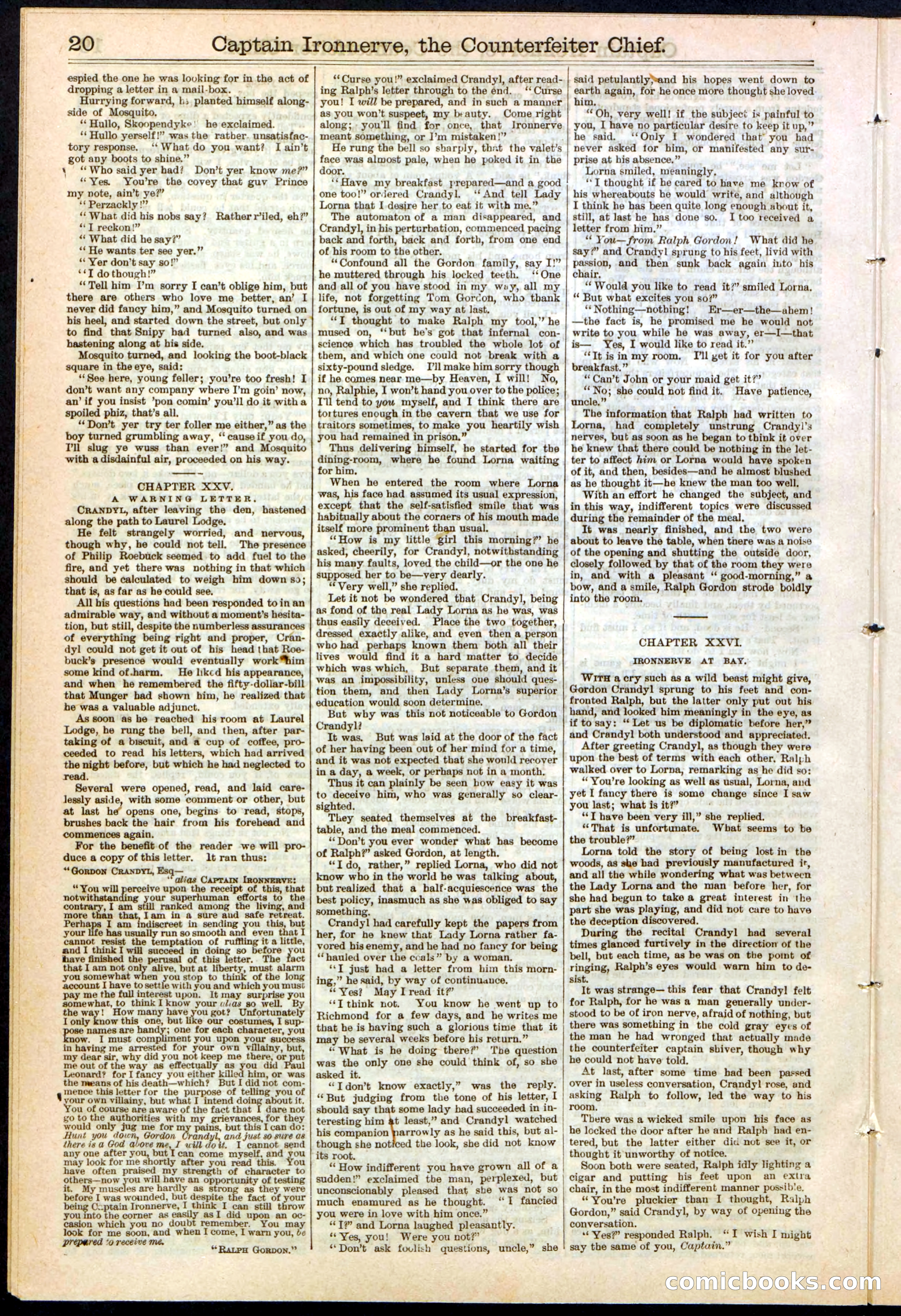
A restored page from Pulp Fiction, 1881. Page through the whole issue in the reader above.
📄 Transcribed text from this page (OCR, searchable)
Machine-transcribed from the original scan — historical spelling and the odd misread are preserved.
= te ee Ay. 2 EO SE sn. Set. Be ee? eee te eee tee ee ee. a Fas i ge ee ee ee a * . —— a — a ae ~ 20 espied the one he was lovking for in the act of dropping a letter in a mail-box. .— Hurrying forward, hs planted himself along- side of Mosquito, | ‘Hullo, Skoopendyke! he exclaimed. ** Hullo yerself!” was the rather. unsatisfac- tory response. ‘‘ What do you want? [I ain’t got any boots to shine,” , ‘Who said yer had? Don’t yer know me?” ‘Yes. You’re the covey that guv Prince my note, ain’t ye?” ‘** Perzackly!’’ ** What did his nobs say? Ratherr’iled, eh?” **T reckon!” *“* What did he say?” ‘‘ He wants ter see yer.” ‘Yer don’t say so!” ‘*T do though!” “Tell him I’m sorry I can’t oblige him, but there are others who love me better, an’ I never did fancy him,” and Mosquito turned on bis heel, and started down the street, but only to find that Snipy bad turned also, and was hastening along at bis side. Mosquito turned, and looking the boot-black square in the eye, said: ‘See here, young feller; you’re too fresh! I don’t want any company where I’m goin’ now, an’ if you insist ’pon comin’ you’ll do it witha spoiled phiz, that’s all. “Don’t yer try ter foller me either,” as the boy turned grumbling away, “ causeif you do, Tll slug ye wuss than ever!” and Mosquito with a disdainful air, proceeded on his way. CHAPTER XXV. A WARNING LETTER, CRANDYL, after leaving the den, hastened along the path to Laurel Lodge. He felt strangely worried, and nervous, though why, he could not tell. The presence of Philip Roebuck seemed to add fuel to the fire, and yet there was nothing in that which should be calculated to weigh him down s0; that is, as far as he could see. All his questions had been responded toin an admirable way, and without a moment's hesita- tion, but still, despite the numberless assurances of everything being right and proper, Cran- dyl could not get it out of his head that Roe- buck’s presence would eventually work*him some kind of.harm. He liked his appearance, and when he remembered the fifty-dollar-bill that Munger had shown him, he realized that be was a valuable adjunct. As soon as be reached his room at Laurel Lodge, he rung the bell, and then, after par- taking of a biscuit, and a cup of coffee, pro- ceeded to read his letters, which had arrived the night before, but which he had neglected to read. Several were opened, read, and laid care- lessly aside, with some comment or other, but at last he’ opens one, begins to ‘read, stops, brushes back the hair from his forehead and commences again. For the benefit of the reader we will pro- duce a copy of this letter. 1t ran thus: ““Gorpon CRANDYL, ‘alias CAPTAIN [RONNERVE: “You will vere upon the receipt of this, that notwithstan our superhuman efforts to the con , 1 am still ranked among the living, and more t Iam in a sure and safe retreat. olny | I am indiscreet in sending i this, but your has run so smooth and even that I resist the temptation of ruffling it a little, cannot and I think I will succeed in do so before you have finished the perusal of this letter. The fact that I am not only alive, but at liberty, must alarm you somewhat when you stop to think of the long account I have to settle with you and which you must pay me the full interest upon. It may surprise you somewhat, to think I know your ui.as so well. By the seal How many have # hens got? Unfortunately I only know this one, but like our costumes, I sup- names are bendy one for each character, you w. I must compliment you upon your success in having me arrested for your own villainy, but, my dear sir, why did you not keep me there, or put me out of the way as effectually as you did Leonard? for I fancy you either killed him, or was the means of his death—which? But I did not com- q mence this letter for the purpose of telling you of your own villainy, but what I intend doing about it. You of course are aware of the fact that I dare not go to the authorities with my grievances, for they would only jug me for my pains, but this I can do: Aunt you down, Gordon Crandyl, and just so sure as there is a God above me, I will. dow. I cannot send any one after you, but ITcan come myself, and Fhe may look for me shortly after you read this. ou have often praised my strength of character to others—now you will have an opportunity of testing it. My muscles are hardly as strong as they were before I was wounded, but despite the fact of your Captain Ironnerve, I think I can still throw you into the corner as easily asI did upon an oc- casion which you no doubt remember. You may look for me soon, and when I come, I warn you, ve prepared to receive me. r * RatpH Gorpon.” - — ‘Curse you!” exclaimed Crandyl, after read- ing Ralph’s letter through to the énd.__ ‘‘ Curse you! I will be prepared, and in such a manner as you won’t suspeet, my beauty. Come right along; you'll find for once, that Jronnerve meant something, or I’m mistaken!” He rung the bell so sharply, that the valet’s face was almost pale, when he poked it in the door. ‘*Have my breakfast prepared—and a good one too!” ordered Crandyl. ‘‘And tell Lady Lorna that I desire her to eat it with me.” The automaton of a man disappeared, and Crandyl, in his perturbation, commenced pacing back and forth, back and forth, from one end of his room to the other. “‘Confound all the Gordon family, say I!” he muttered through his locked teeth. ‘‘One and all of you have stood in my wuy, all my life, not forgetting Tom Gorcon, who tbank fortune, is out of my way at last. ““T thought to make Ralph my tool,” he mused on, ‘‘but he’s got that infernal con- science which has troubled the whole lot of them, and which one could not break with a sixty-pound sledge. Il make him sorry though if he comes near me—by Heaven, I will! No, no, Ralphie, I won’t hand you over to the police; Tl tend to you myself, and I think there are tortures enough in the cavern that we use for traitors sometimes, to make you heartily wish you had remained in prison,” Thus delivering bimself, he started for the dining-room, where he found Lorna waiting for him. When he entered the room where Lorna was, his face had assumed its usual expression, except that the self-satisfied smile that was habitually about the corners of his mouth made itself more prominent than usual. “How is my little girl this morning?’ he asked, cheerily, for Crandyl, notwithstanding his many faults, loved the child—or the one he supposed her to be—yvery dearly. “Very well,” she replied. Let it not be wondered that Crandyl, being as fond of the real Lady Lorna as he was, was thus easily deeeived. Place the two together, dressed exactly alike, and even then a person who had perhaps known them both all their lives would find it a hard matter to decide which was which, But separate them, and it was an impossibility, unless ove should ques- tion them, and then Lady Lorna’s superior education would soon determine. But why was this not noticeable to Gordon Crandyl? It was. But was laid at the door of the fact of her having been out of her mind for a time, and it was not expected that she wonld recover in a day, a week, or perhaps not in a month. Thus it can plainly be seen bow easy it was to deceive him, who was generally so clear- sighted. They seated themselves at the breakfast- table, and the meal commenced. ““Don’t you ever wonder what has become of Ralph?” asked Gordon, at length. “IT do, rather,” replied Lorna, who did not know who in the world he was talking about, but realized that a half-acquiescence was the best policy, inasmuch as she was obliged to say something. Crandyl had carefully kept the papers from her, for he knew that Lady Lorna rather fa- vored his enemy, and he had no fancy for being “hauled over the ccals” by a woman. ‘*T just had a letter from him this morn- ing,”’ he said, by way of continuance. “Yes? May I read it?’ ‘“‘T think not. You know he went up to Richmond for a few days, and he writes me tbat he is having such a glorious time that it may be several weeks before his return.” “What is he doing there?’ Tbe question was the only one she could think of, so she asked it. “T don’t know exactly,” was the reply. “But judging from the tone of his letter, I should say that some lady bad succeeded in in- teresting him 4t least,” and Crandyl watched | his companion arrowly as he said this, but al- though she noticed the look, she did not know its root. “ How indifferent you have grown all of a | sudden!” exclaimed the man, perplexed, but | unconscionably pleased that she was not so much enamured as he thought. “I fancied you were in love with him once.” “1? and Lorna laughed pleasantly. **'Yes, you! Were you not?” ‘Don’t ask fovlish questions, uncle,” she Captain Ironnerve, the Counterfeiter Chief. said petulantlyand his hopes went down to on again, for he once more thought she loved im, “Oh, very well! if the subject is painful to you, I have no particular desire to keep it up,” he said. ‘‘Only I wondered that you had never asked for him, or manifested any sur- prise at his absence,” Lorna smiled, meaningly, ‘*T thought if he cared to have me know of his whereabouts he would write, and although I think he has been quite long enough about it, still, at last he has done so. I too received a letter from him.” ** You—from Ralph Gordon! What did he say?” and Crandyl sprung to his feet, livid with passion, and then sunk back again into his chair, ' ‘Would you like to read it?’ smiled Lorna, * But what excites you so?” ** Nothing—nothing! Er—er—the—ahem! —the fact is, he promised me be would not write to you while he was away, er—I—that is— Yes, I would like to read it.” “Tt isin my room. [I'll yet it for you after breakfast.” *Can’t Jobn or your maid get it?’ “No; she could not find it. Have patience, uncle.” The information that Ralph had written to Lorna, had completely unstrung Crandy|’s nerves, but as soon as he began to think it over he knew that there could be notbing in the let- ter to affect him or Lorna would have spoken of it, and then, besides—and he almost blushed as he thought it—he knew the man too well, With an effort he changed the subject, and in this way, indifferent topics were discussed during the remainder of the meal, It was nearly finished, and the two were about to leave the table, when there was a noise of the opening and shutting the outside door, closely followed by that of the room they were in, and with a pleasant ‘* good-morning,” a bow, and a smile, Ralph Gordon strode boldly into the room. CHAPTER XXVI. IRONNERVE AT BAY, Wir acry such as a wild beast might give, Gordon Crandyl sprung to his feet and con- fronted Ralph, but the latter only put out his hand, and looked him meaningly in the eye, as if to say: “* Let us be diplomatic before her,” and Crandyl both understood and appreciated. After greeting Crandyl, as though they were upon the best of terms with each other, Ralph walked over to Lorna, remarking as he did so: “You’re looking as well as usual, Lorna, and yet I fancy there is some change since I saw you last; what is it?” ““T have been very ill,” she replied. “That is unfortunate. What seems to be the trouble?’ Lorna told the story of being lost in the woods, as she had previously manufactured ir, and all the while wondering what was between the Lady Lorna and the man before her, for she had begun to take a great interest in the part she was playing, and did not care to have the deception discovered. During the recital Crandyl had several times glanced furtively in the directio of the bell, but each time, as be was on the point of ringing, Ralph’s eyes would warn him to de- sist. It was strange— this fear that Crandyl felt for Ralph, for he was a man generally under- stood to be of iron nerve, afraid of nothing, but there was something in the cold gray eyes of the man he had wronged that actually made the counterfeiter captain sbiver, though why he could not have told. At last, after some time had been passed over in useless conversation, Crandyl! rose, and asking Ralph to follow, led the way to his room. Tbere was a wicked smile upon his face as | he locked the door after he and Ralph had en- tered, but the latter either did not see it, or thought it unworthy of notice. Soon both were seated, Ralph idly lighting a cigar and putting his feet upon an eXtra | chair, in the most indifferent manner possib'e. “You're pluckier than I thought, Ralph Gordon,” said Crandyl, by way of opening the conversation. ‘‘ Yes?” responded Ralph. “TI wish I might say the same of you, Captain.” m “S (elo) Eomichboo