
Pulp Fiction, 1881 · page 22 of 32
Beadle's Dime Library No. 152 — page 22: what you’re looking at
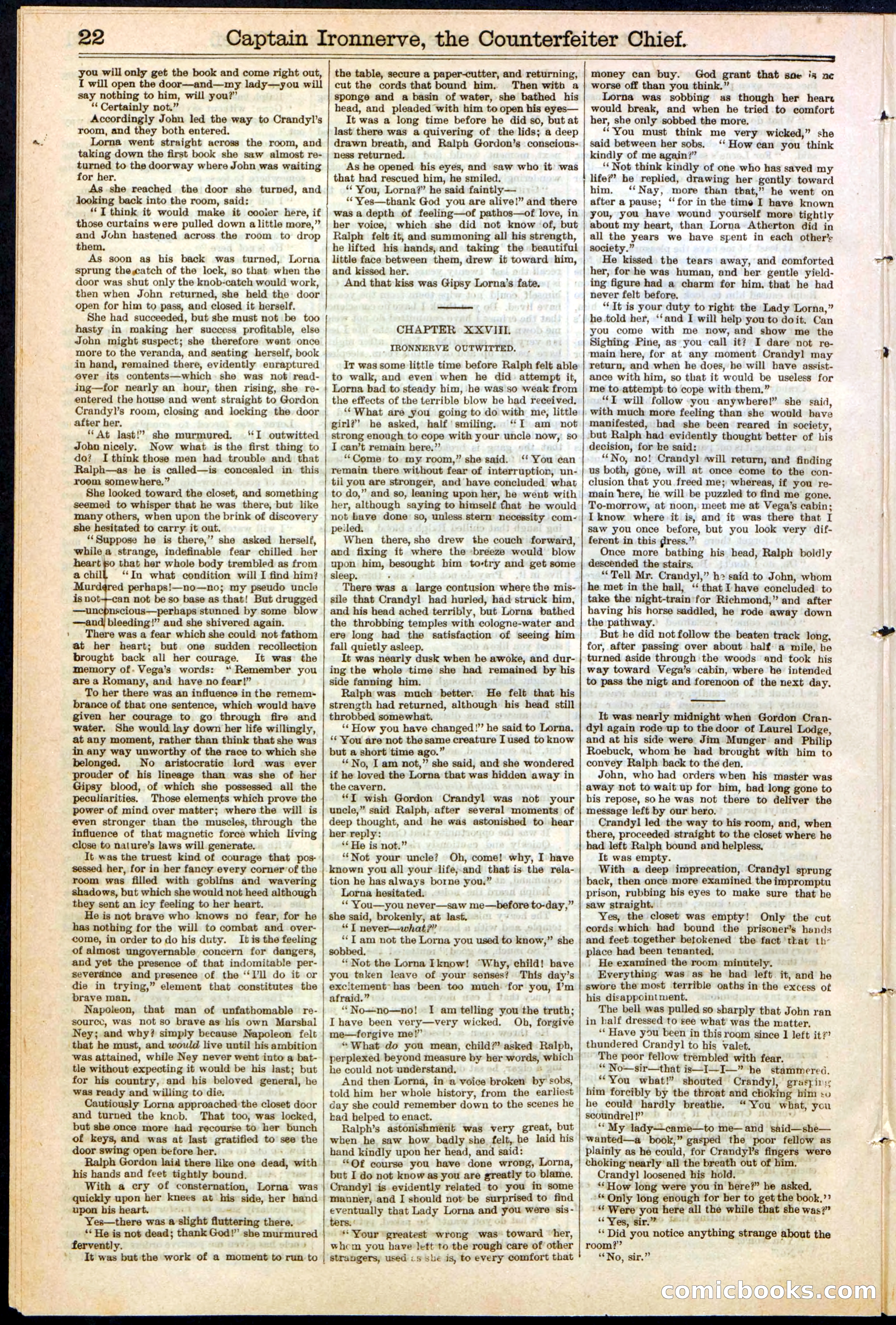
A restored page from Pulp Fiction, 1881. Page through the whole issue in the reader above.
📄 Transcribed text from this page (OCR, searchable)
Machine-transcribed from the original scan — historical spelling and the odd misread are preserved.
~ - a eee eee —_-—- — --- paaee 22 you will only get the book and come right out, I will open the door—and—my lady—you will say nothing to him, will you?” ** Certainly not.” Accordingly John led the way to Crandyl’s room, and they both entered. Lorna went straight across the room, and taking down the first book she saw almost re- turned to the doorway where John was waiting for her. As she reached the door she turned, and looking back into the room, said: ‘‘T think it would make it cooier here, if those curtains were pulled down alittle more,” and John hastened across the room to drop them. As soon as bis back was turned, Lorna sprung thegatch of the lock, so that when the door was shut only the knob-catch would work, then when John returned, she held the door open for him to pass, and closed it herself. She had succeeded, but she must not be too hasty in making her success profitable, else John might suspect; she therefore went once more to the veranda, and seating herself, book in hand, remained there, evidently enraptured ever its contents—which she was not read- ing—for nearly an hour, then rising, she re- entered the house and went straight to Gordon Crandy!’s room, closing and locking the door after her. ‘At last!” she murmured. ‘I outwitted John nicely. Now what is the first thing to do? I think those men had trouble and that Ralph—as he is called—is concealed in this room somewhere.” She looked toward the closet, and something seemed to whisper that he was there, but like many others, when upon the brink of discovery she hesitated to carry it out. *‘Suppose he is there,’ she asked herself, while a strange, indefinable fear chilled her heart $0 that her whole body trembled as from achill ‘In what condition will I find him? Murd¢red perhaps!—no—no; my pseudo uncle is not+can not be so base as that! But drugged | nscious—perhaps stunned by some blow —and bleeding!’ aud she shivered again. ' There was a fear which she could not fathom at her heart; but one sudden recollection brought back all her courage. It was the memory of. Vega’s words: “ Remember you are a Romany, and have no fear!” To her there was an influence in the remem-~ brance of that one sentence, which would have given her courage to go through fire and water. She would lay down her life willingly, at any moment, rather than think that she was in any way unworthy of the race to which she belonged. No aristocratic lord was ever prouder of his lineage than was she of her Gipsy blood, of which she possessed all the peculiarities. Those elements which prove the power of mind over matter; where the will is éven stronger than the muscles, through the influence of that magnetic force which living close to na\ure’s laws will generate. It was the truest kind of courage that pos- sessed her, for in her fancy every corner of the room was filled with goblins and wavering shadows, but which she would not heed although they sent an icy feeling to her heart. He is not brave who knows no fear, for he has nothing for the will to combat and over- come, in order to do his duty. Itis the feeling of almost ungovernable concern for dangers, and yet the presence of that indomitable per- severdnce and presence of the ‘‘I’ll do it or die in trying,” element that constitutes the brave man. Napoleon, that man of unfathomable re- source, was not so brave as his own Marshal Ney; and why? simply because Napoleon felt that he must, and would live until his ambition ‘was attained, while Ney never went into a bat- tle without expecting it would be his last; but for his country, and bis beloved general, he was ready and willing to die. Cautiously Lorna approached the closet door and turned the knob, That too, was locked, but she once more had recourse to her bunch of keys, and was at last gratified to see the door swing open before her. Ralph Gordon laid there like one dead, with his hands and feet tightly bound. With a cry of consternation, Lorna was quickly upon her knees at his side, her hand upon bis heart. a - Yes—there was a slight fl there, ** He is not dead; thank God!” she murmured fervently. te ‘Tt was but the work of a moment to run to A ti, ~~ ttt Captain Ironnerve, the Counterfeiter Chief. oooooooooooowwnma@@=qoOoqoqoqoaoDoaD oo ee —— SS the table, secure a paper-cutter, and returning, cut the cords that bound him, Then witb a sponge and a basin of water, she bathed his head, and pleaded with him to open his eyes— It was a long time before he did so, but at last there was a quivering of the lids; a deep drawn breath, and Ralph Gordon’s conscious- ness returned. As he opened his eyes, and saw who it was that had rescued him, he smiled. ** You, Lorna?” he said faintly — “Yes—thank God you are alive!” and there was a depth of feeling—of pathos—of love, in her voice, which she did not know of, but Ralph felt it, and summoning all his strength, he lifted his hands, and taking the beautiful little face between them, drew it toward him, and kissed her. And that kiss was Gipsy Lorna’s fate. CHAPTER XXVIII. IRONNERVE OUTWITTED. It was some little time before Ralph felt able to walk, and even when he did attempt it, Lorna bad to steady him, he was so weak from the effects of the terrible blow he bad received, ‘‘What are you going to do with me, little girl?’ he asked, half smiling. ‘I am _ not strong enough to cope with your uncle now, so I can’t remain here,” “‘Come to my room,” she said. ‘' You ean remain there without fear of interruption, un- til you are stronger, and have concluded what to do,” and so, leaning upon her, he went with her, although saying to himself fhat he would not bave done so, unless stern’ necessity com- peiled. When there,she drew the couch forward, and fixing it where the -breeze would blow upon him, besought him to-try and get some sleep. There was a large contusion where the mis- sile that Crandyl had hurled, had struck him, and his head ached terribly, but Lorna bathed the throbbing temples with cologne-water and ere long had the satisfaction of seeing him fall quietly asleep. It was nearly dusk when he awoke, and dur- ing the whole time she had remained by his side fanning him. Ralph was much better. He felt that his strength had returned, although his head still throbbed somewhat. ‘* How you have changed!’’ he said to Lorna. ** You are not the same creature I used to know but a short time ago.” ‘* No, I am not,” she said, and she wondered if he loved the Lorna that was hidden away in the cavern. “I wish Gordon Crandyl was not your uncle,” said Ralph, after several moments of deep thought, and he was astonished to hear her reply: ** He is not.” “Not your uncle? Oh, come! why, I have known you all your life,-and that is the rela- tion he has always borne you,” Lorna hesitated. ‘* You—you never—saw me—before to-day,” she said, brokenly, at last. ; “T never—what?” ‘“‘T am not the Lorna you used to know,” she sobbed. “Not the Lorna Iknow! “Why, child! have you taken leave of your senses? This day’s excitement’ has been too much ‘for you, I’m afraid.” “ No—no—no! I am telling you the truth; I have been very—very wicked. Ob, forgive me—forgive me!” i al * What do you mean, child?’ asked Ralph, perplexed beyond measure by her words, which he could not understand. as And then Lorna, in a voice broken by sobs, told him her whole history, from the earliest day she could remember down to the scenes he bad helped to enact. Ralph’s astonishmerit was very great, but when he saw how. badly she felt, be laid his hand kindly upon her head, and said: ““Of course you have done wrong, Lorna, but I do not know as you are greatly to blame. Crandyl is evidently related to you in some manner, and I should not be surprised to find eventually that Lady Lorna and you were sis- * Your ‘greatest wrong was toward her, whem you have left to the rough care of other strangers, used is she is, to every comfort that money can buy. God grant that sae is ne worse off than you think.” Lorna was sobbing as though her heart would break, and when he tried to comfort her, she only sobbed the more. “You must think me very wicked,” she said between her sobs. ‘‘ How can you think kindly of me again?” ‘* Not think kindly of one who has saved my life?” be replied, drawing her gently toward him. ‘Nay, more than that,” he went on after a pause; “for in the time I have known you, you have wound yourself more tightly about my heart, than Lorna Atherton did in all the years we have spent in each other’s society.” He kissed the tears away, and comforted her, for he was human, and her gentle yield- ing figure had a charm for him. that he had never felt before. “It is your duty to right the Lady Lorna,” he told her, ‘‘and I will help you to doit. Can you come with me now, and show me the Sighing Pine, as you call it? I dare not re- main here, for at any moment Crandyl may return, and when be does, be will have assist- ance with him, so that it would be useless for me to attempt to cope with them.” ‘“‘T will follow you anywhere!” she said, with much more feeling than she would bave manifested, bad she been reared in society, but Ralph had evidently thought better of bis decision, for he said: ‘“‘No, no! Crandy! will return, and finding us both, gone, will at once come to the con- clusion that you freed me; whereas, if you re- main ‘here, he will be puzzled to find me gone. To-morrow, at noon, meet me at Vega’s cabin; I know where it is, and it was there that I saw you once before, but you look very dif- ferent in this gress.” Once more bathing his head, Ralph boldly descended the stairs. “Tell Mr. Crandy],” hz said to John, whom he met in the hall, “ that I have concluded to take the night-train for Richmond,” and after having his horse saddled, he rode away down the pathway. . But he did not follow the beaten track long, for, after passing over about half a mile, be turned aside through the woods and took his way toward Vega’s cabin, where he intended to pass the nigt and forenoon of the next day. It was nearly midnight when Gordon Cran- dyl again rode up to the door of Laurel Lodge, and at his side were Jim Munger and Philip Roebuck, whom he had brought with him to convey Ralph back to the den. John, who had orders when his master was away not to wait up for him, had long gone to his repose, so he was not there to deliver the message left by our bero. | Crandyl led the way to his room, and, when there, proceeded straight to the closet where he bad left Ralph bound and helpless. It was empty. With a deep imprecation, Crandyl sprung back, then once more examined the impromptu prison, rubbing bis eyes to make sure that he saw straight. ) Yes, the closet was empty! Only the cut cords which had bound the prisoner’s hands and feet together betokened the fact that th- place had been tenanted., _ He examined the room minutely. Everything was as he had left it, and he swore the most terrible oaths in the excess of his disappointment. The bell was pulled so sharply that John ran in half dressed to see what was the matter. ‘‘ Have you been in this room since ] left it?” thundered Crandyl to his Valet; The poor fellow trembled with fear. ** No—sir—that is—I—I—” ‘he stammered. “You what!” shouted Crandy), grasyin;: him forcibly by the throat and choking bim +o he could hardly breathe. “You what, you scoundrel] !” . > ‘**My lady—came—to me—and said—she— wanted—a book,” gasped the poor fellow as plainly as he could, for Crandyl’s fingers were choking nearly all the breath out of him, — Crandy] loosened his hold. ~ ‘‘How long were you in here?” he asked, “Only long enough for her to get the book,’’ - Were you here all the while that she was?” “ Yes, sir.” be bs ’ . ‘‘ Did you notice anything strange about the room?” “No, sir.” Gomic S) eX oX9) Eo