
Pulp Fiction, 1877 · page 4 of 40
Beadle's New York Dime Library, Vol. II, No. 15 — page 4: what you’re looking at
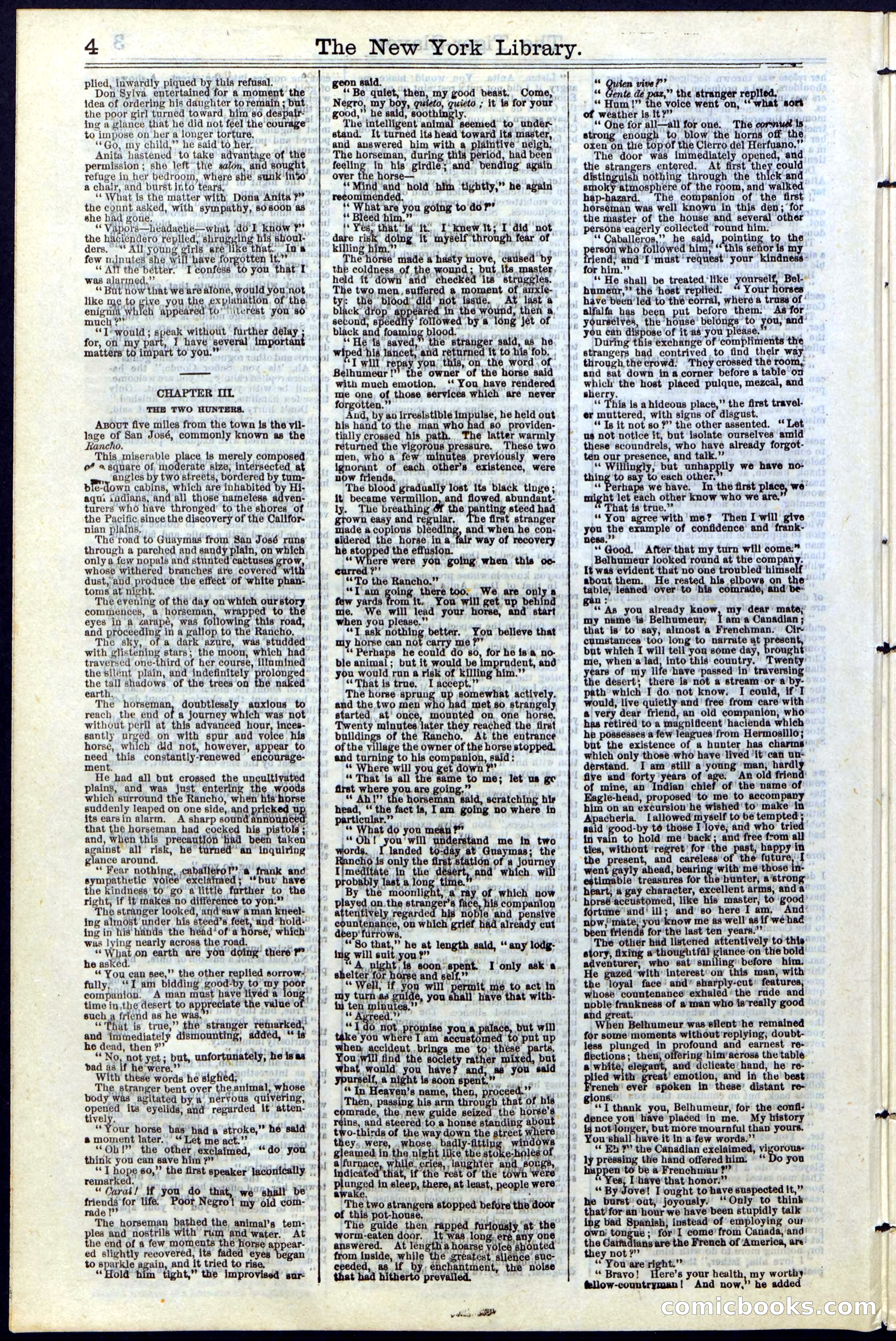
A restored page from Pulp Fiction, 1877. Page through the whole issue in the reader above.
📄 Transcribed text from this page (OCR, searchable)
Machine-transcribed from the original scan — historical spelling and the odd misread are preserved.
& plied, inwardly piqued by this refusal. Don Sylva entertained for a moment the idea of ordering his daughter to remain ; but the poor girl turned toward him so despair- ing a glance that he did not feel the courage” to impose on ber a longer torture, ‘*Go, my child,” he said'to her. - Anita hastened to take advantage of the permission; she left the salon, and sought. refuge in her bedroom, where she sunk ‘into a chair, and burst into tears, ‘‘ What is the matter with Dona Anita?” the count asked, with sympathy, s0s800D as she had gone, ** Vapors—headache—what do'l know ?’’ the haciendero replied, shrugging his shoul- ders. ““* All young girls are like that. In's few niinutes she will have forgotten gst ‘“ AT! the bétter. I confess to you that I was alarmed? ) “But now that we are alone, would you not like enigma Wh much ?”” “Tewould; speak without further delay ; for, on my ait 1 have several importan matters to impart to you.” ch appeared to’ \\lerest you 80 CHAPTER OL THE TWO HUNTERS. AxsooT five miles from the town Is the yil- lage of San José, commonly known as the Rancho. This miserable place is merely composed o* a square of moderate size, intersected at angles by two streets, bordered by tum- bilown cabins, which are tahabited by Hi. aqui indians, and all those nameless adyen- turers who have thronged’ to the shores of the Pacific since the discovery of the Califor- nian plains, The road to Guaymas from San José runs through a parched and sandy plain, on which only a few nopals and stunted cactuses grow, whose withered branches are covered’ with dust, and produce the effect of white phan- toms at night. The evening of the day on which our story commences, &@ horseman, wrapped to the eyes in a zarapé, was following this road, and proceeding in a gallop to the Rancho, The sky, of a dark azure, was studded with glistening stars; the moon, which had traversed one-third of her course, illumined the silent plain, and indefinitely 2 pe ed the tall shadows of the trees on the naked’ earth. The horseman, doubtlessly anxious to reach the end of a journey which was not without peril at this advanced hour, inces- santly urged on with spur and voice his horse, which did not, however, appear to need this constantly-renewed encourage- ment. He had all but crossed the opgultl yee plains, and was just entering the woods — cote the Rancho, w = his horse suddenly leaped on one side,. an ic 1 its earsin alarm. A sharp sot Ranouneed that the horseman had cocked his pistols} The New York Library. me to pixe you the explanation of the. . The two, men, Paid geon said. ‘Be quiet, then, my good beast. Come, N egro, my boys quieto, quieto ; it is for your good,’’ he said, soothingly. The intelligent animal seemed to under stand. It turned its head toward ita master, and answered him with a plaintive neigh, The horseman, during this period, had been feeling In his girdle; and bending again over the horse— , “Mind ‘and hold him tightly,” he again PH hat are you gottig to’ ad at are you 0 * Bleed | ttn.” oe | ' Yes, that is it. I° knew it; I did not dare risk doing it myselfthrough fear of killing him.” _ : d ait 3 Be ree. nee a hasty gt * get the coldness of the wound; Dut, master, held it’ down atid’ Thecxet iD struggles. & moment of anxie- Re etn Matt “4.3 Bpee seton ny followed by a long jet of black and foa ng blood ng ‘He ig saved,” the stranger sald, as he. | wiped his lancet, and returned it to his fob. . and, When this precaution bad been taken against all risk, he” glance around. art, Soa ‘* Fear nothing, wabell Ya frank and sympathetic yoice exclatmed; ‘but have the kindness to go a little further to the right, if it makes no différence to yon.” he stranger looked, and'saw aman kneel ing almost under his steed’s feet, and hold» ing in his hinds the head‘ of’a horse, which’ wus lying nearly acrosa the road. vo ‘*What on earth are you doing’ there ?” he asked. ~ an inquiring _ . - “You can see,” the other replied sorrow~ © fully, ‘(I am bidding good-by tomy poor companion. ng, time in the desert to appreciate e value such a friend as he was,” stranger remarked, “That is true,” the and initnediately dismounting, added, “* is he dead, then ?”’ . “No, not yet; but, unfortunately, he is as vad as if he'were.”’ Ye With these words he sighed, The stranger bent over the animal, whose body Was agitated by a nervous quivering, open h its eyelids, and regurded it atten- vely, ‘Your horse has had a stroke,” he said a moment later. “Let me act.” “Ob!” the other exclaimed, “do you . think you can save him »” “y hope 80,” the first speaker laconically | | that, we" shall be” remarke “ Carat! if you "y friends for life. Poo eng Negro! my old com- rade The horseman bathed the, animal’s tem- ace and nostrils with rum and ‘water. At he end of a few moments the Horse appear- Horse. Poon ed slightly recovered, its faded ‘eyes to epee ain, and it tried to rise, ** Hold hin tight,” the improvised sar: A man must have livéd a long’ **T will repay you, this, on the word of” Belhumeur!”’ the owner of the horse said with much emotion, ‘‘ You have rendered me one of those services which are never forgotten.” ud, by ao Irresistible Impulse, he held out his hand to the man who had 80 providen- tially crossed his path. The latter warmly returned the vigorous pressure. These two men, who a few minutes previously were ignorant of each other’s existence, were now friends, ; The blood gradually lost its black tinge; it became vermilion, and flowed abundant- ly. The breathing the panting steed had grown easy and regular, e first stranger miade acopious blee and when he con- sidered the horse ina way of recovery he stogped the effusion. “ “re were you going when this oo- “To the Rancho.” _, “Tam going there too. We Ww orn, Cul a. mit. You will get up behind yards a We will lead your horse, and start en you please,” “*T ask nothing better. You believe that miy horse can not carry me?” . ‘* Perhaps he could do 60, for he is a no- ble animal; but it would be imprudent, and you would run a risk of killing him.”’ “That is trne, I accept,” The horse sprung up somewhat achively, and the two men who had met 60 strangely, started at’ once, mounted on. one horse, Twenty minutes later they reached the first buildings of the Rancho, At the entrance of the village the owner of the horse stopped. and turning to his companion, said: ‘* Where will you get down ?” “ That is all the same to me; let us gc first where youare going,” : “* Ah!” the horseman said, scratching his head, ‘‘the fact is, lam going no where in PAS What do you ta “Oh! you will retand me in two landed pas Fae rat the asia te See a By the moonlight, a ray of which now & fhe, ayed on. the stran is companio eitentiely regarded his noble ‘and pensive untensnce, on which griéf had already cut deep ' furrows ‘So that,” he at length said, ‘ any lodg- ing will suit you ?” : roe ‘A, night is soon spent. I'only ask'a shelter f ¢ and an” os | “Ww w ‘Permit, 6 to act In 6, you have that with- ten minutes,” 46 AS F. ; _ . “Ido not, promise y: “6, but will : take you whate Tain Pipa "to pat up » eomrade, the new - — _ two-thirds of the way down the street en accident .brings me to’ these parts, ou will find the societ eather mired, but hat would you have? and, as you said urself,.a night is soon spent.” “ In Heayven’s name, then, pro wet “ Then, passing, his arm through that of his new guide seized the hor Ag ins, and steered to a honse standing about | ey. Were, whose, badly-fitting win gleamed in, t) ight J se pr} a\furnac gries ter a dicated'th if the rest 0 the to a: Ai in sleep, there, at least, people were ake, ’ ‘The two atrangera stopped b ‘thie’ door © of au ngete sophel etre The palde then pred Hot © guide then rap worm-eaten door. It: Wr iteas answered. At length a hoarse yo} from inside, wuts Bea ce suc- t : : Ket had Minette preial ee ee ~ bumedr,”’ thé ‘host renee es. sand “ Ht oe ona the stran lied, ente dé paz,” the s replied . “ Hum!” the voice Wanton: ce what sort of weather is.It?”’ “* One for all—all for one. The cormuél is strong enongy to blow the horns off the oxen on the top of the Cierro del Herfuano.’ The door was immediately opened, and the strangers entered. At first a could distinguish nothing through the thick and smoky atmosphere of the room, and walked hap-hazard. The companion of the first horseman was well known in ‘this den; ‘for. the master of the house and several other persons eagerly collected round him. ‘“‘ Caballeros,’’ he said, Pointin to the erson who folléwed him, “this senor is my riend; and’ I ‘must ‘request’ your kindness - for him.”’ lied: “* Your horses _ have been’ led‘to thé corral, where a truss of ’ the present, an ' borsé accustomed, like his master, to good: ut before them: Asfor alfalfa has been you, Bulg ’ b hgh the honse’ belongs ‘to you cah dispose ‘of it as you please,” | ) During this exchange of ‘compliments the strangers had contrived to find their way, through the crowd: They crossed the room, and sat down in a corner before a table on which the host placed pulque, mezcal, and mere ‘« This is a hideous place,” the first travel- er muttered, with signs of disgust. ‘‘ Tg it not so ?”’ the other assented. “ Let us not notice it, but isolate ourselves amid these scoundrels, who have already forgot- ten our presence, and talk.” “ Willingly, but unhappily we have no- thing to say to each other.” ‘* Perhaps we have. ! might let each other know who we That is true.” “ Yon agree with me? Then I will give you the example of confidence’ and frank- ness “Good. After that my turn will come.” Belhumeur looked round at the company. It was evident that no one troubled ‘himself’ about them. He rested ble, leaned’ over to his comrade, nn; ‘““ As you already know, my déar mate; my name is Belhumeur, I ama Canadian; that is to say, almost a Frenchman. Cir cumstances too long to narrate at ghia but which I will tell you some day, brough me, when'a lad, into this country. Twenty’ ears of my life ‘have ‘passed in’ traversing 1e desert; there is not a stream or a’by- th which I do not know. I could, if’! ould, live quietly and’ free from care with a very dear friend, an old companion, who’ has retiréd to a magnificent hacienda which he possesses a few leagues from Hermosillo; but the existence of a hunter has charms’ which only those who have lived ‘it'can un- derstand. I am ‘still a young man, hardl five and forty ‘years of 2 An old friend’ of mine, = eestor che ap oinauerd le-head, pro me to accom at on an Rdeursion’ he wished to’ make in me pt tay be yn age to be ee . d ‘good-by to those I love, and wh in vain to ro me back ; and free from all , without ‘re the careless ‘of ‘the’ future ‘i nt Bayly ahead, te aha Pb mé those in- timable treasures for t heart, a gay character, excellent arms, anda’ fortune” and! ill; and so here I am, And’ w)mate; you'know me as well as if we had been friends for'the last ten years.” The other had listened attentively to this: story, fixing a*thoughtfal zlance‘on the bold’ venturer, who sat smiling’ before him. e gazed with’ interest’ on man, with e loyal face and” sharply-cut’ features, hose countenance exhaled’ the rade an noble frankness of a man who is‘really good d great. When Belhumeur was eflent'he remained for some moments without replying; doubt- a plunged in ander and earnest re- fiections; then offering himacross the table. a white; el and dclicate: hand, he re- ie th ench ever spoken in these’ distant re- ons.’ ~ ee I thank you, Belhumenr, for the confi- rae you have placed in me. My history not‘longer, but more mournful thap yours. - Youshall have it in afew words.”’ ' ly pressing the hand offered him: © “ ‘* Eh ? the Canadian exclaimed, vigorous- you : eee be a Frenchmau ?” es; -have' that honor.” _“ By Jovel I ought to have suspected it,” burst oat, joyously, ‘‘Only to think at! for an hour we have been stupidly talk g bad Spanish, instead of employing our Ma ; for’ I come’ from Canada, and’ the Caifadians are'the French of ‘America, are: ' they not?” ‘You are right.”” “ Bravo! Here’s your health, my worthy f@llow-countryman! And now,” he adde ‘He shall be treatedlike yourself, Bel-’ In the first piace we his elbows o e t' for the past, happy in e’ hunter, a’strong” ‘emotion; and in the best: GOMmicboo ss) (E() im, . |