
Pulp Fiction, 1877 · page 3 of 40
Beadle's New York Dime Library, Vol. II, No. 15 — page 3: what you’re looking at
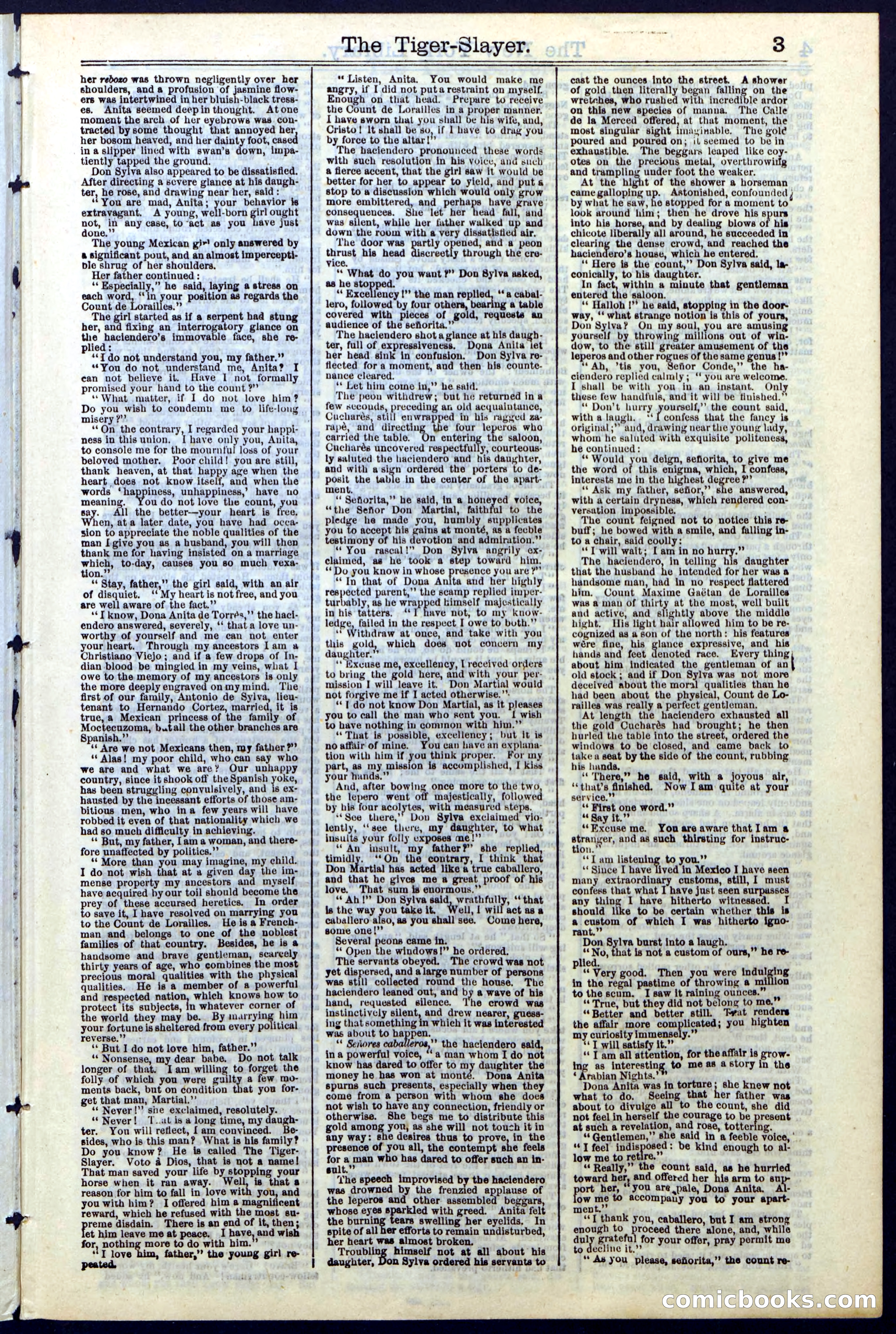
A restored page from Pulp Fiction, 1877. Page through the whole issue in the reader above.
📄 Transcribed text from this page (OCR, searchable)
Machine-transcribed from the original scan — historical spelling and the odd misread are preserved.
J : y » i ; <“% wee ee her rebozo was thrown negligently over her shoulders, and a profusion of jasmine flow- ers was intertwined in her bluish-black tress- es. Anita seemed deepin thought. Atone moment the arch of her eyebrows was con- tracted by some thought that annoyed her her bosom heaved, and her dainty foot, cased in a slipper lined with swan’s down, impa- tiently tapped the ground. | Don Sylva also appeared to be dissatisfied. After directing a scvere glance at his daugh- ter, he rose, and drawing near her, said: ‘“You are mad, Anita; your behavior is extravagant. A young, well-born gin! ought not, in any case, to-act as you have just done.” The young Mexican gi~' only answered by a significant pout, and an almost impercepti- ble shrug of her shoulders. Her father continued : ‘* Especially,” he said, laying a stress on each word, ‘‘in your position as regards the Count de Lorailles.” The girl started as if a serpent had stung her, and fixing an interrogatory glance on “ Porlenderes immovable face, she re- ed: ym I do not understand you, my father.” “You do not understand me, Anita? I ean not believe it. Have I not formally promised your hand to the count ?” ‘‘What matter, if I do not love him? Do you wish to condemu me to life-long misery ?”’ ‘*On the contrary, I regarded your happi- ness in this union, I have only you, Anita, to console me for the mournful loss of your beloved mother. Poor child! you are still, thank heaven, at that happy age when the heart does not know itself, and when the words ‘happiness, unhappiness,’ have no meaning. You do not love the count, you a All the better—your heart is free, hen, ata later date, you have had occa- sion to appreciate the noble qualities of the man [give you as a husband, you will then thank me for having insisted on a marriage : which, to-day, causes you 680 much vexa- n ‘* Stay, father,” the girl said, with an air of disquiet. ‘‘ My heart is not free, and you are well aware of the fact.” ‘*T know, Dona Anita de Torrés,”’ the haci- endero answered, severely, ‘* that a love un- worthy of yourself and me can not enter your heart. Through my ancestors lam a Christiano Viejo; and if a few drops of In- dian blood be mingled in my veins, what I owe to the memory of my ancestors is only the more deeply engraved onmy mind, The first of our family, Antonio de Sylva, lieu- tenant to Hernando Cortez, married, it is true, a Mexican princess of the family of Moctecuzoma, b.utall the other branches are Spanish.’’ ‘¢ Are we not Mexicans then, my father?” “ Alas! my poor child, who can say who we are and what we are? Our unhappy country, since it shook off the Spanish yore has been struggling convulsively, and is ex- hausted by the incessant efforts of those am- bitious men, who ina few years will have robbed it even of that nationality which we had so much difficulty in achieving. ‘“‘ But, my father, [am a woman, and there- fore unaffected by politics.” ‘‘ More than you may imagine, my child. I do not wish that at a given day the im- mense property my ancestors and myself have acquired by our toil should become the prey of these accursed heretics. In order to save it, I have resolved on marrying you to the Count de Lorailles. He is a French- man and belongs to one of the noblest families of that country. Besides, he is a handsome and brave gentleman, scarcely thirty years of age, who combines the most precious moral qualities with the physical qualities. He is a member of a powerful and respected nation, which knows how to protect its subjects, in whatever corner of the world they may be. By marrying him your fortune is sheltered from every political reverse.” - ‘‘ But I do not love him, father.” ‘‘ Nonsense, my dear babe. Do not talk longer of that. Iam willing to forget the folly of which you were guilty a few mo- ments back, but on condition that you for- get that man, Martial.’’ ‘“‘ Never !’’ she exclaimed, ongoing “ Never! T..at is a long time, my onan ter. You will reflect, [am convinced. Be- sides, who is this man? What is his family? Do you know? He is called The Tiger- Slayer. Voto a Dios, that is not a name! That man saved your life by stopping your horse when it ran away. Well, is that a reason for him to fall in love with you, and you with him? I offered hima cent reward, which he refused with the most eu- reme disdain. There is an end of it, then; et him leave me at peace. 1 have, and wish for, nothing more to do with him. **T love Tinw father,”’ the young girl re- peated. you to call the man who sent you. _ was about to bappen. The Tiger-Slayer. * Listen, Anita. You would make. me angry, if I did not puta restraint on myself. Enough on that head. Prepure to receive the Count de Lorailles in a proper manner. I have sworn that you shall be his wife, and, Cristo! It shall be BO, if L have to drag you by force to the altar!” The baciendero pronounced these words with such resolution in his voice, and such a flerce accent, that the girl saw it would be better for her to appear to yield, and put 6 stop to a discussion which would only grow more embittered, and perhaps have grave re consequences. She let her head fall, and was silent, while her futher walked up and down the room with a very dissatistied air. The door was partly op aa, and a peon thrust his head discreetly through the cre- vice. ‘** What do you want ?”” Don Sylva asked, as he ches a ‘* Excellency !”’ the man replied, ‘‘a cabal- lero, followed by four spre ng a table covered with pieces of gold, requests an audience of the sefiorita.”’ The haciendero shot a glance at his daugh- ter, full of expressiveness, Dona Anila let her head sink in confusion. Don Sylva re- flected fora moment, and then his counte- nance cleared. ‘* Let him come in,” he said. The peou withdrew; but he returned ina few seconds, preceding an old acquaintance, - Cucharés, still enwrapped in his ragyed za- rapé, and directing the four leperos who carried the table. On entering the saloon, Cucharés uncovered respectfully, courteous- ly saluted the haciendero and his dauhter, and with a sign ordered the porters to de- posit the tab ment, ‘* Sefiorita,”’ he said, in a honeyed voice, “the Sefior Don Martial, faith to the pledge he made you, humbly supplicates you to accept his gains at monté, as a fecble testimony of his devotion and admiration.” * You rascal!” Don Sylva angrily ex- | claimed, as he took a step toward him. “*Do you know in whose presence you are ?”’ “In that of Dona Anita and her highly respected parent,”’ the scamp replied imper- turbably, as he wra tpt himself majestically in his tatters. “‘T have not, to my know- ledge failed in the respect I owe to both.” ‘* Withdraw at once, and take with you this gold, which does not concern my daughter.” ‘* Excuse me, excellency, L received orders to bring the gold here, and with your per- mission I will leave it. Don Martial would not forgive me if I acted otherwise,’’. ‘*1 do not know Don Martial, as it pleases { wish to have nothing in common with him.”’ ‘* That is possible, excellency; but it is no affair of mine. You can have an explana- tion with him if you think proper. For my part, as my mission is accomplished, I kiss your hands.” And, after bowing once more to the two, the lepero went off majestically, followed by his four acolytes, with measured steps. ** See there,’ insults your folly ve me!’ “An insult, my father?” she replied timidly. ‘On the contrary, I think that Don Martial has acted like a true caballero, and that he gives me a great proof of his love. That sum is enormous.” ‘* Ah!’ Don Sylva said, wrathfully, *‘ that is the way you take it, Well, I will act asa caballero also, as you shall see. Come here, some one!” Several peons came in. *“ Open the windows!” he ordered. The servants obeyed. The crowd was not yet Supewes and alarge number of persons was still collected round the house, The haciendero leaned out, and by a wave of his hand, requested silence. The crowd was instinctively silent, and drew nearer, guess- ing that something in which it was interested “* Serores ” the haciendero sai in a powerful voice, “‘a man whom I do no know has dared to offer to my daughter the money he has won at monte. Dona Anita spurns such presents, especially when they come from a person wit not wish to have any connection, friendly or otherwise. She begs me to distribute this gold among you, as she will not touch it in any way: she desires thus to prove, in the presence of you all, the contempt she feels ie 5a who has dared to offer such an in- 6 The speech improvised by the haciendero was drowned by the frenzied applause of the leperos and other assembled beg; whose eyés 8 the burn swelling her eyelids. In spite of all her efforts to remain undisturbed, her heart was almost broken. Troub himself not at all about his } daughter, Don Sylva ordered his servants to. e in the center of the apart- | Dov Sylva exclaimed vio- _ lently, ‘‘see there, my daughter, to what whom she does | kled with greed. Anita felt . 3 —_ cast the ounces into the street. A shower of gold then literally began falling on the wretches, who rushed with incredible ardor on this new species of manna. The Calle de la Merced offered, at that moment, the most singular sight imayinable, The gole poured and poured on; it seemed to be in exhaustible. The beggars leaped like coy- otes on the precious metal, overthrowillg and trampling under foot the weaker. At the hight of the shower a horseman came galloping up. Astonished, confounded } by what he saw, he stopped for a moment to look around him; then he drove his spurs into his horse, and by dealing blows of his chicote liberally all around, he succeeded in clearing the dense crowd, and reached the haciendero’s house, which he entered. ‘* Here is the count,’’ Don Sylva said, la- conically, to his daughter. In aa within a minute that gentleman entered the saloon. ‘* Halloh |” he said, stopping in the door way, ‘‘ what strange notion is this of yours, Don Sylva? On my soul, you are amusing yourself by throwing millions out of win- dow, to the still greater amusement of the leperos and other rogues of the same genus!” ‘““Ah, ’tis you, Sefior Conde,’’ the ha- ciendero replied calmly; ‘' you are welcome, I shall be with you in an instant. Only these few handfuls, and it will be finished.” ** Don't hurry yourself,”’ the count said, with a laugh. ‘‘I confess that the fancy is original;” aud, drawing near the young lady, whom he saluted with exquisite politeness, he continued: ** Would you deign, sefiorita, to give me the word of this enigma, which, I confess, interests me in the highest degree?” ‘* Ask my father, sefior,”” she answered, with a certain dryness, which rendered con- versation impossible. ; The count feigned not to notice this re- buff; he bowed with a smile, and falling in- _ toa chair, said coully: _ ‘*T will wait; [am in no wt a The haciendero, in telling his daughter that the husband he intended for her was a handsome man, had in no respect flattered him. Count Maxime Gaétan de Lorailles was aman Of thirty at the most, well built and active, and slightly above the middle hight. His light hair allowed him to be re- cognized as a son of the north: his features wére fine, his glance expressive, and his hands and feet denoted race. about him indicated the gentleman of an old stock ; and if Don Sylva was not more deceived about the moral qualities than he had been about the physical, Count de Lo- railles was really a perfect gentleman, At length the haciendero exhausted all the gold Cucharés had brought; he then hurled the table into the street, ordered the windows to be closed, and came back to take a seat by the side of the count, rubbing his hands, “There,” he said, with a joyous air, ‘that’s finished. Now Iam quite at your service.” ‘* First one word.” “Say it.” ‘““Excuse me. You are aware that Iam a rh nN and a8 such thirsting for instruc- on.’ ‘‘T am listening to you.”’ ‘* Since I have lived in Mexico I have seen many extraordinary customs, still, I must confess that what I have just seen surpasses any Bale I have hitherto witnessed. I should like to be certain whether this is a custom of which I was hitherto igno- rant,” Don Sylva burst into a laugh. hea” t is not a custom of ours,” he re- e . arr Very good. Then you were indulging in the regal pastime of throwing @ million to the scum. I saw itraining ounces. “True, but they did not belong to me, “Better and better stil. Twat renders the affair more conelicptens you highten my curiosity immensely.” ‘T will satisfy it.” ‘Tam all attention, for the affair is grow- ing as interesting, to meas astory in the ‘ Arabian Nights.’ Dona Anita was in torture; she knew not what to do. Seeing that her father was about to divulge all to the count, she did not feel in herself the courage to be present at such a revelation, and rose, tottering. “ Gentlemen,”’ she said in a feeble voice, ' “I feel indisposed: be kind enough to al- low me to re “ Really,”’ the count said, as he hurried toward her, and offered her his arm to By port her, “you are pale, Dona Anita, Al- ow me to accompany you to your apart- men t. “‘[ thank you, caballero, but I am strong enough to proceed there alone, and, while aply grateful for your offer, pray permit me to decline it,”’ ‘* As you please, sefiorita,” the count re- eom Every f ea cS (¢ (e) Gboo