
Pulp Fiction, 1877 · page 5 of 40
Beadle's New York Dime Library, Vol. II, No. 15 — page 5: what you’re looking at
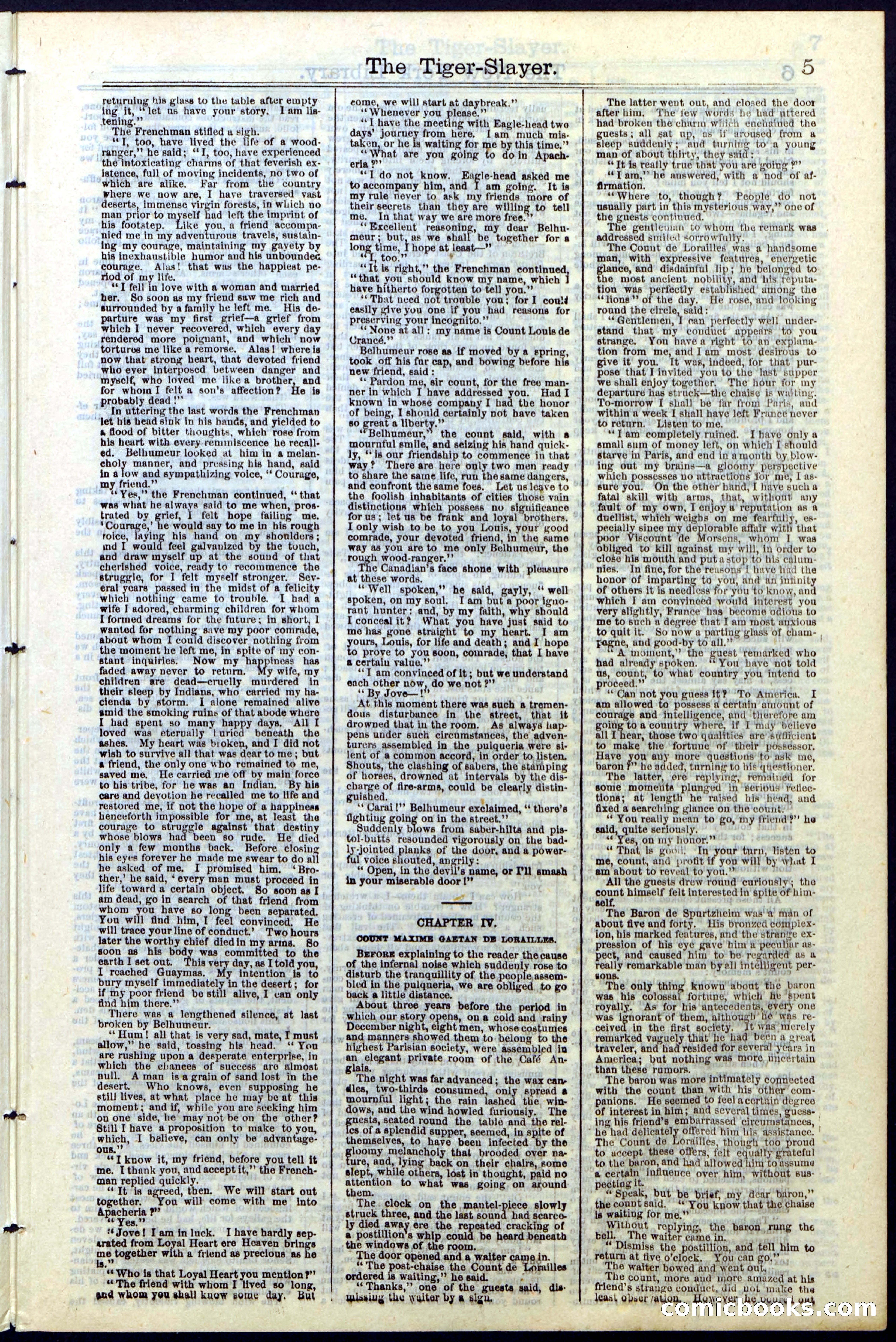
A restored page from Pulp Fiction, 1877. Page through the whole issue in the reader above.
📄 Transcribed text from this page (OCR, searchable)
Machine-transcribed from the original scan — historical spelling and the odd misread are preserved.
‘riod of my life. n ‘surrounded by a family be left me. returuing his glass to the table after empty ing it, “let us have your story. 1am lis- tening.”’ The Frenchman stifled a sigh. **T, too, have lived the life of a wood- ranger,’’ he said; ‘“‘I, too, have experienced thé intoxicating charms of that feverish ex- istence, full of moving incidents, no two of which are alike. Far from the country where we now are, I have traversed vast deserts, immense virgin forests, in which no man prior to myself had left the imprint of his footstep. Like you, a friend accompa- nied me in my adventurous travels, sustain- ing my courage, rieaej33hes my gayety by his inexhaustible humor and his unboundea courage. Alus! that was the happiest pe- **T fell in love with a woman and married So soon as my friend saw me rich and rt mre aera Bee feokn ure was m rst grief—a ef from which I never Takovehed: which every day rendered more poignant, and which now tortures me like a remorse, Alas! whereis now that strong heart, that devoted friend who ever interposed between danger and myself, who loved me like a brother, and for whom I felt a son’s affection? He is her. probably dead !”" In uttering the last words the Frenchman ‘Jet his head sink in his hands, and yielded to & flood of bitter thoughts, which rose from his heart with every reminiscence he recall- ed. Belhumeur looked at him in a melan- choly manner, and pressing his hand, said in a low and sympathizing voice, ‘* Courage, my friend.” ~ “Yes,” the Frenchman continued, “ that was what he always said to me when, pros- trated by grief, felt hope failing me. CRETPES, e would a to me in his rough roice, laying his hand on my shoulders; ind I would feel gulvanized by the touch, and draw myself up at the sound of that cherished voice, ready to recommence the struggle, for I felt myself stronger. Sey- eral ycars passed in the midst of a felicity which nothing came to trouble. I had a wife I adored, charming children for whom [ formed dreams for the future; in short, I wanted for nothing save my poor comrade, about whom I could discover nothing from the moment he left me, in spite of my con- stant inquiries. Now my PARP es has faded away never to return. y wife, my children are dead—cruelly murdered in their sleep by Indians, who carried my ha- clenda by storm. I alone remained alive smid the smoking ruins of that abode where I had spent so many happy days, All I loved was eternally turied beneath the ashes. My heart was broken, and I did not wish to survive all that was dear to me; but a friend, the only one who remained to me, saved me. He carried me off by main force to his tribe, for he was an Indian. By his care and devotion he recalled me to life and restored me, if not the hope of a happiness henceforth impossible for me, at least the couriye to struggle against that destiny whose blows had been so rude. He died only a few months back. Before closing his eyes forever he made me swear to do al he asked of me. I promised him, ‘Bro- ther,’ he said, ‘every man must proceed in life toward a certain object. 80 soon as I am dead, goin search of that friend from whom you have so long been separated. You will find him, I feel convinced, He will trace your line of conduct.’ Two hours later the worthy chief diedin my armns. So soon as his body was eontinitted to the earth 1 set out. This td day, as I told you, I reached Guaymas. My intention is to bury myself immediately in the desert; for if my poor friend be still alive, I can only find him there.” There was a lengthened silence, at last broken by Belhumeur. ) ‘‘Hum! all that is very sad, mate, I must allow,” he said, tossing his head. ‘ You are rushing upon a desperate enterprise, in which the ehanees of success arc almost null. Aman isa grain of sand lost in the desert. Who knows, even supposing he still lives, at what place he may be at this moment, and if, while you are seeking him ov one side, he may not be on the other? © Still I have a proposition to make to you, which, I believe, can only be adyantage- | ’ ous. . “T know it, my friend, before Aik tell it me. [ thank you, and accept it,” the French- man replied vse pr “Tt "is ed, then. We will start out together, ou will come with me into Apacheria o Jove! Iaminluck. I have hardly sep- arated from its Heart ere Heaven brin me together with a friend as precions as he “Who is that Loyal Heart you mention?” “The friend with whom I lived so long, end whom you shall know some day. But the windows of the room... The Tiger-Slayer. come, we will start at daybreak.” ‘“Whenever you please.” “*] have the meeting with Eagle-head two days’ Jpurney from here. Lam much mis- taken, or he is waiting for me by this time.” “What are you going to doin Apach- eria ?”’ “I do not know. Eagle-head asked me to accompany him, and I am going. It is my rule neyer to ask my friends more of their secrets than they are willing to tell me. In that way we are more free.”’ “‘Excellent reasoning, my dear Belhu- meur; but, as we shall be together for a big Ayaka I hope at least—’’ * I 1G, v “Tt is right,” the Frenchman continued “that you should know my name, which ] have hitherto forgotten to tell you.” ‘““That need not trouble you; for1 could easily give you one if you had reasons for preserving ont incognito.” “None at all: my name is Count Louis de Crancé.”’ Belhumeur rose as if moved by a epring, took off his fur cap, and bowing before his new friend, said: ** Pardon me, sir count, for the free man- ner in which I have addressed you. Had I known in whose company I had the honor of being, I should certainly not have taken 60 great a liberty.” **Belhumeur,”’ the count said, with a mournful smile, and seizing his hand quick- ly, ‘‘is our friendship to commence in that way’ There are here only two men ready to share the same life, run the same dangers, and confront the same foes. Let us leave to the foolish inhabitants of cities those vain distinctions which possess nv significance for us; let us be frank and loyal brothers. I only wish to be to you Louis, your good comrade, your devoted friend, in the same | way as you are to me only Belhumeur, the rough wood-ranger,’’ e Canadian’s face shone with pleasure at these words. ‘Well spoken,” he sald, gayly, ‘ well spoken, on my soul. I am but a poor igno- rant hunter: and, by my faith, why should I conceal it? What you have just said to me has gone straight to my heart. I am YORE, Louis, for life and death; and I hope prove to you 600n, comrade, that I have a certain value.”’ ‘“*T am convinced of it; but we understand each other now, do we not ?”’ ‘* By Jove—!” At this moment there was such a tremen- dous disturbunce in the street, that it drowned that in the room. As always hap- pon’ under such circumstances, the adven- urers assembled in the pulqueria were si- lent of a common accord, in order to, listen. Shouts, the clashing of sabers, the stamping of horses, drowned at intervals by the dis- Pan fire-arms, could be clearly distin- shed. ‘** Carail’’? Belhumeur exclaimed, ‘“* there’s fighting going on in the street.”’ Suddenly blows from saber-hilts and pis- tol-butts resounded vigorously on the bad- A dolnied lanks of the door, and a power- voice shouted, angrily “ Open, in the deyil’s n in your miserable door !”’ wt CHAPTER IV. COUNT MAXIME GAETAN DE LORAILIES. BErorE explaining to the reader the 6 of the infernal nolan which suddenl natn disturb the tranquillity of the people,assem- ame, or Pll smash | bled in the pulqueria, we are obliged to go | back a little distance. About three years before the period in which our story o December night, eight men, whose Soames Cc , and manners showed them to belong to ns, on a cold and rainy highest Parisian society, were assembled in ow wesenk private room of the Café An- glais. The night was far advanced; the wax can dles, two-thirds consumed, onl laiodd a mournful light; the rain lashe dows, and the wind howled furiously. The ests, seated round the table and the rel- cs of a splendid supper, seemed, in spite of themselves, to have been infected by the gloomy melancholy that brooded over na- ure, and, lying back on their c airs, some slept, while others, lost in thought, paid no attention to what was going on around em. The. clock on the mantel-piece slowl aa tre three, and the last soun ae pedal y d a a postillion’s whip could be heard beneath _ The door opened and 9 waiter camein. “The post-chaise the Count de lles ordered is waiting,” he. ‘Genta tne “Thanks,” one of the guests apid, dis- 1 Uplasing the waiter by a sign, y the win- | way ere the a ig cracking of | ‘tT Tite ees ‘Pegtiog | Wabenicomicbooks S) The latter went out, and closed the door after him. The few words he had uttered had broken the charm wilich enchained the guests; all sat up, as if aroused from a sleep suddenly; and turning to’ a young man of about thirty, they said: ” | “Tt is really true that you are going ?”’ “Tam,” he answered, with a nod of af- firmation. ‘““Where to, though? People do not usually part in this mysterious way,’’ one of the guests continued. The gentletian to Whom the remark was addressed smiled sorrowfully. The Count de Lorailles was a handsome man, with expressive features, energetic a and disdainful lip; he belonged to he most ancient nobility, and his reputa- tion was Paes established’ among the “‘lions”’ of the day. He rose, and looking round the circle, seid: “Gentlemen, I ean perfectly well under- stand that my conduct appeirs to you strange. You have a right to an explana- tion from me, and] am most desirous to give it you. It was, indeed, for that pur- pose that I invited you to the last supper we shall enjoy together. The hour for my departure has struck—the chaise is wiiting. To-morrow [I shall be far from Paris, aud within a week I shall have left France never to return. Listen to me. “Tam completely rnined. I have only a small sum of money left, on which I should starve in Paris, and end in amonth by blow- ing out my brains—a gloomy perspective which possesses no uttractions for me, I as- sure you. On the other band, T have sucha fatal skill with arms, that, without any fault of my own, I enjoy a reputation as a duellist, which weighs on me fearftlly, es- pecially since my deplorable affair with that poor Viscount de Morsens, whom I was obliged to kill against my will, in order to close his mouth and putastop to his calum- nies. In fine, for the reasons [ have lind the honor of imparting to you, and an intinity of others it is needless for you to know, and which I am conyineed would interest you very slightly, France has become odious to me to such a degree that Tam most anxious to quit it. Fagne, and good-by to all,’’ A moment,” the guest remarked who had already spoken. ‘*You have not told us, count, to what country you intend to proceed.” ‘Can not you guess it? To America. I am allowed to possess a certain amount of courage and intelligence, and therefore am going to a country where, if I muy believe all I hear, those two qualities are sifficient to make the fortune of ‘their possessor, Have me any more questions to ask me, baron ?” he added, turning to his qtiestioner. The latter, ere replying, remained for some mometta plunged in serivus: fellec- tions; at length he raised his’ head; and fixed a searching glance on the count. “You really mean to go, my friend'?’’ he said, quite seriously. = Yes, on my honor.” . “That is good, In ex turn, listen to me, count, and profit if you will by what I am about to reveal to you.” All the guests drew round curiously; the gaunt himself felt interested in spite of him- The Baron de Spurtzheim was''a man of about five and forty. His bronzed complex- ion, his marked features, and the stranive ex- pression of his eye gave him a pecular as- pect, and caused him to be remiss as & really remarkable man by ell intelligent per- The only thing known about the baron was his colossal fortune, which he ‘spent royally. As for his antecedents, every one was ieee of them, ulthongh He was re- ceived in the first society, Jt was micrely remarked vaguely that he had been a preat traveler, and had resided for several years in America; but nothing was more, unicertain than these rumors. The baron was more intimately connected with the count than with his other com- panions. He seemed to feel acertiin degree So now a parting glass of cham- | of interest in him; and several times, guess- | ing his friend’s embarrassed circumstances, ~ he had doheately offered him his assistance. orailles, though too proud — The Count de to uccept. these offers, felt equally grateful _to the baron, and had allowed him to assume a certain nfluence over him, without sus- tiag It . t “Speak, but be brief, my, dear baron,” we count said, ‘ou dow that the chaise is waiting for me.” “ Without. replying, the baron. rung the _ “Dismiss the postillion, and tell him to ea at tive o’clock. You can £0," ® waiter bowed and went out, | The count, more and more amazed at his bell. The waiter came in. _ friend’s strange conduct, did pot make the — —_ co