
Pulp Fiction, 1877 · page 35 of 40
Beadle's New York Dime Library, Vol. II, No. 15 — page 35: what you’re looking at
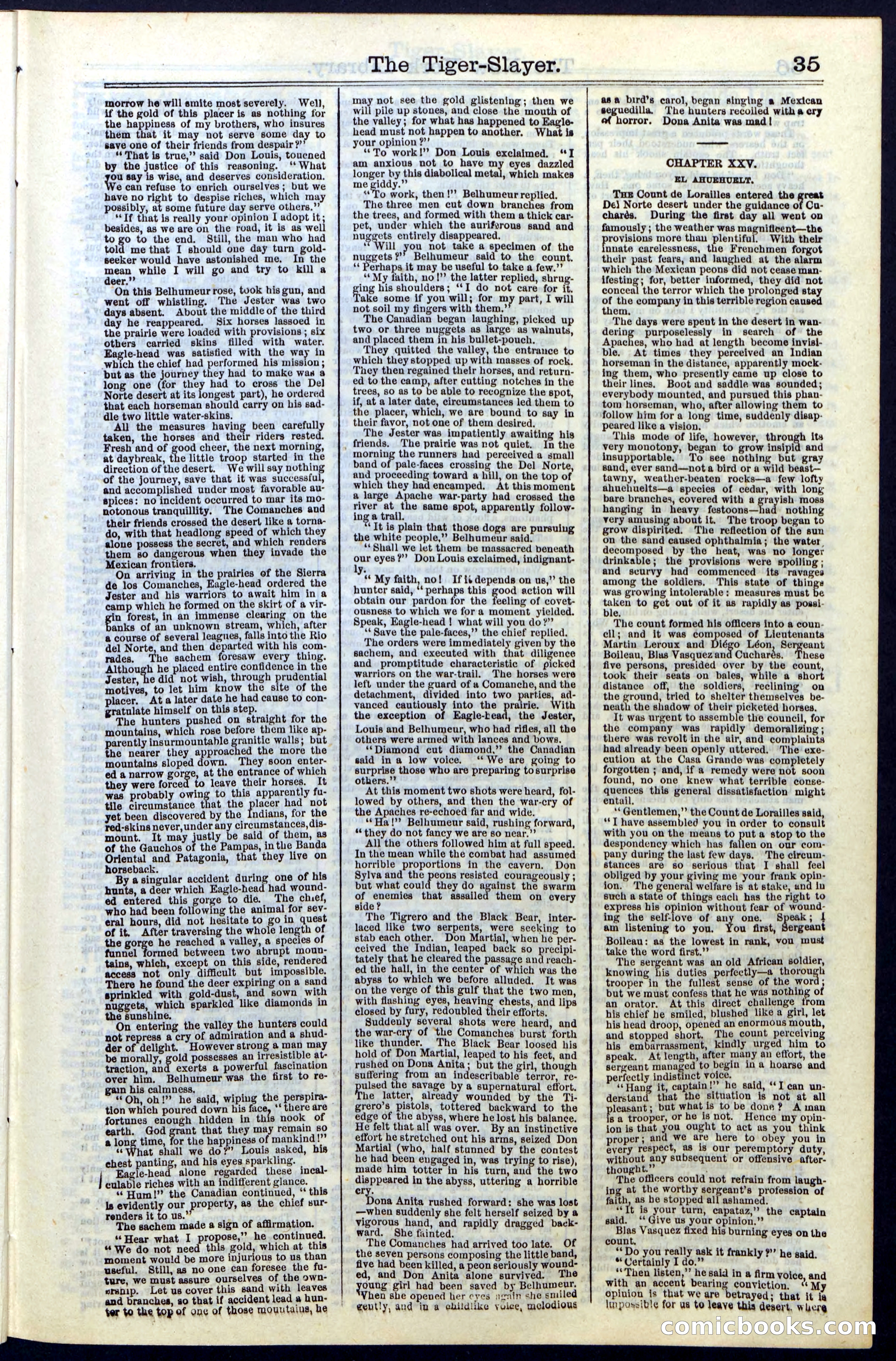
A restored page from Pulp Fiction, 1877. Page through the whole issue in the reader above.
📄 Transcribed text from this page (OCR, searchable)
Machine-transcribed from the original scan — historical spelling and the odd misread are preserved.
SS morrow he will smite most severely. Well, if the gold of this placer is as nothing for the happiness of my brothers, who insures them that it may not serve some day to save one of their friends from despair?’ ‘That is true,” said Don Louis, touecned by the justice of this reasoning. ‘* What you say is wise, and deserves consideration. e can refuse to enrich ourselves; but we have no right to despise riches, which may possibly, at some future day serve others.”’ “If that is really your opinion I adopt it; besides, as we are on the road, it is as well to go to the end. Still, the man who had told me that I should one day turn gold- seeker would have astonished me. In the mean while I will go and try to kill a deer.” On this Belhumeur rose, tvok his gun, and went off whistling. The Jester was two days absent. About the middle of the third day he reappeared. Six horses lassoed in the prairie were loaded with provisions ; six others carried skins filled with water. Eagle-head was satisfied with the _ in which the chief had performed his mission ; but as the journey they had to make was a long one (for they had to cross the Del Norte desert at its longest part), he ordered that each horseman should carry on his sad- dle two little water-skins. All the measures having been carefull taken, the horses and their riders rested. Fresh and of good cheer, the next morning, at daybreak, the little troop started in the direction of the desert. We will say er of the journey, save that it was successful, and accomplished under most favorable au- spices: no incident occurred to mar its mo- notonous tranquillity. The Comanches and their friends crossed the desert like a torna- do, with that headlong speed of which they alone possess the secret, and which renders them so dangerous when they invade the Mexican frontiers. On arriving in the prairies of the Sierra de los Comanches, EKagle-head ordered the Jester and his warriors to await him in a camp which he formed on the skirt of a vir- n forest, in an immense clearing on the Banks of an unknown stream, which, after a course of several leagues, falls into the Rio del Norte, and then departed with his com- rades, The sachem foresaw every thing. Although he placed entire confidence in the Jester, he did not wish, through prudential motives, to let him know the site of the placer. Ata later date he had cause to con- gratulate himself on this step. The hunters pushed on straight for the mountains, which rose before them like ap- parently insurmountable granitic walls; but the nearer they approached the more the mountains sloped down. They soon enter- ed a narrow gorge, at the entrance of which they were forced to leave their horses. It was probably owing to this apparently fu- tile circumstance that the placer had not yet been discovered by the ndians, for the red-skins never, under any circumstances, dis- mount. It may yey be said of them, as of the Gauchos of the Pampas, inthe Banda Oriental and Patagonia, that they live on horseback. By asingular accident during one of his hunts, a deer which Eagle-head had wound- ed entered this gorge to die. The chef, who had been following the animal for sev- eral hours, did not hesitate to go in quest of it. After traversing the whole length of the gorge he reached a valley, a species of funnel formed between two abrupt moun- tains, which, except on this side, rendered access not only difficult but impossible. There he found the deer expiring on a sand sprinkled with gold-dust, and sown with nuggets, which sparkled like diamonds in the sunshine. On entering the valley the hunters could not repress a cry of admiration and a shud- der of delight. However strong ® man may be morally, gold possesses an irresistible at- traction, ug exerts a powerful fascination over him. Belhumeur was the first to re- © his calmness, “Oh, oh!’’ he said, wipin the perspira- tion which poured down his gin ** there are fortunes enough hidden in this nook of earth. God grant that they may remain 60 a long time, for the happiness of mankind! “What shall we do?” A Aelte his anting, and his eyes sparkling. ig "alone heeartied these incal- Eagle-hea . | butable riches with an indifferent glance. “ Hum!” the Canadian continued, ‘* this _ Is evidently our property, as the chief sur- renders it to us.” , The sachem made a sign of affirmation. i ss ropose,”’ he continued. * Wado matt: this gold which at this moment would be more injurious to us than useful. Still, as no one can foresee the fu- ture, we must assure ourselves of the own- erepip. Let us cover this sand with leaves and branches, so that if accident lead a hun- ter to the top of onc of those mouutaius, he ' { _ friends. may not see the gold glistening; then we will pile up stones, and close the mouth of the valley; for what has happened to Eagle- head must not happen to another. What is your opinion ?”’ “To work!’ Don Louis exclaimed. ‘I am anxious not to have my eyes dazzled longer by this diabolical metal, which makes me giddy.” “To work, then!’’ Belhumeur replied. The three men cut down branches from the trees, and formed with them a thick car- pet, under which the aurifyrous sand and nug rets entirely disappeared. Will you not take a specimen of the nuggets ??’ Belhumeur said to the count. ‘* Perhaps it may be useful to take a few.”’ ‘“‘My faith, no!’’ the latter replied, shrug- ing his shoulders; ‘‘I do not care for it. Fale some if you will; for my part, I will not soil my fingers with them.’ The Canadian began laughing, picked up two or three nuggets as large as walnuts, and placed them in his bullet-pouch. They quitted the valley, the entrance to which they stopped up with masses of rock. They then regained their horses, and return- ed to the camp, after cutting notches in the trees, so as to be able to recognize the spot, if, at a later date, circumstances led them to the placer, which, we are bound to say in their favor, not one of them desired. The Jester was impatiently awaiting his The prairie was not quiet. In the morning the runners had perceived a small band of pale-faces crossing the Del Norte, and proceeding toward a hill, on the top of which they had encamped. At this moment a large Apache war-party had crossed the river at the same spot, apparently follow- ing a trail. ‘It is plain that those dogs are pursuing the white people,” Belhumeur said. ‘*Shall we let them be massacred beneath our eyes?’ Don Louis exclaimed, indignant- ly. ** My faith, no! If {+ depends on us,” the hunter said, ‘‘ perhaps this good action will obtain our pardon for the feeling of covet- ousness to which we fora moment yielded. Speak, Eagle-head ! what will you do?” ‘* Save the pale-faces,’’ the chief replied. The orders were immediately given by the sachem, and executed with that diligence and promptitude characteristic of picked warriors On the war-trail. The horses were left under the guard of » Comanche, and the detachment, divided into two parties, ad- vanced cautiously into the prairie. With the exception of Eagle-head, the Jester, Louis and Belhumeur, who had rifles, all the others were armed with lances and bows. ‘*Diamond cut diamond,’’ the Canadian said in a low voice. ‘“ We are going to surprise those who are preparing tosurprise others.’’ At this moment two shots were heard, fol- lowed by others, and then the war-cry of the Apaches re-echoed far and wide. ‘Ha!’ Belhumeur said, rushing forward, “they do not fancy we are so near.” All the others followed him at full speed. In the mean while the combat had assumed horrible proportions in the cavern. Don Sylva and the fact resisted courageously ; but what could they do against the swarm of enemies that assaile side? The Tigrero and the Black Bear, inter- laced like two serpents, were secking to stab each other. Don Martial, when he per- ceived the Indian, leaped back so precipi- tately that he cleared the passage ind reach- ed the hall, in the center of which was the abyss to which we before alluded. It was on the verge of this gulf that the two men, with flashing eyes, heaving chests, and lips closed by fury, redoubled their efforts. Suddenly several shots were heard, and the war-cry of the Comanches burst forth like thunder. The Black Bear loosed his hold of Don Martial, leaped to his feet, and rushed on Dona Anita; but the girl, though suffering from an indescribable terror, re- polaes the savage by a supernatural effort. he latter, already wounded by the Ti- grero’s pistols, tottered backward to the edge of the abyss, where he lost his balance. He felt that all was over. By an instinctive effort he stretched out his arms, seized Don Martial (who, half stanned by the contest he had been engaged in, was trying to rise), made him totter in his turn, aud the two them on every - disppeared in the abyss, uttering a horrible cry. ‘Dora Anita rushed forward: she was lost —when suddenly she felt herself seized by a vigorous hand, and rapidly dragged back- ward. She fainted. The Comanches had arrived too late. Of the seven persons composing the little band, five had been killed, a peon seriously wound: - ed, and Don Anita alone survived. young girl had been saved by Belhumeur, Vhen she opened her cyes again she smiled gently, and in a childlike yuice, melodious The Tiger-Slayer. 35 = ee ew ee a eter asa bird’s carol, began singing a Mexican seguedilla. The hunters recoiled with a cry horror. Dona Anita was mad! CHAPTER XXV. EL AHUEHUELT, Tue Count de Lorailles entered the great De} Norte desert under the guidance of Cu- charés. During the first day all went on famously ; the weather was magnificent—the rovisions more than plentiful. With their nnate carelessness, the Frenchmen forgot their past fears, and laughed at the alarm which the Mexican peons did not cease man- ifesting; for, better informed, they did not conceal the terror which the prolonged stay of the company in this terrible region caused them, . The days were spent in the desert in wan- yee purposelessly in search of the Apaches, who had at length become invisi- ble. At times they perceived an Indian horseman in the distance, apparently mock- ing them, who presently came up close to their lines. Boot and saddle was sounded; everybody mounted, and pursued this phan- tom horseman, who, after allowing them to follow him for a long time, suddenly disap- peared like a vision. This mode of life, however, through its very monotony, began to grow insipid and insupportable. To see nothing but gray sand, ever sand—not a bird or a wild beast— tawny, weather-beaten rocks—a few lofty ahuchuelts—a species of cedar, with long bare branches, covered with a grayish moss hanging in heavy festoons—had nothing very amusing about it. The troop began to grow dispirited. The reflection of the sun on the sand caused ophthalmia; the water. decomposed by the heat, was no longer drinkable; the provisions were spoiling ; and scurvy had commenced its ravages among the soldiers. This state of things was growing intolerable: measures must be et to get out of it as rapidly as possi- e The count formed his officers into a coun- cll; and it was composed of Lieutenants Martin Leroux and Diégo Léon 57 es Boileau, Blus Vasquez an Cucharés. ‘These five persons, presided over by the count, took their seats on bales, while a short distance off, the soldiers, reclining on the Hendy, tried to shelter themselves be- neath the shadow of their picketed horses. It was urgent to assemble the council, for the company was rapidly demoralizing ; there was revolt in the air, and complaints had already been openly uttered. The exe- cution at the Casa Grande was completely forgotten ; and, if a remedy were not soon found, no one knew what terrible conse- hr this general dissatisfaction might entail. ‘*Gentlemen,”’ the Count de Lorailles said, **T have assembled you in order to consult with you on the means to ree a stop to the despondency which has fallen on our com- pany during the last few days. The circum- stances are so serious that I shall feel obliged by your piving me your frank opin- ion. The general welfare is at stake, und ln such a state of things each has the right to express his opinion without fear of wound- ing the self-love of any one. Speak; am listening to you, You first, Sergean Boileau: as the lowest in rank, vou must take the word first.”’ The af) Seah was an old African soldier, knowing his duties perfectly—a thorough trooper in the fullest sense of the wor ; but we must confess that he was nothing o an orator. At this direct challenge from his chief he smiled, blushed like a girl, let his head droop, opened an enormous mouth, and stopped short. The count perceiving his embarrassment, kindly urged him to speak, At, length, after many an effort, the sergeant mansgen ty ri Sa in a hoarse and erfectly indistinct voice. P eHtare it, captain!’’ he said, ‘I can un- derstand that the situation is not at all leasant; but whatis to be done? A man sa trooper, or he is not. Hence my opin- jon is that you ought to act as you think proper; and we are here to obey you in every respect, a8 is our peremptory duty, without any subsequent or offensive after- thought.” The officers could not refrain from laugh- ing at the worthy sergeant’s profession of faith, as be stopped all ashamed. “Tt is your turn, capataz,’”’ the captain said. ‘* Give us your opinion.” Blas Vasquez fixed his burning eyes on the arcs lly ask it frank oO you really as ly?” he ; “ Certainly I do.” Minh bea ‘*Then listen,’’ he said in a firm voice, and with an accent bearin conviction. “M opinion is that we are betrayed; that it ia Impossible for us to leave this desert, where Eomichbooks (alo) in =_—'