
Pulp Fiction, 1877 · page 34 of 40
Beadle's New York Dime Library, Vol. II, No. 15 — page 34: what you’re looking at
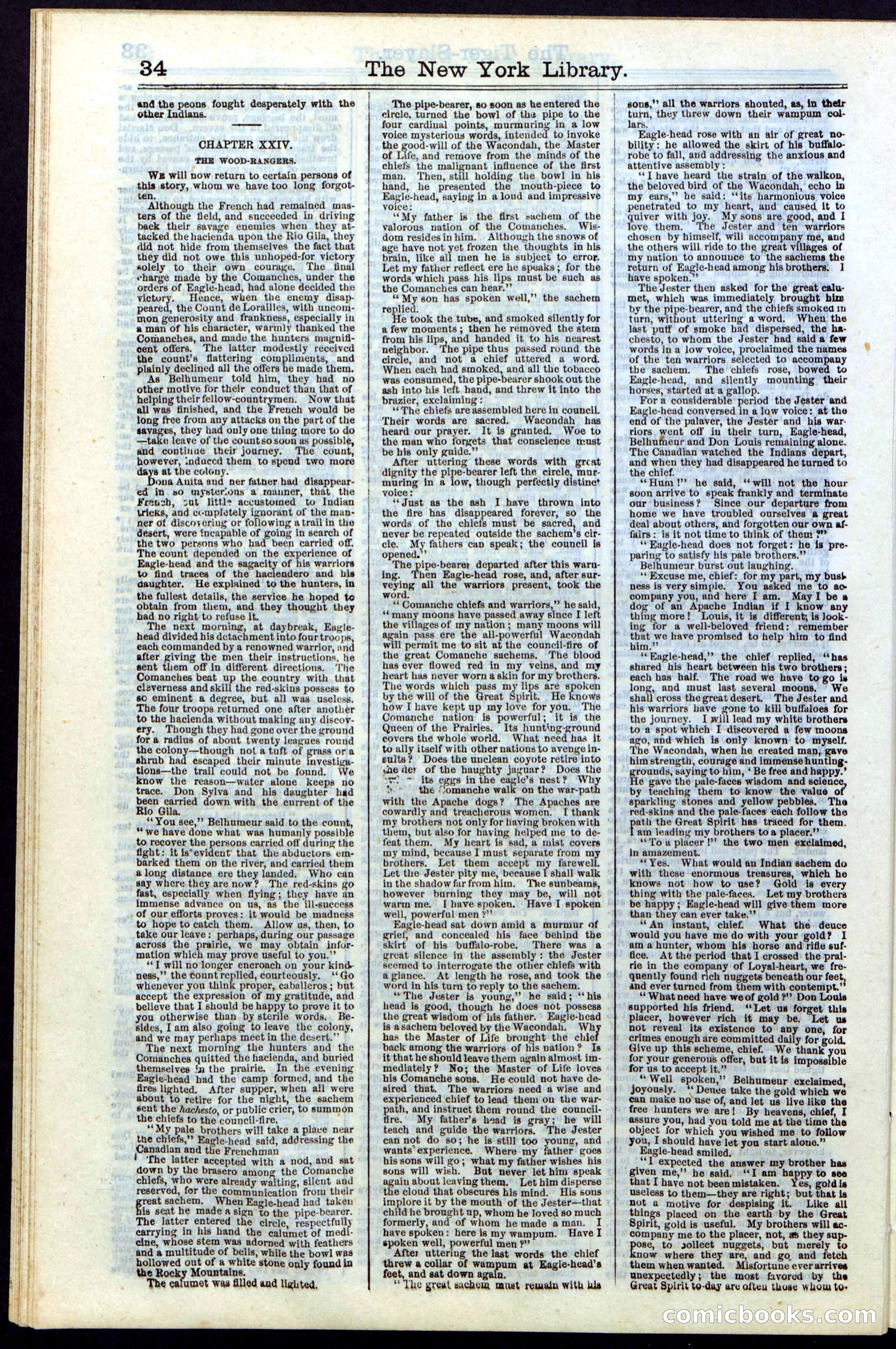
A restored page from Pulp Fiction, 1877. Page through the whole issue in the reader above.
📄 Transcribed text from this page (OCR, searchable)
Machine-transcribed from the original scan — historical spelling and the odd misread are preserved.
OF oe Oe PS SES LS EET COKE es ee =: T= en ee ee woe; = = = ——————— x . h = SSS SS es : > ——— ~ Pe ee ee -— — ~———» a = - ss--—— ——. - is oo ————_-— ’ - SS Te Tay _— ew = a el —~= — —~ a an - I t —— 34 and the peons fought desperately with the other Indians. CHAPTER XXIV. THE WOOD-RANGERS. WE will now return to certain persons of this story, whom we have too long forgot- ten. Although the French had remained mas- ters of the fleld, and succeeded in driving back their savage enemies when they at- tacked the hacienda upon the Rio Gila, they did not hide from themselves the fact that they did not owe this unhoped-for victory solely to their own courage. The final eharge made by the Comanches, under the orders of Eagle-head, had alone decided the victury. Hence, when the enemy disap- peared, the Count de Lorailles, with uncom- mon generosity and frankness, especially in a man of his character, warmly thanked the Comanches, and made the hunters magnifi- cent offers. The latter modestly received the count’s flattering compliments, and plainly declined all the offers he made them. As Belhumeur told him, they had no other motive for their conduct than that of helping their fellow-countrymen. Now that all was finished, and the French would be long free from any attacks on the part of the savages, they had only one thing more to do —take leave of the countsosovn as possible, and continue their journey. The count, however, .ndaced them to spend two more days at the colony. ona Anita aud ner fatner had disappear- ed in so mysterions a rmauner, that the Freuch, cut little accustomed to Indian tricks, and completely ignorant of the man- ner of discovering or following a trail in the desert, were fncapable of going in search of the two persons who had been carried off. The count depended on the experience of Eagle-head and the sagacity of his warriors to find traces of the haciendero and his daughter. He explained to the hunters, in the fullest details, the service he hoped to obtain from them, and they thought they had no right to refuse it, The next morning, at daybreak, Eugle- head divided his detachment into four troops, each commanded by a renowned warrior, and after giving the men their instructions, he sent them off in different directions. ‘The Comanches beat up the country with that cleverness and skill the red-skins possess to 6© eminent a degree, but all was useless. The four troops returned one after another to the hacienda without making any discoy- ery. Though they had gone over the ground for a radius of about twenty leagues round the Hy eens not a tuft of grass ora shrub had escaped their minute investiga- tions—the trail could not be found. We know the reason—water alone keeps no trace. Don Sylva and his daughter had been carried down with the current of the Rio Gila. ** You see,’’ Belhumeur said to the count, “we have done what was humanly possible to recover the persons carried off during the fight: it is*evident that the abductors em- barked them op the river, and carried them along distance ere they landed. Who can say where they are now? The red-skins go fast, especially when flying; they have an immense advance on us, as the ill-sueccess of our efforts proves: it would be madness to hope to catch them. Allow as, then, to take our leave: perhaps, during our passage across the perm we may obtain infor- mation which may prove useful to you.,”’ ‘**T will no longer encroach on your kind ness,”’ the count Py Spain courteously. ‘Go whenever you think proper, caballeros ; but accept the expression of my gratitude, and believe that I should be happy to prove it to you otherwise than by sterile words. Be- sides, Iam also going to leave the colony, and we may perhaps meetin the desert.” The next morning the hunters and the Comanches quitted the hacienda, and buried themselves in the prairie. In the evening Eagie-head had the camp formed, and the fires lighted. After supper, when all were about to retire for the night, the sachem sent the hachesto, or public crier, to summon the chiefs to the council-fire. ‘My pale brothers will take a plave near the chiefs,”” Eagle-head said, addressing the (Canadian and the Frenchman The latter accepted with a nod, and sat down by the brasero among the Comanche chiefs, who were already waiting, silent and reserved, for the communication from their Sige sachem. When Eagle-head had taken is seat he madeasign to the pipe-bearer. The latter entered the circle, respectfully earrying in his hand the calumet of medi- cine, whose stem was adorned with feathers and a multitude of bells, while the bowl was hollowed out of a white stone only found in the Rocky Mountains. The ecalumet was filled and lighted, The New York Library. The pipe-bearer, so soon as he entered the eircle, turned the bowl of the pipe to the four cardinal points, murmuring in a low voice mysterious words, intended to invoke the good-will of the Wacondah, the Master of Life, and remove from the minds of the chiefs the malignant influence of the first man. ‘Then, still holding the bowl in his hand, he presented the mouth-piece to Eagle-head, saying in aloud and impressive yoice: ‘““My father is the first suchem of the yalorous nation of the Comanches. Wis- dom residesinhim. Although the snows of age have not yet frozen the thoughts in his brain, like all men he is subject to error. Let my father reflect ere he speaks; for the words which pass his lips must be such as the Comanches can hear,’’ “My son has spoken well,” the sachem re lied. e took the tubs, and smoked silently for a few moments; then he removed the stem from his lips, and handed it to his nearest neighbor. The pipe thus passed round the circle, and not a chief uttered a word. When each had smoked, and all the tobacco was consumed, the pipe-bearer shook out the ash into his left hand, and threw it into the brazier, exclaiming: ‘The chiefs are assembled here in council. Their words are sacred. Wacondah has heard our prayer. It is granted. Woe to the man who forgets that conscience must be his only guide.”’ After uttering these words with grcat dignity the ty patho ca bid left the circle, mur- muring in a low, though perfectly distinct voice: ‘‘ Just as the ash I have thrown into the fire has disappeared forever, so the words of the chiefs must be sacred, and never be repeated outside the sachem’s cir- cle. My fathers cun speak; the council is opened.” The pipe-bearer departed after this warn- ing. Then Eagie-head rose, and, after sur- veying all the warriors present, took the word. ‘* Comanche chiefs and warriors,” he said, ‘*many moons have passed away since I left the villages of my nation ; many moons will in pass ere the all-powerful Wacondah will permit me to sit at the council-fire of the great Comanche sachems. The blood has ever flowed red in my veins, and my heart has never worn a skin for my brothers. The words which ap my lips are spoken by the will of the Great Spirit. He knows how I have kept up my love for you. The Comanche nation is powerful; it is the Queen of the Prairies. Its hunting-ground covers the whole world. What need has it to ally itself with other nations to avenge in- eults? Does the unclean coyote retire into she der of the haughty jaguar? Does the ence site eggs in the eagle’s nest? Wh ®.° the Comanche walk on the war-pat with the Apache dogs? The Apaches are cowardly and treacherous women. I thank my brothers not only for having broken with them, but also for having helped me to de- ‘feat them. My heart is sad, a mist covers my mind, because I must separate from m brothers. Let them accept my farewel Let the Jester pity me, because I shall walk in the shadow far from him. The sunbeams, however burning they may be, will not warm me. [havespoken. Have I spoken well, powerful men ?”’ Eagle-head sat down amid a murmur of grief, and concealed his face behind the skirt of his buffalo-robe. There was a great silence in the assembly: the Jester seemed to interrogate the other chiefs with a glance. word in his turn to reply to the sachem. “The Jester is young,” he said; ‘his head is good, though he does not possess the great wisdom of his father. Eagle-head is asachem beloved by the Wacondah. Wh has the Master of Life brought the chie back among the warriors of his nation? Is it that he should leave them again almost im- mediately? No; the Master of Life loves his Comanche sons. He could not have de- sired that. The warriors need a wise and experienced chief to lead them on the war- path, and instruct them round the council- fire. My father’s head is gray; he will teach and guide the warriors, The Jester can not do 80; he is still too wants experience. Where my father goes his sons will go; what my father wishes his sons will wish. But never let him speak again about leaving them. Let him disperse e cloud that obscures his mind. His sons implore it by the mouth of the Jester—that child he brought up, whom he loved so much formerly, and of whom he made aman. I have spoken : here is my wampum. Have I spoken well, powerful men ?”” After uttering the last words the chief threw a collar of wampum at Eagle-head’s feet, and sat down again. ‘The great sachem must remain with bila At length he rose, and took the © oung, and . sons,”’ all the warriors shouted, as, in their turn, they threw down their wampum col- rs, Eagle-head rose with an air of great no- bility: he allowed the skirt of his buffalo- robe to fall, and addressing the anxious and attentive assembly : ‘“‘T have heard the strain of the walkon, the beloved bird of the Wacondah, echo in my ears,’’ he said: ‘‘its harmonious voice penetrated to my heart, and caused it to quiver with Joy. My sons are good, and I love them, he Jester and ten warriors chosen by himself, will accompany me, and the others will ride to the great villages of my nation to annouuce to the sachems the return of Eagle-head among his brothers. 1 have spoken.” The Jester then asked for the great calu- met, which was immediately brought bim by the pipe-bearer, and the chiefs smoked in turn, without uttering a word. When the last puff of smoke had dispersed, the ha- chesto, to whom the Jester had said a few words in a low voice, proclaimed the names of the ten warriors selected to accompany the sachem. The chiefs rose, bowed to Eagle-head, and silently mounting their horses, started at a gallop. For a considerable period the Jester and Eagle-head conversed in a low voice: at the end of the palaver, the Jester and his war- riors went off in their turn, Hagle-head, Belhumeur and Don Louis remaining alone. The Canadian watched the Indians depart, and when they had disappeared he turned to the chief. “Hum !’’ he said, ‘‘ will not the hour soon arrive to speak frankly and terminate our business? Since our departure from home we have troubled ourselves a great dea) about others, and forgotten our own af- fairs: is it not time to think of them ?” ‘*Eagle-head does not forget: he is pre- paring to satisfy his pale brothers.” Belhumeur burst out laughing. ‘* Excuse me, chief: for my part, my bust ness is very simple. You asked me to ac company you, and here [ am. MaylI be a dog of an Apache Indian if I know any thing more! Louis, it is different; is Jook- ing for a well-beloved friend: remember saa we have promised to help him to find m. . ‘*Eagle-head,”? the chief replied, ‘has shared his heart between his two brothers; each has half. The road we have to go ls long, and must last several moons, We shall cross the great desert. The Jester and his warriors have gone to kill buffaloes for the journey. I will lead my white brothers to a spot which I discovered a few moons ago, and which is only known to myself. The Wacondah, when he created man, gave him strength, courage and immense hunting- gr ouuae. saying to him, ‘ Be free and happy.’ e gave the pale-faces wisdom and science by teaching them to know the value of sparkling stones and yellow pebbles, The red-skins and the pale-faces each follow the oki the Great Spirit has traced for them. am leading my brothers toa placer,” ‘To u placer |”? the two men exclaimed, in amazement. “Yes. What would an Indian sachem do with these enormous treasures, which he knows not how to use? Gold is every thing with the pale-faces. Let my brothers be happy; Eagle-head will give them more than they can ever take.’ ‘*“An instant, chief. What the deuce would you have me do with your gold? I am ahunter, whom his horse and rifle suf- fice. At the period that I crossed the pral- rie in the company of Loyal-heart, we fre- quently found rich nuggets beneath our feet, and ever turned from them with contempt.’ ‘* What need have weof gold ?’””? Don Louis supported his friend. ‘Let us forget this placer, however rich it may be. Let us not reveal its existence to any one, for crimes enough are committed daily for gold. Give up this scheme, chief. We thank you for your generous offer, but it is impossible for us to accept it.” “Well spoken,’ Belhumeur exclai joyously. “ Deuve take the gold which we can make no use of, and let us live like the free hunters we are! By heavens, chief, I assure you, had you told me at the time the Object for which you wished me to follow you, I should have let you start alone.” Eagle-head smiled. ‘Tl expected the answer my brother has ven me,’ he said. ‘*I am happy to see at I have not beenmistaken. Yes, gold is useless to them—they are right; but that is not a motive for despising it. Like all things placed on the earth by the Great Spirit, gold is useful. My brothers will ac- company me to the placer, not, a they sup- pers, to jollect nuggets, but merely to now where they are, and go and fetch them when wanted. Misfortune ever arrives unexpectedly; the most favored by the Great Spirit to-day are often those whom to- Gomichbooks (E(@)