
Pulp Fiction, 1877 · page 36 of 40
Beadle's New York Dime Library, Vol. II, No. 15 — page 36: what you’re looking at
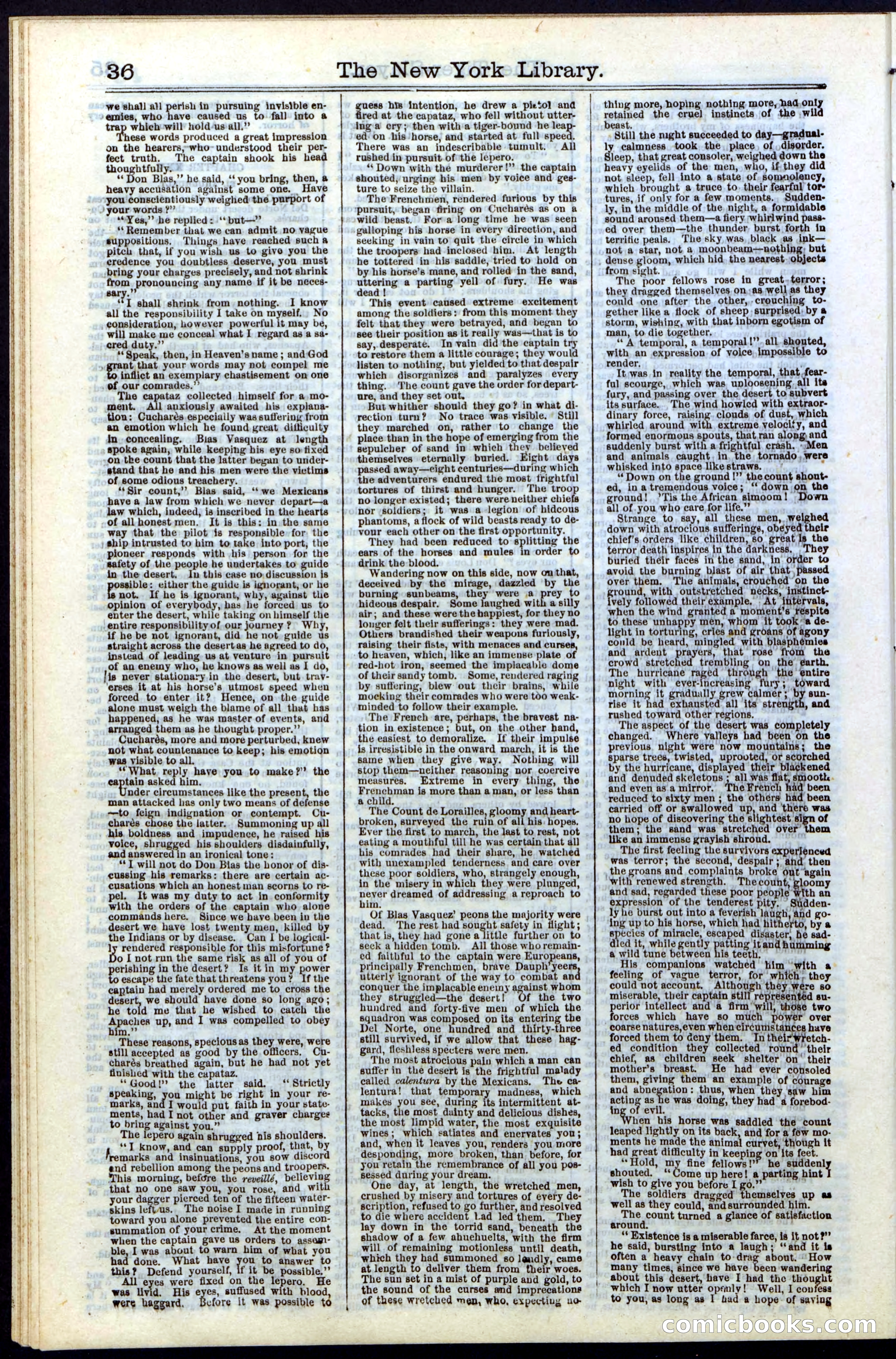
A restored page from Pulp Fiction, 1877. Page through the whole issue in the reader above.
📄 Transcribed text from this page (OCR, searchable)
Machine-transcribed from the original scan — historical spelling and the odd misread are preserved.
————= ee 36 we shall all perish in pursuing invisible en- emies, who have caused us to fal) into a trap which will hold-us all.” These words produced a great impression on the hearers,-who- understood their per- fect truth. The captain shook his head thoughtfully. **Don Blas,’’ he said, ‘‘ you bring, then, @ heavy accusation against some one. Have you conscientiously weighed the purport of ) your words ?”’ ““Yes,’’ he replied: ‘* but—”’ ‘*Remember that we can admit no vague suppositions. Things haye reached such a pitch that, if you wish us to give you the eredence you doubtless deserve, you must bring your charges precisely, and not shrink from pronouncing any name if it be neces- ‘*] shall shrink from nothing. I know all the responsibility I take on myself. No consideration, however powerful it may be, will make me conceal what I regard as a sa- cred duty.”’ ‘Speak, then, in Heaven's name ; and:God greet that your words may not compel me inflict an exemplary chastisement on one of our comrades.”’ The capataz collected himself for a mo- ment. l anxiously awaited his explana- tion: Cucharés especiaily was suffering from an emotion which he found great difticulty In concealing. Bias Vasquez at length spoke again, while keeping his eye so tixed on tke count that the latter began to under- stand that he and his men were the victims of some odious treachery. ‘*Sir count,’’ Blas said, ‘*we Mexicans have a law from which we never depart—a law which, indeed, ia inscribed in the hearts of allhonest men, It is this: in the same way that the pilot is responsible for the ship intrusted to him to take into port, the pioneer responds with his person for the safety of the people he undertakes to guide in the desert, In this case no discussion is peeaines either the guide is ignorant, or he not. If he is ignorant, why, against the opinion of overyNagy. has he forced us to enter the desert, while taking on himself the entire responsibilityof our journey? Why, if he be not ignorant, did he not guide us straight across the desertas he agreed to do, instead of leading us at venture in pursuit of an enemy who, he knows as well as | do, | is never stationary in the desert, but trav- ‘erses it at his horse’s utmost speed when forced to enter it? Hence, on the guide alone must weigh the blame of all that has happened, as he was master of events, and arranged them as he thought proper.” Cucharés, more and more perturbed, knew not what countenance to keep; his emotion was visible to all. ** What reply have you to make?’ the captain asked him. nder circumstances like the present, the man attacked has only two means of defense ~—to felgn indignation or contempt. Cu- charés chose the latter. Summoning up all his. boldness and impudence, he raised his voice, shrugged his shoulders disdainfully, and answered in an ironical tone: **] will not do Don Bias the honor of dis- cussing his remarks: there are certain ac- cusations which an honest man scorns to re- It was my duty to act in conformity with the orders of the captain who alone commands here. Since we bave been iv the desert we have lost twenty men, killed b the Indians or by disease. Can I be logical- ly rendered responsible for this misfortune ? o I not run the same risk as all of you of erishing in the desert? Is itin my or to escape the fate that threatens you? Ifthe captain had merely ordered me to cross the desert, we should have done so long ago; | he told me that he wished to catch the st i up, and I was compelled to obey him.”’ These reasons, specious as they were, were still accepted as good by the officers, Cu- charés breathed again, but he had not yet finished with the cupataz. “Good!” the latter said, ‘‘ Strictly speaking, you might be right in your re- marks, and I would put faith in your state- ments, had I not other and graver charges to bring against you.” The lepero again shrugged nis shoulders. **] know, and can supply proof, that, by fremarks and insinuations, you sow discord end rebellion among the peons and troopers. This morning, before the reveillé, believin that no one saw you, you rose, and wi your dagger pierced ten of the fifteen water- skins le . The noise I made in running toward you alone prevented the entire con- summation of yourcrime. At the moment when the captain gave us orders to assam- ble, I was about to warn him of what you had done. What have bier to answer to this? Defend yourself, if it be possible.”’ eyes were fixed on the lepero. He was livid. His eyes, suffused with ges were haggard, Before It was possible oe Ce his intention, he drew a pieSo! and red at the capataz, who fell without utter- ing:'a cry; then with a tiger-bound he ar ed: on his horse, and started at full speed. There was an indescribable tumult. All rushed in pursuit of the lepero. ** Down with the murderer!’ the captain shouted, urging his men by voice and ges- ture to seize the villain. The Frenchmen, rendered furious by this ‘pursuit, began firing on Cucharés as on a wild beast. Fora long time he was seen galloping bis horse in every direction, and seeking in vain to quit the circle in which the troopers had inclosed him. At length he tottered in his saddle, tried to hold on by his horse’s mane, and rolled in the sand, — a parting yell of fury. He was ead | This event caused extreme excitement among the soldiers: from this moment. they felt that they were betrayed, and began to see their position as it really was—that is to say, desperate. In vain did the captain try to restore them a little courage; they would listen to nothing, but yielded to that despair which disorganizes and paralyzes every thing. The count gave the order for depart- ure, and they set out, But whither should they go? in what di- rection turn? No trace was visible. © Still they marched on, rather to change the place than in the hope of emerging from the sepulcher of sand in whieh they believed themselves eternally buried. Eight days passed away—eight eenturies—during which the adventurers endured the most frightful tortures of thirst and hunger. The troo no longer existed; there were neither chie nor soldiers; it was a legion of hidcous phantoms, a flock of wild beasts ready to de- vour each other on the first opportunity. They had been reduced to splitting the ears of the horses and mules in order to drink the blood. Wandering now on this side, now on that, deceived by the mirage, dazzled by the burning sunbeams, they were a prey to hideous despair. Some laughed with a silly air; and these were the happiest, for they no longer felt their sufferings: they were mad. Others brandished their weapons furiously, raising their fists, with menaces and curse to htaven, which, like an immense plate o red-hot iron, seemed the implacable dome of their sandy tomb. Some, rendered raging by suffering, blew out their brains, while mocking their comrades who were too weak- minded to follow their example. The French are, perhaps, the bravest na- tion in existence; but, on the other hand, the easiest to demoralize. If their impulse is irresistible in the onward march, it is the same when they give way. Nothing will stop them—neither reasoning nor coercive measures. Extreme in every thing, the Frenchman is more than a man, or less than a child. The Count de Lorailles, gloomy and heart- broken, surveyed the ruin of all his. hopes. Ever the first to march, the last to rest, not eating a mouthful till he was certain that all his comrades had their share, he watched with unexampled tenderness and care over these poor soldiers, who, strangely enough, in the misery in which they were plunged, paree dreamed of addressing a reproach to im. Of Blas Vasquez’ peons the majority were dead. The rest had vm tr safety in flight; that is, they had gone a little further on to seck a hidden tomb. All those whoremain- ed faithful to the captain were Europeans, principally Frenchmen, brave Dauph’yeers utterly ignorant of the way to combat an conquer the implacable eneiny t whom they struggled—the desert! f the two hundred and forty-five men of which the squadron was composed on its entering the Del Norte, one hundred and thirty-three still survived, if we allow that these hag- gard, fleshless specters were men. The most atrocious pain which a man can suffer in the desert is the frightful malady called calentura by the Mexicans. The ca- lentura! that tempo madness, which makes you see, during its intermittent at- tacks, the most duinty and delicious dishes, the most limpid water, the most exquisite wines; which satiates and enervates you; and, when it leaves you, renders you more desponding, more broken, than before, for you retain the remembrance of all you pos- sessed during your dream. One day, at length, the wretched men, crushed by misery and tortures of eyery de- scription, refused to go further, and resolved to die where accident Lad led them. They lay down in the torrid sand, beneath the shadow of a few ahuehuelts, with the firm will of remaining motionless until death, which 48 ae summoned so leudly, came at length to deliver them from their woes. The sun set in a mist of purple and gold, to the sound of the curses and imprecations of these wretched men, who, expecting ue The New York Library. a thing more, hoping nothing more, had.on! retained the crue) instinets of the wil beast. . Still the night succeeded to day—gradual- ly calmness took the. place, of disorder. leep, that great consoler, weighed down the heavy eyelids of the men, who, if they did not sleep, fell into a state of sommolency, which brought a trace to, their fearful tor- tures, if only for a few moments. Sudden- ly, in the middle of the night, a formidable sound aroused them—a fiery whirlwind pass- ed over them—the thunder burst forth in territic peals. ‘The sky was, black as ink— not a star, not a moon hens BatoMig: but _ dense gloom, which hid the nearest. objects from sight. _. The poor fellows rose in great.terror; they dragged themselves on, as well as they could one after the other,-creuching to- gether like a flock of sheep surprised, by @ storm, wishing, with that inborn egotism of man, to die together. “A temporal, a temporal !’’ all shouted, with an expression of voice impossible to render, ; It. was In reality the temporal, that fear- fal scourge, which was uploosening. all its fury, and passing over the desert to subvert its surface. The wind howled with extraor- dinary force, raising. clouds of dust, which whirled around with extreme velocity, and formed enormous spouts, that.ran alopg and suddenly burst with a frightful crash. Men and animals caught. in, the tornado, were whisked into space likestraws. | “Down on the ground !”’ thecount shout- ed, in a tremendous voice; ‘ down on the ground! ’Tis the African simoom! Down all of. you who care for life.” Strange to say, all these men, weighed down with atrocious sufferings, ob¢éyed their chief's orders like children, 80 great is the terror death inspires in the darkness, They buried their faces in the sand, in order to avuid the burning blast of air that, passed over them, The animals, crouched on the Froud, with outstretched By vely followed their example, At 1 tervals, when the wind granted a moment's respite to these unhappy men, whom it took’a de- light in torturing, erles and groans of agony conld be heard, mingled with blasphémies and ardent prayers, that rose from the crowd stretched trembling on the em The hurricane raged through ‘the entire night with ever-increasing fury; toward morning it gradually grew calmer; by sun- rise it had exhausted all its strength, and rushed toward other regions. The aspect of the desert was completely changed. Where yalleys had been on the previous. night were now mountains; the sparse trees, twisted, uprooted, or scorched by the hurricane, displayed their bla a and denuded skeletons ; all was fit, and even asa mirror. ‘The French had reduced to sixty men ; the others had been carried off or swallowed up, and ‘there was no hope of discovering the slightest sign of them q them; the sand was stretched over like an immense grayish shroud. The first feeling the survivors experlénced was terror; the second, despair; ahd then _the groans and complaints broke Ont ‘again with renewed strength. Theecount, gloomy and sad, regarded these poor people With an expression of the tenderest pity, Sudden- ly he burst out into a feverish i h, and go- ing up to his horse, which had itherto, by a A ae Of BESS, ercehed rash he sad- ed it, while gently patting it and humming a wild tune between is teeth Be ow His companions watched him “with a feeling of vague terror, for which. they could not account. Although they were so miserable, their captain still rep BSI Bu- perior intellect and a firm ‘will, those two forces which have so much power over coarse natures,even when circumstances have forced them to Geny them. In their'wretch- ed condition they collected round’ their chief, as children seek shelter on‘ their mother’s breast. He had ever consoled them, giving them an example of courage and abuegntion : thus, when they saw him acting as he was doing, they had 4 forebod- ing of evil. ote en his horse was saddled the count leaped lightly on its back, and for a few mo- ments he made the animal curvet, though it had great difficulty in keeping on its feet. “Hold, my fine fellows!’ he appar shouted. ‘Come up here! a parting hint wish to give you before I §0." ; The soldiers dragged themselves up as well as they could, andsurrounded him. The count turned a glance of satisfaction around. ‘* Existence is a miserable farce, is it not?” he said, bursting into a laugh; ‘and it is often a heavy chain to- drag about. How many times, since we have been wandering about this desert, have I had the thought which I now utter openly! Well, I confess to you, as long as I bad a hope of saving GomicbooksrGo