
Pulp Fiction, 1877 · page 2 of 40
Beadle's New York Dime Library, Vol. II, No. 15 — page 2: what you’re looking at
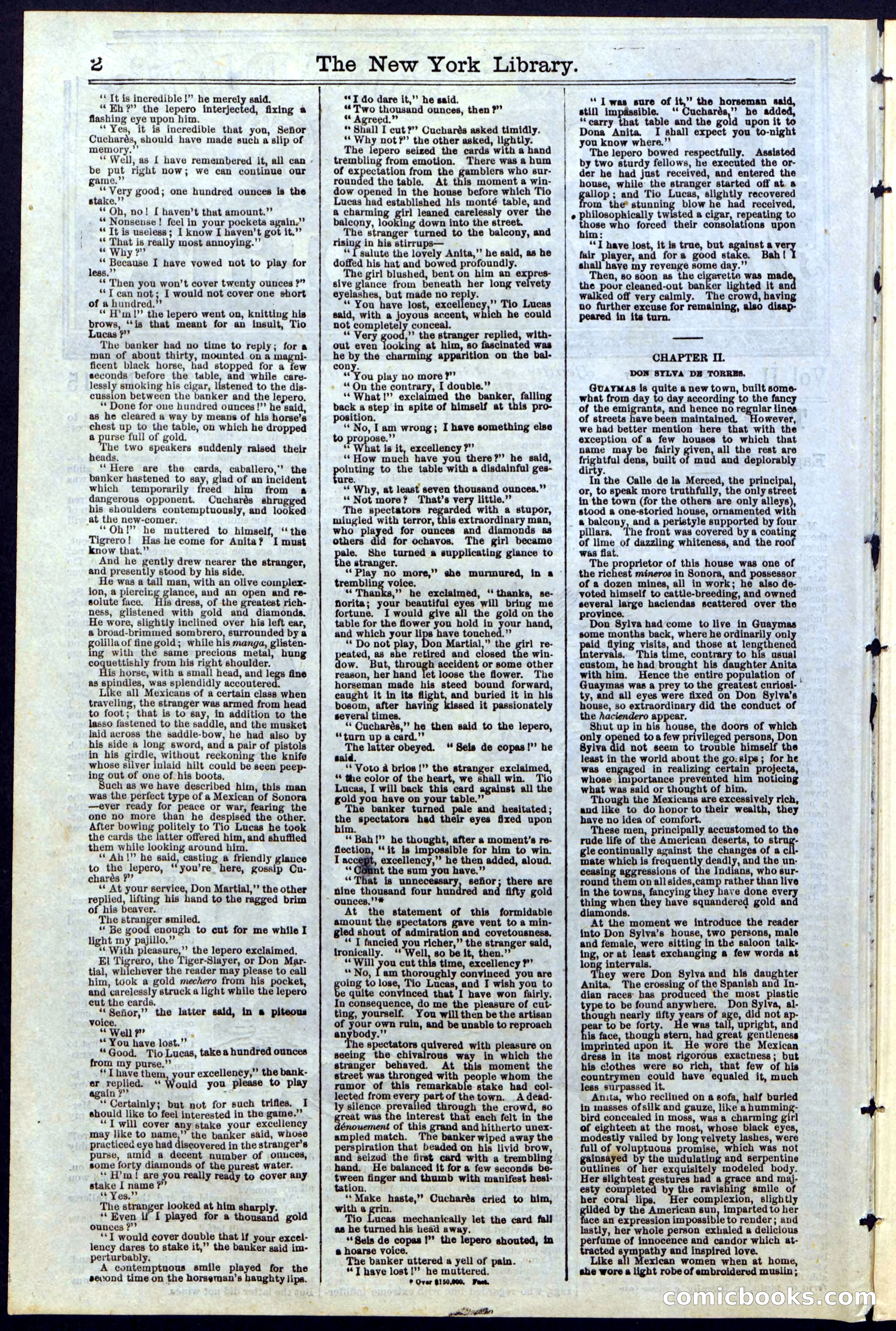
A restored page from Pulp Fiction, 1877. Page through the whole issue in the reader above.
📄 Transcribed text from this page (OCR, searchable)
Machine-transcribed from the original scan — historical spelling and the odd misread are preserved.
2 The New York Library. ‘* It is incredible !” he merely said. “Eh?” the lepero interjected, fixing a flashing eye upon him. ‘** Yes, it is incredible that you, Sefior Cucharés, should have made such a slip of memory,’ ‘** Well, as [ have remembered it, all can - be put right now; we can continue our game.” “Very good; one hundred ounces is the stake,’’ ** Oh, no! [ haven’t that amount.”’ ** Nonsense! feelin your pockets again.” ** Tt is useless; 1 know I haven't got it.” “* That is really most annoying.” 4 Why 9”? : a Because I have vowed not to play for ess.’’ “Then you won’t cover twenty ounces ?” “*T can not; I would not cover one short of a hundred.” | “* H’m!’ the lepero went on, knitting his brows, ‘“‘is that meant for an insult, Tio Lucas ?”’ The banker had no time to reply; for a man of about thirty, mounted on a magni- ficent black horse, had stopped for a few seconds before the table, and while care- lessly smoking his cigar, listened to the dis- cussion between the banker and the lepero., “* Done for one hundred ounces !”’ he gai as he cleared a way by means of his horse’s chest up to the table, on which he dropped a pase full of gold. he two speakers suddenly raised their heads. ‘‘ Here are the cards, caballero,”’ the banker hastened to ay glad of an incident which temporarily freed him from a dangerous opponent. Cucharés shrugged his shoulders contemptuously, and looked at the new-comer. “Oh!” he muttered to himself, ‘the Tigrero! Has he come for Anita? I must know that.” And he gently drew nearer the stranger, and presently stood by his side. He was a tall man, with an olive complex- ion, a aie, J ores and an open and re- solute face. is dress, of the greatest rich- ness, glistened with gold and diamonds, He wore, slightly inclined over his left ear, a broad-brimmed sombrero, surrounded by a pas of fine gold; while his manga, glisten- g with the same precious metal, hung coquettishly from his right shoulder. is horse, with a small head, and legs fine as Eth was splendidly accoutere Like all Mexicans of a certain class when traveling, the stranger was armed from head to foot; that is to say, in addition to the lasso fastened to the saddle, and the musket laid across the saddle-bow, he had also by his side a long sword, and a pair of pistols in his girdle, without reckoning the knife whose silver inlaid hilt could be seen peep- ing out of one of his boots. uch as we have described him, this man was the perfect type of a Mexican of Sonora —ever ready for peace or war, fearing the one nO more than he despised the other. After bowing politely to Tio Lucas he took the cards the latter offered him, and shuffled them while looking around him. ** Ah!” he said, casting a friendly glance to the lepero, “‘you’re here, gossip Cu- charés ?”’ ‘** At your service, Don Martial,” the other replied, lifting his hand to the ragged brim of his beaver. The stranger smiled. ** Be good enough to cut for me while I light my pajillo,” ‘* With pleasure,’’ the lepero exclaimed. El Las Bho the Tiger-Slayer, or Don Mar- tial, whichever the reader may please to call him, took a gold mechero from his pocket, and carelessly struck a light while the lepero eut the cards. ‘‘Sefior,” the latter sald, in a piteous voice, ** Well ?” . ** You have lost.’’ “Good. Tio Lucas, take a hundred ounces from my purse.” ‘tT have them, your excellency,” the bank- er replied. “* Would you please to play again ?”’ . ‘* Certainly; but not for such trifles. I should like to feel interested in the game.” “‘] will cover any stake your excellency may like to name,”’ the banker said, whose practiced eye had discovered in the stranger's purse, amid a decent number of onuces, some forty diamonds of the purest water. ‘* H’m! are you really to cover any stake I name ?”’ ‘+ Yos,”’ The stranger looked at him sharply. ‘* Even if I played for a thonsand gold ounces ?”’ ‘*T would cover double that if your excel- lency dares to stake it,”’ the banker said im- perturbably. A contemptuous smile played for the sevond time on the horseman’s haughty lips. **T do dare it,’ he said. “Two thousand ounces, then ?” “ Agreed.” ** Shall I cut?’ Cucharés asked timidly. “Why not?” the other asked, lightly. The lepero seized the cards with a hand trembling from emotion. There was a hum of expectation from the gamblers who sur- rounded the table. At this moment a win- dow opened in the house before which Tio Lucas had established his monté table, and & charming girl leaned carelessly over the balcony, looking down into the street. he stranger turned to the balcony, and rising in his stirrups— “I sulute the lovely Anita,’’ he said, as he doffed his hat and bowed profoundly. The girl blushed, bent on him an ad sive glance from beneath her long velvety eyelashes, but made no ee ‘““ You have lost, excel anny ” Tio Lucas said, with a joyous accent, w ich he could not Spuipletel "eign we Johan ery goo e8 r replied, with- out axed Tookin at him, so fascinated was he by the charming apparition on the bal- cony. “You play no more ?”’ “On the contrary, I double.” ‘* What!” exclaimed the banker, falling back a step in spite of himself at this pro- position. ‘* No, Iam wrong; I have something else to propose.”’ ** What is it, excellency ?”’ ‘How much have you there?” he said, pointers to the table with a disdainful ges- u re. “Why, at least seven thousand ounces.” “Not more? That’s very little.” The spectators arded with a stupor, miugled with terror, extraordinary man, who ar for ounces and diamonds as others did for ochayos. The girl became spe She turned a supplicating glance to he stranger. “Play no more,” she murmured, in a ~ Vinge voice. “ , he exclaimed, “ thanks, se- Norita; your beautiful eyes will bring me fortune. I would give the gold on the table for the flower you hold in your hand, and which your lips have touched.”’ ** Do not play, Don Martial,” the girl re- eated, as she retired and closed the win- AB But, through accident or some other reason, her hand let loose the flower. The horseman made his steed bound forward, caught it in its flight, and buried it in his bosom, after having it passionately several times. ‘“‘ Cucharés,” he then said to the lepero, “turn up a card.”’ ry latter obeyed. “ Sele de copas!’’ he ‘* Voto a brios !’”’ the stranger exclaimed, ** the color of the heart, we shall win. Tio Lucas, I will back this card against all the gold you have on your table.’’ The banker turned pale and hesitated; me spectatore had their eyes fixed upon m. ‘Bah! he thought, after a moment’s re- flection, “it Is impossible for him to win. I ac excellency,”’ he then added, aloud. - t the sum you have.”’ a is unn sefior; there are nine thousand four hundred and fifty gold ’ ounces,’’* At the statement of this formidable amount the spectators gave vent to a min- gled shout of admiration and covetousness. ““ T fancied you richer,” the stranger said, fronically. ‘* Well, so be it, then.’’ “Will you cut time, excellency ?”’ ** No, | am thoroughly convinced you are going to lose, Tio Lucas, and I wish you to e quite convinced that I have won fairly. In consequence, do me the pleasure of cut- ting, yourself. You will then be the artisan of your own ruin, and be unable to reproach ga e spectators quivered with pleasure on seeing the chi us way in which the stranger behaved. At this moment the street was thronged with sg whom the rumor of this remarkable stake had col- lected from every part of the town. A dead- ly silence prevailed ret ah the crowd, 80 Volta e interest that each felt in the of this grand and hitherto unex- ampled match. The banker wiped away the perspiration that beaded on his livid brow, and seized the first card with a trembling hand, He balanced it for a few seconds be- vs De finger and thumb with manifest hesi- on. ‘*Make haste,” Cucharés cried to him, with a oo Tio Lucas mechanically let the card fall as he turned his head away, **Sels de copas !’’ the lepero shouted, in a hoarse voice. The banker uttered a yell of pain. “T have lost!’ he muttered. © Over $150,000, Fact. ’ hi ‘1 was sure of ieee horseman said, still impfssible. ‘*‘ Cuch ” he added, “carry that table and the gold upon it to Dona Anita. I shall expect you to-night you know where.”’ The lepero bowed respectfully. Assisted by two sturdy fellows, he executed the or- der he had just received, and entered the house, while the stranger started off at. a allop; and Tio Lucas, slightly recovered m the* stunning blow he had received, hilosophically twisted a cigar, repeating to ose who forced their consolations upon m: “*T have lost, it is true, but nstav fair player, “3 fora good ar a Bah | t shall have my revenge some day.” Then, 80 soon as the ms pond was mad the poor cleaned-out banker lighted it an walked off very calmly. The crowd, having no further excuse for remaining, also disap- peared in its t urn. CHAPTER IL DON SYLVA DE TORRES. Guarmas is quite a new town, built some- what from day to day according to the fancy of the emigrants, and hence no lar lines of streets have been maintained owever, we had better mention here that with the exception of a few houses to which that name may be fairly given, all the rest are gest ens, built of mud and deplorably y. In the Calle de la Merced, the principal or, to speak more truthfully, the only street in the town (for the others are only alleys), stood a one-storied house, ornamented wit a balcony, and a peristyle supported by four pillars, The front was covered by 8 coatin of lime of dazzling whiteness, and the roo was flat. The proprietor of this house was one of the richest mineros in Sonora, and possessor of a dozen mines, all in work; he also de- voted himself to cattle-breeding, and owned several large haciendas scattered over the province. Don Sylva had come to live in Guaymas some months back, where he ordinaril only oem flying visits, and those at lengthen tervala,- This time, contrary to his saul custom, he had brought his daughter Anita with him. Hence the entire population of Guaymas was a prey to the greatest cnriosi-' ty, and all eyes were tixed on Don Sylva’s house, so extraordinary did the conduct of the haciendero appear. Shut up in his house, the doors of which only opened toa few privileged persons, Don Sylva did not seem to trouble himself the least in the world about the go: sips; for he was engaged in realizing certain projects, whose importance prevented him noticing what was said or thought of him. Though the Mexicans are excessively rich, and like to do honor to their wealth, they have no idea of comfort. These przit s ee ped accustomed to the rude life of the American deserts, to strug- gle continually against the changes of a cll- mate which is frequently deadly, and the un- ceasing aggressions of the Indians, who eur- round them on all sides,camp rather than live in the towns, fancying they have done eve thing when they have squandered gold an diamonds. At the moment we introduce the reader into Don Sylva’s house, two persons, male and female, were sitting in the saloon talk- ing, or at least exchanging a few words at long intervals. They were Don Sylva and his daughter Anita, The crossing of the Spanish and In- dian races: has produced the most plastic type to be found anywhere. Don Sylva, al- h nearly fifty years of age, did not ap- be forty. He was tall, upright, and fis face, though stern, had great gentleness imprinted upon it. He wore the Mexican dress in its most rigorous exactness; but his clothes were so rich, that few of bis countrymen could have equaled it, much less surpassed it. Anita, who reclined on @ sofa, half buried in masses ofsilk and gauze, like ahumming- bird concealed in moss, was a charming girl of eighteen at the most, whose black eyes, modestly vailed by long velvety lashes, were full of voluptuous promise, which was not gainsayed by the undulating and serpentine outlines of her exquisitely modeled body. Her slightest gestures bad a and maj- esty completed by the ravishing smile of her coral lips. er complexion, slightly ded by the American sun, imparted to her é an expression impossible to render; and lastly, her whole person exhaled a delicious xb of innocence and candor which at- ted thy and inspired love. Like all Mexican women when at home, abe wore a light robe of embroidered muslin ; Gomicboo cS es | | ; 1 -