
Pulp Fiction, 1877 · page 23 of 40
Beadle's New York Dime Library, Vol. II, No. 15 — page 23: what you’re looking at
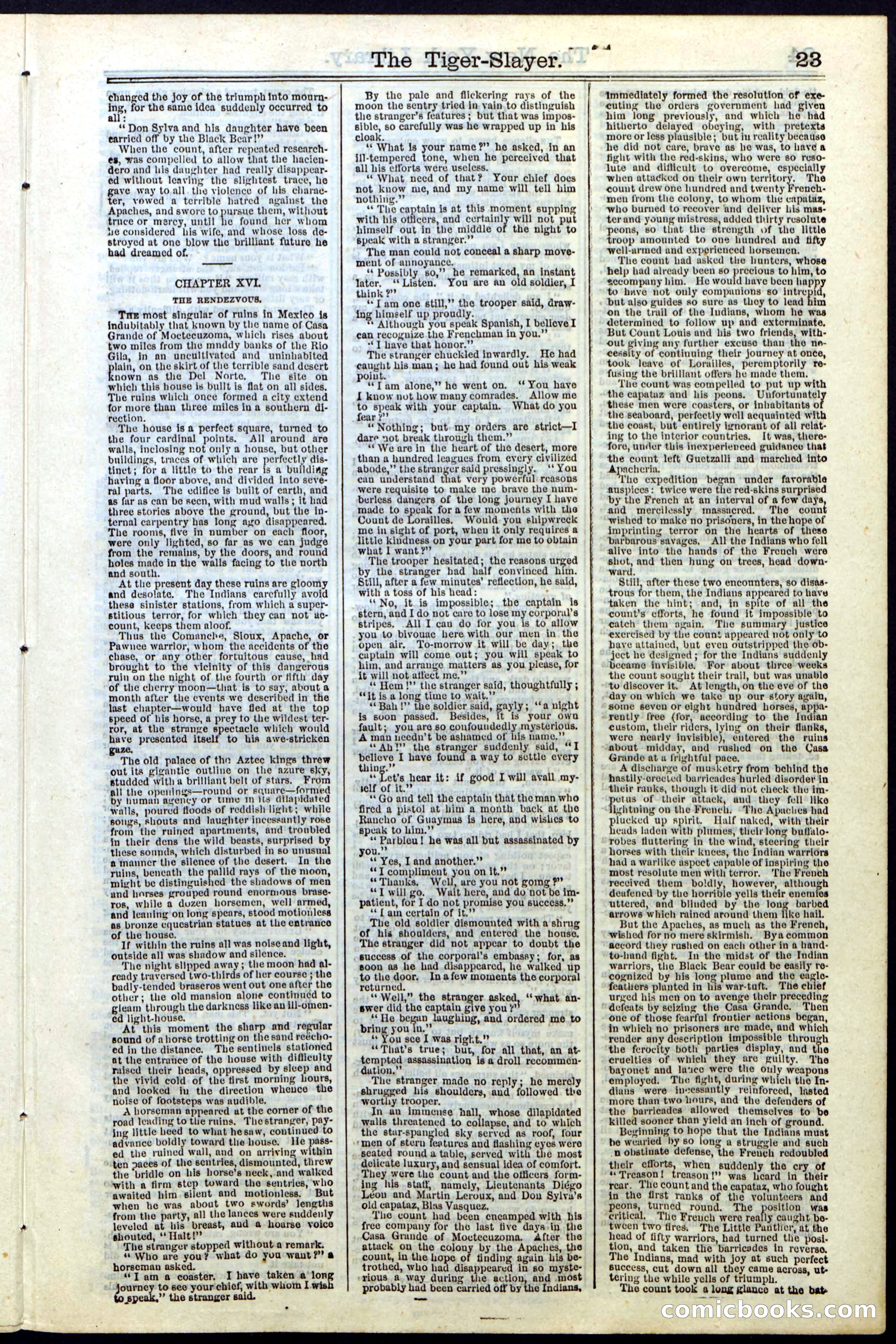
A restored page from Pulp Fiction, 1877. Page through the whole issue in the reader above.
📄 Transcribed text from this page (OCR, searchable)
Machine-transcribed from the original scan — historical spelling and the odd misread are preserved.
—————————EE—— a — — —— —— — ———————S—— changed the joy of the triumph Into mourn- ing, for the same idea suddenly occurred to all: ‘‘Don Sylva and his daughter have been earricd off by the Black Bear!” When the count, after repeated research- es, was compelled to allow that the hacien- dero and his daughter had really disappear- ed without leaving the slightest trace, he gave way to. all. the violence of his charae- ter, vowed a terrible hatred against the Apaches, and swore to pursue them, without truce or mercy, until he found her whom ue considered his wife, and whose loss de- stroyed at one blow the brilliant future he had dreamed of. CHAPTER XVI. THE RENDEZVOUS, Tre most singular of ruins in Mexico is indubitably that known by the name of Casa Grande of Moctecuzoma, which rises about two miles from the mnddy banks of the Rio Gila, in an uncultivated and uninhabited lain, on the skirt of the terrible sand desert Ecown as the Del Norte, The site on which this house is built is flat on all sides. The ruins which once formed a city extend for more than three miles in a southern di- rection. The house is a perfect square, turned to the four cardinal points. All around are walls, inclosing not only a house, but other buildings, traces of which are gt oof dis- tinet; for a little to the rear is a building having a floor above, and divided into seve- ral parts. The edifice is built of earth, and as far as can be secn, with mud walls; it had three stories above the ground, but the in- ternal carpentry has long ago disappeared. The rooms, five in number on each floor, were only lighted, so far as we can judge from the remains, by the doors, and round holes made in the walls facing to the north and south. At the present day these ruins are gloomy and desolate. The Indians carefully avoid these sinister stations, from which a super- stitious terror, for which they can not uc- count, keeps them aloof. Thus the Comanche, Sioux, Apache, or Pawnee warrior, whom the accidents of the chase, or any other fortuitous cause, had brought to the vicinity of this dangerous ruin on the night of the fourth or fifth day of the cherry moon—that is to say, about a month after the eyents we described in the last chapter—would have fled at the top speed of his horse, a prey to the wildest ter- ror, at the strange spectacle which would have presented itself to his awe-stricken The old palace of the Aztec kings threw out its gigantic outline on the azure sky, studded with a brilliant belt of stars. From all the openings—round or square—formed by human agency or time mm its dilapidated walls, poured floods of reddish light; while songs, shouts and laughter incessantly rose from the ruined apartments, and troubled in their dens the wild beasts, surprised by these sounds, which disturbed in so unusual manner the silence of the desert. In the ruins, beneath the pets rays of the moon, might be distinguished the shadows of men and horses grouped round enormous brase- ros, while a duzen horsemen, well armed, and leaning on long spears, stood motionless as bronze equestrian statues at the entrance of the house. If within the ruins all was nolseand light, outside all was shadow and silence. The night slipped away; the moon had al- ready traversed two-thirds of her course ; the badly-tended braseros went out one after the other; the old mansion alone continued to gleam through the darkness like an ill-omen- ed light-house. At this moment the sharp and regular sound of ahorse trotting on the sand reécho- ‘ed in the distance, The sentinels stationed at the entrance of the house with difficulty raised their heads, oppressed by sleep and the vivid cold of the tirst morning hours, and looked iu the direction whence the noise of footsteps was audible, A horseman appeared at the corner of the road lending to the ruins, Thestranger, pay- jing little heed to what hesaw, continued to advance peas’ toward the house. He pass- ed the ruined wall, and on arriving within “ten paces of the sentries, dismounted, threw the bridle on his horse’s neck, and walked with a firm step toward the sentries, who awaited him silent and motionless. when he was about two swords’ lengths from the party, all the lances were suddenly leveled at bis breast, aud a hoarse voice shouted, * Halt!” The stranger stopped without a remark, “Who are you? what do you want?” a horseman asked. “IT am a coaster, I have taken oe op to see your chief, with whom Iw 5 ” the stranger said. _ seated round a table, served with The Tiger-Slayer. By the pale and flickering rays of the moon the sentry tried in vain to distinguish the stranger’s features ; but that was impos- sible, so carefully was he wrapped up in his cloak. ‘“ What Is your name?’ he asked, in an ill-tempered tone, when he perceived that all his efforts were useless. “ What need of that? Your chief does not know me, and my name will tell him nothing.” “‘ The captain is at this moment supping with his officers, and certainly will not put himself out in the middle of the night to speak with a stranger.” The man could not conceal a sharp move- ment of annoyance. ‘« Possibly so,’’ he remarked, an instant later. ‘Listen. You are an old soldier, I think ?”’ ‘*T am one atill,”’ the trooper said, draw- ing himeelf up proudly. ‘ Although you speak Spanish, I belicve I can recognize the Frenchman in you,’ “‘T have that honor,” The stranyver chuckled inwardly. He had caught his man; he had found out his weak oiut. ac Iam alone,” he went on. ‘* You have I know not how many comrades. Allow me to speak with your captain. What do you fear ?”’ “Nothing; but my orders are strict—I dare not break through them.” ‘*We are in the heart of the desert, more than a hundred leagues from every civilized abode,”’ the Bin 52 said pressingly. ‘‘ You can understand that very powerful reasons were requisite to make me brave the num- berless dangers of the long journey I haye made to (me for a few moments with the Count de Lorailles. Would you shipwreck me in sight of port, when it only requires a little kindness on your part for me to obtain what I want?” The trooper hesitated; the reasons urged by the stranger had half convinced him. Still, after a few minutes’ reflection, he said, with a toss of his head: : ‘“No, it. is impossible; the captain is stern, and I do not care to lose my corporal’s stripes. All I can do for you is to allow you to bivouae here with our men in the open air, To-morrow it will be day; the cuptuin will come out; you will speak to him, and Srreuee matters as you please, for it will not affect me,” “ Hem !’’ the stranger said, thoughtfully ; ‘*it is a long time to wait,”’ “‘Bah !’’ the soldier said, gayly; ‘fa night is suon passed. Besides, it is your own fault; you are so cpufonndedty mysterious. A man needn’t be ashamed of his name,” “Ahn!” the stranger suddenly said, “TI Seine I have found a way to settle every thing.” ‘‘ Let’s hear it: if good I will avail my- self of it.” , ‘**Go and tell the captain that the man who fired a pistol at him a month back at the Rancho of Guaymas is here, and wishes to speak to him.” re Pat bleu! he was all but assassinated by ** Yes, I and another.” **T compliment, you on it.” “Thanks. Well, are you not gomg ?” “T will go. Wait here, and do not be im- patient, for I do not promise you success.” ‘*T ain certain of it,’’ The old soldier dismounted with a shrug Of his shoalders, and entered the house, The stranger did not appear to doubt the success of the corporal’s embassy; for, as soon as he had disappeared, he walked up to the door, Inafew moments the corporal returned. “Well,” the stranger asked, “what. an- swer did the captain give you?” “He began laughing, and ordered me to bring you in.” ** You sce I was right.” “That's true; but, for all that, an at- tempted assassination is a droll recommen- dation,” : The stranger made no reply; he merely shrugged his shoulders, and followed the worthy trooper. In an immense hall, whose dilapidated _ walls threatened to collapse, and to which the stur-spangled sky served as roof, four ‘men of stern features and flashing oh wero 16 most delicate luxury, and sensual idea of comfort. _ They were the count and the officers form- ing his statt, namely, Lieutenants Diégo Leéov and Martin Leroux, and Dou Sylvua’s old capataz, Blas Vasquez. The count had been eneamped with his free company for the last five days. in the Casa Grande of Moctecuzoma. After the attack on the colony by the Apaches, the count, in the bone of tinding aguin his be- py who a“ copeybe i 8 eet ‘rious a way dur ie. action, and .mos s a vin i probably had been carried off by the , aneetedanees aaa -d in so myste- & A Immediately formed the resolution of exe- ecuting the orders government had given him long previously, and which he had hitherto delayed obeying, with pretexts more or less plausible; but in reality because he did not care, brave as he was, to have a fight with the red-skins, who were 80 reso- lute and difficult to overcome, especially when attacked on their own territory. The count drew one hundred and twenty Bretidh- men from the colony, to whom the capataz, who burned to recover and deliver lis mas- terand young mistress, added thirty resolute peons, 80 that the strength of the little troop amounted to one hundred and fifty well-armed and experienced horsemen. The count had asked the hunters, whose help had already been so precious to him, to eccompany him. He would have been bapp to have not only compunions so intre d. but also guides so sure as they to lead him on the trail of the Indians, whom he was determined to follow up and exterminate, But Count Louis and his two friends, with- out giving any further excuse than the ne- cessity of continuing their journey at once, took leave of Loruilles, peremptorily re- fusing the brilliant offers he made them, The count was compelled to put up with the capataz and his peons. Unfortunate] these men were coasters, or inhabitants o the seaboard, perfectly well acquainted with the coast, but entirely ignorant of all relat- ing to the interior countries. It was, there- fore, under this inexperienced guidance that the count left Guetzalli and marched into Apacheria, ‘hue expedition began under favorable fuspices: twice were the red-skins surprised by the French at an interval of a few days and mercilessly massacred. The coun wished to make no prisoners, in the hape of imprinting terror on the hearts of these barbarous savages, All the Indians who fell alive into the hands of the French were shot, and then hung on trees, head down- ‘ward. Still, after these two encounters, so disas- trous for them, the Indians appeared to have taken the hint; and, in spite of all the count’s efforts, he found it impossible to eatch them again. The summury justice exercised by the connt appeared not only to have attained, but even outstripped the ob- ject he designed; for the Indians suddenly beeame invisible. For about three weeks the count sought their trail, but was unable to discover it. At length, on the eve of the day on which we take up our story again, some seven or eight hundred horses, appa- -rently free (for, according to the Indian custom, their riders, 1 ing on their flanks, were nearly invisible}, entered the ruins “about midday, and rushed on the Casa Grande at a frightful pace, A discharge of musketry from behind the hastily-ereceted barricades hurled disorder in their ranks, though it did not check the im- too of their attack, and they fell like ightoing on the French. ©The Apuches had lucked up spirit. Half naked, with their cads laden with plumes, theirlong buflalo- robes fluttering In the wind, steering their horses with their knees, the Indian warriors had a warlike aspect capable of inspiring the most resolute men with terror. The French reccived them boldly, however, although deufened by the horrible yells their enemies uttered, and blinded by the long barbed arrows which rained around them Tike hail. But the Apaches, as much as the French, wished for no mere skirmish. Bya common accord they rushed on each other in a hand- to-hand fight. In the midst of the Indian warriors, the Black Bear could be easily re- cognized by his Lote! Fh and the eaglo- feathers planted in his war-taft. The chief urged his men on to avenge their 7 ir a defeats by seizing the Casa Grande. Then one of those fearful frontier actions began, in Which no prisoners are made, and which render any description impossible bad ‘the ferocity both parties display, and the cruelties of which they are guilty. The bayonet and latice were the oak weapons employed. The fight, during which the In- dians were inevessantly reinforced, lasted more than two ours, and the defenders of the acs ret allowed themsclves to be killed sooner than yield an inch of ground. Beginning to hope thut the Indians must be wearied by 80 long a struggle and such pn obstinate defense, the French redoubled their efforts, when suddenly the cry of “Treason! treason!’ was heard in their rear. The countand the capataz, who fought in the first ranks of the volunteers and peons, turned round. The position was critical, The Freuch were really caught be- tween two fires. The Little Puntlicr, at the head of fifty warriors, had turned the posi- tion, and taken the barricsdes in reverso, The Indians, mad with joy at such perfect success, cut down all they came across, ut- tering the while yells of triumph. The count took a long glance at the bat (eco) Gomicbooks -