
Pulp Fiction, 1877 · page 24 of 40
Beadle's New York Dime Library, Vol. II, No. 15 — page 24: what you’re looking at
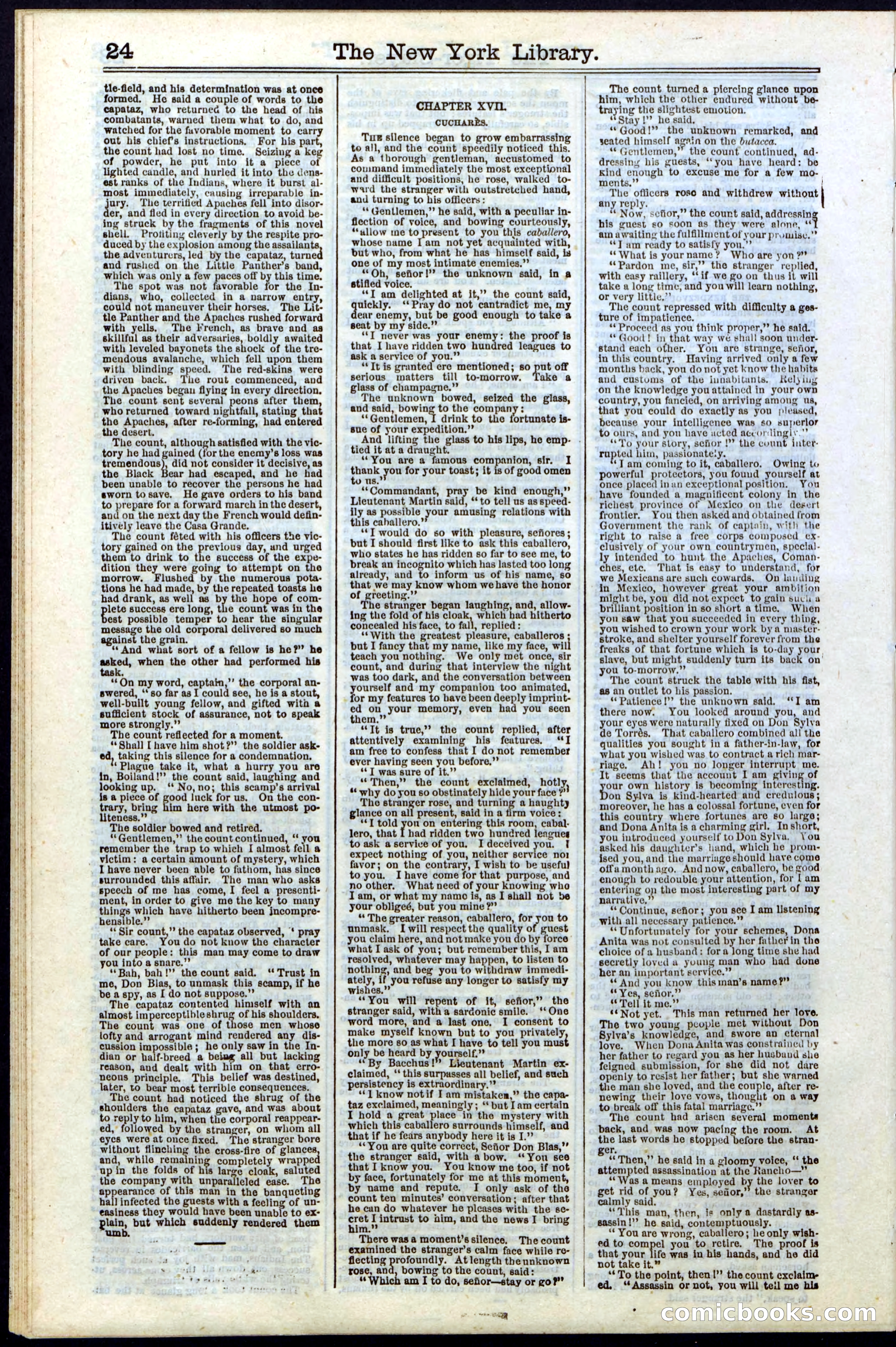
A restored page from Pulp Fiction, 1877. Page through the whole issue in the reader above.
📄 Transcribed text from this page (OCR, searchable)
Machine-transcribed from the original scan — historical spelling and the odd misread are preserved.
are oe =, ae 2 ee ee a a a ae 2 = Ts NM a Be Pe ee et ee oon Se ee eee Ss Se Se ee = Sa | —— = ee 2S SSS ae SS SES SS Oe - Fru = — SS -. - * se SS —_ ~gnar : ST er ees See “ a = 24 tle-field, and his determ{nation was at once formed. He said a couple of words to the capataz, who returnea to the head of his combatants, warned them what to do, and watched for the fuvorable moment to carry out his chief's instructions. For his part, the count had lost no time. Seizing a ke of powder, he put into it a piece o lighted candle, and hurled it into the dens- est ranks of the Indians, where it burst al- most immediately, causing irreparable in- ary; The terrified Apaches fell into disor- er, and fled in every direction to avoid be- ing struck by the fragments of this novel shell. Protiting cleverly by the respite pro- duced by the explosion among the assailants the adventurers, led by the capataz, turned and rushed on the Little Panther’s band, which was only a few pecs off by this time. The spot was not favorable for the In- dians, who, collected in a narrow entry, could not maneuver their horses. The Lit: tle Panther and the Apaches rushed forward with yells. The French, as brave and as skillful as their adversaries, boldly awaited with leveled bayonets the shock of the tre- mendous avalanche, which fell upon them with blinding speed. The red-skins were driven back. The rout commenced, and the Apaches began flying in every direction, The count sent several peons after them who returned toward nightfall, stating that the Apaches, after re-forming, had entered the desert. The count, although satisfied with the vic- tory he had gained (for the enemy’s loss was high!” did not consider it decisive, as the Black Bear had escaped, and he had been unable to recover the persons he had sworn tosave. He gave orders to his band to proper for a forward march in the desert, and on the next day the French would defin- itivély leave the Casa Grande. The count féted with his officers the vic- tory gained on the poner. day, und urged them to drink to the success of the expe- dition they were going to attempt on the morrow. Flushed by the numerous pota- tions he had made, by the repeated toasts he had drank, as well as by the hope of com- pee success ere long, the count was in the est possible temper to hear the singular ee the old corporal delivered s0 much against the grain. “And what sort of a fellow is he?” he — when the other had performed his tas ‘On my word, captain,’’ the corporal an- swered, ‘‘so far as I could see, he is a stout, well-built young fellow, and gifted with a sufficient stock of assurance, not to speak more strongly.” The count reflected for a moment. “Shall [have him shot?” the soldier ask- ed, taking this silence for a condemnation, ‘Plague take it, what a hurry you are in, Boiland!”’ the count said, laughing and looking up. ‘ No, no; this scamp’s arrival is a piece of good luck for us. On the con- trary, bring him here with the utmost po- liteness.”’ The soldier bowed and retired. **Gentlemen,”’ the count continued, ‘‘ you remember the trap to which I almost fell a _ victim: a certain amount of mystery, which I have never been able to fathom, has since surrounded this affair. The man who asks speech of me has come, I feel a presenti- | ment, in order to give me the key to many things which have hitherto been jncompre- hensible.” ‘‘ Sir count,” the capataz observed, ‘ pray take care. You do not know the character of our people: this man may come to draw you into a snare,”’ ‘Bah, bah!’’ the count said. ‘“ Trust in me, Don Blas, to unmask this scamp, if he be a spy, as I do not suppose.”’ The capataz contented himself with an almost imperceptible ones. of his shoulders, The count was one of those men whose lofty and arrogant mind rendered any dis- cussion impossible; he only saw in the In- dian or half-breed a fan all but lacking reason, and dealt with him on that erro- neous principle. This belief was destined, later, to bear most terrible consequences. The count had noticed the shrug of the shoulders the capataz gave, and was about to reply to him, when the corporal reappear- ed, followed by the stranger, on whom all eycs were at once fixed. The stranger bore without flinching the cross-fire of glances and, while rema ang. completely wrapped up in the folds of his large cloak, saluted the company with unparalleled ease. The 42 PIG of this man in the banqueting hall infected the guests with a feeling of un- easiness they would have been Guabls to ex- plain, but which suddenly rendered them um CHAPTER XVIL CUCHARES. TuE silence began to grow embarrassing to all, and the count speedily noticed this. As a thorough gentleman, avcustomed to couimand immediately the most exceptional and difficult positions, he rose, walked to- ward the stranger with outstretched hand, and turning to his officers: ** GenLlemen,”’ he said, with a peculiar in- flection of voice, and bowing cvourteously, “allow me to present to you this caballero, whose name lam not yet acquainted with, but who, from what he has himself said, is one of my most intimate enemies.”’ “Oh, sefior!’? the unknown said, in a stifled voice. “T am delighted at it,’’ the count said, uickly. ‘‘Pray do not cantradict me, my ear enemy, but be good enough to take a seat by my side.” ‘“*T never was your enemy: the proof is that I have ridden two hundred leagues to ask a service of you.” “It is granted ere mentioned; so put off serious matters till to-morrow. Take a glass of champagne.” The unknown bowed, seized the glass, and said, tte,” to the company: ‘Gentlemen, I drink to the fortunate is- sue of your expedition.” And lifting the glass to his lips, he emp- . tied it at a draught. “You are a famous companion, sir. I thank you for your toast; it is of good omen to us.’ “Commandant, pray be kind enough,” Lieutenant Martin said, “to tell us as speed- ily as possible your amusing relations with this cahallero.’ ‘“*T would do so with pleasure, sefiores; but I should first like to ask this caballero, who states he has ridden so far to see me, to break an incognito which has lasted too long already, and to inform us of his name, so that we may know whom we have the honor of greeting.” he stranger began laughing, and, allow- ing the fold of his cloak, which bad hitherto concealed his face, to fall, replied: ‘With the greatest pleasure, caballeros ; but I fancy that my name, like my face, wil teach you nothing. We only met once, sir count, and during that interview the night was too dark, and the conversation between ourself and my companion too animated, _ for my features to bave been deeply imprint- ed on your memory, even had you seen them.” “Tt is true,’”’ the count replied, after attentively examining his features. “TI am free to confess that I do not remember ever having seen you before,” ‘*T was sure of it.’’ “Then,” the count exclaimed, hotly, “why do you so obstinately hide your face ?” The stranger rose, and turning a haughty glance on all present, said in a firm voice: “*T told th on entering this room, cabal. lero, that I had ridden two hundred leagues to ask aservive of you. I deceived you. [| expect nothing of you, neither service nor favor; on the contrary, I wish to be usefu) to you. Ihave come for that purpose, and no other. What need of your knowing who Iam, or what my namo is, as I shall not be your obligeé, but you mine?” “ The ter reason, caballero, for you to unmask. I will respect the se of guest you claim here, and not make you do by force what Task of you; but remember this, I am resolved, whatever may happen, to listen to nothing, and beg you to withdraw immedi- ately, if you refuse any longer to satisfy my wishes.” “You will repent of it, sefior,” the stranger said, with a sardonic smile. ‘*One word more, and a last one, I consent to make myself known but to you privately the more so as what [ have to tell you must only be heard by yourself.” ‘“By Bacchus!” Lieutenant Martin ex- claimed, ‘ this surpusses all belief, and such persistency is extraordinary.” ‘*] know notif Iam mistaken,” the capa- taz exclaimed, meaningly; “ but Iam certain I hold a great place in the mystery with which this caballero surrounds himself, and that if he fears anybody here it is I.” ‘“You are quite correct, Sefior Don Blas,’’ the stranger said, with a bow. “You see that I know you. You know me too, if not by face, fortunately for me at this moment, by name and repute. I only ask of the count ten minutes’ conversation; after that he can do whatever he pleases with the se- cret I intrust to nim, and the news! bring him.” ere was a moment’s silence, The count examined the stranger’s calm face while re- flecting pape staf At length the unknown rose, and, bowing to the count, said: “Which am I to do, sehor—stay or go?” sae a | The New York Library. | | The count turned a piercing glance upon him, which the other endured without be- traying the slightest emotion. “Stay 1” he said, **Good!” the unknown remarked, and seated himself again on the butacea. “Gentlemen,” the count continued, ad- dressiny his guests, “‘you have heard: be Kind enough to excuse me for a few mo- ments.”’ The officers roso and withdrew without any reply. * Now, sefior,” the count said, addressin his guest so soon as they were alone, uy ain awaiting the fulfillment of your promise.” “T am ready to satisfy yon.” ‘What is yourname? Who are yon?’ “Pardon me, sir,” the stranger replied, with easy raillery, “if we go on thus it will take a long time, and you will learn nothing, or very littie,”’ The connt repressed with difficulty a ges- ture of impatience. ** Proceed as you think proper,’”’ he said. “Good! in that way we shall soon under- stand each other. Yon are strange, sefor, in this country. Having arrived only a few months back, you do not yet know the habits and custums of the iunabitants, Relying on the Knowledge you attained in your own country, you fancied, on arriving among us, that you could do exactly as you pleased, because your intelligenee was s0 superior to ours, and you have ucted accordingly." “To your story, sefior !” the count inter- rupted him, passionatety. ‘Iam coming to it, caballero, Owing to powerful protectors, you found yourself at once placed inan exceptional position. You have founded a magnificent colony in the richest province of Mexico on the desert frontier. You then asked and obtained from Government the rank of captain, with the right to raise a free corps compused ex- clusively of your own countrymen, special- ly intended to hunt the Apaches, Coman- ches, etc. That is easy to understand, for we Mexicans are such cowards, On lauding in Mexico, however great your ambition might be, you did not expect to gain such a brilliant position in so short atime. When you saw that you succeeded in every thing, you wished to crown your work bya master- stroke, and shelter yourself forever from the freaks of that fortune which is to-day your slave, but might suddenly turn its back on’ you to-morrow,” The count struck the table with his fist, as an outlet to his passion. ‘Patience!’ the unknown said. “I am there now. You looked around you, and your eyes were naturally fixed on Don Sylva de Torrés. That caballero combined all the qualities you sought in a father-in-law, for what you wished was to contract a rich mar- riage. Ah! you no longer interrupt me. It seems that the account I am giving of our own history is becoming interesting. Don Sylva is kind-hearted and credulous; moreover, he has a colossal fortune, even for this country where fortunes are so large; and Dona Anita is a charming girl. In short, you introduced yourself toDon Sylva, You asked his daughter’s land, which he prom- ised you, and the marriage should have come offamonth ago. And now, caballero, be good enough to redouble your attention, for [am entering on the most interesting part of my narrative,’ ‘Continue, sefior; you see I am listening with all necessary patience.” “Unfortunately for oy schemes, Dona Anita was not consulted by her father in the choice of a husband: fora long time she had secretly loved a young man who had done her an important service.” * And you know this man’s name?” ** Yes, senor.” “Tell it me.” ‘*Not yet. This man returned her love. The two young people met without Don Bylva’s knowledge, and swore an cternal love. When Dona Anita was constrained by her father to regard you as her husbavd she feigned submission, for she did not dare openly to resist her father; but she warned the man she loved, and the couple, after re- newing their love vows, thought on a way to break off this fatal marriage.” The count had arisen several moments back, and was now pacing the room. At the last words he stonpad hanes the stran- er. 2 ‘“‘Then,”’ he said in a gloomy voice, ‘ the attempted assassination at the Rancho—” “Was a means employed by the lover to get rid of you? Yes, seior,” the stranger calmly said. “This man, then, is only a dastardly as- sassin!’’ he said, Contam PLOGuAE. “You are wrong, caballero; he only wish- ed to compel you to retire. The proof is that your life was in his hands, and he did not take it.” | ‘*To the point, then!” the count exclaim ed, “Assassin or not, you will teil me his Sj = (eoynnyicel eyveye) (ECO)